What Is Average Order Value and Why It's Your Most Powerful Metric
Feb 11, 2026
|
Published
Let’s cut through the jargon. Average Order Value (AOV) is, quite simply, the average amount of money a customer drops every time they hit "buy now" on your site.
Think of it as the average size of a customer's shopping cart at checkout. It's a direct, no-fluff measure of their spending habits, and it’s deeply connected to customer lifetime value (LTV), the total value a customer brings to your brand over time.
What Average Order Value Actually Means for Your Store
While many Shopify merchants get tunnel vision chasing more traffic, AOV is the quiet metric that speaks volumes about your store’s health. It tells you exactly how much value you're squeezing out of the customers you already have.
A higher AOV means you're making more money from the same number of transactions. That's the secret to profitable scaling. This isn't just an abstract number; it's a critical pulse check on your business, helping you make smarter decisions that boost revenue without burning more cash on ads.
How to Calculate AOV
Thankfully, calculating your AOV is refreshingly simple. It gives you a clean snapshot of buying behavior over any period you choose—a week, a month, or an entire quarter.
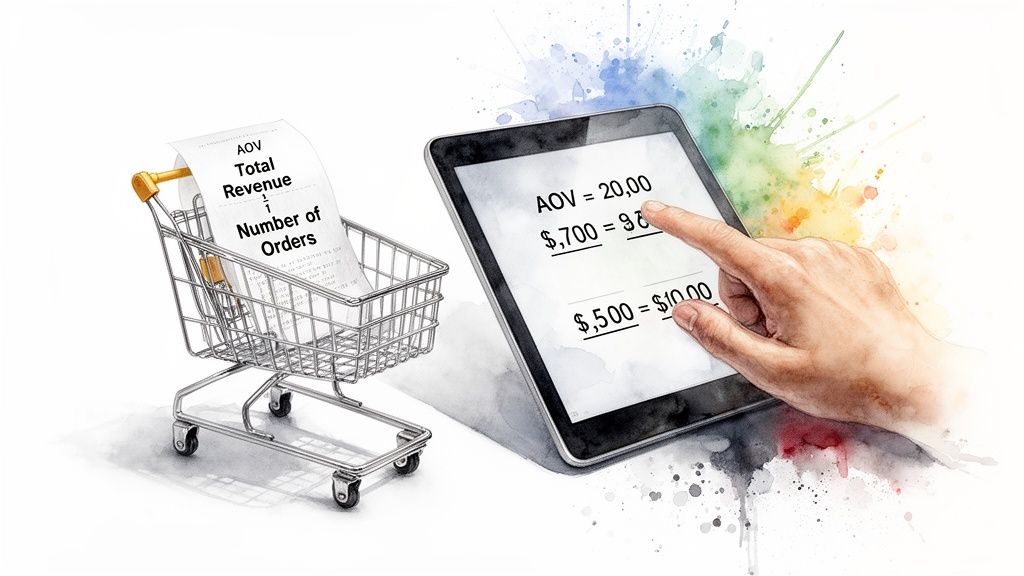
The AOV Formula: Total Revenue ÷ Number of Orders = Average Order Value
Let’s walk through a quick example. Imagine your store pulled in $50,000 in revenue from 500 separate orders last month.
$50,000 (Total Revenue) / 500 (Number of Orders) = $100 (Average Order Value)
Boom. Your AOV for that month was $100. Now you have a baseline—a number to beat.
Why AOV Is a Foundation for Growth
Tracking AOV is the first step toward building a more resilient, profitable business. It forces a mindset shift: away from the expensive chase for new customers and toward maximizing the potential of the ones you’ve already won over.
A rising AOV is almost always a sign of a healthy brand with strong customer relationships. It perfectly sets the stage for increasing customer lifetime value (LTV). After all, a customer who spends more on their first purchase is far more likely to stick around and become a high-value fan of your brand.
This link between AOV and LTV is where sustainable growth really ignites, especially when you start using margin-safe incentives like native Shopify store credit instead of just throwing profit-killing discounts at everyone.
Why AOV Is the Metric That Matters Most for Profitability
In the world of e-commerce, it’s easy to get obsessed with traffic and conversion rates. They’re flashy and exciting. But the quiet hero, the metric that truly drives a healthy bottom line, is Average Order Value (AOV).
Think of it this way: AOV is all about getting more from the customers you already have. It's the difference between working harder and working smarter. Instead of constantly feeding the expensive ad machine for new eyeballs, you can generate a whole lot more revenue from the exact same number of people walking through your digital door. Even a small bump in what each person spends can have a massive impact on your profitability.
The AOV and Lifetime Value Connection
AOV isn't just about a single transaction; it’s a peek into the future. It has a powerful, direct link to Customer Lifetime Value (LTV)—the total amount a customer will spend with you over their entire relationship with your brand.
When a customer makes a bigger first purchase, they’re sending a strong signal. They’re showing a higher level of trust and commitment right from the start. That initial confidence often blossoms into a much more valuable long-term relationship, leading to more repeat purchases and a higher overall LTV.
By focusing on AOV, you’re not just optimizing one sale. You’re actively cultivating a customer base that will drive predictable revenue for months, even years, to come.
Shifting from Discounts to Real Value
For too long, the go-to "growth" tactic has been slapping a discount on everything. But sitewide sales and confusing loyalty points are a dangerous game. They train your customers to wait for a deal, cheapen your brand’s image, and absolutely demolish your profit margins. It's a race to the bottom you can't win.
A much smarter path is to increase AOV by adding genuine value to the shopping experience. This is where a tactic like offering native Shopify store credit really shines. Instead of slashing your prices with a 20% off coupon, you can offer a compelling reward like, "$10 in store credit when you spend $100."
This simple shift accomplishes several things at once:
Encourages Bigger Carts: It gives shoppers a clear, attainable goal, nudging them to add just one more item to their cart to hit the threshold.
Protects Your Margins: Store credit isn’t a discount. It only becomes a cost when the customer comes back to make a second purchase, turning a promotional expense into a powerful retention tool.
Drives Repeat Business: That earned credit is a powerful reason for customers to return, directly fueling your repeat purchase rate and LTV.
Building a resilient brand means ditching the short-sighted tactics. When you focus on AOV and use margin-safe incentives like store credit, you kickstart a powerful cycle of higher initial sales and rock-solid long-term loyalty. That’s the real foundation of profitable growth.
How Your AOV Stacks Up Against Industry Benchmarks
So, you’ve calculated your Average Order Value. Great. But that number doesn’t mean much on its own—it needs context. To really understand your store's health and spot opportunities, you have to see how you measure up against everyone else.
Think of it like this: knowing your own running speed is useful, but knowing how you place in a race is what tells you if you need to train harder. Benchmarking your AOV is the same thing. It shows you whether you’re leading the pack in your niche or if there's a ton of money being left on the table.
These core metrics—Traffic, Conversions, and AOV—are all interconnected. You can pour money into ads to boost traffic, but if your AOV is low, you're not getting the most out of every single customer you fought so hard to win.
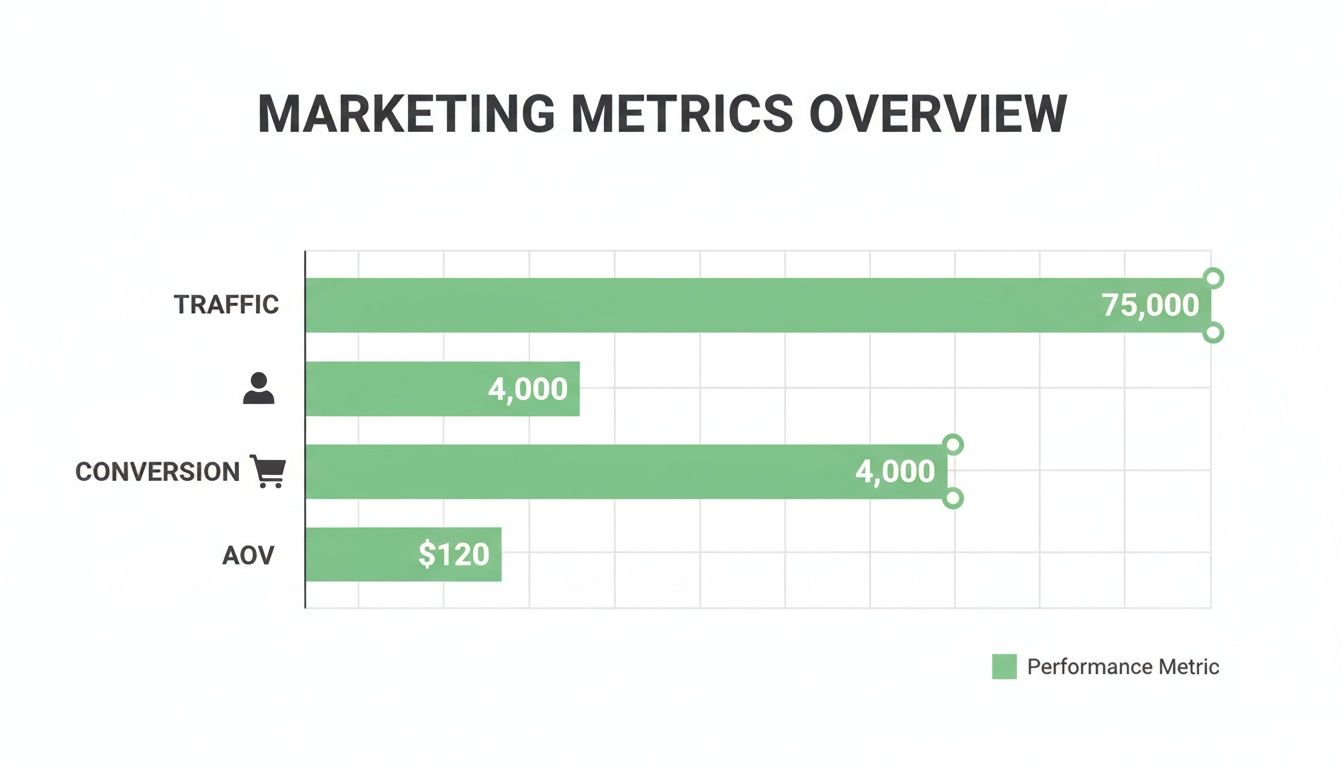
This is where AOV becomes your secret weapon. By focusing on increasing the value of each order, you make every conversion more profitable.
The Myth of a One-Size-Fits-All AOV
Everyone wants to know, "What's a good AOV?" The honest answer? It completely depends. Chasing a single magic number is a fool's errand because the ideal AOV swings wildly based on who you are and what you sell.
A few key things dramatically change what's considered "good":
Industry and Niche: A high-end furniture brand's AOV will naturally dwarf that of a shop selling stickers. An AOV of $50 would be a massive win for a cosmetics store but a huge red flag for a business selling home appliances.
Platform: Customer habits and business types vary across platforms. A typical store on Shopify might have a very different AOV profile compared to one on an enterprise platform like BigCommerce or a marketplace like Amazon.
Device: People shop differently on their phones versus their desktops. Desktop users often take more time, build bigger carts, and spend more. Mobile shoppers, on the other hand, tend to make faster, smaller purchases on the go.
The only comparison that matters is an apples-to-apples one. You need to benchmark your store against others in the same industry with a similar business model. This gives you a real baseline to measure your strategies against.
Average Order Value Across Ecommerce Platforms and Industries
To give you a clearer picture, here’s a quick look at how AOV can differ. Use this table to find the categories closest to your own and get a feel for where you stand.
Category | Average Order Value (AOV) |
|---|---|
Global Ecommerce | $144 |
Shopify (General) | $80 - $120 |
BigCommerce (General) | $140 - $180 |
Fashion & Apparel | $100 - $150 |
Health & Beauty | $70 - $110 |
Home & Garden | $200 - $300+ |
Food & Beverage | $50 - $90 |
Electronics & Accessories | $150 - $250 |
This data isn't just trivia; it’s a starting point. If your numbers are significantly lower than the benchmarks for your industry, it’s a clear signal that there's room to grow.
A Global Trend You Can’t Ignore
While the specifics vary, one massive, overarching trend is happening right now. The global e-commerce AOV recently hit a record high of $144. That’s the fourth straight year of growth and a staggering 30% jump since before the pandemic.
What does this tell us? Shoppers are getting smarter. Faced with inflation, they're making fewer, but bigger, purchases to maximize value. They're looking for free shipping, bundling products, and hunting for meaningful rewards.
For DTC brands, this is a golden opportunity. By ditching margin-killing discounts and instead offering native Shopify store credit, you tap directly into this behavior. When customers know they'll earn real, cash-like rewards for spending a bit more, they’ll gladly pad their carts. It's the perfect way to turn one-time buyers into high-spending loyal customers. You can dive deeper into more e-commerce benchmarks to see the full story.
Turning Benchmarks into Action
Okay, so you know where you stand. Now what? Use that knowledge to set smart, achievable goals.
If your AOV is lagging behind your industry peers, it’s time to look at your strategy. Are you leaning too heavily on sitewide sales that shrink every cart? Are your loyalty rewards too complicated for anyone to bother with?
This is precisely where a native store credit system like Redeebly shines. Instead of confusing points, you offer a clear incentive: "Spend X, get Y back in store credit." It's simple, powerful, and aligns perfectly with how customers are already shopping. You give them a compelling reason to spend more in every single session, pushing your AOV up while protecting your margins.
The Hidden Costs of Discounts and Confusing Loyalty Points
For a lot of Shopify stores, the go-to move for boosting sales is a big, splashy discount. Slapping a "20% OFF!" banner on your site will almost certainly get you a quick spike in orders, but it's a classic case of short-term gain for long-term pain. It's also one of the fastest ways to kill your average order value (AOV).
Think about it. Once you start running sales all the time, you're basically training your customers to wait. Why would they ever pay full price when they know another promotion is just around the corner? This erodes your brand's value and absolutely demolishes your profit margins. You get stuck in a dangerous cycle where your products are seen as "cheap," making it nearly impossible to grow your business the right way.
Why Vague Points Programs Miss the Mark
The other common approach—a complicated loyalty points system—often falls just as flat. These programs are meant to create loyalty, but they usually just create confusion.
When a customer reads "earn 5 points for every dollar spent," what does that even mean? They're forced to do mental gymnastics to figure out the actual value. Is a point worth a dollar? A penny? The whole thing feels disconnected and abstract, and the reward seems miles away. Shoppers aren't motivated to toss another item in their cart because the benefit is fuzzy and feels like too much work. For a deeper dive into getting this right, check out our guide on building effective loyalty program tiers.
The fundamental issue with both deep discounts and confusing points is that they fail to build real value. One sacrifices profit for a quick sale, while the other creates a barrier to engagement.
The Real Damage to LTV and AOV
These tactics don't just hurt a single transaction; they chip away at the entire customer relationship. By focusing on the lowest price or a convoluted points game, you're attracting one-and-done bargain hunters, not building a community of loyal fans.
This has a direct, negative hit on your most critical growth metrics:
Shrinking AOV: Discounts literally lower the value of every single cart, dragging your AOV down with each promotional sale.
Damaged LTV: Customers who only buy on sale are way less likely to come back for full-price items, which means a lower lifetime value.
Eroded Margins: Constant discounting is a direct assault on your profitability, leaving you with less cash to put back into your product, marketing, or customer experience.
This downward spiral makes it clear that brands need a smarter, margin-safe alternative. The goal isn't just to make a sale today; it's to increase the value of every order while giving customers a real reason to return. This is where a clear, tangible reward system like native Shopify store credit completely changes the game. It provides a powerful incentive without all the hidden costs.
Boost Your AOV with a Margin-Safe Store Credit Strategy
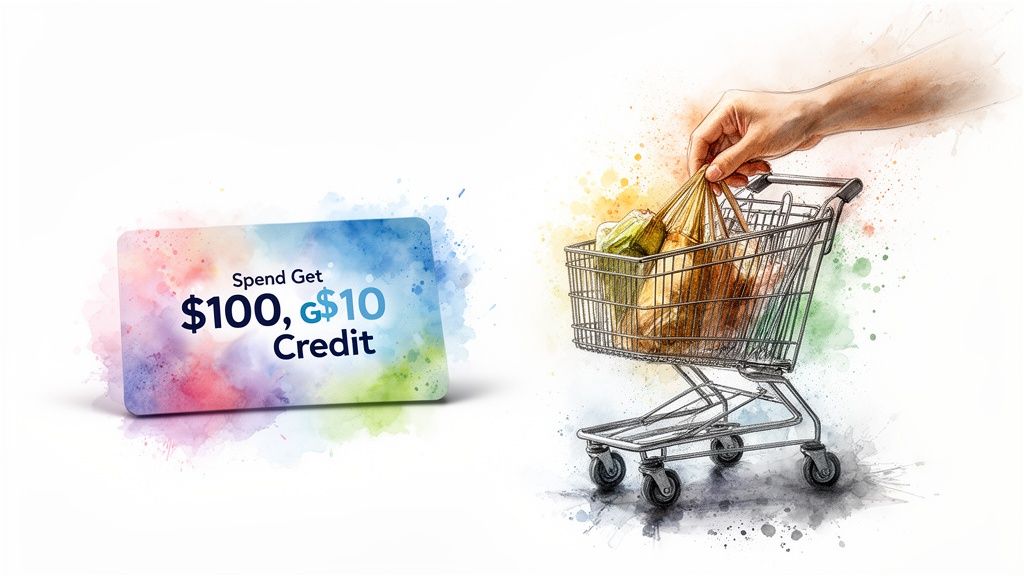
What if you could reward customers in a way that actually grows your profits? That's the real power you unlock when you shift away from profit-killing discounts and embrace a margin-safe store credit strategy. It’s a simple move that changes the customer's mindset from "How much can I save?" to "How much can I earn?"
Instead of slashing your margins right off the bat with a 20% off coupon, you're giving customers tangible, cash-like rewards. This pivot is the secret to nudging up your average order value (AOV) and building a healthier, more profitable relationship with your customers for the long haul.
The Psychology of Earning vs. Saving
There's a huge psychological gap between getting a discount and earning store credit. A discount feels like a fleeting bargain—a one-and-done deal. But store credit? That feels like you've just found money in your pocket, a balance just waiting to be spent.
This creates an immediate, powerful nudge for shoppers to add more to their cart right now. When someone sees a clear, simple offer like, "Spend $100, Get $10 in Credit," the goal is crystal clear. They aren't just buying things anymore; they're actively working toward a reward they can almost taste.
Store credit turns passive shopping into an active goal. This simple bit of gamification encourages customers to close the gap between their current cart total and the next reward, directly pushing your AOV higher in the process.
This is a world away from confusing points systems where the value is abstract and hard to calculate. Customers don't need a spreadsheet to understand that $10 in credit is $10 they can spend later. That makes it a much stronger motivator. For a deep dive, check out our guide on how to implement Shopify store credit the right way.
Protect Your Cash Flow and Drive Repeat Business
One of the best parts of a store credit model is how friendly it is to your bottom line. A typical discount is an immediate cost. It’s money you never see, reducing your revenue and profit margin on the spot.
Store credit works on a totally different principle. It only becomes a "cost" when a customer comes back to your store to make another purchase. This gives your business two massive advantages:
You protect your upfront margins. You collect the full revenue on the initial, larger order, keeping your cash flow healthy.
You practically guarantee a repeat purchase. That earned credit is a powerful magnet, pulling customers back to your store to cash in on their reward.
This simple shift turns a promotional expense into a direct investment in customer loyalty. You aren't just giving away margin anymore; you're funding the creation of a loyal, repeat customer—and that’s the foundation of a sky-high customer lifetime value (LTV).
A Practical Example in a High-AOV Industry
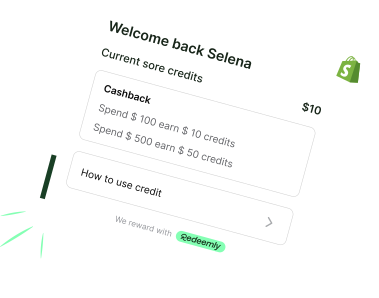
This strategy is a game-changer in high-spending categories. Take fashion and apparel, where the e-commerce average order value is an impressive $196, putting it at the top of the heap globally. Shopify merchants in this niche can use floating wallets that constantly remind shoppers of their store credit balance, dangling bigger rewards for bigger carts. It’s the perfect prompt to get someone to add that extra scarf or pair of shoes.
Build Lasting Relationships, Not Just Transactions
At the end of the day, a store credit strategy is about more than just boosting one metric. It’s about changing the very nature of your relationship with your customers. You get to move away from transactional, price-driven sales and toward a partnership built on mutual value.
Customers feel genuinely appreciated, rewarded for their loyalty in a way they can actually see and use. They have a real reason to stay connected to your brand, looking forward to their next chance to spend the credit they’ve earned.
This helps you build a more resilient business that isn't trapped in a constant cycle of promotions. Of course, this works best when paired with amazing e-commerce customer service that builds loyalty, which is key to encouraging those repeat purchases. When you combine top-notch service with a smart rewards program, you create a powerful engine for sustainable, profitable growth.
Setting Up and Measuring Your Store Credit Program
Alright, let's move from just talking about store credit to actually putting it to work. This is where you’ll start seeing a real lift in your average order value and, just as importantly, your customer lifetime value.
A native Shopify store credit program is more than just another app to install. It’s a smart shift in your retention strategy. Instead of relying on confusing points or margin-killing discounts, you’re giving customers a simple, cash-like reward. That clarity creates a powerful, straightforward reason for them to spend a little more on every single order.
The best part? It’s surprisingly simple to set up. You don't need complex rules or confusing logic. You're just creating clear, achievable spending goals that make sense to your shoppers, making the reward feel real and within reach.
Designing Your Reward Tiers for Maximum Impact
First things first, you need to design reward tiers that are both compelling for your customers and profitable for you. The whole idea is to set a target just a little bit above what people are already spending. You want to create a small, tempting gap that feels easy and worthwhile to close.
A great rule of thumb is to set your first reward tier 15-20% higher than your current AOV.
For example: If your store's AOV is currently $85, your first tier could be as simple as: "Spend $100 and get $10 in store credit."
This nudge is often all it takes to convince someone who was about to spend $85 to toss one more small item into their cart. They hit the $100 mark and unlock a reward they can use next time. It feels like a win.
From there, you can layer in a couple of higher tiers to incentivize your biggest spenders and push your AOV even higher with your most loyal customers.
This tiered model completely changes the shopping dynamic. Customers aren't just buying things anymore; they're actively working toward a tangible goal. That simple shift in mindset is what gets them to happily increase their cart size.
This strategy is especially effective on platforms where there's clear room to grow. Shopify stores, for instance, average an AOV of around $92. A well-structured store credit program is a golden opportunity for these brands to protect their margins while motivating customers to hit higher spending thresholds.
Measuring the Success of Your Program
Launching your program is just the start. The real proof comes from measuring its impact and seeing the return on your efforts. You'll want to track AOV, of course, but a few other key performance indicators (KPIs) will give you the full picture.
Before you go live, establish a clear baseline. Pull your numbers for the previous month or quarter so you have something to compare against.
Key Metrics to Track:
Average Order Value (AOV): This is your most direct measure of success. Keep an eye on it weekly in your Shopify Analytics to spot trends after the launch.
Repeat Purchase Rate: Store credit is designed to bring people back. Are more customers making that crucial second or third purchase? This metric will tell you.
Customer Lifetime Value (LTV): This is the long game. A successful program will lead to a noticeable increase in how much a customer is worth to your business over time.
To really nail this down, it’s worth knowing how to use Google Analytics to get a granular view of these KPIs. By comparing your 'before' and 'after' data, you can build a rock-solid case for how this margin-safe rewards program is fueling profitable growth.
And if you want a refresher, you can always check out our guide on how to calculate AOV to make sure your numbers are spot-on. This data-backed approach will help you fine-tune your tiers and optimize your strategy for even better results down the road.
Got Questions About AOV? We've Got Answers.
Pivoting your rewards strategy to focus on store credit can feel like a big move. It's totally normal to have questions. We’ve gathered the most common ones we hear from Shopify merchants who are serious about lifting their average order value (AOV) and building a rewards program that actually pays off.
Getting clear on these points is the first step to ditching margin-killing discounts and confusing points systems for good. It's about creating a growth loop that boosts both your AOV and your customer lifetime value.
How Often Should I Be Checking My AOV?
For the big picture, you'll want to review your AOV at least monthly. This helps you spot general trends and see how you’re doing over time. But if you want insights you can act on quickly, checking it weekly is the way to go. A weekly check-in shows you the real impact of that new email campaign, a product launch, or a change you made to your store credit offers.
And during the busy season? Think Black Friday or a big holiday sale. Daily monitoring can be a lifesaver, letting you make smart adjustments on the fly. The key isn't just one number; it's about watching the trends consistently.
Is Store Credit Really Better Than a Points Program for AOV?
When it comes to boosting AOV right now, in the current shopping session? Absolutely. Store credit is way more effective. It's a real, cash-like reward that people just get. "Spend $100, get $10 back" is simple, tangible, and creates an immediate incentive to add one more thing to the cart to hit that goal.
Points systems often feel like a puzzle. "Earn 5 points for every dollar spent" is abstract and makes the reward feel far off. That mental friction is enough to kill the motivation for an immediate upsell. Simplicity is what gets people to act.
Where Should I Start With Setting Up Reward Tiers?
A great rule of thumb is to set your first tier about 15-20% above your current AOV. So, if your AOV is sitting around $85, a perfect starting offer would be, "Spend $100 and get $10 in store credit."
That creates a small, reachable gap that nudges shoppers to add just one more item. From there, you can layer on one or two higher tiers to reward your top customers. The best approach is to look at your own order data—find the common spending thresholds and build your tiers around what your customers are already doing.
Won't Store Credit Eat Into My Margins Like Discounts Do?
Nope, and this is the most important difference. A discount is a guaranteed hit to your profit on that specific sale. Store credit, on the other hand, only becomes a cost when the customer comes back to spend it on a future purchase.
Not only does this protect your margin on the initial sale, but it also practically guarantees a repeat purchase, which is the whole point of building customer lifetime value. You’re not just giving away profit; you're investing in the next sale.
Ready to lift your AOV and LTV without killing your margins? With Redeemly, you can launch a store credit program that feels native to Shopify. Replace confusing points and deep discounts with cash-like rewards that your customers will actually use.



Join 7000+ brands using our apps