Ditch the Loyalty Program Tiers: Boost LTV with Store Credit
Dec 27, 2025
|
Published
We all love the idea of getting VIP treatment. But for most Shopify stores, traditional loyalty program tiers are a trap. They sound great in theory, but in reality, they often create a mess of eroding margins, confused customers, and technical headaches. The complexity of points and coupons often fails to drive the key metrics that matter: lifetime value (LTV) and average order value (AOV).
Let’s pull back the curtain on these common pain points and set the stage for a simpler, more powerful way to build loyalty: Shopify native store credit.
The Hidden Flaws in Traditional Loyalty Program Tiers
The promise of loyalty tiers is seductive: give your best customers exclusive perks, and they’ll spend more to climb the ladder. It taps into a powerful psychological need for achievement and status. It’s no surprise that globally, 70% of brands with a rewards program use some form of tiered benefits.
But behind that statistic is a much more complicated reality, especially for Shopify merchants. You can discover more insights about these loyalty program trends and see why satisfaction rates often stay stubbornly low, despite how popular tiers are. Complex point systems and discount codes simply don't drive profitable growth.
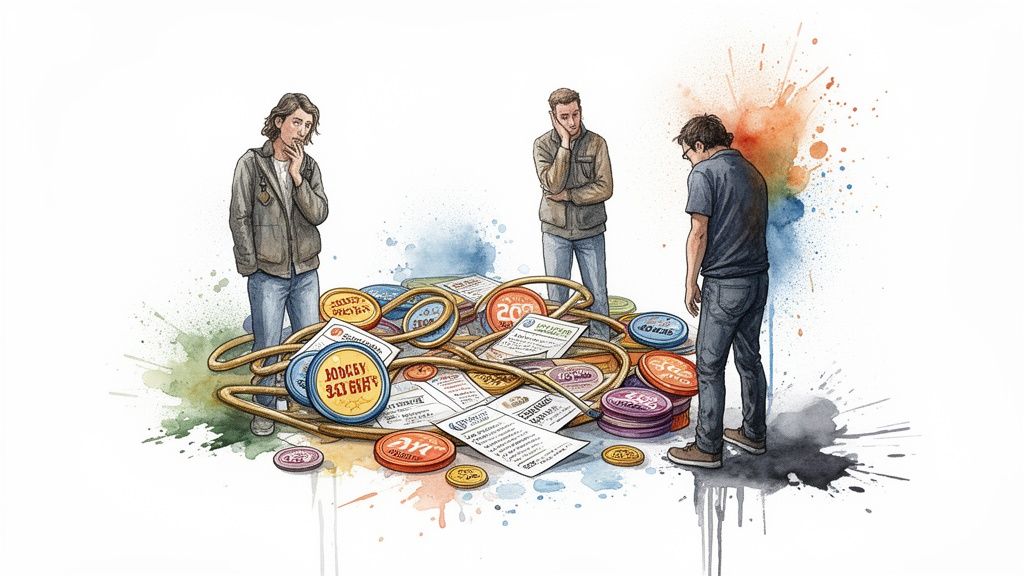
Why Tiers Feel Like a Complicated Board Game
Ever tried to play a board game with a rulebook the size of a novel? That’s what a tiered program feels like to your customers. It might look impressive with all its levels and confusing point systems, but for the average person, it’s just a headache.
Shoppers are forced to track points, figure out spending thresholds, and remember which perks unlock at what level. All that friction leads to one thing: disengagement.
Instead of motivating people to buy again, the complexity overwhelms them. They just give up on the "game" entirely. A loyalty program should make getting a reward feel easy, not like solving a puzzle. This confusion fails to increase LTV and actively discourages repeat purchases.
For store owners, this complexity is a massive resource drain. You end up installing a clunky loyalty app, fielding endless emails from confused customers, and handing out discount coupons that bleed your profit margins dry. It's a system that demands constant babysitting for very little impact on your bottom line.
The True Cost of Tiered Complexity
The problem isn't just customer confusion. Tiered programs, with their reliance on discount codes, often force you into a direct conflict with your store's financial health. This strategy chips away at your average order value and lifetime value in a way that’s tough to bounce back from.
The hidden costs really start to add up:
Margin Erosion: Every discount coupon you offer to nudge a customer to the next tier is a direct hit to your bottom line.
Technical Debt: Feature-heavy loyalty apps bloat your site with code, leading to slower page loads and sinking conversion rates.
Customer Apathy: If the top tiers feel completely out of reach, most of your customers won't even bother trying. The program becomes irrelevant.
To get ahead of this, it's crucial to get good at predicting subscriber churn with retention models. This is precisely where a simpler approach, like native Shopify store credit, shines. It ditches the confusing rules and gives customers a direct, cash-like incentive they instantly understand and value, driving real engagement and profitability by focusing on LTV.
Why Giant Retailer Strategies Fail on Shopify
It’s tempting to look at retail titans like Sephora or Starbucks and think, "I want that." Their loyalty programs are the stuff of legend. But trying to bolt their complex, tiered systems onto your Shopify store is a classic case of biting off more than you can chew.
Think of it this way: a small sailboat doesn't use an aircraft carrier's navigation system. The scale and resources are completely different. These massive companies have dedicated teams and marketing budgets in the millions. They're playing a different game—one that doesn't rely on preserving the profit margins of every single sale.
The Myth of the "Attainable" Top Tier
For a company with millions of customers, making a top tier feel exclusive yet reachable is easy. But for a typical Shopify store, the math just doesn't add up. The spending required to unlock a "VIP" tier often seems so out of reach that most of your customers won't even bother trying.
This creates a loyalty program that caters exclusively to your top 1% while leaving the other 99% out in the cold. Instead of inspiring loyalty, you create apathy. The program completely fails to do its main job: lifting the lifetime value of your entire customer base.
A loyalty program that feels impossible is worse than having no program at all. It tells your customers that the best perks are for an elite few, effectively ignoring the loyal, mid-range shoppers who are the true backbone of your business.
That’s a huge misstep for any brand serious about sustainable growth. The real goal isn't just to reward the whales; it's to get your average customer to buy a little more, a little more often, thereby increasing both AOV and LTV.
The Hidden Costs of Complexity
Beyond the psychological disconnect, trying to imitate a giant retailer's strategy on Shopify brings a whole host of technical and financial headaches. Large, feature-heavy loyalty apps are notorious for slowing down your site. Every extra script adds to your page load time, a known killer for conversion rates.
All this complexity also becomes a massive distraction. Instead of focusing on your product and customer experience, you end up bogged down managing a convoluted system of points and the inevitable customer complaints that come with it.
Just think about the ongoing maintenance and hidden costs:
Constant Discounting: Most tiers rely heavily on discount coupons to push people to the next level, which chips away at your profit margins with every single purchase.
Technical Headaches: Complicated apps are prone to glitches, creating a frustrating experience for your customers.
Customer Confusion: You suddenly become a help desk for a confusing points system instead of a brand that offers clear, simple value.
Even the giants are constantly overhauling their programs. In fact, a recent study found that 64% of loyalty owners who updated their programs reported high satisfaction afterward—a clear sign that these systems require constant evolution. To see how top brands are adapting, you can explore the 2025 loyalty landscape and its top trends.
For a lean Shopify store, that level of upkeep is unsustainable. It drains your time and money. A simpler, profit-focused approach like native Shopify store credit builds loyalty without the operational drag, giving you a straightforward way to boost lifetime value and average order value that actually aligns with your goals.
Driving Profitability with Simple Store Credit
After digging into the common pitfalls of tiered loyalty programs, it’s obvious many brands need a different playbook—one that builds real, sustainable value. The answer is surprisingly simple, yet incredibly powerful: native Shopify store credit. This isn’t about handling returns; it’s about turning credit into a proactive loyalty engine that directly increases LTV and AOV.
Ever found a forgotten $20 bill in an old jacket? It feels like free money. Now, contrast that with a 10% off coupon. That just feels like a marketing gimmick.
Store credit creates that same "cash in your wallet" feeling. It’s tangible, immediate, and feels like real value, which is precisely why it’s so good at getting people to buy again.
Protecting Your Margins with a Smarter Incentive
Let's be honest, the biggest problem with traditional loyalty programs is their reliance on discount coupons. Every time a customer uses a coupon code, it eats directly into your revenue for that sale. Your profit margin shrinks instantly.
Native Shopify store credit completely flips that model on its head.
Instead of devaluing a customer's current purchase with a discount, you’re rewarding them with credit to spend on a future purchase. This switch has two massive benefits for your bottom line:
Delayed Cost: You only "pay" for the reward when the customer comes back to redeem it, often on a full-priced item.
Increased Cash Flow: You get the full revenue from the initial sale right away, boosting your immediate cash flow.
This structure protects your margins while giving customers a compelling reason to return. It transforms your loyalty program from a cost center into a profit driver, directly impacting LTV. You can learn more about the strategic advantages of Shopify store credit as a loyalty tool and how it protects your unit economics.
The Psychology Behind Boosting AOV and LTV
Store credit taps into customer behavior in ways that complicated loyalty program tiers just can't. The psychological triggers are simple but remarkably effective at pushing up both your Average Order Value (AOV) and Customer Lifetime Value (LTV).
Picture this common checkout scenario: A customer has $85 worth of products in their cart. A small pop-up appears: "Spend just $15 more to get $10 in store credit!" The incentive is crystal clear. That little nudge is often all it takes to get them to add one more item, giving your AOV an instant lift.
This is a classic example of the goal-gradient theory in action. People get more motivated the closer they are to reaching a reward. Store credit makes that reward feel close and achievable with every single purchase.
And the effect doesn't end there. Once a customer has store credit sitting in their account, it acts as a powerful psychological hook, pulling them back. Nobody likes the feeling of "leaving money on the table." That simple thought dramatically increases repeat purchase rates. By driving that second, third, and fourth purchase, you are fundamentally boosting LTV across your entire customer base.
Simplicity Is the Ultimate Retention Tool
Your customers are drowning in information. The last thing they need is another complicated system to figure out. Confusing point conversions and abstract tiers just create friction and cause people to tune out.
A native Shopify store credit system cuts right through that noise.
The value is spelled out in plain dollars and cents—a language everyone understands. There's no mental math needed. This simplicity is the secret to building a retention program that customers actually use. When rewards are easy to earn and even easier to spend, people feel valued and are far more likely to stick around. It's a frictionless experience that builds a genuine relationship and ensures your efforts to increase LTV actually pay off.
Comparing Loyalty Tiers vs. Store Credit for Key Goals
When you're mapping out a loyalty strategy, you'll eventually come to a fork in the road. Down one path, you have traditional loyalty program tiers with their points and coupons. Down the other, a much simpler native Shopify store credit system. Both aim to keep customers coming back, but they produce wildly different results for the metrics that actually matter: Average Order Value (AOV) and Customer Lifetime Value (LTV).
Let's put them head-to-head. To really know which is right for your brand, you have to measure them against your core business goals. For most Shopify stores, one of these models is the clear winner for driving profitable growth.
AOV and Immediate Incentives
At the end of the day, a loyalty program has one job: get customers to spend more right now. This is where the sheer clarity of store credit gives it a huge advantage over the abstract promises of tiered systems.
With store credit, the deal is simple. A message at checkout that says, "You're only $15 away from unlocking $5 in store credit," creates a tangible goal. Your customer sees an immediate, cash-like reward, making it a no-brainer to toss another item in the cart, instantly boosting AOV.
Contrast that with a tiered program. The incentive is often a vague promise of reaching a "Gold" status someday. That's a much weaker psychological pull. The reward feels distant, so the motivation to spend more in that moment just isn't there.
This infographic really nails the core benefits a straightforward store credit model brings to the table.
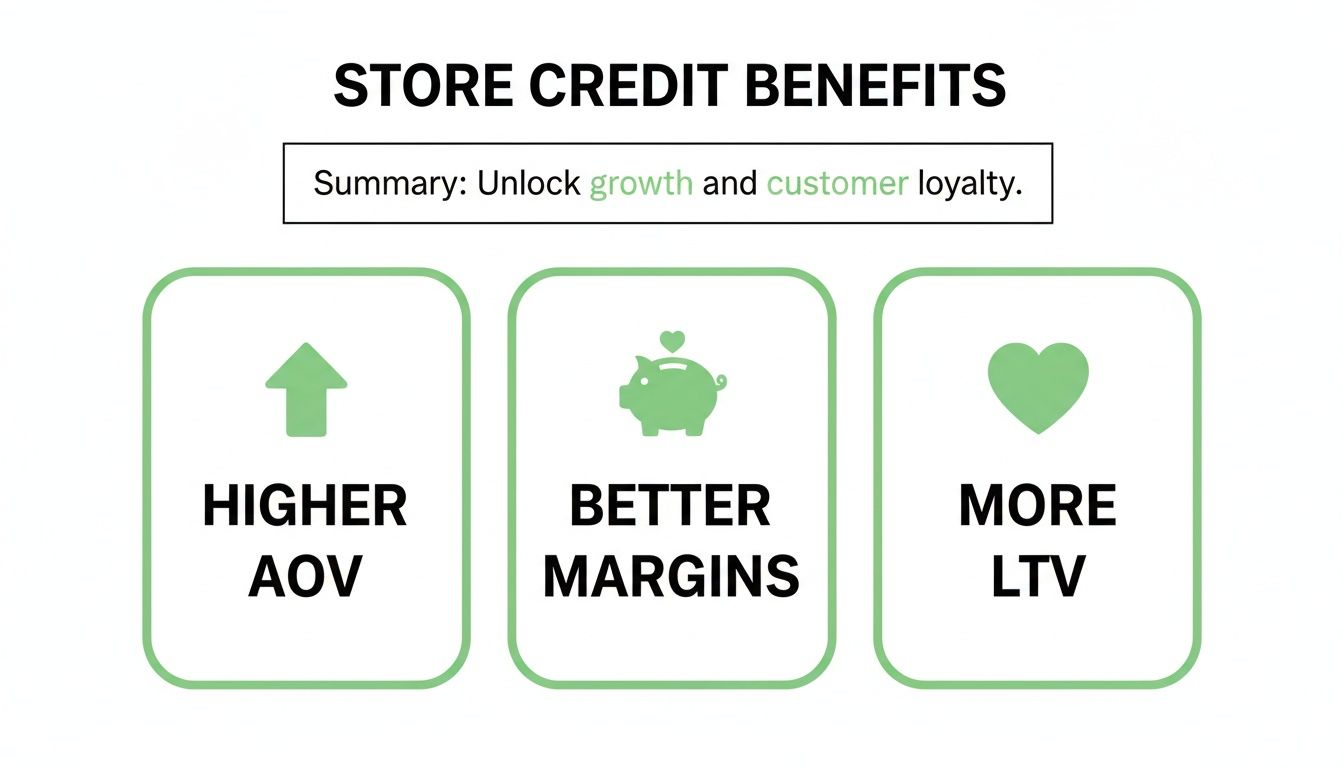
As you can see, connecting spending directly to a reward is a powerful driver for the metrics that matter most.
LTV and Margin Protection
The first purchase is one thing, but the real test is whether your loyalty program can drive profitable repeat business and grow LTV. This is where you see the long-term impact of each strategy really diverge.
Shopify store credit is fantastic for LTV because it makes your brand "sticky." Once a customer has a balance in their account, it acts like a magnet, pulling them back for their next purchase. That feeling of having "money on the table" is incredibly effective at encouraging another order. Best of all, store credit protects your margins because it’s only redeemed on future, full-priced purchases. You're not just giving away discount coupons.
On the other hand, tiered programs often have to lean on a constant drip of discounts to feel worthwhile. This can train your customers to wait for a sale, slowly eroding your margins and devaluing your brand over time. It fails to build the kind of relationship that increases lifetime value.
So, how do they stack up? This table breaks it down, goal by goal.
Loyalty Program Tiers vs. Native Store Credit: A Head-to-Head Comparison
For any ecommerce brand, the choice between these two models comes down to performance. Below, we compare how each approach stacks up against the business goals that are crucial for profitable growth.
Business Goal | Loyalty Program Tiers Approach | Native Store Credit Approach | Which Is Better for Most Shopify Stores? |
|---|---|---|---|
Boosting AOV | Relies on abstract progression, which often fails to motivate immediate action. | Offers a tangible, immediate reward (e.g., "$5 credit for spending $15 more"), directly encouraging larger cart sizes. | Store Credit |
Increasing LTV | Can create apathy if tiers feel unattainable, failing to engage the majority of customers. | Creates a powerful incentive for repeat purchases by giving customers a "wallet" of value they want to spend. | Store Credit |
Protecting Margins | Often depends on upfront discount coupons that directly reduce revenue and erode profit on every sale. | Rewards are only redeemed on future, full-priced orders, protecting the margin of the initial sale. | Store Credit |
Customer Experience | Frequently involves confusing points, complex rules, and clunky apps that create friction. | Provides a simple, transparent system where value is clear (1 credit = $1), leading to higher engagement and satisfaction. | Store Credit |
For the vast majority of Shopify stores, the verdict is clear. The direct, transparent, and profit-friendly nature of a native Shopify store credit system makes it a much more powerful tool for increasing LTV and AOV than the convoluted prestige of a complex tiered program.
Alright, let's move from theory to action. While setting up complex loyalty program tiers can feel like a marathon, launching a store credit program with Redeemly is more like a sprint. It’s built to be fast, simple, and get you results almost immediately.
Because Redeemly taps directly into Shopify's native functionality, you can have a powerful customer retention engine focused on boosting LTV up and running in minutes. No developers, no messy integrations—just a straightforward way to keep customers coming back.
The entire process was designed to sidestep the technical headaches that plague so many third-party loyalty apps. You don't have to worry about clunky scripts slowing down your site or external widgets that feel disconnected from your brand. It’s a lightweight, profit-focused system that simply works.
A Simple, No-Code Setup
Getting started with Redeemly is dead simple—and that’s by design. Once you install the app from the Shopify App Store, a quick setup guide walks you through defining your earning rules. This is where you decide exactly how customers will earn their store credit.
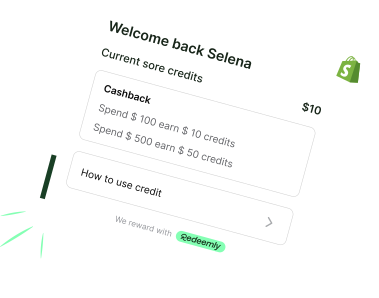
A really popular (and effective) rule is a direct cash-back model. Think something like, "Get $10 in store credit for every $100 spent." This dollar-for-dollar value is crystal clear. Customers instantly get it and see the benefit, which is exactly what you need to nudge that average order value higher.
Here’s a look at the Redeemly dashboard where you’ll set up these rules. It's clean, intuitive, and built for people who want to run a business, not learn to code.
Once you've set your rules, Redeemly handles the rest, automatically integrating with your store. Handy on-site widgets, like a floating customer wallet, pop up to show shoppers their credit balance. It’s a constant, gentle reminder of the reward waiting for them, keeping your store top-of-mind for their next purchase.
The Customer Experience
For your customers, the whole thing feels seamless. There are no confusing points to track or tiers to figure out. They just see a native Shopify store credit balance in their account, which feels a lot like real money ready to be spent.
The real magic happens at checkout. When a customer with store credit returns, they can apply it to their purchase with a single click. This frictionless redemption is the secret to boosting your repeat purchase rate and building genuine, long-term lifetime value.
By using Shopify's own store credit system, Redeemly guarantees a reliable and consistent experience. It’s a turnkey solution for merchants who are tired of chipping away at their margins with endless discount codes. If you want a deeper dive, our guide on how to give store credit on Shopify walks through just how smoothly it all works.
At the end of the day, launching with Redeemly lets you focus on your business, not on managing a clunky program. It gives you the tools to:
Boost AOV: Shoppers are motivated to add just one more item to their cart to hit that next credit milestone.
Increase LTV: You’re giving customers a tangible reason to make their second, third, and fourth purchases with you.
Protect Margins: Reward your best customers without falling back on profit-killing discount codes.
By swapping the complexity of tiers for the simple, powerful value of native Shopify store credit, you create a system that both you and your customers will actually love. It's a direct path to more profitable, predictable growth for your store.
The Future of Loyalty Is Simple and Profitable
Let's cut to the chase. The debate about the "best" way to build customer loyalty is over. For growing brands, the answer isn't buried in complicated loyalty program tiers, confusing point systems, or endless discount codes. The future is simple, clear, and built on the tangible value you only get from a native Shopify store credit system.
Think about it from your customer's perspective. They don't want to decipher a complex set of rules. They just want to feel valued. They want rewards that feel like actual money in their pocket, ready to spend.
This is a fundamental shift away from the old model of making customers jump through hoops for some far-off VIP status. Instead, it creates a clean, honest exchange: spend with us, and we'll give you real value back. This approach directly boosts lifetime value by fostering a stronger bond than any convoluted tier system ever could.

Driving Growth with Clarity and Value
Real, lasting loyalty is built on mutual benefit, not on a labyrinth of rules that eat into your margins. While those gamified tiers might look good on paper—and sure, some data shows progression mechanics can deliver a 1.8x ROI lift—they often hide a darker side. All that complexity leads to customer confusion and bogs down your site.
The core message is undeniable: A loyalty strategy should add to your bottom line, not slowly chip away at it. Native Shopify store credit protects your margins by encouraging future full-price purchases, unlike discount coupons that devalue your brand today.
Making this pivot is just a smart, sustainable business decision. You're creating a system that naturally increases average order value (AOV) and gives customers a powerful reason to come back for their next purchase—all without resorting to profit-killing tactics.
Embrace a Smarter Retention Strategy
At the end of the day, moving from complex tiers to a simpler store credit model is all about improving customer lifetime value in a way that fuels real, sustainable growth. It's time to stop trying to copy the massive, resource-heavy programs of retail giants and start building a loyalty system that actually works for your Shopify store.
By embracing a simple, powerful retention strategy built on store credit, you can:
Delight Your Customers: Give them a reward they instantly understand and genuinely value.
Protect Your Margins: Finally break free from the endless, draining cycle of discount coupons.
Boost AOV and LTV: Create real incentives that drive the kind of profitable behavior you want to see.
Stop chasing complexity. A clear, powerful, and profitable loyalty program is right there for the taking. It’s time to give your customers the straightforward value they deserve and watch your business thrive as a result.
Got Questions? We've Got Answers.
Still on the fence? Let's tackle some of the most common questions Shopify merchants have when they're thinking about moving away from complicated loyalty tiers and embracing a simpler, more powerful store credit system.
How Does Store Credit Actually Lift Average Order Value?
It's all about influencing the customer right at the moment of purchase. A tiered system promises a vague future benefit.
Native store credit, on the other hand, gives customers a concrete, immediate goal. A simple prompt like, "You're only $10 away from getting $5 back in store credit!" creates an irresistible urge to add one more item to the cart. That small, tangible nudge is dramatically more effective at boosting AOV than the abstract idea of climbing a loyalty ladder.
Is Store Credit Really More Profitable Than Discounts?
Without a doubt. When you offer a discount coupon, you're immediately cutting into your revenue and profit margin on that very sale. It's a direct hit to your bottom line.
Store credit is different. It's a reward that brings customers back for a future purchase. You get the full-priced order today, protecting your margins, while the credit acts as a powerful hook for a second sale. You're not just giving money away; you're investing in the next transaction and fundamentally boosting customer lifetime value.
A native Shopify store credit program transforms your loyalty budget from an expense into a profit driver. You stop devaluing your brand with constant sales and start rewarding people in a way that actually encourages more full-priced shopping.
But Won't My Customers Miss the Status of VIP Tiers?
Honestly, most of them won't. While a tiny handful of your most elite shoppers might enjoy the title that comes with a top tier, complex systems often leave the other 99% of your customers feeling left out. They see the best rewards as hopelessly out of reach.
A straightforward native Shopify store credit system feels more democratic and transparent. Every dollar spent earns a clear reward, making it fair and engaging for your entire customer base. This broader participation is what truly drives loyalty and lifetime value across the board.
Ready to trade confusing tiers for profitable growth? Redeemly makes it incredibly simple to reward your customers with native Shopify store credit, boosting LTV and AOV without chipping away at your margins. Learn more and see how it works at redeemly.ai.


Join 7000+ brands using our apps