Shopify Store Credit: Your Guide to Higher LTV and AOV
Dec 4, 2025
|
Published

Look, we get it. When you hear "Shopify store credit," your mind probably jumps straight to one thing: returns. It's the tool you pull out when something goes wrong. But what if I told you that you're sitting on one of the most powerful, yet overlooked, levers for boosting your Customer Lifetime Value (LTV) and Average Order Value (AOV)?
This isn't just about managing refunds. This is about breaking free from the endless cycle of discount codes that bleed your margins dry and complex points systems that confuse your customers. It's time to build real, profitable loyalty with a simpler, more powerful tool: native Shopify store credit.
The Problem with Discounts and Points
In the cut-throat world of ecommerce, keeping the customers you have is everything. You've probably heard the stats—it costs five times more to win a new customer than to keep an old one. Yet, so many brands are stuck using tactics that actively sabotage their long-term health and profitability.
Think about it. Non-stop sales devalue your products and attract one-off bargain hunters. Complicated points systems often feel like a chore, leaving shoppers uninspired and unlikely to come back.
There’s a much cleaner, more direct way forward that smart brands are waking up to: native Shopify store credit. The big shift is to stop seeing it as a reactive fix for unhappy customers and start using it as a proactive investment in your future revenue. It flips store credit from a cost centre into a genuine profit driver, directly impacting your most crucial growth metrics.
A Smarter Way to Build Loyalty
Imagine this: instead of a flimsy coupon, you give your customer a balance that feels like real cash in their digital wallet, exclusively for your store. That's the magic of a proper store credit strategy.
You're creating a powerful, direct financial reason for them to come back and shop again, effectively locking in future sales. It's a completely different psychological game than a 10% off code, which just attracts bargain hunters. Store credit builds a real, committed relationship.
This one simple change can have a massive impact on two of the most important metrics for growth:
Customer Lifetime Value (LTV): When customers have a balance waiting for them, they come back more often and spend more over time. It’s a simple, powerful hook for repeat business.
Average Order Value (AOV): Ever had a gift card and spent a little extra to "use it all up"? The same thing happens here. Shoppers with store credit often add more to their baskets to get the most value from their balance.
By reframing store credit as a reward and a retention tool, you sidestep the race-to-the-bottom pricing that discounts create. You aren't just giving money away; you are strategically reinvesting in your most valuable asset—your existing customers.
In this guide, we’re going to show you exactly how to turn this often-neglected feature into the foundation of your retention marketing. We’ll break down how top brands use native Shopify store credit not just to solve problems, but to build a healthier, more profitable business with higher LTV and AOV.
It’s time to stop training customers to wait for sales and start building a loyal community that values what you offer at full price. Forget the headache of points systems; the future of loyalty is simpler and more powerful than you realise.
Why Native Store Credit Beats Discounts and Points
For years, the ecommerce playbook has been pretty straightforward: want more sales? Offer a discount. But while that approach might give you a short-term bump, it often comes at a steep long-term cost to your LTV.
Discount codes and loyalty points have their place, but they can create serious problems that a smart Shopify store credit strategy neatly sidesteps. Let's dig into why store credit is often the better choice for building a brand that's not just popular, but truly profitable.
The Problem with Discounts and Points
Think of discount codes as a shot of adrenaline. They get you a quick sales spike, but the crash that follows can be brutal. Constantly slapping a 20% off sticker on your products doesn't just eat into your margins; it teaches your customers to wait for the next sale. You end up in a race to the bottom, attracting bargain hunters who have zero brand loyalty instead of cultivating genuine fans.
Loyalty points, on the other hand, often fail for a different reason: they're just too complicated. A customer sees they have "500 points," but what does that actually mean? The mental maths required to figure out the real-world value creates a disconnect. This confusion kills engagement, and your loyalty programme becomes a forgotten gimmick instead of the powerful retention tool it was meant to be.
The Power of a Digital Wallet
This is where Shopify store credit changes the game entirely. It works just like cash sitting in your customer's digital wallet—a simple, tangible asset they can immediately understand. There are no confusing calculations or hoops to jump through. £10 in credit is £10 to spend. Simple as that.
That psychological shift is incredibly powerful. It makes customers feel like they're spending "found money," which encourages them to make full-price purchases. Someone with a £15 store credit balance is far more likely to buy a £50 item at full price than a customer who feels they need a discount code to justify the purchase. This directly contributes to a higher Average Order Value (AOV).
The benefits really stack up, leading to a much healthier growth cycle for your business.
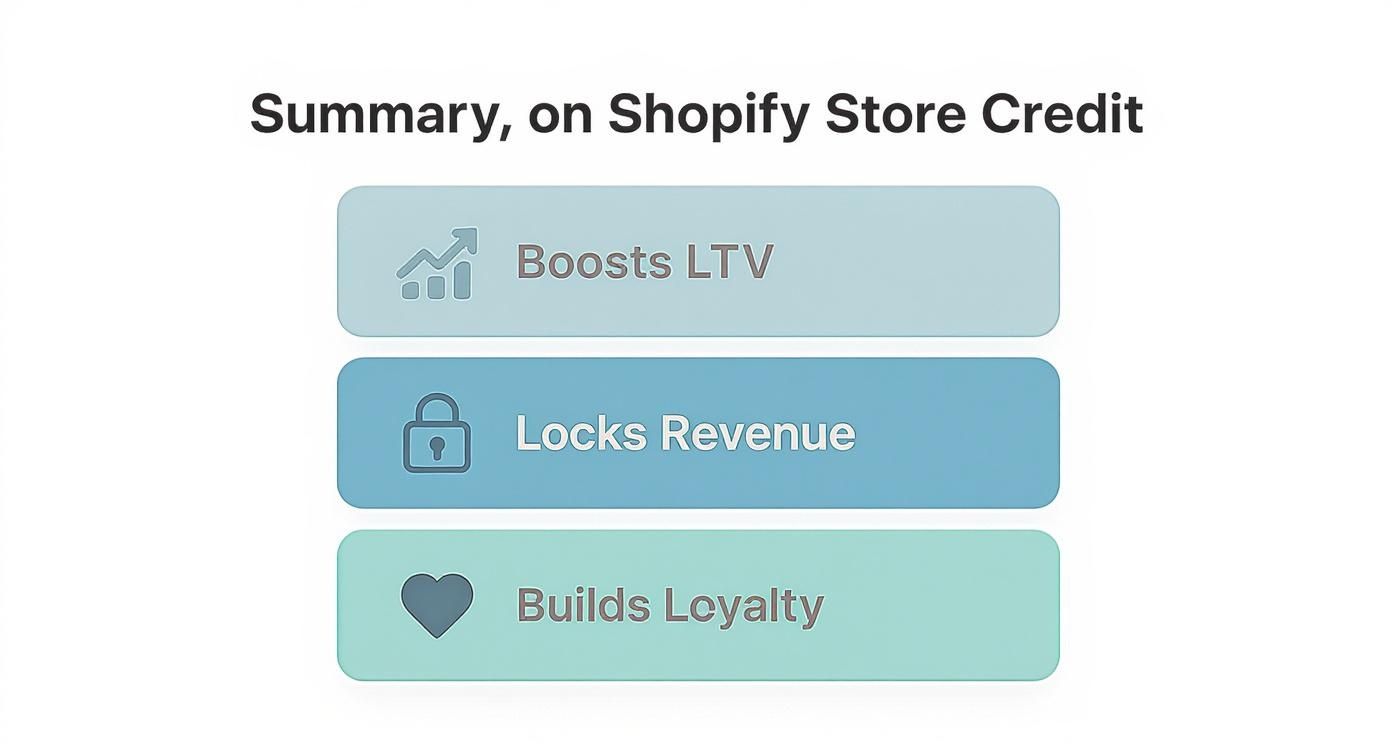
As you can see, it’s all about locking in future revenue and building real loyalty, which are the two key ingredients for boosting the lifetime value of every customer.
A Clear Comparison for Growth
To really see the difference, it helps to put these three approaches side-by-side. While each has a role, their long-term impact on your bottom line and customer relationships couldn't be more different.
Here’s a breakdown to help you weigh the options for your own store.
Store Credit vs Discounts vs Points: A Strategic Comparison
Attribute | Shopify Store Credit | Discount Codes | Loyalty Points |
|---|---|---|---|
Customer Perception | Seen as real cash or a gift. High perceived value and easy to understand. | A temporary price reduction. Can devalue the brand over time. | An abstract reward. Often confusing and hard to translate into real value. |
Margin Impact | Protects margins by encouraging full-price purchases. | Directly erodes profit margins on every single transaction. | Can be costly to maintain and often has low redemption rates. |
Revenue | Locks in future revenue, as the credit can only be spent in your store. | Drives one-off sales but doesn't guarantee a repeat purchase. | Aims to encourage future purchases, but the complex system can fail. |
Customer Loyalty | Builds a strong, ongoing relationship and an incentive to return. | Attracts transactional, price-sensitive shoppers, not loyal fans. | Tries to build loyalty but often suffers from low engagement. |
Brand Equity | Enhances brand value by rewarding customers without devaluing products. | Can cheapen the brand image and train customers to wait for sales. | Neutral impact, but can feel like a generic, impersonal system. |
This table makes it clear: store credit is built for a fundamentally different, more sustainable kind of growth. If you’re looking for more ways to build on this, our guide on how to improve customer retention offers strategies that work perfectly alongside a store credit programme.
Think about the customer's journey. A discount code is purely transactional; the relationship ends the moment the sale is made. A point system is aspirational; it dangles a vague reward in the future that may never even be claimed.
Store credit, however, is relational. It creates an immediate, concrete reason for that customer to come back.
Store credit is a promise kept. Unlike a discount that devalues a single transaction, store credit invests in the next one, turning a one-time buyer into a repeat customer.
This is where you'll see a real impact on your most important metrics. Shoppers will often spend more than their credit balance just to use it up, which naturally increases your Average Order Value (AOV). And because the credit is such a powerful reason to return, it consistently boosts your repeat purchase rate—the engine of Customer Lifetime Value (LTV).
Instead of constantly fighting for the next sale with margin-killing discounts, you build a system where customers are genuinely excited to come back. It's a fundamental shift from chasing transactions to cultivating relationships.
Getting to Grips with Shopify's Native Store Credit Features
You might be surprised to learn you don’t need a complicated web of third-party apps to run a solid store credit programme. Shopify has some seriously powerful, native features baked right into its core platform—and frankly, most merchants don't even know they're there. These tools give you everything you need to start moving away from constant discounts and build a much more profitable way to keep customers coming back.
The real magic is in how you can issue and manage this credit. Whether your customer service team needs to fix a problem on the fly or you want to set up automated rewards, Shopify’s built-in tools are flexible enough to handle both. This is how you create a smooth customer experience without slowing your site down with more apps.

Unifying the Customer Experience
One of the biggest wins of using Shopify’s own system is how it creates a truly unified shopping experience. When a customer gets store credit, it’s not stuck in one place. It’s a flexible balance that follows them wherever they shop with you, whether that's on your website or in your physical store.
This is a game-changer for modern retail. Picture this: a customer returns something at your brick-and-mortar shop and you offer them store credit. With a native setup, they can then go home and use that exact credit to buy something from your website that evening. No friction, no fuss—just a happy customer who feels valued.
For your team, it means everyone has a single, up-to-the-minute view of a customer’s credit history. A support agent can see a balance and add more credit instantly, while a store associate can look up the same account on the POS. This single source of truth cuts out the confusion and empowers your staff to deliver brilliant service.
Putting the Store Credit API to Work
Beyond issuing credit by hand, the real strategic power comes from Shopify's Store Credit API. This is what lets you automatically issue credit based on what your customers actually do. Think of it as the engine that drives automated loyalty programmes, pushing up both Average Order Value and Lifetime Value without you lifting a finger.
Here are a few practical ideas to get you started:
Automated VIP Rewards: Set up a rule to automatically send a surprise £10 credit to any customer who spends over £250 in a month. It’s a small thank you that goes a long way.
Customer Service Excellence: Give your support team the power to resolve issues on the spot by issuing credit directly to a customer’s account. It’s a fantastic way to turn a potential complaint into a positive experience.
Incentivise Reviews: Automatically drop a small amount of credit into a customer's account as soon as they leave a verified product review.
Birthday Surprises: Delight your best customers with an automatic store credit gift on their birthday. It’s a personal touch that builds a real connection.
The Store Credit API turns store credit from a simple line on a spreadsheet into a dynamic marketing tool. It’s all about creating proactive, positive moments that build relationships and lock in future sales—all without killing your margins with discounts.
This API-first approach means your store credit programme can run smoothly in the background, constantly rewarding the behaviour you want to see. It’s this blend of hands-on control and clever automation that makes Shopify’s native features so effective.
For UK businesses, these unified capabilities are especially powerful. Retailers using integrated systems like Shopify POS see an average 8.9% increase in annual sales just by connecting their digital and physical stores. You can learn more about how Shopify supports UK retailers by checking out their research on store credit for customer retention.
Strategic Plays to Increase LTV and AOV

Alright, enough with the theory. It's time to put your Shopify store credit programme to work. This is where we turn a simple line on a balance sheet into a powerful engine that nudges your most important numbers—like LTV and AOV—in the right direction. The goal isn’t just to hand out credit; it’s to use it with intent to encourage specific, profitable customer actions.
What follows are some of the most effective, high-impact strategies I've seen brands use to grow both Customer Lifetime Value (LTV) and Average Order Value (AOV). Each one taps into simple but potent psychological triggers that get customers spending more, and more often.
Offer Store Credit Instead of Cash Refunds
This is the absolute cornerstone of any smart store credit strategy. When a customer wants to return something, offering them store credit instead of a cash refund is a game-changer. Why? Because it keeps the money right where you want it: inside your business.
You’re not just preventing a sale from being completely lost; you're building a bridge to a guaranteed future purchase. This single move is a fantastic way to protect your cash flow and give a customer a reason to come back.
The psychology behind it is straightforward. The customer has already mentally parted with that money, so accepting credit feels more like a fair swap than a loss. It's one of the best retention marketing strategies out there because it creates a second chance to deliver a great experience, massively increasing the odds that a one-time buyer will become a loyal, repeat customer.
Run Proactive "Surprise and Delight" Campaigns
Don't just sit back and wait for a return request to issue credit. Being proactive and rewarding your best customers creates a huge amount of goodwill and builds genuine loyalty. This approach is all about the principle of reciprocity—when you give someone an unexpected gift, they feel a natural pull to give something back.
Here are a few ways to put this into practice:
Reward High Spenders: Automatically issue a £10 credit to any customer who spends over £200 in a quarter, just to say thanks.
Win Back Lapsed Customers: See a customer who hasn't bought anything in 90 days? Send them a small "we miss you" credit to gently pull them back in.
Celebrate Milestones: A surprise credit on a customer's birthday or the anniversary of their first purchase is a brilliant personal touch.
These small, unexpected gestures make customers feel seen and appreciated in a way a generic 15% discount code never could. The credit acts as a powerful little magnet, drawing them back to your store to spend their "gift."
Implement a Cashback Rewards Programme
A cashback programme that pays out in store credit is a genius move for boosting AOV. Forget confusing points systems. Instead, you make a simple, compelling offer: "Spend £100, Get £10 in Store Credit." This tangible reward gives shoppers a clear incentive to add a few more items to their basket to hit that next threshold.
Unlike a discount that devalues the current sale, a cashback reward is an investment in the next one. You get to protect your margins on today's purchase while creating a rock-solid reason for that customer to come back soon.
This works so well because the reward feels earned and has real value. The customer sees that credit in their account and thinks of it as actual money just waiting to be spent. This "wallet" effect makes their next purchase feel like it's already partially paid for, reducing hesitation and encouraging a much quicker return visit. To really amplify your revenue, you can combine this with other proven tactics to increase average order value that complement your store credit strategy.
By weaving these plays into your marketing, you create a self-fuelling cycle of loyalty and growth. Each bit of store credit you issue becomes a deliberate investment in your customer relationships, systematically driving up LTV and AOV while shielding your precious profit margins from the race-to-the-bottom of endless discounting.
Ready to Roll Out Your Own Store Credit Programme?
Thinking about launching a store credit programme can feel like a massive project, but it’s actually far more straightforward than you’d imagine. This isn't about flipping a switch and hoping for the best. It's about a smart, phased transition that gently moves your business away from those margin-eating discounts and towards a more profitable, customer-centric model.
Think of this as your roadmap. We'll walk through everything from the technical setup to communicating the changes to your customers, all while using the tools Shopify already provides. The aim is to carefully step away from a discount-heavy strategy. Instead of a sudden jolt, you'll introduce the idea of a "store wallet" in a way that feels like a genuine upgrade to their shopping experience.
A Simple Four-Step Plan to Get Started
To make this shift as smooth as possible, just follow these four steps. They're designed to help you build momentum, test the waters, and get your customers genuinely excited about this new way to get rewarded.
Get a Handle on Your Current Discounts: Before you do anything else, you need a clear picture of what's happening right now. Pull a report of every single discount code you've used over the past six months. Your job is to figure out which codes actually bring in new sales, and which ones are just giving away profit to people who were going to buy from you anyway. This data is gold—it shows you exactly where you can start pulling back without losing revenue.
Start with Returns: This is the lowest-hanging fruit and the most logical place to begin. Make an immediate change to your returns policy: offer Shopify store credit as the default option instead of a straight cash refund. The key is how you frame it. Something like, "Get instant credit to find something you'll love," keeps that cash in your business and gives customers a great reason to come back for another look.
Run a Small, Targeted Credit Campaign: Now it’s time for a little experiment. Pick a small group of your most loyal customers—say, your top 5% of spenders. Run a 'surprise and delight' campaign where you drop a small amount of credit directly into their accounts as a thank you. Then, sit back and watch what they do. This pilot will give you priceless data on redemption rates and any uplift in their average order value before you commit to a full-scale launch.
Introduce the "Store Wallet" Idea: Once you've got some positive results from your pilot, you're ready for the main event. Start communicating the benefits of your new programme to everyone. Use your email list and on-site banners to introduce the concept of a "store wallet" where they can build up and spend their credit. Make it clear why this is so much better than constantly hunting for the latest discount code.
Getting the Tech Right for a Seamless Experience
For any of this to work, the customer experience has to be absolutely seamless. Real-time balance tracking is a must. Customers have to be able to see their available credit on their account page and at the checkout, plain as day. Without that transparency, they won't trust it, and they won't use it.
Luckily, Shopify is built for this. The Shopify Store Credit API gives UK merchants a solid, scalable foundation for managing everything. It lets you issue credit, show balances, and handle redemptions right inside the native Shopify Checkout. If your needs are a bit more complex—like integrating with a subscription service—the API is flexible enough to build custom experiences that tie everything together. You can see some great examples of how UK brands are using this for subscription innovation and other clever use cases.
By taking this structured approach, you can confidently steer your business towards a more profitable, loyalty-first model, with Shopify store credit as the engine.
Measuring the Success of Your Programme
So, you’ve launched your store credit programme. How do you know if it's actually working? The real measure of success isn't just about how many people redeem their credit. That's a start, but it doesn't tell the whole story.
The true power of store credit lies in its ability to change customer behaviour for the better – encouraging them to spend more and stay loyal. This means digging into the numbers that really matter and focusing on the KPIs that show a tangible return on your investment. Let's move from hoping it works to knowing it does.
Key Metrics for Store Credit Success
To get a clear picture of your programme's performance, you need to zero in on three core metrics. These directly link your store credit efforts to real-world revenue and loyalty.
Average Order Value (AOV) Uplift: Start by comparing the AOV of orders placed with store credit against those placed without. You’ll often find customers are happy to spend a little extra to use up their balance, giving you a healthy, measurable boost in AOV.
Customer Lifetime Value (LTV) Growth: This is a big one. Take the group of customers who have received store credit and compare their LTV to your general customer base. A winning programme will show a significant increase in how much these customers are worth to your business over time. If you want to get into the nitty-gritty, we have a detailed guide on how to calculate customer LTV.
Revenue Retained from Returns: This is a simple but incredibly powerful metric. Just calculate the total value of returns where store credit was chosen over a cash refund. Every pound and penny here is revenue that you’ve successfully kept in your business, instead of watching it walk out the door.
Leveraging Shopify's Built-In Reporting
To truly get a handle on the ROI of your store credit strategy and measure its impact on LTV and AOV, you need solid data. If you're manually pulling sales data from Shopify into spreadsheets for analysis, consider how data integration consultants can streamline this process.
Fortunately, Shopify has some powerful native tools to help. The 'Store credit transactions' report, found right within Shopify Analytics, gives UK merchants a fantastic shop-wide view of their credit programmes.
This report breaks down all the credits, debits, and even expirations. It allows you to spot trends in how credit is being issued and used, helping you fine-tune your policies to keep customers engaged and spending.
Common Questions About Shopify Store Credit
Thinking about shifting to a Shopify store credit strategy can feel like a big leap, but it's often more straightforward than you might imagine. As more merchants wise up to this margin-friendly approach, a few questions tend to pop up time and again. Getting solid answers is the first step to confidently moving away from the endless discount cycle and into a more profitable, loyalty-first model.
Let's tackle the most common queries so you can get your store credit programme off the ground with total clarity.
Can Customers Use Store Credit with Discounts?
Absolutely, yes. Shopify's native system treats store credit just like any other form of payment—think of it as a gift card or a credit card. So, a customer can pop a discount code into their checkout and then use their store credit to pay for whatever is left.
But here’s the thing: the real goal is to make constant discounts a thing of the past. A clever move is to set up promotions where your best-sellers or new arrivals can’t be bought with a discount code, but can be purchased with store credit. This is a brilliant way to gently nudge customer behaviour, teaching them that their credit balance is the best deal they’re going to get. It’s a win-win that protects your margins and gives your AOV a healthy boost.
The real magic of store credit is its power to encourage full-price purchases. When you make it the most appealing incentive, you break the habit of customers holding out for the next big sale.
How Does Store Credit Work for Returns?
When you’re processing a return in the Shopify admin, you get to a crucial fork in the road. You can either refund the cash straight back to the customer's original payment method, or you can issue that same amount as store credit.
Choosing store credit is a game-changer for locking in revenue. Instead of that sale walking out the door for good, you keep the cash in your ecosystem and give the customer a fantastic reason to come back. This one small change effectively saves the sale, turns a potentially frustrating return into a positive touchpoint, and builds the kind of loyalty that directly grows your LTV.
Is It Hard to Track Store Credit Liability?
Not in the slightest. This is a fear we hear a lot, but Shopify’s built-in reporting makes it incredibly simple. The 'Store credit transactions' report gives you a crystal-clear, real-time picture of every bit of credit you've issued, redeemed, or that has expired across all your customers.
This report takes all the headache out of the accounting side of things, giving you a precise figure for your outstanding liability whenever you need it. It means the financial perks of higher LTV and saved sales aren't just powerful in theory—they're also easy to measure and track.
Ready to swap those margin-killing discounts for a loyalty system that actually grows your profit? Redeemly helps you build a powerful store credit programme right within Shopify, boosting LTV and AOV without the complexity. Learn how Redeemly can build a more profitable loyalty strategy for your brand.



Join 7000+ brands using our apps