How to Calculate Customer LTV: The Metric That Matters More Than AOV
Dec 1, 2025
|
Published
Calculating a customer's Lifetime Value (LTV) is pretty straightforward on the surface. You just multiply your Average Purchase Value by your Average Purchase Frequency Rate, and then multiply that by the Average Customer Lifespan. The result is a powerful forecast of the total revenue a typical customer will bring to your Shopify store over their entire time with you.
Why LTV Is Your Most Important Shopify Metric
For years, Shopify merchants have been told to chase one metric above all others: Average Order Value (AOV). The logic feels solid, right? Get people to spend more in a single go. But this obsession with the first sale is a dangerously short-sighted strategy. It’s like celebrating a great first date without ever thinking about whether you’ll get a second one.
The real key to building a sustainable, profitable brand lies in a completely different number: Customer Lifetime Value (LTV).
LTV flips the script. Instead of focusing on a single transaction, it zooms out to look at the entire customer relationship. It answers a much more critical question: "How much is this customer really worth to my business in the long run?" This shift in perspective will fundamentally change how you think about everything from your marketing budget to customer service and loyalty.
The Problem with Chasing a High AOV
When your main goal is pumping up AOV, you start using tactics that can actually hurt you down the line. Think about the usual suspects: aggressive up-sells, steep "spend more, save more" deals, and a constant barrage of promotional emails. Sure, they might inflate a single shopping basket, but they often come at a heavy price.
Discount Dependency: You're training your customers to wait for a sale. This eats away at your margins and makes your products feel less valuable.
The Acquisition Treadmill: Focusing only on one-off sales means you're stuck in an expensive cycle of constantly finding new customers because you aren't keeping the ones you have.
Transactional Relationships: It creates a cold, transactional vibe where people buy from you based on price, not because they love your brand.
This is where the difference becomes crystal clear. A customer with a high AOV who never comes back is far less valuable than a customer with a modest AOV who buys from you five, ten, or even twenty times.
A New Opportunity with Shopify Store Credit
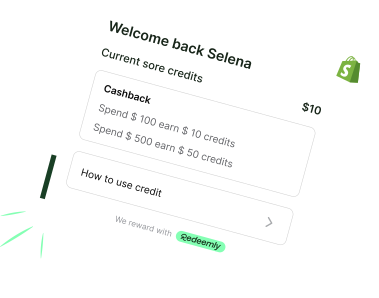
This is exactly why smart loyalty solutions, especially those using Shopify's native store credit system, are becoming so popular. Unlike discounts that just slash your revenue, store credit works completely differently. It acts like a magnet, pulling customers back for their next purchase.
Think about the comparison: Giving a customer £5 in store credit instead of a 10% discount doesn't just protect your profit on the current sale. It gives them a concrete reason to return, which directly boosts their purchase frequency—a crucial part of the LTV formula.
It’s a simple change, but it moves you away from confusing point systems and margin-killing coupons. Instead, you're building genuine, repeatable buying habits. This is especially important today, when so many shoppers feel like their loyalty goes unnoticed. In fact, recent research found that a massive 83% of loyal UK customers feel undervalued by the brands they shop with, even though they keep coming back.
You can learn more about these customer loyalty findings and see how building genuine value bridges this gap. By focusing on LTV, you stop optimising for a single transaction and start building a profitable, resilient business for the long haul.
The Essential LTV Formulas Every Merchant Needs
Getting a real grip on your numbers is the first step to truly understanding customer lifetime value. It might sound a bit academic, but the actual maths is surprisingly straightforward, especially when you know where to look in your Shopify dashboard.
We'll start with the foundational formula that looks at revenue, then sharpen our pencils for a calculation that gets down to actual profit.
This image really nails the core idea: what a customer spends in one go (AOV) is the launchpad for what they're worth to you over time (LTV).
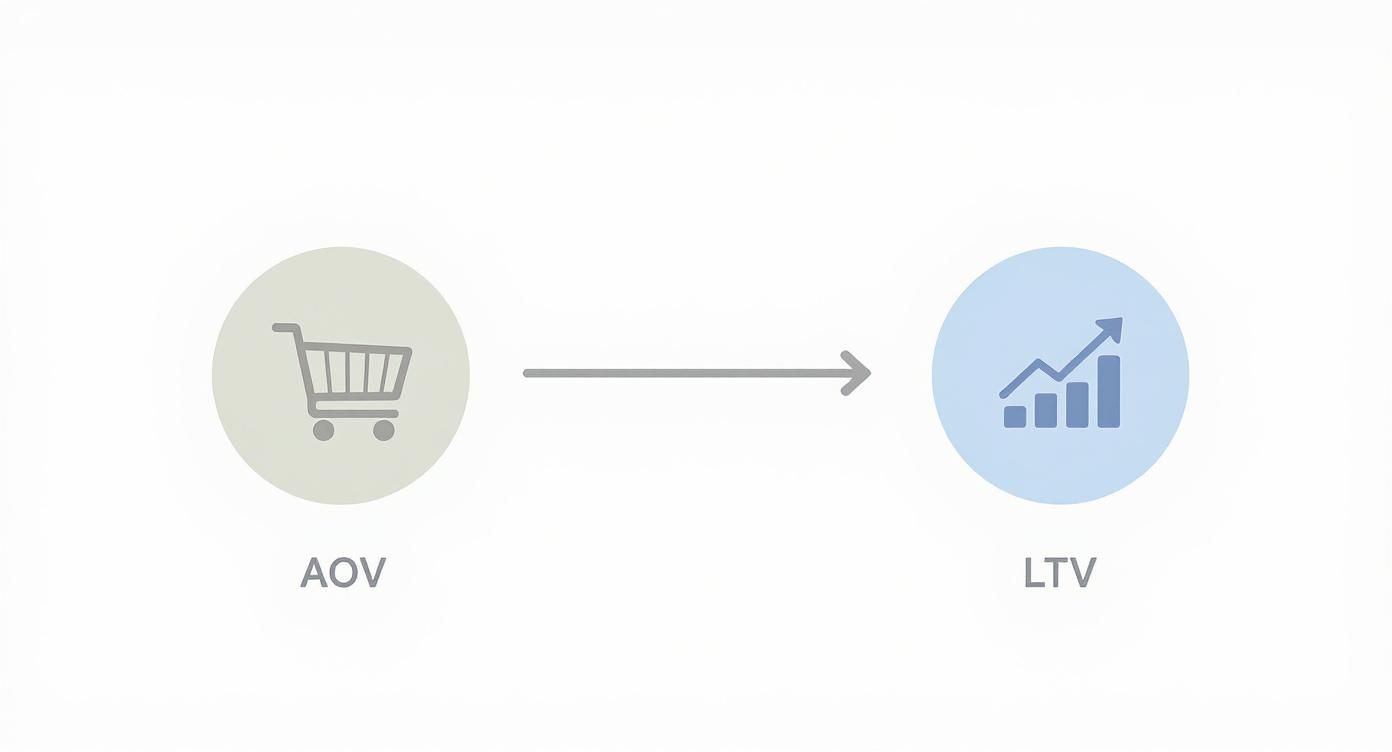
The insight here is simple but powerful. A higher Average Order Value is a fantastic head start for building a much higher Lifetime Value.
Starting With The Basic Historical LTV Formula
The most common way to get your bearings with LTV is to look at past buying habits. This historical model gives you a solid baseline of what an average customer is worth, based on cold, hard data.
Here's the formula:
LTV = Average Order Value (AOV) x Average Purchase Frequency x Average Customer Lifespan
Let's break down each bit.
Average Order Value (AOV): This one's easy—it's the average amount a customer spends per order. A bigger AOV immediately boosts your LTV.
Average Purchase Frequency: This tells you how often a customer buys from you in a set period, usually a year. This is where repeat business really starts to multiply your returns.
Average Customer Lifespan: This is the average time a customer sticks around and keeps buying from you. The longer you keep them, the more valuable they become. Simple as that.
Let’s put it into practice. Imagine your Shopify store has an AOV of £75. Your customers tend to buy from you twice a year, and they typically stay loyal for about three years.
The maths looks like this: £75 (AOV) x 2 (Frequency) x 3 (Lifespan) = £450 LTV.
This means, on average, every new customer you bring in is worth £450 in revenue over their entire relationship with your brand. That’s a number you can take to the bank.
Finding The Data In Your Shopify Analytics
You don't need a PhD in data science to find these figures. Shopify lays it all out for you right in your admin panel.
For AOV: Head to
Analytics > Reports > Sales > Sales over time. You can grab your total sales and divide it by the number of orders to get your AOV for a given period.For Purchase Frequency: Navigate to
Analytics > Reports > Customers > First-time vs. returning customer sales. This report is brilliant for understanding repeat purchase behaviour, which is the heart of this metric.
The conversation around LTV in the UK has moved on. It’s no longer just about transactions. A recent KPMG report highlighted that brands blending transactional data with behavioural insights saw a 30% greater lifetime value from customers. This just goes to show how powerful it is to understand the complete customer journey.
Levelling Up To A Profit-Based LTV
The historical formula is a brilliant starting point, but it has one major blind spot: it only sees revenue, not profit. Two customers could both have a £450 LTV, but if one of them only ever buys heavily discounted items, their real value to your bottom line is much, much lower.
This is where a margin-adjusted formula gives you a much clearer, more honest picture.
Profit-Based LTV = (AOV x Purchase Frequency x Lifespan x Gross Margin %) – Customer Acquisition Cost (CAC)
The two new players here are:
Gross Margin %: The slice of revenue left after you’ve paid for the goods themselves (COGS).
Customer Acquisition Cost (CAC): The total sales and marketing spend it took to get one new customer through the door.
Let's plug our numbers back into this smarter formula. The customer's revenue LTV is £450. If your average gross margin is 60% and it costs you £40 in ad spend to acquire a customer, the story changes completely.
Profit-Based LTV = (£450 x 0.60) – £40 = £230
All of a sudden, that £450 customer is actually worth £230 in pure profit. This is the number that really matters for sustainable growth. It doesn’t just tell you what you’re earning; it tells you what you’re keeping.
This distinction is crucial when you're deciding on loyalty strategies. A discount-heavy approach might pump up your revenue, but it’ll crush your gross margin and shrink your profit-based LTV. In contrast, something like a store credit system protects your margins, ensuring the repeat business you work so hard for is genuinely profitable.
To get even deeper into the specific methods and data you'll need, you can learn how to calculate CLTV for your business.
Look to the Future with Predictive LTV
While historical LTV gives you a solid picture of past performance, relying on it alone is a bit like driving while only looking in the rearview mirror. It shows you where you’ve been, but it won’t tell you much about the road ahead. For a growing Shopify brand, that’s a risky way to navigate.
To really get an edge, you need to stop just analysing past transactions and start anticipating future behaviour.
That’s exactly what predictive LTV is for. Think of it as your crystal ball for forecasting revenue and, crucially, spotting your most valuable customers long before they hit their peak. Instead of waiting a year or two to find out who your VIPs are, you can make incredibly smart guesses based on their early buying signals. This lets you shift your marketing from reactive to proactive, nurturing those high-potential relationships from the very first purchase.
Uncovering Trends with Cohort Analysis
One of the most powerful, yet practical, ways to start predicting future value is through cohort analysis. It sounds technical, but the idea is simple: you group customers who share a common characteristic and then track their spending habits over time.
The most common way to do this is by acquisition date—for example, looking at everyone who made their first purchase in January. But you can get much more granular.
You could create cohorts based on:
Acquisition Channel: Customers from a specific Facebook ad versus those who found you through organic search.
First Product Purchased: Grouping shoppers who bought your flagship product versus those who started with an entry-level item.
Discount Used: Comparing customers who grabbed a "20% Off" welcome offer with those who paid full price from the get-go.
When you track these separate groups, powerful patterns start to emerge. You might discover that customers acquired during your Black Friday sale have a massive initial AOV but almost never buy again. Meanwhile, customers from an influencer campaign might spend less upfront but come back time and time again.
That insight is pure gold. It tells you which campaigns are delivering genuinely valuable, long-term customers, not just a short-term sales spike.
You’re finally able to answer the most important question: "Which of my marketing efforts are actually bringing in the best customers?" It shifts the entire focus from fleeting revenue to sustainable, profitable growth.
The Power of AI in Predicting Customer Value
Not long ago, building these kinds of sophisticated predictive models was out of reach for most Shopify merchants. It was the domain of data scientists with expensive software. Thankfully, that's all changed. Accessible AI tools are levelling the playing field, making it easier than ever to forecast LTV.
These tools can sift through thousands of data points—things like the time between purchases, the product categories a customer browses, and even cart abandonment rates—to spot the subtle signals of a high-potential buyer.
The adoption of artificial intelligence in these calculations has completely changed how UK businesses measure customer value. A study in the UK State of Commerce Report found that companies using AI-driven predictive models saw a 25% increase in business growth. Why? Because AI can adjust LTV forecasts in real-time as a customer’s behaviour evolves. You can learn more about how AI is shaping UK commerce on signifyd.com.
Why This Matters for Your Loyalty Strategy
Once you start thinking in terms of predictive LTV, your whole approach to rewards and retention changes. Instead of throwing the same blanket discount at everyone, you can start making strategic investments in the customers who show the most promise.
Imagine your model flags a new customer as a potential VIP after just their second purchase. You could proactively delight them with a surprise £10 in Shopify store credit. This isn’t just another generic coupon; it’s a targeted investment made with data-driven confidence that this specific customer is worth keeping around.
Compare that to a standard points system that often feels slow and confusing, or a 15% discount that just chips away at your margin without building any real loyalty. Store credit, especially when awarded strategically like this, directly encourages the repeat behaviour you want to see. It’s a smarter, more profitable way to turn a high-potential shopper into a confirmed long-term fan.
How Store Credit Rewrites Your LTV Equation
Let's be honest: your loyalty strategy is a direct input into your LTV calculation. Every decision you make—from running a flash sale to handling a return—either builds or erodes the long-term value of your customers. This is where the rubber meets the road, connecting your rewards program to your actual bottom line.
For too long, the standard loyalty playbook has been full of discounts and overly complex point systems. The problem? They often work against your LTV goals. A much smarter approach, built around Shopify’s native store credit, gives you a powerful way to directly boost the metrics that really matter.

The Problem with Traditional Loyalty Tactics
For years, discounts have been the go-to lever for driving sales. But when you look at them through the lens of a profit-based LTV, you start to see the cracks.
Constant discounts train your best customers to wait for a sale, devaluing your brand and hammering your gross margin. Sure, a 20% off coupon might lock in a sale today, but it shrinks the profit from that one transaction and tends to attract bargain hunters with zero brand loyalty. These shoppers rarely stick around, which means a shorter customer lifespan and a lower LTV.
Then you have point systems. The intention is good, but the execution often falls flat. Customers are forced to do mental gymnastics to figure out what their points are actually worth ("So, what does 1,000 points really get me?"). This friction kills their motivation to even bother. Many shoppers just end up hoarding points they never redeem, meaning the system completely fails to drive the one behaviour it was designed for: repeat purchases.
A Head-to-Head Comparison: Discounts vs. Store Credit
Let’s get practical with a real-world scenario. Imagine a customer, Sarah, makes her first purchase for £100 from two different Shopify stores. Both want her to come back.
Store A (Discounts): Sends Sarah a "15% Off Your Next Order" coupon. When she returns, she feels she has to use it. She spends another £100, but the store only brings in £85 from that sale, cutting straight into its margin. This strategy is also teaching her to expect a discount every single time.
Store B (Store Credit): Gives Sarah £10 in store credit after her first purchase. This feels like cash sitting in her account—a tangible reward just waiting to be spent. When she returns, she sees that £10 credit at checkout. Critically, many shoppers treat this as "found money" and end up spending more to make the most of it, often pushing their basket total to £110 or higher.
The difference is subtle but incredibly powerful. Store A sacrifices its margin for a second sale, while Store B protects its margin and often increases AOV on the very same purchase.
Store credit doesn't devalue your products; it enhances the customer's buying power. This simple psychological shift turns a cost-centre (discounts) into a profit-driver (higher AOV and more repeat business).
How Store Credit Directly Boosts LTV Variables
When you calculate customer LTV, you're really just pulling three core levers: Average Order Value, Purchase Frequency, and Customer Lifespan. A smart store credit system, like the one offered by Redeemly, is uniquely designed to give all three a lift without the downsides of other methods.
Increasing Average Order Value (AOV)
Unlike a flat discount, store credit actually encourages customers to spend more. When a shopper has £10 of credit burning a hole in their pocket, they're far more likely to add that one extra item to their cart or upgrade to a more premium product. Their thinking shifts from "How can I pay less?" to "How can I get more?"
This dynamic directly increases AOV on all future purchases, which is a key multiplier in your LTV formula.
Boosting Purchase Frequency
Store credit is a magnet. It pulls customers back to your store. A pending balance creates a little sense of urgency and serves as a constant reminder of the value waiting for them. It’s an open loop they’ll feel compelled to close.
This is especially effective for turning one-time buyers into repeat customers. A simple email reminding them of their available credit can be far more persuasive than yet another generic sales blast.
Extending Customer Lifespan
By creating a positive cycle of earning and spending, store credit builds genuine loyalty and shopping habits. Customers feel valued and become part of your brand's ecosystem. This consistent, positive reinforcement keeps them engaged for longer, extending their purchasing lifespan and maximising their total value to your business.
The table below gives you a clear picture of how each loyalty approach really stacks up when it comes to the metrics that build long-term value.
Impact of Loyalty Programs on LTV Metrics
A loyalty program isn't just a marketing tool; it's a financial one that directly influences the core variables of your LTV calculation. Here’s a direct comparison of how the three main approaches affect your most important metrics.
LTV Variable | Impact of Discounts | Impact of Point Systems | Impact of Store Credit |
|---|---|---|---|
Average Order Value | Often no impact or can decrease if customers buy just enough to use the code. | Minimal impact, as points are abstract and not tied to immediate spending. | Increases AOV as customers spend more than their credit balance to maximise its value. |
Purchase Frequency | Can increase frequency but often attracts one-off bargain hunters who churn quickly. | Can be ineffective if the system is confusing or redemption thresholds are too high. | Directly drives repeat purchases by giving customers a tangible reason to return. |
Gross Margin | Directly reduces margin on every transaction where a discount is used. | Protects margin better than discounts but can be complex to manage. | Protects margin as credit is often applied to full-price items and encourages upsells. |
Customer Experience | Creates a transactional feel and can devalue the brand's perceived quality. | Often causes confusion and fails to make customers feel genuinely rewarded. | Simple and satisfying, making customers feel like they have cash to spend. |
At the end of the day, the goal isn't just to get another sale. It's to build a more profitable customer relationship for the long haul. By ditching margin-killing discounts and confusing points for the simplicity and power of native store credit, you are fundamentally rewriting your LTV equation for sustainable growth.
Ready to Increase Your Customer LTV? Here’s How.
Knowing your customer LTV is a great start, but the real magic happens when you start actively pushing that number up. This is where you move from theory to building a seriously profitable business. We're going to walk through some concrete strategies that directly pump up your AOV, purchase frequency, and retention—the three pillars of your LTV formula.
Forget relying on those margin-killing discounts. The goal here is to build genuine value for both you and your customers.

Think of each of these strategies as a lever you can pull. When you implement one, you aren’t just vaguely hoping for more sales; you're systematically engineering a higher lifetime value.
Boost Your Average Order Value with Smart Incentives
A higher AOV gives your LTV an immediate head start. The aim is to gently encourage customers to spend a bit more with each purchase, but without resorting to blanket discounts that can devalue your brand. It’s all about adding value, not just slashing prices.
One of the most powerful ways to do this is with tiered store credit rewards. This approach gives customers a direct incentive to increase their basket size in a way a simple discount code just can't match.
For example: Instead of a flat "10% Off," try offering "Spend £75, get £5 in store credit" and "Spend £100, get £10 in store credit."
This structure nudges shoppers to add that one extra item to their cart to hit the next reward level. They're not just spending more today; they're banking tangible value for their next visit. This protects your margins and gives them a very compelling reason to come back. It's a simple but brilliant shift from a one-off saving to a long-term reward.
Another fantastic tactic is smart product bundling. By grouping complementary products together at a slightly better price than if they were bought separately, you solve a customer's problem more completely while increasing the transaction value. Think "The Ultimate Skincare Starter Kit" instead of just a single moisturiser.
Drive Repeat Purchases and Lock in Retention
Getting customers to come back for a second, third, or fourth time is where your LTV really starts to multiply. This is all about building shopping habits and giving people clear reasons to choose you over the competition again and again.
And guess what? Store credit is once again a powerhouse tool for creating these repeat purchase loops.
You can set up simple, automated email flows that reward valuable customer actions with store credit. It’s a win-win.
Product Review Campaigns: Offer £5 in store credit for leaving a review after a purchase. Not only does this generate priceless social proof, but it also puts a credit balance directly into their account, pulling them back for their next shop.
Win-Back Campaigns: Target customers who haven't bought anything in 90 days with a surprise email offering them £10 in credit "just because." This feels like a genuine gift and is far more effective than a generic "We Miss You" email with yet another discount code.
These tactics transform simple customer interactions into powerful retention opportunities. Instead of just asking for a favour (like writing a review), you're creating a reciprocal relationship that rewards their engagement and directly encourages the next sale.
Ultimately, a primary way to boost LTV is simply by keeping your customers for longer. For a deeper dive into extending these relationships, there are some great resources on how to improve customer retention. A solid retention strategy is the bedrock of a healthy LTV.
Finally, don't overlook subscription models for consumable products. They can lock in repeat business and make your purchase frequency wonderfully predictable. Even if you only offer it for one or two core products, a "subscribe & save" option automates the entire repeat purchase process, guaranteeing a steady stream of orders and dramatically increasing the LTV of those customers.
LTV Questions We Hear All the Time
Diving into customer lifetime value can feel a bit complex at first, and it's natural to have questions. Let's tackle some of the most common ones we see from Shopify merchants who are getting serious about this game-changing metric.
What's the Real Difference Between LTV and AOV?
It’s simple, really. Average Order Value (AOV) is a snapshot in time. It tells you what a customer spends in one go. But Customer Lifetime Value (LTV) is the entire film—it’s the total value a customer brings to your business over their whole relationship with you.
Think of it like this: AOV is a single scene, but LTV is the full story. LTV takes that AOV and factors in how often someone comes back to buy and how long they stick around. A high AOV feels great on any given day, but a high LTV is the hallmark of a healthy, sustainable business built for the long haul.
Can I Actually Increase LTV Without Just Offering Discounts?
Absolutely. In fact, relying on discounts can actively sabotage your LTV. You end up attracting one-time bargain hunters and slashing your profit margins, which drags down your real, profit-adjusted lifetime value.
A much smarter play is to build genuine value. Things like issuing Shopify native store credit for returns or as a loyalty reward encourage customers to come back without cheapening your brand. Focusing on brilliant customer service, clever product bundles, and creating a real community around your store are all powerful ways to boost loyalty and LTV without ever hitting the sale button.
A discount asks, "What's the least I can sell this for?" A store credit reward asks, "How can I make sure this customer comes back?" That shift in thinking is everything when it comes to building sustainable LTV.
How Often Should I Be Calculating LTV?
For most Shopify stores, running the numbers quarterly strikes the right balance. It's frequent enough to catch important trends and see if your marketing efforts are paying off, but not so often that you get bogged down in meaningless daily fluctuations.
Of course, if your business is very seasonal or you've just launched a big campaign, you might want to peek at it monthly. The key isn't the exact frequency, but consistency. You need to be able to make reliable comparisons over time to see what's really working.
Is Store Credit a Better Bet Than a Points Programme?
For almost every Shopify store out there, the answer is a firm yes. Store credit is just easier for everyone to understand. A customer sees £10 in credit and knows it’s £10 they can spend. It’s tangible and drives them to act.
Complex points programmes, on the other hand, often just add confusion. How many times have you seen customers hoard points they never actually use because the value is a mystery? ("What are 500 points even worth?"). Store credit feels like cash waiting in their account—a clear, simple reason to come back and spend, directly lifting the purchase frequency and AOV that drive a higher LTV.
Ready to stop giving away your margins and start building real, profitable customer loyalty? With Redeemly, you can swap out confusing points and endless discounts for a simple, powerful store credit rewards programme. It's the most direct way to boost both AOV and LTV. Start your free trial today.


Join 7000+ brands using our apps