how to improve customer retention: 7 proven tactics
Dec 2, 2025
|
Published
It’s time to get real about customer retention. So many brands fall into the trap of thinking discounts are the key to loyalty, but this approach slowly poisons a business. To truly improve customer retention, you must stop focusing on transactional wins and start building genuine, long-term value. This means moving beyond margin-slashing coupons and confusing points systems to create experiences that naturally boost both Average Order Value (AOV) and Customer Lifetime Value (LTV), especially with new opportunities like Shopify's native store credit.
The Hidden Costs of Discount-Driven Retention

Relying on discount codes feels like a quick win, but it’s a strategy that quietly chips away at your brand’s foundation and profitability. You end up in a race to the bottom, accidentally training your best customers to never pay full price. This makes it almost impossible to grow your Average Order Value (AOV) and significantly stunts your Customer Lifetime Value (LTV).
That quick sales spike from a "20% OFF" campaign is often just a sugar rush. It pulls in bargain hunters who are loyal to the deal, not your brand. The moment the discount disappears, so do they. Why would anyone pay full price when they know another offer is just an email away? This vicious cycle creates a low LTV customer base.
Eroding Brand Value and Customer Perception
Every discount you offer sends a subtle message: your sticker price isn't the real price. This damages how people perceive your brand, shifting focus from quality to the size of the markdown. It turns a relationship into a purely transactional exchange.
In contrast, a retention strategy built on real value—like store credit—strengthens the customer's connection to your brand. They come back because they love the experience, not just because you cut the price. This fundamental difference is key to building a high LTV. A discount is a one-time cost that’s gone the second the transaction is over. Store credit is an investment in a future purchase, directly fuelling higher lifetime value.
To illustrate, let's compare these two approaches head-to-head.
Discount Coupons vs Store Credit: A Head-to-Head Comparison
Metric | Discount Coupons | Shopify Native Store Credit |
|---|---|---|
AOV Impact | Often decreases AOV, as customers focus on the lowest possible price. | Increases AOV, as credit acts like a gift card, encouraging customers to spend more. |
LTV Impact | Can suppress LTV by training customers to wait for the next sale. | Directly boosts LTV by incentivising repeat purchases and higher spending over time. |
Brand Perception | Risks devaluing the brand, positioning it as a discount-first business. | Reinforces brand value and builds a premium feel by rewarding loyalty without cheapening products. |
Customer Loyalty | Attracts transactional, price-sensitive shoppers who are loyal to the deal. | Fosters genuine loyalty with customers who feel valued and appreciated by the brand. |
Profit Margins | Directly erodes profit margins on every single discounted transaction. | Protects margins by encouraging full-price purchases with the credited amount. |
Ultimately, a store credit system is an investment in your brand's future, whereas a discount strategy is often just a short-term, margin-eroding fix that damages long-term LTV.
The Problem with Points and Complicated Systems
Beyond simple discounts, many brands use complex, points-based loyalty programmes. The intention is good, but these systems often backfire. Customers are left trying to figure out how many points they need, what those points are worth, and how to redeem them. All that friction leads to frustration and abandonment.
The core issue with both discounts and confusing points systems is that they place a barrier between the customer and the feeling of being rewarded. True loyalty isn't earned by making customers do maths; it's built by making them feel valued in a simple, transparent way.
Modern consumers want clarity. A 2025 report found that 56% of UK adults would be more loyal if rewarded through a structured programme. But that same research reveals 41% view paid loyalty schemes as poor value, showing a clear preference for straightforward, high-value rewards. You can read more about how UK consumers view loyalty programmes to get the full picture.
Knowing how to improve customer retention means choosing the path that builds equity. By moving away from a discount-first mindset, you can stop chasing fleeting transactions and start building a loyal, high-LTV customer base that powers sustainable growth.
Swap Points and Coupons for Smarter Store Credit
For years, we’ve been told that points systems and discount codes are the only way to do loyalty. But these are short-term fixes that train customers to wait for sales and chip away at your margins. The result is a customer base with low Lifetime Value (LTV).
It's time for a smarter approach. The single best way to do this is by making Shopify's native store credit the heart of your retention strategy. This isn't just swapping one reward for another; it's a fundamental shift. A 15% discount is forgotten the second the purchase is made. But store credit? That’s cash locked to your brand, a powerful nudge that keeps customers coming back and directly fuels your efforts to improve customer retention.
The Psychology of Store Credit vs. Points
Put yourself in your customer's shoes. A points system feels like a maths problem. "You have 500 points!" means nothing without a calculator. It creates friction that kills the joy of being rewarded.
Store credit, on the other hand, is brilliantly simple.
Seeing "£10 in your account" is instant, tangible, and valuable. It feels like cash they can only spend at your store. That clarity makes all the difference. You’re not making them work for their reward; you’re giving them a straightforward benefit that makes them feel valued.
The real power of store credit lies in its perceived value. A coupon feels like a temporary reduction in cost, but store credit feels like an asset—money in the bank—that encourages a future purchase. This subtle psychological shift is what drives higher lifetime value.
This difference has a massive impact on your most important growth metrics: AOV and LTV. A coupon often leads to a customer cherry-picking the cheapest item. Store credit encourages them to build a bigger basket. That £10 credit feels like a head start, motivating them to spend an extra £40 or £50 to "make the most of it," boosting AOV and paving the way for higher LTV.
Elevating Average Order Value with Every Reward
One of the biggest silent killers of profitability is a discount-first strategy that consistently drags down your Average Order Value (AOV). Store credit flips this script entirely. Instead of devaluing your products, it protects your margins while encouraging people to spend more.
Let’s compare a common scenario:
With a Coupon: A customer has a 20% off coupon. They find a £50 item, apply the code, and pay £40. Your AOV is pulled down.
With Store Credit: That same customer has £10 of store credit. They see the £50 item but are psychologically primed to spend more. More often than not, they’ll see that £10 credit and decide to buy a £70 item instead, feeling like they're only paying £60. Just like that, you’ve boosted your AOV.
This becomes even more powerful when you use tools built specifically for this. Apps that integrate directly with Shopify's native store credit system, like Redeemly, can automate the entire process.
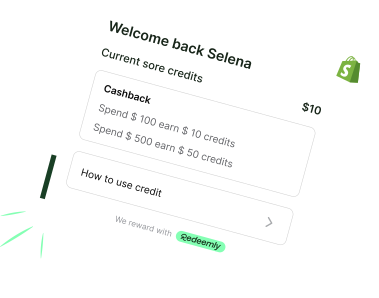
This screenshot from Redeemly's Shopify App Store page shows just how clean the experience can be for the customer. It's not buried in a complex dashboard; it's right there, showing their "Available credit" in clear monetary terms. This reinforces its cash-like value and makes it incredibly easy to apply at checkout.
From Service Recovery to VIP Treatment
The beauty of store credit is its versatility. It's a Swiss Army knife for building rock-solid customer relationships and boosting Lifetime Value (LTV).
Think about all the ways you can use it:
Customer Service Recovery: A parcel arrives damaged. Instead of a simple refund, you immediately issue an apology along with £15 in store credit. You’ve turned a negative experience into a positive one and practically guaranteed a future sale.
Rewarding VIPs: Identify your top 10% of customers by LTV and surprise them with a £25 store credit. This unexpected delight builds incredible goodwill.
Smarter Returns Management: When a customer returns an item, offer them a £50 refund or £55 in store credit. Many will choose the credit, keeping that revenue inside your business.
Each of these actions creates a recurring revenue loop. By consistently funnelling value back to your customers as store credit, you give them a powerful reason to shop with you again, building a base of high-LTV customers.
Building Your High-Impact Retention Programme
A killer retention strategy doesn't start when you're desperately trying to win back a lost customer. It begins the second they make their first purchase. Building a programme that works is about proactively building relationships that directly pump up your lifetime value (LTV) and average order value (AOV).
This is a complete mindset shift away from reactive, margin-killing discounts and confusing points systems. Instead, we're going to use the clear, tangible value of Shopify's native store credit to make customers feel seen every step of the way.
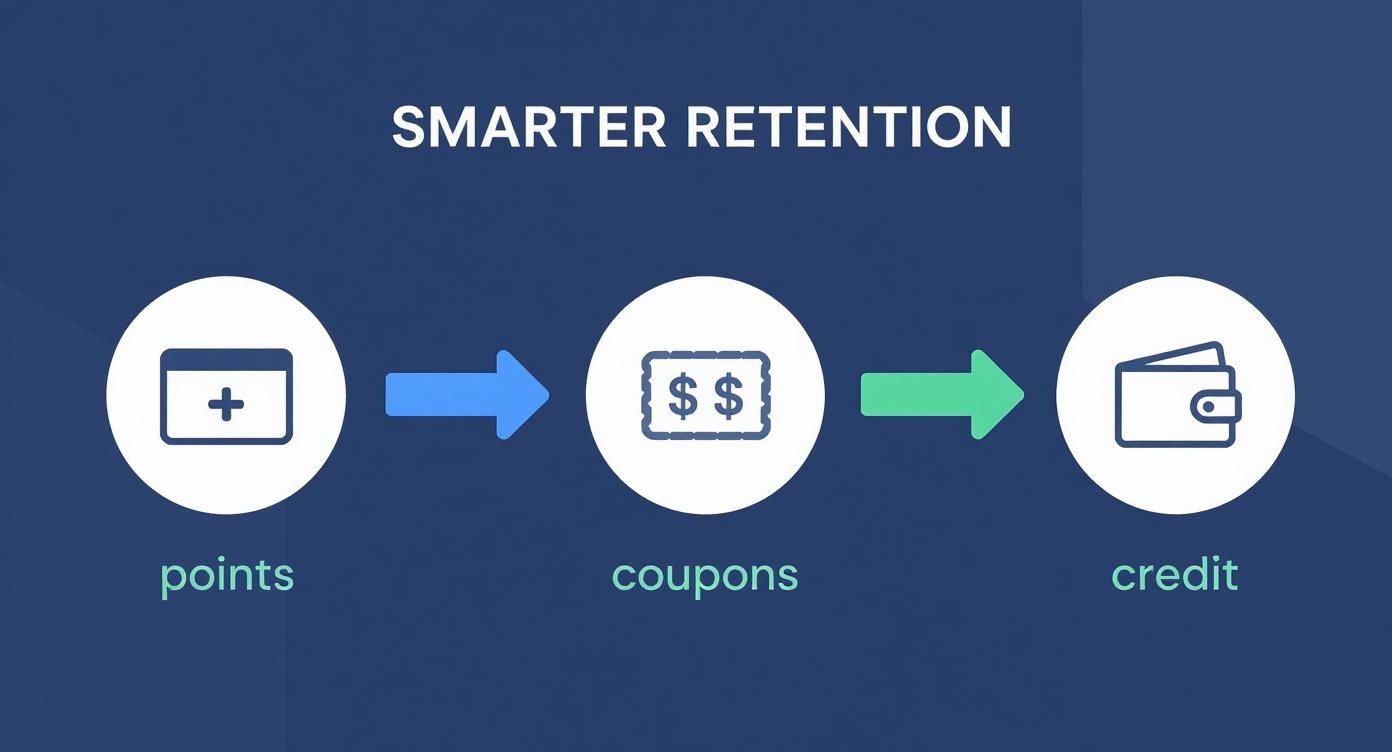
This simple flow shows how you can ditch confusing points and coupons for the clear, cash-like value of store credit—a much cleaner and more compelling experience that drives repeat purchases.
Crafting a Welcome Experience That Builds Bridges
Your welcome sequence is your best shot at a brilliant first impression. It's your moment to do more than just fire off a generic "10% off" email. Think about swapping that tired old discount for a small, no-strings-attached store credit.
The Old Way (Discount): "Here's 15% off your next purchase." This frames the relationship around price and encourages a deal-hunting mindset, immediately lowering the potential AOV of their second purchase.
The Smart Way (Store Credit): "Welcome! We've popped £5 into your account as a thank you." This feels like a genuine gift. It creates instant goodwill and gives them a reason to come back and browse, often leading them to spend far more than the credit amount, thus boosting AOV.
This tiny change is massive for LTV. A discount simply cuts into future revenue. A store credit is an investment that keeps cash circulating within your business and drives a higher AOV on that crucial second purchase.
Using Segmentation to Deliver Personalised Value
One-size-fits-all marketing is dead. To make customers feel appreciated, you need to understand who they are. This is where customer segmentation becomes your secret weapon for increasing LTV.
Start by breaking your customer base down into a few high-impact groups:
High-Spenders (Your VIPs): Customers with a consistently high AOV. They aren't chasing discounts; they value quality and exclusivity. Their LTV potential is enormous.
Frequent Shoppers: They keep coming back, building their LTV through repeat business. Their loyalty is built on convenience and a reliable experience.
At-Risk Customers: People who haven't bought from you in 90-120 days. A friendly nudge can reactivate them and preserve their potential LTV.
Once you have these segments, you can tailor your store credit strategy. A VIP might get a surprise £20 store credit. An at-risk customer might get a "We've missed you!" email with a £5 credit. This targeted approach is infinitely more effective than blasting everyone with the same discount code. If you want to go deeper, explore how retention marketing as a growth engine can change your business.
A segmented approach transforms your retention efforts from a generic broadcast into a series of personal conversations. It’s the difference between shouting into a crowd and whispering a thank you to an individual, and that’s what builds genuine, high-LTV relationships.
Creating Lifecycle Campaigns That Matter
With your segments sorted, you can build automated lifecycle campaigns that deliver the right message at the right time. These are designed to guide customers along their journey, adding value at key moments.
Imagine putting these scenarios on autopilot, powered by Shopify's native store credit:
The Post-Purchase Thank You: A week after their first order, they get an email saying, "Thanks for joining us! We've added £5 to your account for your next order." This reinforces their buying decision and kickstarts the repeat purchase cycle, boosting LTV from day one.
The Milestone Reward: When a customer makes their third purchase, an automation triggers a £10 store credit. This is a powerful way to reward their loyalty and increase their lifetime value.
The Churn Prevention Nudge: If a customer from your "Frequent Shoppers" group hasn't bought anything in 60 days, an automated email offers a small store credit.
Each of these campaigns strengthens customer relationships and drives up lifetime value. By consistently replacing discounts with store credit, you're building a cycle of appreciation that keeps your best customers engaged.
Using Data to Create Experiences Customers Love

If you want to genuinely improve customer retention, you have to create experiences that feel personal. This all comes down to digging into the data you already have and using it to give customers what they want. It’s the secret sauce that turns a simple transaction into a long-term, high-LTV relationship.
The goal is to get past broad assumptions and understand the individual. This allows you to personalize offers that drive up both your Average Order Value (AOV) and Lifetime Value (LTV).
Gathering Valuable First-Party Data
The most powerful data comes straight from your customers. The insights you pull from this are pure rocket fuel for personalisation that can drive up both AOV and LTV.
There are a few straightforward ways to start gathering this gold:
Purchase History: Don't just look at what they bought. Analyse frequency, categories, and spend. Is someone a frequent, low-AOV buyer or a rare, high-AOV shopper? Each needs a different approach to maximize their LTV.
On-Site Quizzes: A simple "Find Your Perfect..." quiz is a brilliant way to collect preference data. It's fun for them and invaluable for you.
Post-Purchase Surveys: A quick, one-question survey right after checkout can be incredibly revealing. Asking "What was the main reason for your purchase today?" helps you pinpoint the exact trigger.
This data isn’t for spreadsheets. It’s for building a living picture of each customer, allowing you to move beyond selling to a demographic and start selling to an individual.
Connecting Data to Action with Store Credit
Once you have these rich customer profiles, the magic begins. You can now launch hyper-relevant marketing and personalised rewards that feel less like a promotion and more like a thoughtful gesture. This is where a native Shopify store credit system absolutely shines.
Let's imagine a customer, Sarah. She’s bought dark roast coffee from you three times in the last six months.
The Discount Approach: You could send her a generic "15% OFF" email. Sure, she might use it, but it does nothing to build a relationship or increase her LTV. It's a purely transactional nudge that eats into your margin.
The Store Credit Approach: Instead, you send her an email: "A Sneak Peek, Just for You, Sarah." Inside, you tell her about an upcoming single-origin dark roast and, as a thank you, you've added £5 of store credit to her account for early access.
This small, targeted act of generosity does more for retention and LTV than a dozen discount campaigns ever could. It shows you know her, you value her, and you're giving her something exclusive. That is how you turn a repeat buyer into a true brand advocate.
This strategy works because it aligns your actions with your customer's behaviour. You’re not just rewarding a purchase; you’re rewarding their specific taste and demonstrating loyalty back to them.
Scaling Personalisation with Technology
This level of personalisation might sound complicated, but the technology is more accessible than ever. Retailers are increasingly using data analytics to deepen customer engagement. The explosion of smartphones has made mobile apps a central part of modern loyalty programmes, which is a major trend. You can discover more about loyalty programme trends in the UK market and see for yourself how technology is shaping customer expectations.
By using your first-party data to power a store credit-based rewards system, you create a powerful cycle. The more a customer shops, the more you learn. The more you learn, the better you can personalise their experience, encouraging them to shop even more and maximizing their LTV.
Measuring What Actually Moves the Needle
https://www.youtube.com/embed/BVbHbNgY358
So, you’ve ditched confusing discounts in favour of genuinely valuable store credit. But how do you know it’s actually working? Without measuring your success, you’re just flying blind. It's time to zoom in on the numbers that have a direct impact on your bottom line.
Focusing on the right Key Performance Indicators (KPIs) is fundamental to improving your customer retention rate because it’s the only way to make decisions based on facts. This is about understanding the true health and long-term viability of your business.
Lifetime Value vs. Average Order Value: The Big Showdown
Two of the most critical metrics you need to live and breathe are Customer Lifetime Value (LTV) and Average Order Value (AOV). They paint very different pictures of your retention efforts.
Average Order Value (AOV) is just a snapshot of a single transaction. A strategy heavy on discounts often massacres your AOV.
Customer Lifetime Value (LTV) is the whole feature film. It measures the total revenue a customer generates throughout their entire relationship with your brand.
A smart store credit strategy is designed to boost both, but its real power lies in dramatically increasing LTV. An AOV-obsessed mindset might push you towards endless flash sales, but an LTV-focused approach forces you to build lasting relationships that pay dividends for years.
Think of it like this: a high AOV is great, but if that customer never comes back, their LTV is identical to their AOV. A truly healthy business is built on customers whose LTV is many multiples of their AOV, and that only happens through repeat purchases.
A Shopify-native store credit programme is a direct investment in LTV. Issuing a £10 store credit might prompt a £60 purchase (a healthy AOV), but more importantly, it gives that customer a compelling reason to come back a third, fourth, and fifth time, multiplying their LTV.
The Key Metrics to Watch
Beyond LTV and AOV, a few other crucial metrics will give you the full picture. Let’s compare the old way (discounts) with the new opportunity (native store credit) and see how they stack up.
Metric | The Impact of Discount Vouchers | The Impact of Shopify Native Store Credit |
|---|---|---|
Repeat Purchase Rate | Attracts one-off deal hunters, often leading to a lower repeat purchase rate from these groups. | Directly encourages return visits as the credit feels like cash that needs to be spent, boosting this rate. |
Customer Churn | Can increase churn among your best customers who feel alienated or trained to wait for sales. | Reduces churn by creating an ongoing sense of value and rewarding loyalty, making customers feel appreciated. |
Profit Margin | Directly eats into your margins on every single transaction, forcing you to sell more just to stay afloat. | Protects margins by encouraging full-price purchases, with the credit acting as a bonus, not a discount. |
By consistently tracking these KPIs, you can see exactly how your shift from discounts to store credit is impacting revenue, customer loyalty, and, ultimately, your profitability and LTV. This data-driven approach separates the brands that struggle from those that build sustainable, long-term growth.
Got Questions About Store Credit? We’ve Got Answers.
Making the switch from discounts and points systems to a store credit programme can feel like a big move. You're probably wondering how it works and—most importantly—how your customers will react. Let’s tackle those common questions head-on.
This isn’t just about swapping one tactic for another. It’s about completely rethinking how you build lasting customer loyalty and increase LTV.
“Is Setting Up a Store Credit Programme a Huge Hassle?”
This is a huge myth. Unlike fiddly points systems that often confuse customers, a native store credit setup is built to run on autopilot. With Shopify's built-in features and apps designed for this exact purpose, it's surprisingly simple.
You set it up once, and it just works:
Loyalty Rewards: Automatically give credit to customers when they hit certain spending goals.
Painless Returns: Make store credit an easy, one-click return option, keeping cash in your business.
Customer Service Fixes: Empower your team to solve problems on the spot by issuing credit.
This automation frees up your team to focus on building genuine relationships with your customers, not managing a complex points ledger.
“But How Does Store Credit Actually Increase LTV and AOV?”
This is where you see the real difference between store credit and old-school discounts. A discount is a one-off hit to your revenue that conditions customers to wait for the next sale. Store credit, on the other hand, is a direct investment in a future purchase, serving as a powerful engine for driving up both Lifetime Value (LTV) and Average Order Value (AOV).
Here's a simple comparison:
Metric | A 15% Discount Voucher | A £15 Store Credit Reward |
|---|---|---|
AOV Impact | This usually leads to smaller baskets. A customer might buy a £50 item for £42.50, pocket the savings, and leave. | This encourages a bigger spend. With £15 already in their account, that same customer is far more likely to go for an £80 item, because it feels like they're only paying £65. |
LTV Impact | You're building loyalty to the deal, not the brand. It’s a purely transactional relationship that rarely leads to repeat business at full price, capping LTV. | You're creating reciprocity. The credit feels like a gift, building goodwill and giving them a concrete reason to come back, which directly increases LTV. |
The psychology here is everything. A discount feels like you're taking away from the price. Store credit feels like you're adding to the customer's wallet—it becomes an asset they can only use with you, which is fundamental for LTV growth.
“Can I Use Store Credit for More Than Just Loyalty Rewards?”
Absolutely! That’s the real beauty of it. Thinking of store credit as just a loyalty tool is like using a smartphone just to make calls. It’s a strategic lever you can pull to build a healthier, more profitable business from multiple angles.
For example, you can use it for:
Customer Service Recovery: A shipment is delayed. An apology is good, but an apology with instant store credit turns a potential one-star review into a five-star experience.
Targeted Marketing: Win back customers who haven't shopped in a while with a small "we miss you" credit, preserving their potential LTV.
Smarter Returns Management: By offering a little extra value in store credit over a straight cash refund, you encourage customers to exchange rather than exit, keeping that revenue locked in.
Notice the pattern? Each of these actions doesn't just solve an immediate problem; it plants the seed for the next purchase. It builds a sustainable loop of repeat business in a way that discount coupons and confusing point systems just can't compete with.
Ready to see how a native store credit system can transform your retention strategy and boost your bottom line? With Redeemly, you can automate your rewards, protect your margins, and turn more first-time buyers into lifelong fans. Discover how Redeemly can work for your Shopify store.


Join 7000+ brands using our apps