7 Examples of Loyalty Programs Built to Boost LTV in 2025
Dec 6, 2025
|
Published

For years, ecommerce brands have been trapped in a cycle of endless discounts and confusing points systems, often sacrificing profit margins for the promise of customer retention. But what if the very tools you're using to build loyalty are actually eroding your bottom line and complicating the customer experience? This guide is for Shopify merchants who are ready to break free from the old model. We'll explore powerful examples of loyalty programs that genuinely drive growth, with a sharp focus on a simpler, more effective alternative: native store credit.
Instead of just listing options, we will dissect real-world programs to show you how they work, what they achieve, and how you can replicate their success. Our goal is to demonstrate why issuing cash-like store credit directly within your Shopify store is a superior strategy for boosting both lifetime value (LTV) and average order value (AOV). This approach creates a sustainable, margin-friendly engine for repeat purchases without the customer confusion or devaluing effects of constant sales.
Each example in this listicle includes a detailed strategic breakdown, screenshots, direct links, and actionable takeaways you can implement immediately. We’ll compare different loyalty structures-from tiered VIP programs to gamified rewards-and show you how a store credit-centric model outperforms them. Beyond just program mechanics, understanding customer behavior is key; exploring effective loyalty lock-in strategies can provide a broader context for why certain incentives resonate more deeply with repeat buyers. Let's dive into the examples that will help you build a loyalty program that pays for itself.
1. Redeemly
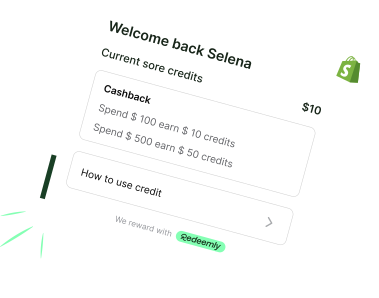
Redeemly presents a powerful and streamlined alternative to conventional loyalty programs, making it an exemplary choice for Shopify merchants focused on sustainable, margin-friendly growth. Instead of relying on margin-eroding discount codes or complex points-based systems, Redeemly leverages Shopify’s native store credit functionality. This approach centers on rewarding customers with cash-like store credit based on their spending, directly influencing key metrics like average order value (AOV) and customer lifetime value (LTV).

The platform is designed for direct-to-consumer (DTC) brands that want to move away from the "race to the bottom" created by perpetual discounting. By automatically issuing store credit as customers spend more, it creates a compelling incentive for shoppers to increase their cart size to unlock higher reward tiers. This store credit then acts as a powerful motivator for repeat purchases, pulling customers back to spend their earned balance.
Strategic Analysis: Store Credit as a Growth Lever
Redeemly’s core strength lies in its strategic use of store credit, which fundamentally shifts the economics of customer retention. Unlike a 10% discount that immediately reduces the margin on a sale, store credit only becomes a cost to the business when a customer returns to redeem it. This model protects unit economics on the initial purchase while simultaneously securing a future sale.
Key Insight: Store credit transforms a loyalty reward from a simple transaction discount into a forward-looking investment in customer retention. It effectively pre-funds a customer's next purchase, making a second or third order feel almost inevitable.
This approach is one of the cleanest examples of loyalty programs designed to directly impact AOV and LTV. The on-site floating wallets and widgets constantly remind shoppers of their available credit, creating a persistent, psychological nudge to return and shop again. This visibility eliminates the friction of remembering coupon codes or tracking points, making the reward feel tangible and immediately usable.
Key Features & Capabilities
Automated Store Credit Rewards: Customers automatically earn store credit based on spending thresholds, creating a clear and motivating incentive structure.
Shopify-Native Integration: Built directly on Shopify's Store Credit API, ensuring a lightweight, fast, and seamless experience without heavy scripts that slow down your site.
On-Site Wallet & Widgets: Visible reminders of earned credit are displayed across the store, keeping the reward top-of-mind and encouraging redemption.
AOV & LTV Focused: The entire system is engineered to encourage customers to spend more per session and return more frequently.
Simple, No-Friction UX: The customer experience is effortless. Credit is automatically applied at checkout, removing any confusion or barriers associated with points or tiers.
Actionable Takeaways for Merchants
For Shopify store owners and retention marketers, Redeemly offers a replicable strategy to enhance loyalty without sacrificing profit margins. The platform is particularly effective for brands seeking to cultivate a loyal customer base that isn't conditioned to wait for sales. Because it's built for Shopify, setup is remarkably fast, allowing merchants to launch a sophisticated, margin-friendly loyalty program quickly.
While public information on pricing and specific case studies is not available on their website, contacting Redeemly for a demo is the next step to see its ROI potential. This Shopify-exclusive focus is its main limitation, as it isn’t a solution for brands on other ecommerce platforms. However, for those in the Shopify ecosystem, Redeemly is a standout example of a modern, effective loyalty program.
Website: https://redeemly.ai
2. Shopify App Store – Loyalty & Rewards category
While not a single loyalty program, the Shopify App Store's Loyalty & Rewards category is an indispensable resource for any merchant exploring examples of loyalty programs in the real world. Think of it as a comprehensive, living catalog where you can browse, compare, and test-drive hundreds of solutions, from complex tiered systems to lightweight, native Shopify store credit platforms. This marketplace is the first step for many brands moving away from margin-cutting discounts and confusing points systems toward more sustainable, value-driven retention strategies.

The primary value here is transparency and choice. Instead of committing to one provider after a sales demo, merchants can directly compare pricing, features, and honest reviews from thousands of other store owners. This competitive landscape forces app developers to innovate, offering features that directly address key DTC metrics like lifetime value (LTV) and average order value (AOV).
Strategic Analysis: A Proving Ground for Retention Tactics
The Shopify App Store is more than a directory; it's a strategic tool for market research. You can filter by program type, install apps with free trials, and see firsthand how they integrate into your store's workflow and customer experience. This hands-on approach de-risks the decision-making process.
Key Strategic Insight: By leveraging the App Store, you can quickly pivot your retention strategy. If a complex points-based system proves too cumbersome for your customers, you can easily uninstall it and test a simpler, more intuitive store credit solution that feels native to the Shopify checkout experience.
Replicable Strategies & Key Takeaways
For Shopify merchants, this platform is the ultimate starting point for building a high-impact loyalty program.
Filter for Your Goals: Use filters to find apps specifically designed to boost AOV or LTV. Look for those emphasizing store credit, cash-back rewards, or members-only perks that encourage larger, more frequent purchases.
Vet with Real Reviews: Pay close attention to reviews that mention customer support quality, app speed impact, and ease of use for both the merchant and the end customer. A powerful app with a poor user interface won't drive engagement.
Test with Free Trials: Install two or three top contenders in a development store to compare their dashboards, customization options, and overall feel before committing.
Explore Beyond Points: Many modern apps are focusing on simpler, more effective models. For more information on this approach, explore the benefits of a native Shopify store credit program.
When exploring the diverse offerings available in app stores for loyalty and rewards, a review of the best referral marketing software platforms can help identify suitable tools to complement your core retention strategy.
Website: https://apps.shopify.com/categories/marketing-and-conversion-customer-loyalty-loyalty-and-rewards
3. Smile.io
Smile.io is one of the most recognized platforms for launching traditional loyalty programs, making it a valuable case study for brands exploring common examples of loyalty programs. It offers a straightforward, self-serve solution for small to mid-market ecommerce businesses to quickly implement points-based rewards, referral marketing, and VIP tiers. While effective for initial engagement, this model represents the older, more complex approach that many Shopify brands are moving away from in favor of simpler, store-credit-based systems.
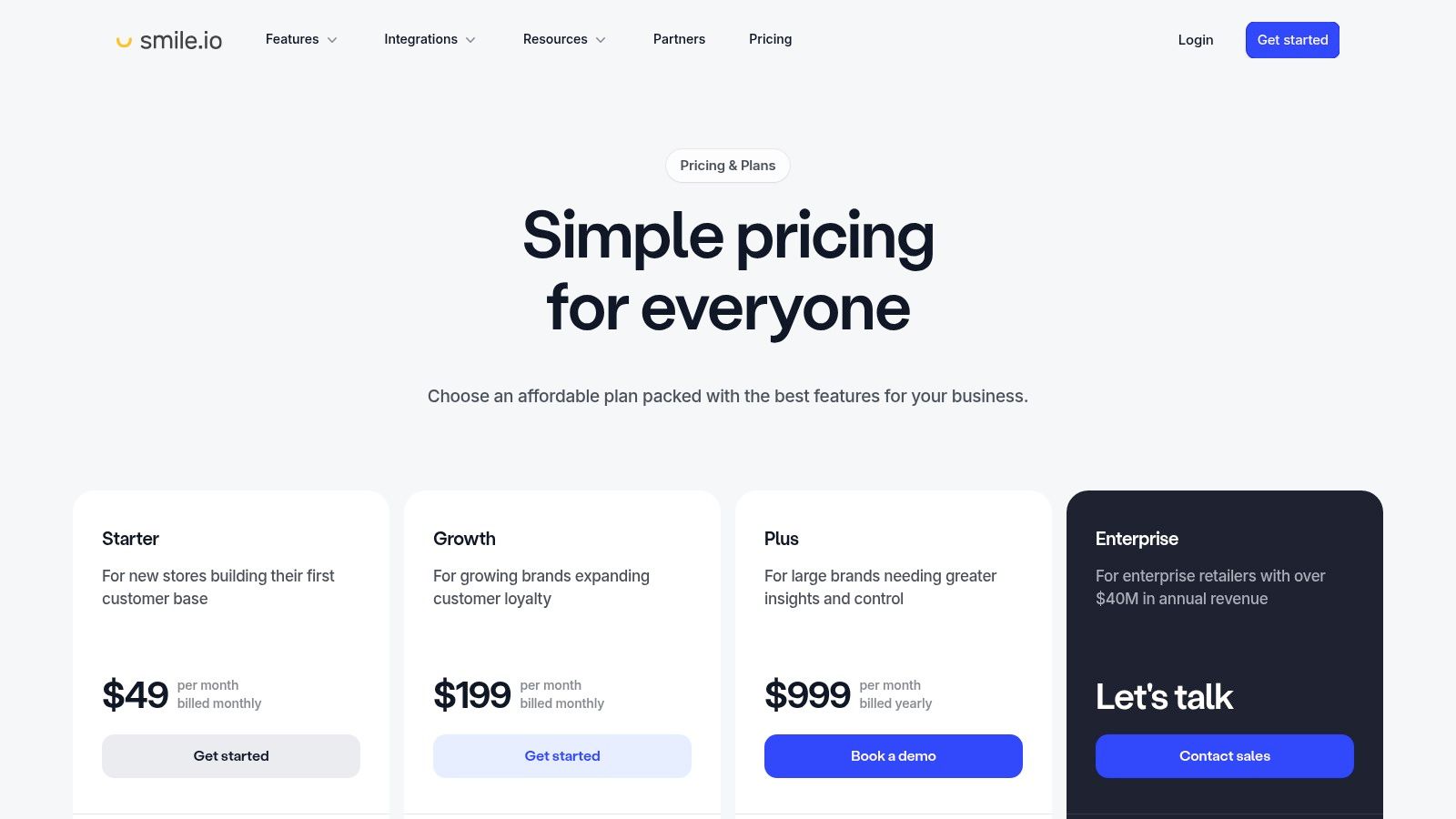
The platform is widely adopted due to its native integrations with Shopify, Wix, and BigCommerce, including Shopify POS support for omnichannel brands. Its core appeal lies in its quick setup and predictable pricing, including a free plan for new stores. This accessibility makes it a common starting point for merchants dipping their toes into customer retention beyond simple discounts.
Strategic Analysis: The Conventional Points Model
Smile.io excels at demonstrating the classic, gamified approach to loyalty. Customers complete actions like making a purchase, leaving a review, or following on social media to accumulate points, which are then exchanged for discount codes. This model is designed to drive engagement through a cycle of earning and burning rewards.
However, this conventional structure can sometimes create friction. The abstraction of points can be confusing for customers, and the reliance on discount-based redemptions can train shoppers to wait for coupons, potentially eroding profit margins. For brands focused on maximizing lifetime value (LTV) and average order value (AOV), this system might not be as effective as a direct, cash-back style store credit program that feels less like a discount game and more like a built-in benefit of shopping.
Key Strategic Insight: While Smile's points-and-tiers model is a proven tactic for initial engagement, it's crucial to analyze its impact on profit margins. A $10 off coupon redeemed via points directly reduces revenue, whereas a $10 store credit reward encourages a full-price repeat purchase, better protecting AOV and LTV.
Replicable Strategies & Key Takeaways
Smile.io serves as an excellent benchmark for understanding the mechanics of a points-based loyalty program.
Launch Quickly: Use Smile’s templates to rapidly deploy a standard loyalty widget and referral page. This allows you to gather baseline data on how your customers respond to points-based incentives.
Monitor Redemption vs. Margin: Pay close attention to the financial impact. Track how many points are redeemed for discounts and calculate whether the resulting repeat purchases offset the margin loss.
Evaluate the Customer Experience: Is the process of earning and redeeming points intuitive for your customers? Survey users or watch session recordings to see if there is any confusion that might hinder engagement.
Compare with Simpler Models: Consider how this approach stacks up against more direct rewards. Implementing a store credit-based system can simplify the customer journey and tie rewards more closely to actual spending power, a core tenet of effective retention marketing strategies.
Website: https://smile.io/pricing
4. Yotpo: Loyalty & Referrals (Shopify App)
Yotpo presents a powerful, enterprise-grade approach for brands seeking comprehensive examples of loyalty programs that extend beyond simple points systems. It offers a unified platform where loyalty, referrals, reviews, SMS, and email marketing work together. This integration is Yotpo’s core value proposition, allowing merchants to build a cohesive retention engine where customer actions in one area, like writing a review, can trigger rewards in another. This synergy helps drive higher lifetime value (LTV) by engaging customers across multiple touchpoints within a single ecosystem.
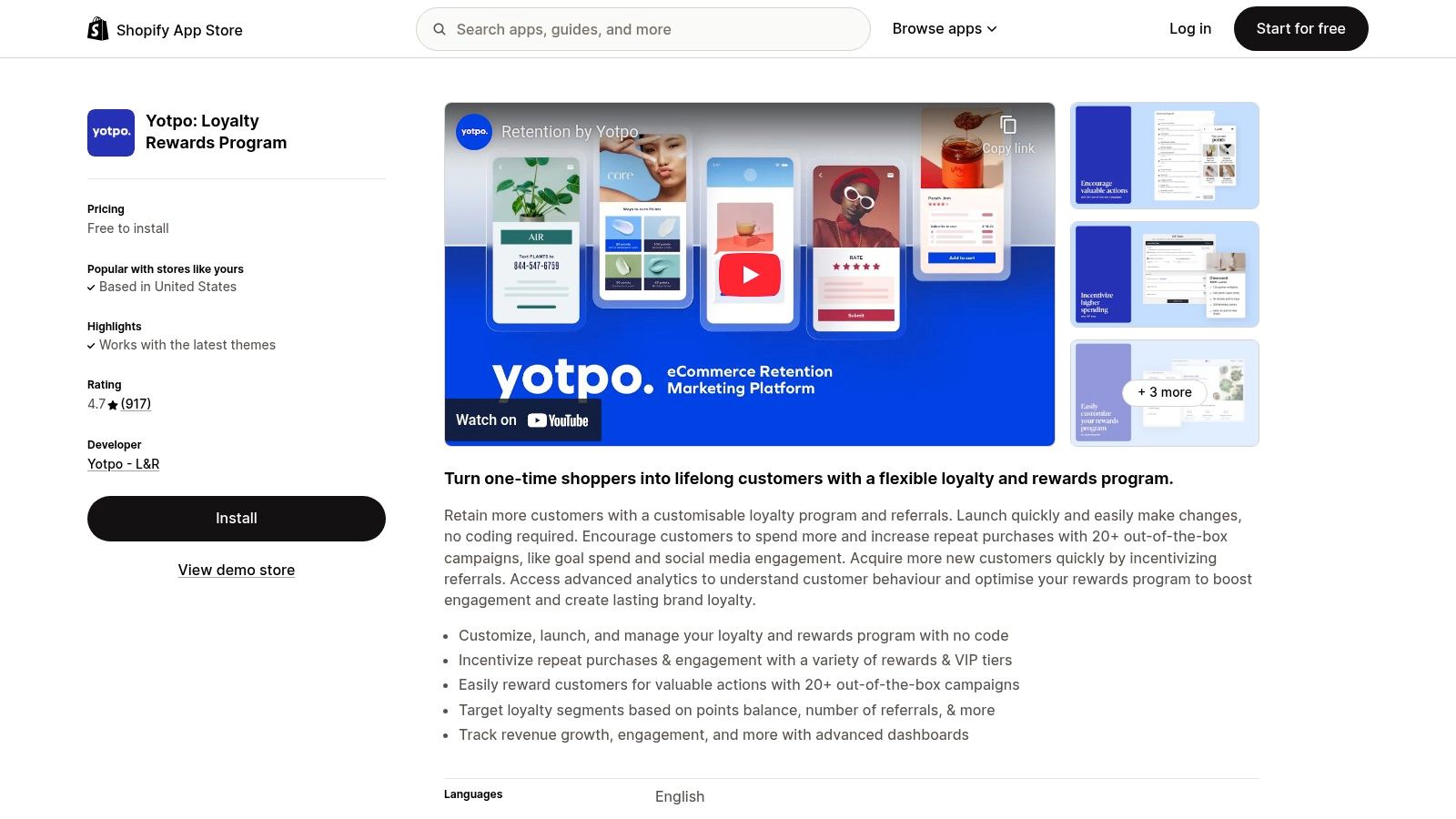
Unlike standalone apps, Yotpo is designed for brands scaling their retention marketing. The Shopify App listing provides transparent pricing tiers based on monthly order volume, making it clear how costs will evolve as a store grows. Merchants can analyze features like VIP tiers, advanced point-earning rules, and deep integrations with platforms like Klaviyo and Shopify POS directly from the listing. This allows for a thorough evaluation of how the system can support complex strategies aimed at increasing average order value (AOV) and repeat purchase rates.
Strategic Analysis: The Power of an Integrated Ecosystem
Yotpo’s strength lies in its ability to connect disparate marketing channels into a single, loyalty-driven experience. A customer can earn points for leaving a product review, receive a VIP tier upgrade notification via SMS, and redeem rewards directly at checkout. This creates a seamless journey that continuously reinforces brand engagement. This integrated model contrasts with simpler, native store credit solutions that focus purely on a frictionless checkout incentive.
Key Strategic Insight: By linking loyalty to user-generated content (reviews) and communication channels (SMS/email), you create a powerful flywheel. Positive reviews build social proof and drive sales, while the points awarded for those reviews encourage repeat purchases, directly boosting LTV.
Replicable Strategies & Key Takeaways
For merchants evaluating a multi-channel retention strategy, Yotpo provides a robust framework.
Unify Customer Actions: Reward customers for more than just purchases. Use Yotpo to grant points for creating an account, leaving a review, or engaging on social media to build a more holistic and engaged community.
Segment with VIP Tiers: Implement tiered rewards to make your best customers feel valued. Offer exclusive perks, early access to sales, or higher point multipliers to incentivize larger and more frequent orders, directly impacting AOV.
Leverage Integration: Connect Yotpo with your email and SMS platforms to run targeted campaigns. Announce double-points weekends or exclusive tier-based offers to drive traffic and sales during specific periods.
Evaluate Total Cost of Ownership: While the ecosystem is powerful, consider the cumulative cost of Yotpo’s modules. For brands focused solely on a lightweight, margin-friendly reward system, a dedicated native Shopify store credit program might offer a more cost-effective solution with a simpler customer experience.
Website: https://apps.shopify.com/swell
5. LoyaltyLion
LoyaltyLion is a specialist data-driven loyalty and engagement platform designed for fast-growing ecommerce brands. It moves beyond simple point systems to provide merchants with the tools to create sophisticated, tiered loyalty programs that are deeply integrated into the customer lifecycle. For brands seeking examples of loyalty programs that are highly configurable and focused on customer behavior, LoyaltyLion serves as a powerful case study in strategic retention. It is built for merchants who want to increase customer lifetime value (LTV) and reward more than just transactions.
The platform’s core strength lies in its flexibility. Merchants can use pre-built earning rules to reward customers for a wide range of actions like social media follows, reviews, and birthdays, not just purchases. This comprehensive approach helps build an emotional connection and keeps the brand top-of-mind, driving engagement between orders and fostering a community around the brand.
Strategic Analysis: Rewarding Engagement, Not Just Transactions
LoyaltyLion excels by allowing brands to design a program that reflects their unique identity and customer base. The ability to create branded loyalty pages and VIP tiers makes the program feel like an exclusive club, rather than a generic add-on. Its deep integrations, particularly with email platforms like Klaviyo, enable hyper-personalized marketing campaigns based on loyalty data, such as a customer's tier or points balance. This allows for targeted efforts to increase average order value (AOV) and encourage repeat purchases.
Key Strategic Insight: By rewarding non-transactional behaviors, you train customers to engage with your brand more frequently. This builds a stronger emotional connection and significantly increases the likelihood of future purchases, turning one-time buyers into long-term advocates.
Replicable Strategies & Key Takeaways
For merchants ready to invest in a more advanced loyalty strategy, LoyaltyLion provides a robust framework for growth.
Implement Tiered VIP Programs: Structure your program with escalating rewards. Offer exclusive perks like early access to sales or free shipping to top-tier members to incentivize higher spending and brand loyalty.
Leverage Deep Integrations: Connect LoyaltyLion with your email service provider to create automated campaigns. Send targeted emails to customers nearing a new reward tier or remind them of their points balance to encourage a return visit.
Go Beyond Purchase Rewards: Set up earning rules for writing reviews, referring friends, or following on social media. This not only boosts engagement but also generates valuable user-generated content and social proof.
Focus on Key Metrics: Use the platform’s analytics to track the impact on core business goals. For a deeper understanding of how these programs contribute to long-term success, it is essential to learn how to calculate customer LTV.
Website: https://loyaltylion.com/pricing
6. Square Loyalty
For merchants operating in both the physical and digital realms, particularly those in food and beverage, retail, and services, Square Loyalty offers one of the most seamless examples of loyalty programs available. It's a turnkey solution built directly into the Square POS and Square Online ecosystem. This tight integration removes the friction often associated with launching a loyalty program, allowing businesses to enroll customers directly at checkout with just a phone number and automate rewards through SMS updates. The focus is on speed and simplicity, making it an ideal choice for businesses that need to get a program running without extensive technical setup.
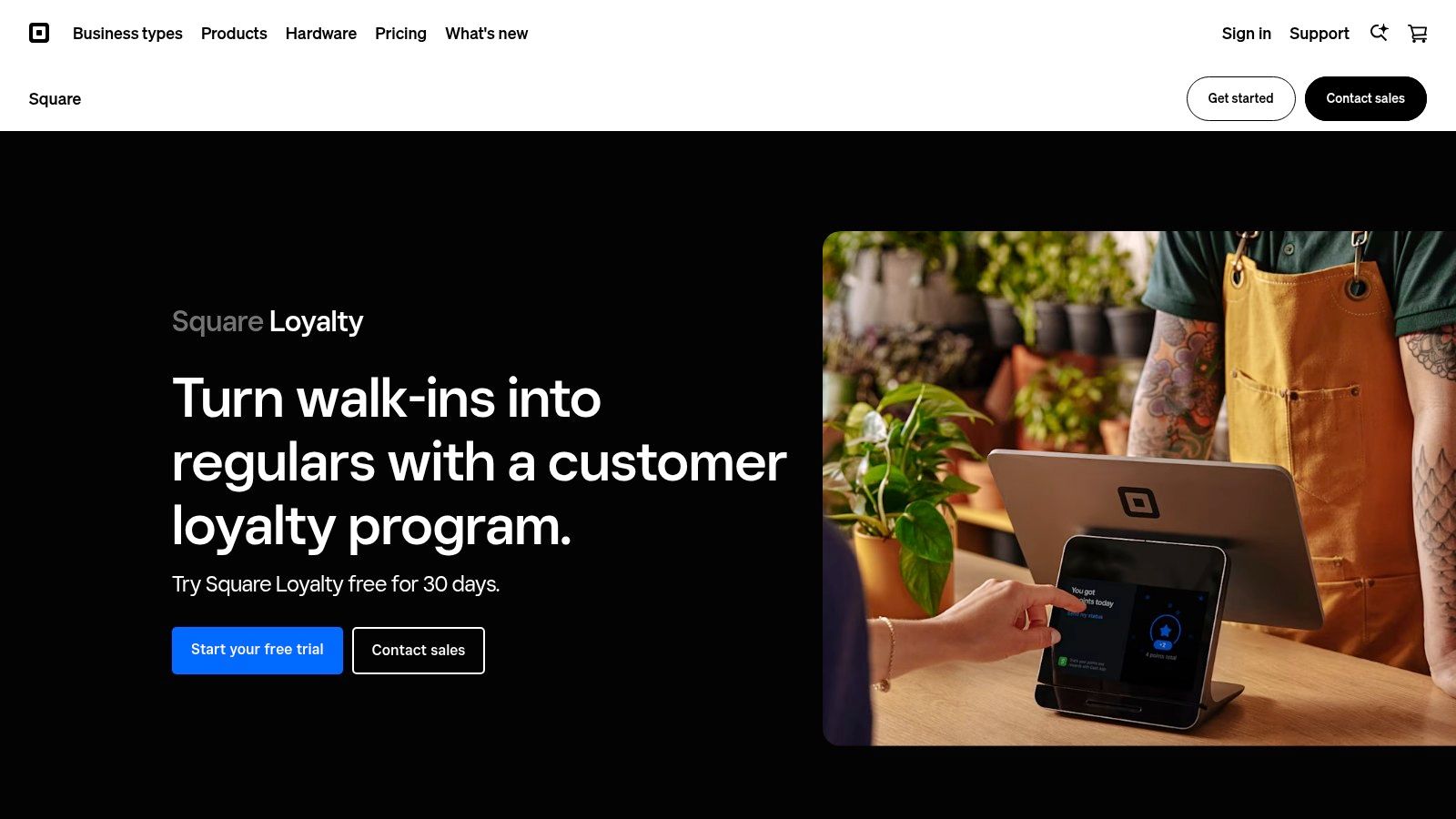
The core strength of Square Loyalty lies in its accessibility. Instead of requiring customers to download an app or remember a physical card, the program is tied to their phone number. This low-barrier approach encourages high adoption rates at the point of sale, which is crucial for brick-and-mortar businesses looking to increase visit frequency and average order value (AOV) from their local customer base. Pricing is also aligned with usage, scaling based on the number of loyalty visits, which makes it a cost-effective option for growing businesses.
Strategic Analysis: Bridging In-Person and Online Retention
Square's platform excels at creating a unified customer profile across in-person and online channels. A customer who signs up at your cafe's register can earn and redeem rewards on your Square Online store, and vice versa. This omnichannel capability is critical for building a holistic view of customer behavior and maximizing lifetime value (LTV). By tracking every interaction, merchants can move beyond simple transaction-based rewards toward a more integrated retention strategy.
Key Strategic Insight: The true power of Square Loyalty is its ability to convert a one-time, in-person transaction into a long-term digital relationship. Capturing a phone number at the POS isn't just for loyalty; it opens the door for SMS marketing and creates a customer profile that can be nurtured online, significantly boosting LTV.
Replicable Strategies & Key Takeaways
For businesses already using or considering the Square ecosystem, implementing their loyalty program is a straightforward way to drive repeat business.
Set Rewards to Boost AOV: Configure your program based on spend rather than visits. For example, offer a reward after a customer spends $100. This directly incentivizes customers to add more items to their cart during each transaction to reach the reward threshold faster.
Leverage Checkout Enrollment: Train staff to make loyalty enrollment a standard part of the checkout process. A simple prompt like, "Want to earn rewards on today's purchase? All I need is your phone number," can dramatically increase sign-ups.
Unify Your Customer Data: If you run both a physical store and a Square Online site, actively promote your loyalty program across both. Ensure customers know their rewards are valid everywhere to encourage cross-channel purchasing.
Compare with App-Based Solutions: While Square is excellent for its ecosystem, Shopify merchants may find that a native store credit solution offers more flexibility and a better online-first experience. Unlike Square's point-based model, a Shopify store credit program often feels more like cash-back, which can be a more powerful motivator for increasing LTV without relying on discounts.
Website: https://squareup.com/loyalty
7. Paytronix
Paytronix serves as an enterprise-grade resource for studying sophisticated examples of loyalty programs, particularly within the restaurant and convenience store industries. While geared toward large, multi-location businesses, its platform showcases how to integrate loyalty with core operations like ordering, delivery, and payments. For DTC brands, Paytronix offers a blueprint for creating deeply embedded retention strategies that go far beyond simple points-for-purchase models, focusing on holistic customer engagement.
The platform is designed for businesses where frequency and AOV are paramount, such as a daily coffee run or a weekly fuel stop. It demonstrates how to leverage data to drive behavior with personalized offers, gamified challenges, and tiered rewards that are seamlessly integrated into a mobile app or digital wallet. While its direct application isn't for a typical Shopify store, the strategic thinking behind its features is highly relevant.
Strategic Analysis: Loyalty as a Core Business Function
Paytronix treats loyalty not as a bolt-on marketing tactic but as a central component of the business operating system. The platform’s strength lies in unifying customer data from multiple touchpoints (in-store, mobile order, delivery) to create a single, actionable customer profile. This approach enables highly personalized campaigns that drive specific KPIs, such as increasing visit frequency or encouraging the trial of new products.
Key Strategic Insight: True loyalty is achieved when the program feels like an inseparable part of the brand experience, not an afterthought. For Shopify merchants, this means exploring how store credit or exclusive perks can be woven into the entire customer journey, from post-purchase flows to customer service resolutions, making it a native element rather than a separate system.
Replicable Strategies & Key Takeaways
While you won't be implementing Paytronix on a Shopify store, you can adapt its enterprise-level strategies to boost lifetime value and average order value.
Integrate Loyalty with Core Operations: Consider how a native store credit system can be used beyond simple rewards. Use it for refunds, appeasements, or as a cash-back incentive on high-margin products to make it a versatile tool across your business.
Study Mobile-First Engagement: Analyze how Paytronix clients use their mobile apps to push notifications, present offers, and manage rewards. This can inspire your email and SMS marketing, creating a more cohesive and engaging communication strategy.
Segment for Personalization: Paytronix excels at using data to create targeted offers. Use your Shopify data to segment customers and offer personalized store credit bonuses based on their past purchase history or LTV, making them feel valued.
Go Beyond Transactions: Explore offering rewards for non-purchase activities, like social media shares or product reviews, similar to how enterprise systems drive engagement across multiple channels. This deepens the customer relationship beyond just the next sale.
Website: https://www.paytronix.com/pricing/
Top 7 Loyalty Program Platforms — Comparison
Item | Implementation 🔄 (complexity) | Resources ⚡ (time / cost / tech) | Expected outcomes 📊 (impact) | Ideal use cases 💡 | Key advantages ⭐ |
|---|---|---|---|---|---|
Redeemly | Low — Shopify-native, fast setup, minimal scripts | Low dev overhead; built on Shopify Store Credit; contact for pricing | Lifts AOV & repeat purchases; improves LTV; costs realized on redemption | Shopify DTC brands seeking margin-friendly loyalty | ⭐ Margin-friendly store credit; seamless UX; lightweight integration |
Shopify App Store – Loyalty & Rewards category | Low–Varies — browse/install plug‑and‑play apps; complexity depends on app chosen | Low initial time to test; vetting time for demos/reviews; many free trials | Discovery-driven: find tested apps and pricing; variable program impact | Merchants researching or trialing multiple loyalty options on Shopify | ⭐ Wide selection + transparent reviews/pricing; fast test/install |
Smile.io | Low — self-serve with templates and widgets | Low to medium; free plan available; higher tiers for analytics/API | Quick launch of points/referrals/VIP; predictable ROI for SMBs | SMBs and mid-market stores wanting standard loyalty quickly | ⭐ Fast setup, branded components, free starter plan |
Yotpo: Loyalty & Referrals (Shopify App) | Medium — enterprise-capable with integrations and rules | Medium–High; costs scale with volume/modules; requires admin work for migrations | Unified retention (loyalty + reviews + messaging); measurable lifecycle gains | Brands wanting integrated reviews, SMS/email and advanced earning rules | ⭐ Strong ecosystem integration; transparent app-tier pricing |
LoyaltyLion | Medium — configurable rules and onboarding-led setup | Medium–High; pricing scales by orders; advanced features on custom plans | Strategic control over loyalty; improved retention with performance reviews | Merchants needing flexible program design and deep integrations | ⭐ Purpose-built loyalty; flexible integrations and strategic services |
Square Loyalty | Very Low — turnkey if using Square POS/Online | Low; pricing scales by loyalty visits; U.S.-focused resources | Fast in-person launches; uplift in visits/spend for retail verticals | U.S. brick-and-mortar merchants (cafes, salons, small retailers) | ⭐ POS-integrated, very fast to launch; visit-based pricing |
Paytronix | High — enterprise implementation, demos, strategic design | High; sales engagement required; longer deployment and services | Enterprise-scale loyalty with robust analytics and CRM; multi-unit support | Large restaurant and convenience chains with multi-location needs | ⭐ Deep vertical specialization; scales to very large member bases |
Choose Simplicity and Profit: The Future of Loyalty is Store Credit
We've explored a diverse landscape of loyalty programs, from the point-based systems of Smile.io and LoyaltyLion to the tiered VIP structures and complex enterprise solutions like Paytronix. Analyzing these examples of loyalty programs reveals a powerful, unifying theme: complexity is the enemy of engagement, and direct value is the ultimate driver of repeat business.
While gamification and exclusive perks have their place, the fundamental goal for any Shopify merchant remains the same: increase customer lifetime value (LTV) and average order value (AOV) without sacrificing your profit margins. This is where the traditional loyalty model often falters. Points create cognitive load, requiring customers to perform mental math ("How many points is this worth? What can I get?"), and tiered systems can feel unattainable, alienating new shoppers instead of encouraging them.
The most profound takeaway from this analysis is that simplicity wins. The future of effective customer retention isn't about convoluted rules or endless reward options. It's about providing a clear, tangible, and immediate incentive that feels like cash in hand.
The Clear Advantage of a Store Credit Model
Store credit cuts through the noise. It replaces confusing points with a straightforward dollar value, an incentive every customer understands instantly. This model directly addresses the core challenges faced by DTC brands.
It Protects Your Margins: Instead of offering site-wide discounts that erode your profitability, store credit acts as a targeted incentive. It keeps revenue within your ecosystem, encouraging customers to return and spend more, directly boosting LTV.
It Increases AOV Naturally: When a customer has a $10 store credit balance, they are more likely to spend $60 to "unlock" its value on a $50 product. This psychological pull is a powerful, organic way to increase basket size without resorting to aggressive upselling.
It Simplifies the Customer Experience: No more charts, no more tiers, no more confusion. Customers see their credit, understand its value, and apply it at checkout. This frictionless experience fosters genuine appreciation and strengthens their connection to your brand.
By examining the various examples of loyalty programs, it becomes evident that while feature-rich apps like Yotpo or LoyaltyLion offer deep customization, they can introduce a level of complexity that undermines the core goal. For the majority of Shopify brands, the most profitable path is the simplest one.
Your Action Plan for Building a Profitable Loyalty Program
Moving forward, the choice isn't just about picking a tool; it's about adopting a strategy. Your loyalty program should be a profit center, not a cost center.
Audit Your Current Incentives: Are you heavily reliant on discount codes? Calculate the true cost of these promotions on your margins. This will reveal the financial upside of shifting to a store-credit model.
Prioritize Simplicity: Choose a solution that is effortless for both you and your customers. The ideal program should feel like a native part of the Shopify experience, not a bolted-on app that slows down your site or confuses your shoppers.
Focus on Key Metrics: Don't get lost in vanity metrics like "points earned." Concentrate on what truly matters: repeat purchase rate, customer lifetime value, and average order value. A store credit system makes tracking this ROI incredibly straightforward.
The most successful brands are those that build a loyal community by consistently delivering value. Shifting from a discount-driven mindset to a value-added, store-credit-based loyalty strategy is the most sustainable way to achieve this. It's a clear, powerful, and profitable approach to ensuring your best customers keep coming back for more.
Ready to replace confusing points and margin-killing discounts with a loyalty solution built for profit? Redeemly offers the simplest way to launch a native Shopify store credit program, helping you increase LTV and AOV from day one. See how our lightweight, powerful approach to loyalty compares to the other examples of loyalty programs by visiting Redeemly and starting your journey toward more profitable customer relationships.


Join 7000+ brands using our apps