Reimagining Tiered Loyalty Programs with Store Credit to Boost LTV
Jan 5, 2026
|
Published
Let's be honest: traditional tiered loyalty programs are often more trouble than they're worth. For many Shopify brands, these complex systems—built on confusing points and steep discounts—end up training customers to just wait for the next sale. This erodes profit margins and hurts long-term engagement. The high effort needed to manage them rarely pays off in a higher customer lifetime value (LTV) or average order value (AOV), which are the metrics that truly matter.
The Problem with Traditional Tiered Loyalty Programs
For years, the standard playbook for keeping customers coming back involved some kind of complicated tiered loyalty program. Brands would roll out these elaborate systems with fancy names like "Silver," "Gold," and "Platinum," rewarding customers with points they could eventually trade for discounts. The idea was solid—encourage repeat business—but for modern DTC brands, the execution often creates more headaches than it solves, especially when it comes to boosting LTV.
The real issue is the complexity. These programs force customers to do mental math, trying to figure out "points-to-dollar" conversions and keep track of abstract rewards. All that friction just leads to people tuning out. It's no surprise that while 83% of consumers are in at least one loyalty program, a whopping 72% use half or less of their memberships. That disconnect points directly to the complexity problem.
Why Points and Discounts Fail Shopify Merchants
The over-reliance on discounts is another huge flaw. When you're constantly dangling coupons as a reward, you inadvertently teach your best customers to never pay full price. This creates a vicious cycle of discounting that chews into your margins and devalues your products over time. You're not building genuine loyalty that increases lifetime value; you're just encouraging people to hunt for the next deal.
This old-school approach also hits your customer experience and operational efficiency in a few key ways:
App Bloat and Site Speed: Many traditional loyalty programs rely on clunky third-party apps that slow down your Shopify store. A slow site leads to a frustrating user experience and can tank your conversion rates.
Confusing Value Proposition: If a customer can't immediately see what their points are worth, the reward feels less valuable. That kills the incentive to spend more to reach the next tier and boost your AOV.
Low Impact on LTV: A one-time discount doesn't do much to guarantee the next purchase. These programs often fail to meaningfully increase customer lifetime value (LTV), which is the whole point of a retention strategy.
The fundamental flaw of point-based systems is that they add a layer of abstraction between a customer’s spending and their reward. A dollar in Shopify native store credit is simple, valuable, and directly motivates the next purchase; a point is just a number that needs translation.
Understanding powerful customer retention marketing tactics is crucial for any brand that wants to build lasting customer relationships. But the old models just aren't cutting it. They demand too much effort for very little return on key metrics like lifetime value. For Shopify brands trying to grow sustainably, it’s time for a simpler, more effective alternative that protects margins while actually driving the repeat business that builds true brand affinity.
Using Store Credit as a Simplified Tiering System
Forget adding another layer of complexity with points and formal tiers. What if you could get better results with a system that’s simpler and far more intuitive? This is exactly where using native Shopify store credit comes into play. It’s a powerful alternative that builds a natural, "invisible" tier structure without ever confusing your customers. The model is beautifully straightforward and aligns perfectly with your core business goals: increasing lifetime value and average order value.
The whole idea is simple: the more a customer spends, the more store credit they get back. This spend-based reward system directly encourages a higher Average Order Value (AOV) because shoppers can see a tangible, cash-like reward waiting for them at the next spending threshold. It completely changes the loyalty experience from a game of collecting points into a clear financial incentive that drives immediate revenue.
Why Store Credit Feels More Valuable
Unlike points, which often require mental gymnastics to figure out their actual worth, store credit is immediately understood. A $10 store credit reward feels exactly like $10 in cash sitting in the customer’s account. That clarity is a huge motivator. When a reward is easy to grasp, it feels more valuable and is far more likely to influence purchasing behavior, leading to higher AOV.
This approach creates a powerful cycle that drives up customer Lifetime Value (LTV). The credit earned from one purchase becomes a direct reason to make the next one, pulling customers right back to your store. Because the reward is already in their account, it removes the friction of making that repeat purchase, helping turn one-time buyers into loyal, long-term customers. For any merchant serious about sustainable growth, understanding the benefits of native Shopify store credit is the first step toward building a much more profitable retention strategy focused on LTV.
Protecting Margins While Driving Repeat Purchases
One of the biggest wins for store credit over traditional discounts is its impact on your profit margins. A discount is an immediate, irreversible loss of revenue on the current sale. Store credit, on the other hand, is a balance sheet liability that only becomes a cost when a customer returns to redeem it on a future purchase—a purchase that boosts their lifetime value and probably wouldn't have happened otherwise.
A discount trains customers to devalue your product, while Shopify native store credit invests in their next purchase. This fundamental shift protects your margins today while securing profitable revenue that increases customer LTV.
This margin-safe model is absolutely critical for your long-term financial health. You get to reward your best customers without torching your profitability. Instead of just giving away revenue, you are strategically reinvesting it into future sales, which is a far more sustainable way to grow LTV.
Modern shoppers are ready for this value-driven approach. In fact, a staggering 74% of consumers agree they would engage more with brands offering different tiers based on how much they spend annually. Better yet, companies with tiered loyalty programs report a 1.8x higher return on investment compared to those with basic, flat-structure programs. This proves the financial upside of treating your high-value customers differently. You can discover more loyalty program statistics and insights on ebbo.com.
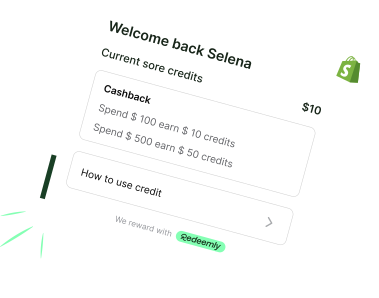
This screenshot from Redeemly, a native Shopify app, shows just how easily merchants can set up spend-based rules like "Spend $100, Get $10 in store credit."
The interface makes it incredibly simple to create these "invisible tiers," ensuring the system is both powerful for your business and completely effortless for your customers.
Comparing Loyalty Models: Store Credit vs. Points
When you’re mapping out a tiered loyalty program, the most important decision you'll make isn't about clever tier names. It’s about the reward itself. For years, points have been the default, but there's a simpler, more potent alternative: using native Shopify store credit. This one choice changes everything—the customer experience, your profit margins, and the real impact on lifetime value (LTV).
To figure out which model actually grows your business, let's dig into how each approach stacks up against the metrics that truly matter for a Shopify brand: boosting Average Order Value (AOV), protecting profit margins, and creating a customer experience that feels genuinely rewarding. The difference is night and day, and it shows why store credit is the most direct route to building LTV.
This decision tree shows just how simple a store credit system feels from the customer's side.
The path is incredibly straightforward. A customer’s spending turns directly into a cash-like reward they can use, wiping out the all-too-common confusion of point conversions.
Customer Experience and Perceived Value
The first big gut check is clarity. Point-based systems make customers do math. Is 500 points worth $5 or $10? That hesitation cheapens the reward and makes it feel distant. Shoppers aren't motivated to change their buying habits for a reward they can't immediately grasp.
Store credit, on the other hand, is dead simple. A $10 credit is understood by everyone as $10 in cash waiting for them. That clarity makes the reward feel more valuable and real, creating a much stronger pull for a future purchase. This same idea holds true for powerful referral program incentives, including credits; simple, cash-like rewards just work better because they don't ask the customer to think.
A discount is an immediate hit to your margin. Store credit is a balance sheet liability that brings a customer back for another—often larger—purchase, directly boosting their lifetime value.
This is a critical distinction. A points program that doles out a 20% off coupon as a top-tier reward is literally throwing away margin on that sale. With store credit, you only incur the cost when a customer comes back to spend it, locking in the repeat purchase that is the lifeblood of LTV growth.
Impact on Key Business Metrics
Your choice between points and store credit directly impacts your store's bottom line. Think about it: traditional points programs often lean on discounts, which inadvertently trains your best customers to hold out for a sale. You're conditioning them to see your products as worth less than full price, which is a dangerous game to play for your brand's long-term health.
A native Shopify store credit system works in the opposite direction. It nudges customers to add more to their cart to hit the next reward threshold (e.g., "Spend $100, Get $10"). That behavior directly lifts your AOV. Then, that earned credit becomes a powerful magnet, pulling them back for a second, third, or fourth purchase. This is the engine that drives repeat purchase rates and, ultimately, LTV. It's the core strategy behind modern loyalty programs for customer retention built for long-term profit.
To see how these two models truly differ in practice, let's put them head-to-head on the goals that matter most.
Loyalty Program Model Comparison: Points vs. Store Credit
Business Goal | Traditional Points & Tiers | Native Store Credit System | Recommendation |
|---|---|---|---|
Average Order Value (AOV) | Tries to influence AOV with complex tier goals that can confuse customers. | Directly increases AOV as customers add items to hit clear spending thresholds for credit rewards. | Store credit provides a much clearer, more direct path to increasing cart size. |
Profit Margin | Damaged by heavy reliance on discounts, which are immediate revenue losses. | Protected. Credit is a liability that encourages a future, full-margin purchase, often with additional spend. | Store credit is the clear winner for protecting and even enhancing long-term profitability. |
Customer Experience (CX) | Often confusing. Customers have to calculate point values and track abstract balances. | Simple and intuitive. Credit feels like cash in their account, displayed in their local currency. | For a frictionless experience, nothing beats the clarity of a dollar value. |
Customer Lifetime Value (LTV) | Can work, but is often held back by customers abandoning the program due to complexity. | Directly boosts LTV by creating a powerful, built-in reason for customers to return again and again. | Store credit creates a natural, compelling "buy again" loop that is the essence of LTV growth. |
The table makes it clear: while points can work, a store credit system is engineered to more directly and effectively drive the key metrics that signal a healthy, growing ecommerce business.
Implementation and Simplicity
Finally, let’s talk about the technical side. Point-based loyalty programs usually mean bolting on a complex third-party app. These apps can slow down your site and cause integration headaches. It’s another thing to manage.
A native Shopify store credit system, in contrast, is wonderfully lean. It uses Shopify’s core functionality, so you know it's fast, secure, and perfectly woven into the checkout experience. That simplicity is a win-win: it's easier for you to run and creates a seamless experience for your customer. And that frictionless experience is what keeps people engaged and drives the repeat business that defines true loyalty and LTV.
Designing a Store Credit Program That Actually Boosts LTV
Switching from a clunky, points-based system to a streamlined store credit model can be a game-changer for your LTV. The real goal isn't just handing out rewards; it's about building a profit engine that drives up both Average Order Value (AOV) and your repeat purchase rate. A great program feels like a natural perk to your customers, all while nudging them toward behaviors that grow your bottom line.
At the heart of this strategy is setting spending thresholds that are both compelling and reachable. You’re looking for that magic number where a customer thinks, "I should add one more thing to my cart to get that credit." This isn't guesswork—it requires a quick look at your own store's data to find a balance that’s profitable for you and motivating for them.
Setting Profitable Spend Thresholds
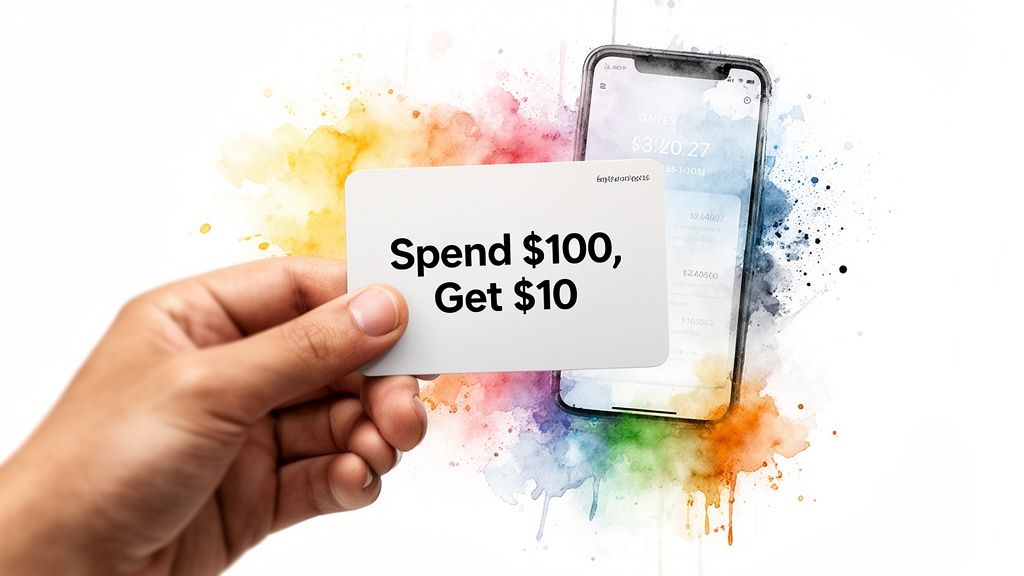
The beauty of a store credit program is in its simplicity. An offer like "Spend $100, Get $10" is instantly understood and incredibly powerful for boosting AOV. To figure out the right numbers for your brand, start by calculating your current AOV. Your first spending goal should be set just a bit higher than that—usually around 15-20% more—to give shoppers a clear reason to bump up their cart size.
Let's say your AOV is $85. Setting your first reward tier at $100 is a perfect starting point. It feels within reach and gives customers hovering around that amount a little push to spend more. This is a classic example of the goal-gradient effect in action: the closer people get to a reward, the more motivated they become to achieve it.
Your goal isn't to create massive hurdles. It's to build small, encouraging steps that guide customers toward spending more on each order, which naturally increases their lifetime value over time.
Once you’ve locked in that first tier, you can build out a few more for your top customers. This creates a kind of "invisible tiering" that makes store credit so effective without the formal program overhead. For example:
Tier 1: Spend $100, get $10 in store credit (10% back)
Tier 2: Spend $200, get $25 in store credit (12.5% back)
Tier 3: Spend $350, get $50 in store credit (~14% back)
This structure naturally gives your biggest spenders a better "cash back" rate, reinforcing their loyalty and maximizing their LTV without the baggage of managing official VIP levels.
Communicating Value Across the Customer Journey
Even the most brilliant program will fall flat if nobody knows about it. You have to weave communication seamlessly into the entire shopping experience, reminding customers of the value they're earning every step of the way to drive up that AOV.
Start with clear, persistent messaging on your site. A floating widget or a simple banner showing a customer their current credit balance and how close they are to the next reward is a fantastic, low-key reminder of the program's perks.
Then, bring that messaging right into the checkout flow. As shoppers review their cart, a dynamic notification can show them just how close they are. A simple message like, "You're only $15 away from earning $10 in store credit!" is a powerful nudge right at the moment of decision. Finally, follow up with email notifications that remind customers about their available balance, turning that earned credit into the perfect excuse for their next purchase, thereby increasing their LTV.
The global loyalty management market is on track to hit over $18.2 billion USD by 2026 for a reason. Companies that master this see an incredible return, earning an average of 4.9X more revenue than they spend on their programs.
Why Native Shopify Integration Drives Better Results
The tech you choose for your tiered loyalty program is just as critical as the rewards you design. There's a much smarter path than third-party apps: a native Shopify solution built directly on Shopify's own store credit system. It's safer, faster, and far more effective for long-term growth in LTV and AOV.
The most immediate win is site speed. It’s no secret that many third-party apps are bloated with heavy JavaScript that drags your store to a crawl. That lag kills conversions. A native system, on the other hand, is built to be lightweight, keeping your site snappy and your customers happy. You're protecting the revenue you fought so hard to win.
A Frictionless Customer and Merchant Experience
Beyond just speed, a native integration feels right. When your loyalty program uses Shopify’s core store credit functionality, the rewards feel like a genuine part of your brand, not some bolted-on widget. Customers see their balance and apply it at checkout without ever feeling like they've left your store.
This seamlessness extends to your back end, too. Life is just simpler for you, the merchant.
Perfect Checkout Integration: Store credit just shows up as a payment option. No code, no fuss.
Shopify POS Compatibility: Your rewards work just as smoothly in-store as they do online, unifying your entire business.
Future-Proof Reliability: You can stop worrying about Shopify updates breaking your loyalty app. A native solution is always in sync.
By running on Shopify’s own rails, a native store credit program eliminates technical headaches. This frees you to focus on growing customer lifetime value instead of troubleshooting app conflicts.
This streamlined setup means you can get a powerful program running in minutes, not days. Once you understand how to issue store credit on Shopify, a native app can automate the entire workflow based on your customers' spending habits.
Enhanced Security and Trust
Let’s talk security. A native solution is simply safer. You aren't constantly syncing sensitive customer and order data to an outside platform, which dramatically reduces your exposure to potential data breaches.
Everything is managed within Shopify's trusted, secure environment. That builds confidence—both for you and your customers. For any brand serious about building a sustainable loyalty program, this blend of speed, simplicity, and security makes the native approach the undisputed winner for boosting lifetime value.
Measuring the Success of Your Store Credit Program
To really know if your loyalty strategy is working, you have to track the right numbers. Shifting from a confusing points system to a straightforward store credit program is about driving profitable growth. That means you need to zero in on the key performance indicators (KPIs) that actually reflect the health of your business: Customer Lifetime Value (LTV) and Average Order Value (AOV).
A successful program shows its value on your bottom line. When you measure the impact on LTV and AOV, you're building a clear case for the ROI of this simpler, more effective approach.
Key Metrics for Proving ROI
The best tiered loyalty programs change customer behavior for the better. When you switch to store credit, you're putting a system in place that is designed to move a few critical KPIs in the right direction. If you track these before and after you launch, you'll have undeniable proof that it's driving LTV and AOV.
These metrics prove your program isn't just another expense—it's a powerful engine for sustainable growth. Let’s break down the essential numbers you should be watching.
Customer Lifetime Value (LTV): This is the ultimate yardstick for loyalty. A store credit program gives customers a tangible, cash-like reason to make their second, third, and fourth purchases, which directly feeds into a higher LTV.
Average Order Value (AOV): Setting clear spending thresholds (think: "Spend $100, get $10 back") gives customers a little nudge to add just one more item to their cart to unlock that reward. It's a simple, effective way to lift your AOV right away.
Repeat Purchase Rate: This one’s simple—it tells you how many customers are coming back for more. Store credit acts like a magnet, pulling customers back to your store to use their balance and pushing this crucial retention number up. A higher repeat purchase rate is a direct contributor to LTV.
Time Between Purchases: A shorter gap between purchases means your customers are more engaged. A simple email reminder about an available store credit balance can be all it takes to close that gap and increase purchase frequency, boosting LTV.
How to Measure the Uplift
To see the real impact, you first need a solid baseline. Before launching your store credit program, pull reports for the last six to twelve months on LTV, AOV, and repeat purchase rate. This gives you a clear "before" picture.
Once your new program is live, start tracking those same metrics monthly and quarterly. The real magic happens when you compare the behavior of customers who are actively earning and redeeming store credit against those who aren't.
The most powerful proof you'll find is in a cohort analysis. Compare the LTV of customers you acquired after launching the store credit program to those you acquired before. A meaningful jump here is a direct signal of the program's financial impact.
For instance, you might discover that your loyalty members have a 30% higher AOV and a 50% higher repeat purchase rate than your non-members. These are the kinds of hard numbers that prove your store credit program isn't just a nice-to-have feature—it’s a core driver of profitable, long-term growth for your brand by maximizing lifetime value.
Frequently Asked Questions
It's smart to have questions when you're thinking about a major shift in your loyalty strategy. Let's walk through some of the most common ones we hear from Shopify merchants who are moving away from points and discounts toward a more profitable, store credit-based model focused on lifetime value.
Is a Store Credit Program Really a Tiered Loyalty Program?
Yes, absolutely. Think of a spend-based store credit system as a smarter, more streamlined version of tiered loyalty. You're still rewarding customers based on how much they spend—the more they buy, the more credit they earn—but you're doing it without the clunky 'Silver' or 'Gold' labels.
This approach creates the same powerful drive for customers to spend more to unlock a better reward, directly impacting AOV and LTV. The key difference is that it feels completely natural. It's an invisible tiering system that gets the job done without the confusing rules that make traditional programs feel like work.
Will My Customers Be Confused if I Switch From Points to Store Credit?
This is a common worry, but the transition is almost always smoother than merchants expect. Why? Because everyone understands store credit. Unlike points, which force customers to do mental math, a $10 store credit reward is immediately recognized as $10 they can spend.
The key is a clear communication plan. When you announce the change, frame it around the benefits to them. Something as simple as, "Your rewards are now like cash in your account!" works wonders. Most people will see it as an upgrade—a more transparent and tangible way to be rewarded.
Shifting to Shopify native store credit removes the abstraction of points. Customers don’t have to calculate value—they see it directly in their currency, which dramatically improves the perceived worth of their loyalty.
How Does Store Credit Impact Profit Margins Compared to Discounts?
This is where store credit really shines for boosting LTV. A 20% discount code is a straight 20% cut from your revenue on that one sale, and it's gone forever.
Store credit, on the other hand, is recorded as a liability on your balance sheet. It only becomes a cost when a customer comes back to spend it. This simple accounting difference is a game-changer because it guarantees a repeat purchase that might not have happened otherwise, directly boosting that customer's lifetime value. Plus, we consistently see that when customers come back to redeem their credit, they almost always spend more than the credit amount, lifting the AOV of their return visit.
Do I Need to Hire a Developer to Set This Up?
Nope. That's one of the biggest advantages of using a native Shopify solution. These apps are built to work with Shopify's own store credit system, which means you don't have to mess with installing complicated scripts or editing your theme's code. Most merchants can get their entire program configured and launched in a matter of minutes, right from an easy-to-use dashboard.
Ready to build a loyalty program that protects your margins and actually grows LTV? Redeemly helps you replace confusing points and discounts with simple, powerful store credit rewards that drive profitable growth. Learn how Redeemly can transform your retention strategy.


Join 7000+ brands using our apps