Your Guide to a Shopify Referral Program That Drives Profit
Jan 31, 2026
|
Published
Let's be real for a second. Customer acquisition costs are out of control. If your growth strategy hinges on constantly throwing discounts at new shoppers, you're fighting a losing battle—a race to the bottom that chews up your profit margins with every "deal."
A modern Shopify referral program offers a way out of that cycle. It's a marketing strategy that turns your best, most loyal customers into a powerful growth engine, rewarding them for spreading the word and bringing new people into the fold. But here’s the key: the most effective programs today ditch the complex points and margin-killing coupons. Instead, they run on native Shopify store credit, a simple tweak that has a massive impact on customer lifetime value and your bottom line.
Why Your Shopify Referral Program Needs to Evolve
The old playbook just doesn't cut it anymore, especially for brands focused on profitability. Relying on a constant stream of coupons and promotions attracts deal-hunters, not genuine fans who will stick around. This approach conditions your audience to wait for the next sale, which slowly chips away at your brand's value and directly harms your average order value (AOV).

It's time to think differently. What if you could turn your most passionate customers into a dedicated, high-performing sales team? That’s the magic of a Shopify referral program built on store credit. It’s not just another channel; it’s a sustainable engine for profitable, long-term growth driven by higher lifetime value (LTV).
The Problem with Old Referral Tactics
Think about the traditional referral model for a minute. It’s fundamentally broken for brands focused on growth. Offering deep discounts and confusing point systems often leads to:
Eroded Profit Margins: You start every new customer relationship in the red by giving away a chunk of your profit upfront.
Lower Lifetime Value (LTV): A customer who comes in on a 20% off coupon is far less likely to come back and make a second purchase at full price. They were chasing the deal, not your brand.
Decreased Average Order Value (AOV): One-off discounts rarely encourage shoppers to spend more; they just lower the price on what they were already going to buy.
A referral program should build assets, not just drive one-off transactions. When you reward with native Shopify store credit, you're not just acquiring a customer; you're securing their next purchase and investing directly into higher LTV.
A Smarter Path to Growth
Shifting from coupons to native Shopify store credit creates a brilliant, self-sustaining growth loop focused on increasing lifetime value. For your customers, store credit feels like cash in their pocket—a tangible reward that gives them a real reason to return and shop again. This is far more powerful than a flimsy coupon or a complex point system they can't easily understand.
This simple change aligns everyone's incentives perfectly. Your brand advocates feel genuinely valued for their loyalty. New customers get a warm, meaningful welcome. And most importantly, your business benefits from guaranteed repeat purchases, boosting your LTV and turning word-of-mouth into your most profitable acquisition channel.
For years, referral marketing has been stuck in a rut. Brands have been throwing percentage-off coupons and confusing point systems at customers, hoping something sticks. But this approach is a sugar rush—it might give you a quick sales bump, but it mostly attracts bargain hunters who vanish after that first purchase, killing your LTV.
This creates a race to the bottom. When you constantly dangle discounts, you're teaching your customers to wait for a sale. It slowly chips away at your brand’s value and squeezes your margins. You end up with a customer list full of people who love a deal more than they love your product.
Moving Beyond the First Sale to Build Real Loyalty
Store credit, on the other hand, is a completely different game. Think of it less like a fleeting discount and more like a gift card—it's a reason for them to come back. Psychologically, that credit feels like real money just sitting in their account, creating a powerful, built-in nudge to place their next order. This is the foundation for increasing customer lifetime value.
This simple shift changes everything. You’re no longer just processing a one-time transaction; you're starting a relationship. It's an incredibly effective way to turn a successful referral into a guaranteed repeat customer, which is exactly how you start seeing a real impact on your LTV and retention numbers. Your Shopify referral program stops being a cost center and starts driving actual profit.
Store credit is an investment in your customer's next purchase. Unlike a discount that simply reduces revenue on the current order, store credit secures future revenue and turns a new shopper into a repeat buyer, directly boosting LTV.
How Store Credit Supercharges LTV and AOV
The real magic of using native Shopify store credit is how it impacts your most critical growth metrics: customer lifetime value (LTV) and average order value (AOV). Because you only "pay" for the referral (in the form of redeemed credit) when a customer makes a future purchase, your margins on that initial sale are completely protected.
This model also gets customers to spend more. Someone with a $20 credit in their account is far more likely to toss an extra item or two into their cart to make the most of it. Before you know it, their order total is well above the credit they used, boosting your AOV without you having to run a sitewide sale.
The numbers back this up, too. Referred customers are a different breed. They deliver 37% better retention and a 25% higher lifetime value on average. We saw this with an eco-conscious beauty brand on Shopify that notched a 25% spike in customer acquisition and a flood of repeat orders after making this switch. When a friend gets a reward, their conversion rates can jump to between 15-22%, which shows you just how powerful a smart incentive can be. You can learn more about these powerful referral program statistics and see how the best programs get it done.
By building your Shopify referral program around store credit, you create a self-sustaining growth engine. You bring in better customers who are already primed to become loyal fans, all while protecting your brand and improving your bottom line.
How to Design Your High-Impact Referral Program
Alright, let's get down to brass tacks. Moving from theory to action, the goal here is to build a Shopify referral program that’s a win-win for everyone involved—irresistible for your customers and wildly profitable for you. The secret isn't some complex, ten-step formula. It's actually a simple, powerful structure: the double-sided incentive, powered by native Shopify store credit.
Think about it. When you reward both your loyal customer (the advocate) and their friend, you create a totally seamless, guilt-free sharing moment. It stops feeling like a sales pitch and starts feeling like one friend helping another discover something awesome. This simple shift gets rid of that social awkwardness that kills so many referral programs before they even get started.
Crafting the Perfect Offer
The best offers are the ones people don't have to think about. Vague percentages like "15% off" or complex point systems are easy to ignore and often fail to make an impact. But a concrete offer like "Give $20, Get $20" in native Shopify store credit? That's instantly understood. It feels like real money, and it gives both people an equal reason to take action.
The beauty of a double-sided store credit reward is its perfect alignment of incentives. Your advocate gets a tangible reward for their loyalty, the new customer gets a warm welcome with credit to spend, and your business secures a future purchase, directly boosting lifetime value.
Want to make it even more profitable? Structure the reward to naturally bump up your Average Order Value (AOV). For instance, you could require the new customer to hit a minimum spend to use their credit. An offer like, "Get $20 off your first order of $75+" makes sure every single referral is profitable from day one and immediately increases your AOV for this channel.
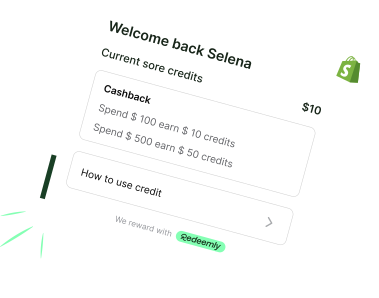
The image below really drives home the strategic difference between using store credit to build long-term relationships versus using one-off discounts that just chase quick sales.
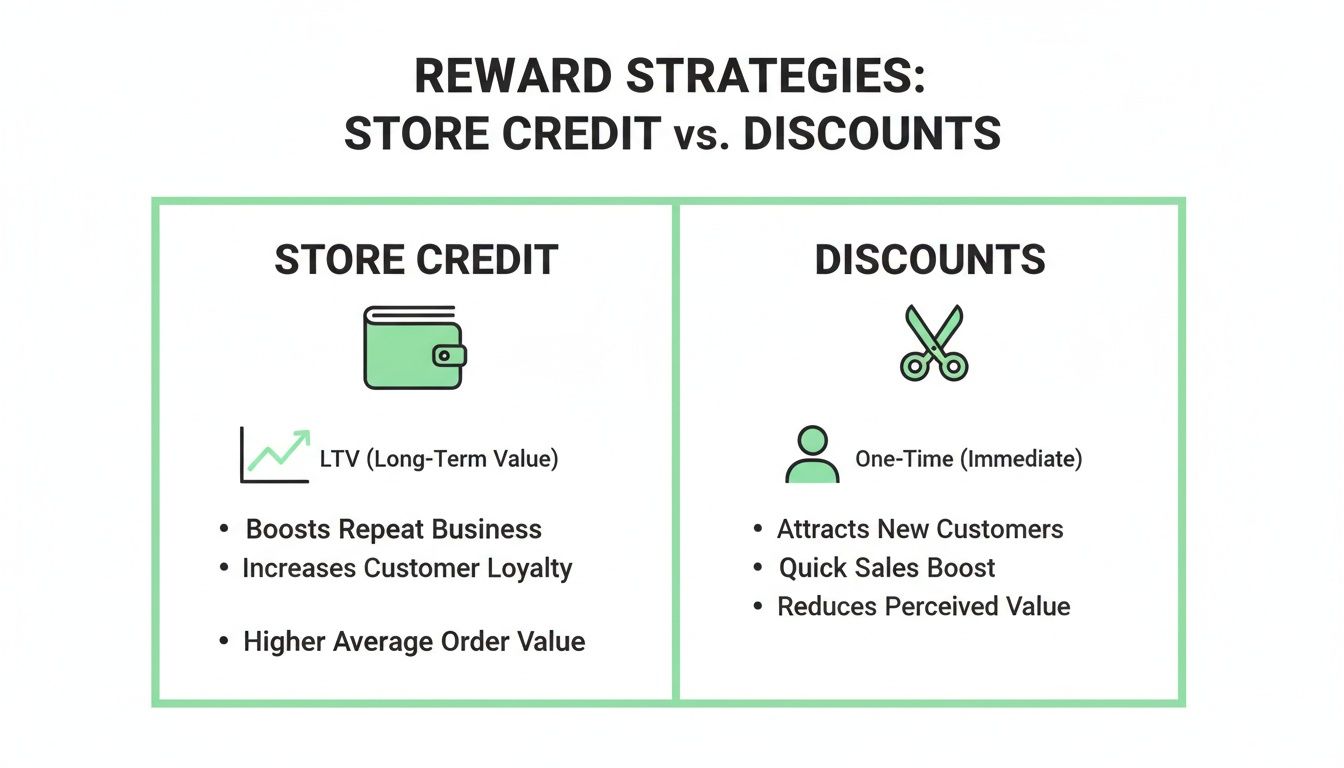
As you can see, store credit builds a customer wallet, encouraging them to come back again and again. Discounts, on the other hand, are often just a transactional blip on the radar.
Why This Model Works So Well
Let's look at why store credit is the smarter play for brands focused on long-term growth and profitability. It's not just about a single sale; it's about building a sustainable customer base with high LTV.
Reward Model Comparison Store Credit vs. Discounts
Attribute | Store Credit Rewards | Discount Code Rewards |
|---|---|---|
Customer LTV | Directly increases LTV by incentivizing repeat purchases. | Often encourages one-time, transactional purchases. |
Profit Margins | Preserves margins, as credit is spent on full-price items. | Directly erodes margins on the initial sale. |
Customer Relationship | Fosters a long-term relationship and brand loyalty. | Is purely transactional and short-lived. |
Breakage | Unused credit ("breakage") is pure profit for the business. | No breakage benefit; the discount is either used or not. |
AOV Impact | Can be tied to minimum spend, lifting AOV. | Typically applied to any order size, potentially lowering AOV. |
In short, while discounts get you a quick sale, native Shopify store credit gets you a loyal customer with a higher LTV. For DTC brands playing the long game, the choice is clear.
The data backs this up, too. Brands see incredible results with this model. Double-sided rewards generate 2.3x more shares and achieve 1.8x higher conversions. What’s more, for DTC brands, referred customers have a 37% higher retention rate and spend 25% more over their lifetime. If you're tired of margin-killing tactics, this is your path to smarter growth.
For a little inspiration, check out these real-world e-commerce referral program examples to see how other brands are crushing it. You can also explore different referral program ideas to find one that fits your brand. The end game is to build a system that doesn’t just bring in new faces, but ensures every customer becomes more valuable over time.
Setting It Up: How to Get Your Program Live Without Headaches
You don’t need a team of developers or weeks of frustrating back-and-forth to launch a powerful Shopify referral program. The real secret is picking a tool that plugs directly into Shopify’s native store credit system. When you do that, the whole experience just works. It feels like a core part of your store, not some clunky, tacked-on feature.
Forget about those bloated, third-party scripts that drag down your site speed and kill your conversion rates. A native integration means the entire referral system operates smoothly inside your existing Shopify setup. The interface looks and feels familiar to you and your customers, which makes everyone more likely to actually use it.
This direct connection is what makes a headache-free setup possible. You get to run a high-impact program that boosts customer LTV and AOV, all without the technical nightmares that so many other platforms create.
The Key Steps to a Successful Launch
Getting started is actually pretty straightforward. The whole process is about defining your offer and tailoring the experience to fit your brand. The goal here isn't a long, drawn-out project; it's to get a high-quality program live quickly so it can start working for you. A good app will walk you through these steps without any guesswork.
Here’s what that setup process typically looks like:
Nail Down Your Offer: First, decide on the store credit amounts. What will the advocate get? What will their friend receive? A balanced, double-sided reward like “Give $20, Get $20” is a classic for a reason—it’s simple, fair, and incredibly effective at driving repeat business.
Customize Your Messaging: This is where you make it yours. Tweak the on-site widgets, pop-ups, and the dedicated referral landing page to match your brand’s voice and style. You want to clearly and concisely explain why someone should share.
Automate Your Emails: Let the system do the work for you. Set up the automated emails that handle everything from the initial invitation, to the "Your friend just bought!" notification, to the gentle nudge reminding advocates they have credit waiting for them.
A native setup completely demolishes the technical walls that stand between a great idea and a successful launch. By working with Shopify's core features instead of against them, you end up with a program that's faster, more stable, and feels far more professional—which builds the trust you need for customers to participate.
The final piece of the puzzle is visibility. Make it impossible to miss! Add links to your program in your store’s main navigation, the footer, and on customer account pages. When sharing feels like a natural part of the shopping journey, you'll see engagement skyrocket from day one.
If you want to dig into the mechanics of how the rewards work, check out our guide on how to issue store credit on Shopify. This streamlined approach lets you spend less time worrying about the tech and more time doing what you do best: growing your brand.
How to Promote Your Program for Maximum Engagement
So you've built your Shopify referral program. That's a great first step, but it's only half the job. A killer program that no one knows about is just a missed opportunity. To really turn this thing into a growth engine, you need a smart promotion strategy that makes sharing a natural, can't-miss part of your customer experience.
The old "if you build it, they will come" idea just doesn't fly here. You have to actively weave your program into the fabric of the customer journey. This isn't about a single launch announcement; it's about creating multiple, consistent reminders that encourage customers to tell their friends about you.
Create a Dedicated Referral Hub
Every solid referral program needs a home base. Think of it as a dedicated landing page—a central hub for everything related to your program. When a customer lands there, it should instantly answer three questions:
What’s in it for me? Spell out the store credit they get.
What’s in it for my friend? Show the awesome store credit their friend receives.
How do I start? Make the call-to-action to grab their unique sharing link impossible to miss.
This page eliminates all the guesswork. It gives your support team a single, easy link to share and acts as the destination for all your promotional efforts, from email blasts to social posts.
Promote Across the Entire Customer Journey
To get people to actually participate, you need to show up where they already are. That means placing prompts at key moments when they’re most excited about your brand.
Think about these high-impact spots:
Post-Purchase Confirmation: The "thank you" page is prime real estate. A customer just bought something, and their excitement is peaking. Hit them with a pop-up or a clear section inviting them to join the program right then and there.
Email Campaigns: Don't stop at one announcement email. Weave referral reminders into your transactional emails, like shipping confirmations. Better yet, create dedicated campaigns to nudge customers who haven't shared yet.
On-Site Visibility: Make it easy to find. Add a permanent link to your referral program in your site's main navigation, the footer, and inside the customer account page.
The best referral programs are never a secret. They're a visible, celebrated part of the brand experience, making it incredibly easy and rewarding for your happiest customers to become your most effective marketers.
When you promote it right, a Shopify referral program becomes a revenue machine. We've seen top-performing stores get a sales lift of up to 30%, with participation rates tripling once they started promoting it actively. The data doesn't lie: referred customers are a goldmine for LTV-focused brands. They spend 25% more over time and have a 37% higher retention rate. By promoting your program strategically, you’re not just adding a feature—you’re building a powerful, profit-safe growth channel. Discover more powerful insights about referral marketing success.
Measuring the Metrics That Actually Matter
Getting your Shopify referral program live is a great first step, but the real work starts now. To figure out if it's actually working, you need to look past vanity metrics like share counts and dig into the numbers that hit your bottom line. This is especially true if you're running a profit-focused program built on native Shopify store credit.
Don't get lost in surface-level data. The real goal here is to measure how this channel is building sustainable, long-term growth for your brand. Are you bringing in customers who spend more and stick around longer? Is the program actually profitable? You need to be tracking the right data from day one to answer these questions with confidence.
KPIs for a Profit-Focused Program
Your analytics dashboard should tell a clear story about the value of your word-of-mouth marketing. These are the numbers that will guide your strategy and prove the program is a driver of lifetime value.
Here are the core metrics you should be watching like a hawk:
LTV of Referred vs. Non-Referred Customers: This is the big one. A winning program will consistently bring in new customers who have a significantly higher lifetime value than customers from other channels.
Referral-Driven Average Order Value (AOV): Are the new customers coming from referrals spending more on their first purchase? A higher AOV from this group is a fantastic sign that you're attracting high-quality buyers.
Referral Channel Customer Acquisition Cost (CAC): Figure out your true acquisition cost by dividing the total store credit redeemed by the number of new customers you gained. You'll almost always find this is far more profitable than your paid ad spend.
The real magic happens when you start comparing cohorts. When you can confidently say, "A customer we acquired through our referral program is 35% more valuable over their lifetime," you've struck gold. That’s the kind of data that proves the immense worth of your program.
Optimizing for Continuous Improvement
Tracking these numbers isn’t just a one-and-done task; it's a continuous loop of learning and refining. Use your data to run A/B tests on your offers. Does "Give $25, Get $25" pull in better customers than "Give $15, Get $15"? What happens to your AOV and LTV if you add a minimum spend for the new customer's first order?
To really dial this in, you can get a huge leg up by using powerful tools like AI-driven ecommerce analytics to uncover deeper patterns. If you want to go further on measuring loyalty, you can learn more about user retention metrics and see how they connect directly to your program's success. This data-first approach turns your referral program from a simple tactic into a powerful, ever-improving engine for profitable growth.
FAQs: Your Questions About Store Credit Programs, Answered
Thinking about switching to a store-credit-based referral program? It’s a smart move, but it’s totally normal to have questions about how it works in practice. This approach is all about building long-term value, which is a bit different from the usual discount game.
Let’s tackle a few of the most common questions we hear from merchants.
Is This Going to Be Complicated for My Customers?
Not in the slightest. In fact, it’s easier. When you use a native Shopify app, the store credit gets added right into a customer's account automatically. When they go to check out, it’s sitting there waiting for them, just like a gift card balance.
There are no clunky codes to copy and paste or weird point systems to figure out. It just feels like they have money to spend in your store, which is a far more seamless and rewarding experience than a typical coupon.
How Exactly Does Store Credit Help My Profit Margins?
This is where the magic happens. Store credit is a game-changer for your margins because you only absorb the cost of the reward when a customer comes back to make a second purchase. This structure practically guarantees a repeat sale and gives your retention a massive boost.
Think about it: upfront discounts slash your revenue on the very first order. Store credit, on the other hand, is an investment in a future purchase. This model directly drives up your customer lifetime value (LTV) and ensures your marketing dollars are fueling real, profitable growth, not just one-and-done transactions.
Can I Run a Store Credit Program During a Big Sale?
Yes, absolutely! And this is one of its biggest advantages. Because native Shopify store credit works just like a gift card, it’s treated like a form of payment.
That means customers can usually stack their referral credit on top of other site-wide sales or promotions you’re running (this can depend on your specific store settings). This flexibility makes your offers feel incredibly generous and compelling, all without you having to wrestle with conflicting discount codes.
Ready to stop killing your margins with discounts and start building a loyalty program that actually drives profit? Redeemly uses native Shopify store credit to boost your LTV and AOV. Launch your profit-focused loyalty program today.


Join 7000+ brands using our apps