Shopify Loyalty Programs That Actually Drive Lifetime Value
Feb 6, 2026
|
Published
Let's be honest, most loyalty programs on Shopify feel like they're built on a shaky foundation. The default playbook is all about points and discounts, but that's a dangerous game. It teaches your customers to hold out for a sale, which slowly but surely eats away at your profit margins and devalues your brand.
There’s a much smarter way to play. The most effective Shopify loyalty programs use native Shopify store credit as the primary reward—treating it like a cash-back bonus. This simple shift encourages customers to return and spend more, all without putting your products on the discount rack. It’s a strategy designed from the ground up to significantly boost your average order value (AOV) and customer lifetime value (LTV).
Why Traditional Loyalty Programs Are a Leaky Bucket
For most Shopify store owners, setting up a loyalty program feels like a no-brainer for retention. The idea is sound: reward your best customers, and they'll stick around. The problem is, the most common methods—like complicated points systems and constant coupon codes—often create more headaches than they solve.
These old-school programs can turn into a leaky bucket for your business. You pour money into acquiring new customers to fill it up, but your loyalty strategy lets profit and genuine engagement drain right out the bottom.
The Problem with Points and Discounts
The real issue with these programs is the psychology they create. When you're constantly dangling discounts or points that just turn into more discounts, you're telling your customers your products aren't worth full price. They quickly learn to wait for a promo code or only buy when they can cash in a reward, which directly torpedoes your margins on every single sale.
This creates a nasty cycle. The "reward" stops being a delightful surprise and becomes an expectation. Instead of building real love for your brand, you’re just competing on price—and that’s a race to the bottom you can't win.
On top of that, points systems are just plain confusing. Customers have to do mental gymnastics to figure out what their points are actually worth ("So, is 1,000 points a lot or a little?"). They often find the rewards are too small or too difficult to redeem, which just leads to frustration and disengagement.
The classic points-based model is on its way out. Industry analysis reveals that a staggering 44% of consumers ditched at least one loyalty program in the last year. The main culprits? Rewards that weren't relevant, flexible, or valuable enough. You can discover more insights about customer loyalty triggers and how to fine-tune your own program.
Eroding Margins and Customer Lifetime Value
When your loyalty program is built on a foundation of discounts, every redeemed reward is a direct hit to your profit. It might help you close one more sale today, but it does very little to make that customer relationship more profitable over the long haul.
This approach fails to move the needle on the two metrics that really matter for sustainable growth:
Average Order Value (AOV): Discount-focused rewards rarely encourage customers to add more to their cart. They just lower the price of what they were already going to buy.
Customer Lifetime Value (LTV): While the goal is retention, training customers to hunt for deals actually lowers their long-term spending potential. It also makes them far more likely to jump ship the second a competitor offers a slightly better coupon.
This leaky bucket model—spending a fortune to acquire customers only to give away your margin to keep them—is completely unsustainable. It’s time for a better strategy, one that actually plugs the leaks by creating real, lasting value for both your customers and your business.
What If You Used Store Credit as Your Loyalty Engine?
Let's try a different way of thinking about customer rewards. For years, we've been stuck on confusing point systems or discounts that just slash our margins. But what if the best Shopify loyalty programs didn't need any of that? What if the most powerful incentive was simply native Shopify store credit?
This isn't about the store credit you issue for a return. This is about transforming store credit into a rewarding, cash-like currency that customers want to earn and are genuinely excited to spend.
The whole strategy pivots on a subtle but powerful psychological shift. You're moving the customer's focus from "how do I get a discount code?" to "how much do I have in my account to spend?" It stops feeling like a temporary sale and starts feeling like they have a digital wallet just for your brand. This simple change drives repeat purchases without ever devaluing your products.
Unfortunately, most traditional loyalty models are a leaky bucket—they drain your margins and often leave customers more frustrated than loyal.
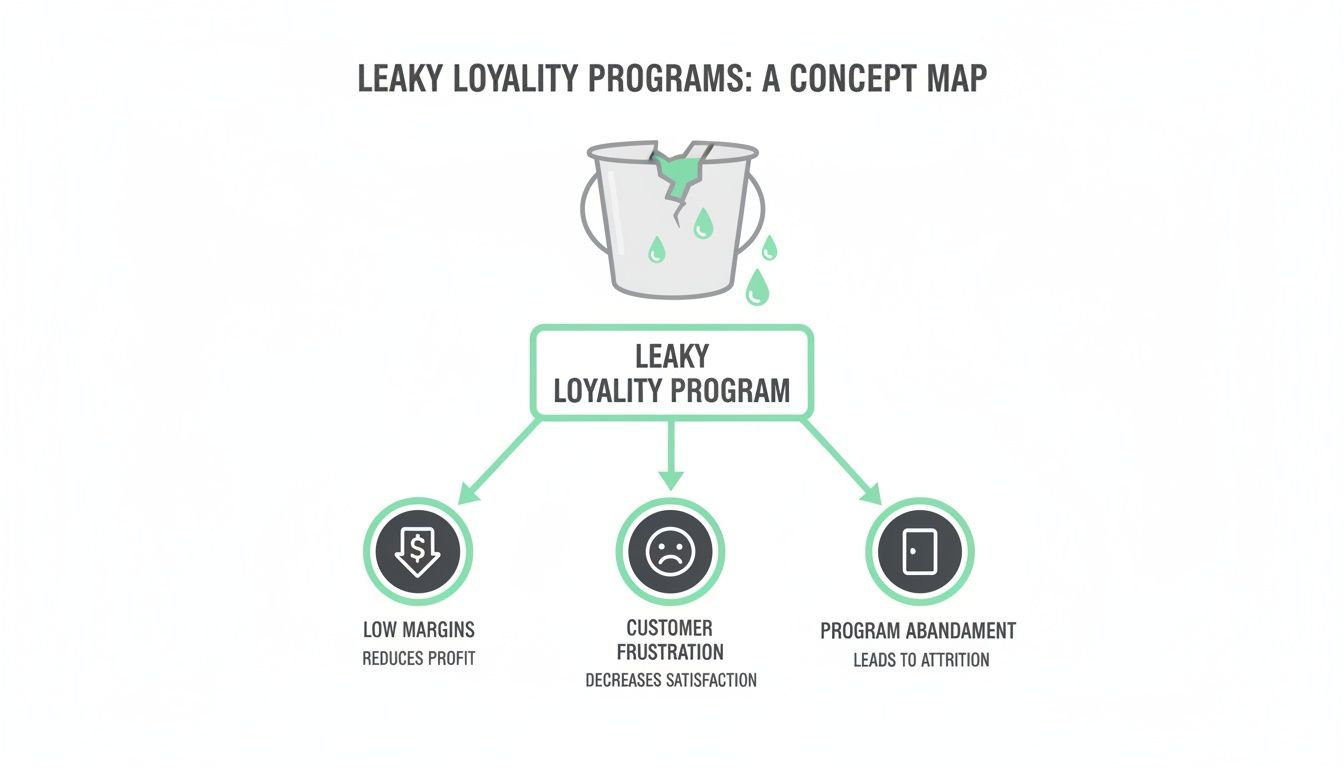
As you can see, a constant reliance on discounts and confusing points directly chips away at profits and can even push customers away. A simpler approach isn't just nice to have; it's essential for real growth.
To really see the difference, let’s put these models side-by-side.
Loyalty Program Models: A Head-to-Head Comparison
The table below breaks down the core differences in customer experience, merchant economics, and business impact between traditional loyalty models and a native store credit program.
Feature | Discount Coupons | Points Systems | Native Store Credit |
|---|---|---|---|
Customer Experience | Transactional; customers hunt for the next deal. | Complex; requires mental math to see value. | Simple & intuitive; feels like having cash to spend. |
Perceived Value | Low; often feels expected or devalues the product. | Abstract; "1,000 points" feels less real than a dollar amount. | High & tangible; "$10.00" is clear and easy to understand. |
Margin Impact | Immediate profit cut on the initial purchase. | Delayed cost, but can lead to "points liability" on the books. | Margin-safe; cost is only realized on a future purchase. |
Redemption Process | Can be clunky; codes expire or get lost. | Often involves multiple steps to convert points to a reward. | Seamless; balance is native to the customer's account and applied at checkout. |
Impact on AOV/LTV | Can decrease AOV if customers only buy on sale. | Moderate LTV impact, but friction can limit engagement. | Boosts both AOV and LTV by encouraging repeat, larger purchases. |
Brand Perception | Can create a "discount brand" image. | Can feel impersonal or like a gimmick. | Fosters genuine loyalty and feels like a true brand benefit. |
As the comparison shows, moving to a native store credit model isn't just a small tweak—it fundamentally changes the entire dynamic for both you and your customer, creating a healthier, more profitable relationship.
A Margin-Safe Approach to Retention
One of the biggest wins with a store credit system is how it protects your bottom line. Unlike a discount that immediately carves up your revenue on a sale, store credit is inherently margin-safe. The cost of that reward is only realized when a customer comes back to make their next purchase.
By issuing store credit, you're essentially turning a future liability into guaranteed future revenue. A customer with a balance is a customer with a powerful reason to return.
This completely flips the economics of customer retention. You're no longer just giving away profit; you're investing directly into a future transaction. This has a massive influence on lifetime value (LTV), building a flywheel where each purchase helps fund the next. And that customer returning to spend their $10 credit? They're almost certainly going to add more to their cart, boosting your average order value (AOV) at the same time.
The Power of Tangible Value
Think about it from your customer's perspective. A balance of "1,000 points" feels abstract and requires mental gymnastics. How much is that worth? What can I get? But seeing "$10.00 in your account" is concrete, tangible, and instantly understood. It has a clear cash value that people recognize and are motivated to use.
That clarity cuts through all the friction and confusion that makes people give up on other loyalty programs. It makes the reward feel more real and accessible, which drives a much higher redemption rate. The result? A more engaged customer base that sees real, undeniable value in sticking with your brand.
No Complex Tiers: Customers get rewarded for their spending, simple as that. No confusing VIP levels to track.
Instant Gratification: The value is crystal clear the moment it's earned, unlike points that need to be "cashed in."
Seamless Redemption: Since it’s native, Shopify store credit can be applied right at checkout. It just works.
By leaning into store credit, you're building a loyalty engine that’s both customer-friendly and incredibly profitable. You can explore the mechanics in our complete guide to Shopify store credit and see exactly how it builds lasting relationships. This model doesn't just reward transactions; it builds a foundation for genuine loyalty and predictable, profitable growth.
How Store Credit Directly Increases AOV and LTV
It's one thing to have a loyalty program, but it's another thing entirely to connect it to the metrics that actually grow your business. While points and discounts might feel like you're building loyalty, they often fall short of moving the needle on Average Order Value (AOV) and Customer Lifetime Value (LTV). A smart store credit program, on the other hand, is built from the ground up to boost both.
This isn't just about rewarding a purchase; it's about fundamentally changing how customers shop. When you offer tangible, cash-like rewards for spending more, you create a powerful incentive that directly impacts how much a customer spends today and how often they come back tomorrow.
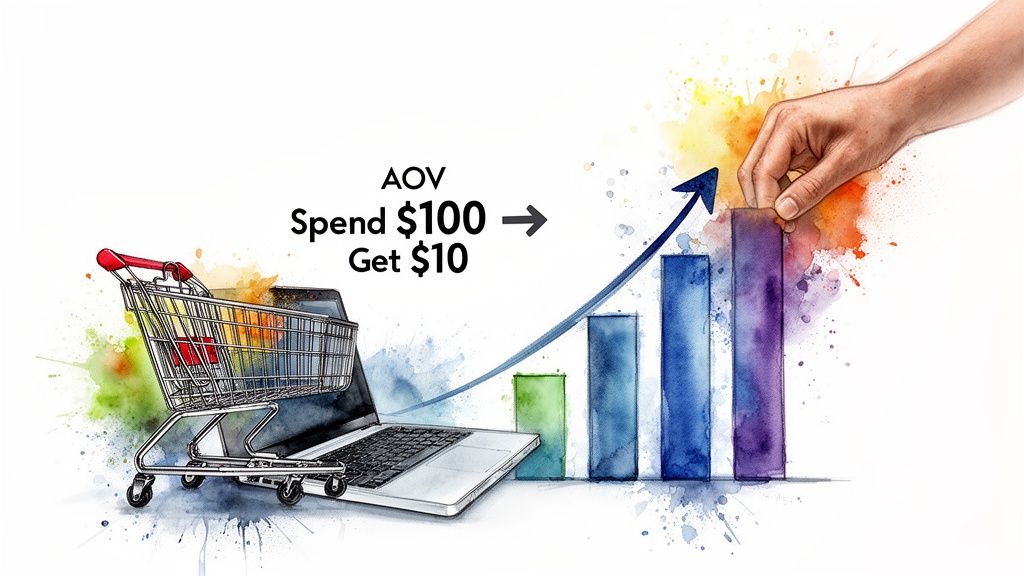
Let's break down exactly how this virtuous cycle works, from the very first purchase to the fifth.
Engineering a Higher Average Order Value
The most immediate way Shopify loyalty programs based on store credit grow revenue is by pushing up your AOV. You can do this with simple, crystal-clear campaigns that reward shoppers for hitting specific spending targets.
Think about a classic campaign: "Spend $100, Get $10 in store credit."
Suddenly, shopping becomes a game. A customer with $85 worth of products in their cart is now at a crossroads. Do they check out, or do they find one more $15 item to unlock that $10 reward for later? In their head, that extra item now feels like it only costs them $5. It’s a no-brainer.
This simple mechanic is incredibly effective for a few reasons:
It gamifies the checkout: Shoppers are naturally motivated to "win" the reward by hitting the spending goal.
It boosts perceived value: The store credit feels like finding free money, which makes the higher cart total feel completely justified.
It protects your brand: Unlike a blanket 10% off coupon, the customer still pays full price for every single product. You aren't devaluing your brand.
This is so much more powerful than a discount because it gets customers to add more to their cart instead of just slashing the price of what’s already there.
Creating a Powerful Return Trigger for LTV
Once a customer earns that $10 in credit, the second part of the growth engine kicks in. That balance sitting in their account is no longer just a reward—it’s a powerful return trigger.
Think of it like a gift card that’s always there, waiting for them. Automated emails can gently remind them, "Hey, you have $10 waiting for you!" This gives them a real, compelling reason to come back for a second, third, and fourth purchase. This is where you see a dramatic impact on LTV.
A customer with a store credit balance is a customer who is highly likely to return. They feel like they would be leaving money on the table if they didn't come back to spend it.
This process builds a self-sustaining loyalty loop. The first purchase boosts AOV, and the credit they earn makes a repeat purchase almost inevitable. When they return to spend that credit, they'll almost certainly spend more than the credited amount, pushing their lifetime value even higher.
The data backs this up in a big way. Loyalty program members who actually redeem rewards spend up to 164% more than non-members, and their purchase frequency is 73% higher than members who don't bother to redeem. On top of that, the average basket size for a redeeming customer is 39% higher.
While store credit is a fantastic tool for AOV and LTV, it's also smart to look at the bigger picture. You can explore broader strategies to improve ecommerce conversion rate and drive sales for an even greater impact.
Ultimately, this simple cycle—earn credit, get reminded, return to spend—is the key to turning one-time buyers into profitable, lifelong fans.
Getting Your Native Store Credit Program Off the Ground
Switching to a loyalty program built around store credit is one of the smartest, fastest wins a Shopify brand can get. Seriously. We’re not talking about a massive six-month development project. With the right app, you can have a powerful, profit-boosting program up and running in less time than it takes to brew a pot of coffee. The secret is that it all works with Shopify’s own native store credit system.
The magic of a native Shopify program is how ridiculously simple and seamless it is. Apps like Redeemly are built to plug directly into your store's DNA. This “native” design means no clunky, site-slowing scripts to install, no messy integrations to wrestle with, and no jarring third-party widgets that break your beautiful customer experience. It just works.
Your customers will see and use their credit right in the Shopify checkout they already know and trust. This makes the whole process feel natural, builds confidence, and drives conversions sky-high. The program feels like it belongs to your store, not like some gimmicky add-on.
The Setup is a Breeze
Getting your store credit program live is almost laughably easy. The whole point is to get you from idea to reality in minutes, not weeks, without ever having to call a developer.
It really just boils down to a few simple steps:
Install the App: Head over to the Shopify App Store, pick a native store credit app, and install it with a click. The integration handles itself.
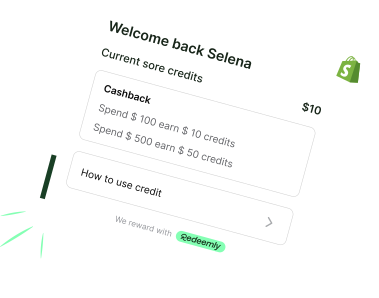
Set Up Your First Campaign: Figure out your first reward. A fantastic place to start is a classic spend-and-get offer, like "Spend $100, Get $10." It’s a proven winner for bumping up your average order value (AOV).
Tweak the On-Site Look: Use the app’s simple settings to add a floating wallet icon or on-page displays. This makes sure customers always see their balance and know how to earn more, keeping your program right in front of them.
And that’s it. You’re all set to start rewarding your best customers and building a powerful engine for repeat sales. This quick setup puts any brand—no matter the size or technical know-how—in a position to launch a program that directly fattens the bottom line.
Spreading the Word
With your program live, the last piece of the puzzle is telling your customers about it. Smart, clear communication is what will get people excited and using the program right away.
Don't just announce a new "program." Frame it as an upgrade for them. Try messaging like, "We're making rewards simple! Earn cash-like credit on every purchase." It cuts through the noise of points systems and makes the benefit crystal clear.
Here are a few proven ways to roll out the red carpet for your new program:
An All-Hands Email Blast: Send a dedicated email to your entire list introducing the new way to earn rewards. Explain how simple it is, highlight the value of store credit, and maybe even drop a small starting balance in everyone's account to get the ball rolling.
On-Site Banners: Use your homepage banner or a sticky bar at the top of your site to announce the launch to every single visitor. Make your call-to-action impossible to miss, like "Start Earning Store Credit Today!"
Post-Purchase Reminders: This is a big one. Update your order confirmation emails and pages to show customers the credit they just earned. This instantly proves the value of their purchase and gives them a reason to come back, directly boosting their lifetime value (LTV).
Making the Switch From an Old Loyalty App
Let’s be honest, moving away from a loyalty system you’ve had for a while can feel a bit scary. The last thing you want to do is upset your best customers or lose all the goodwill you’ve built. But what if the change wasn't a disruption? What if it was a massive upgrade that made your customers feel even more appreciated?
Switching to a native Shopify store credit program is your chance to do just that. It's an opportunity to breathe new life into your community. You can bring all your customer data over smoothly, making sure every single person feels seen and rewarded. The trick is to position the change as a powerful improvement—one that makes their life simpler and gives them real, tangible value.
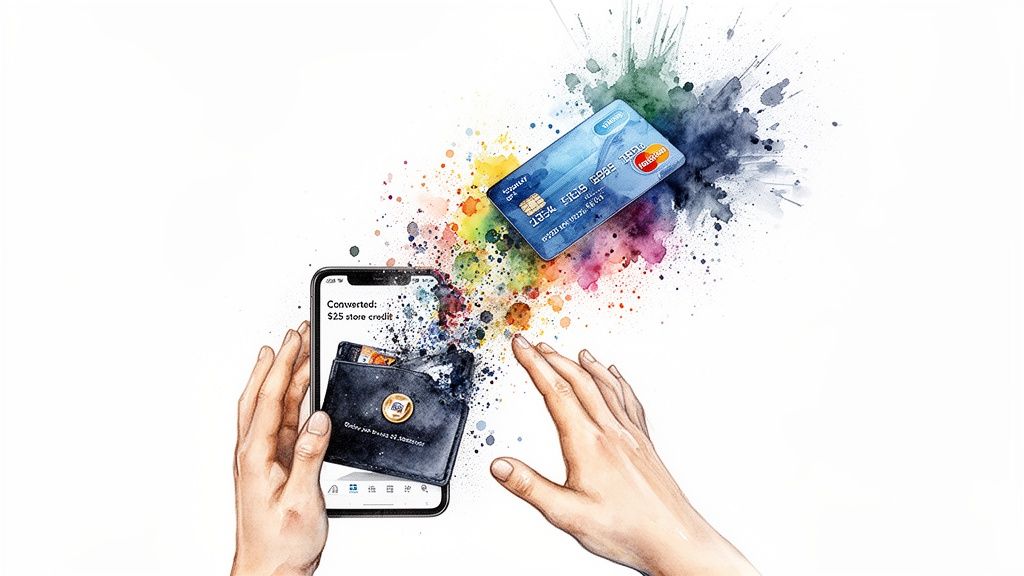
A Simple, Step-by-Step Migration Plan
A smooth transition all comes down to having a good plan. When you break the process into a few clear steps, you can sidestep the common headaches and get your customers genuinely excited about what’s coming.
Here’s a straightforward roadmap that works every time:
Calculate the Cash Value of Existing Points: First things first, figure out what everyone's points are actually worth. For instance, if 100 points = $1, then a customer with 1,500 points has $15 sitting in their account. This number is the key to a fair and transparent switch.
Export Your Customer Data: Your current loyalty app should let you export a CSV file of all your members. This file will contain the essentials: names, emails, and their current point balances. This is the precious cargo you'll be moving to the new system.
Import and Convert to Store Credit: With a native app like Redeemly, you can simply import that CSV file. The system takes over, automatically converting those point balances into the correct dollar amount and issuing it as native Shopify store credit right into each customer’s account.
Honestly, this three-step process is the easy part. It’s purely technical and often takes just a few minutes. No one gets left behind.
How to Tell Your Customers About the Upgrade
The way you announce this change is just as crucial as the technical side. Your goal is to make it crystal clear that this isn't about taking away points—it's about giving them a huge upgrade in value and convenience. Your messaging needs to be built around excitement and clarity.
Frame the change as a customer-first improvement. Think about using language like, "Your points just became cash in your wallet! We're simplifying our rewards to make them easier to use and more valuable than ever." This immediately turns an abstract number into a real dollar amount they can spend right now.
Get the word out everywhere. Send a dedicated email blast explaining the benefits, pop a banner on your homepage, and create some buzz on social media. Be totally transparent. Explain that you’re honoring their loyalty by converting it into something even better. To dive deeper into different loyalty models, you can check out our guide on Shopify loyalty programs.
Making Sure Every Customer Feels Valued
The last, and maybe most important, piece of the puzzle is making sure the whole thing feels effortless for your customers. As soon as the store credit hits their accounts, send them a quick follow-up email confirming their new balance. Let’s face it, seeing "$15.00 available" in their account is way more exciting than seeing "1,500 points."
This kind of proactive communication builds incredible trust. It shows you respect their history with your brand and are genuinely invested in making their experience better. When you handle the migration with care, you transform a potentially tricky situation into a loyalty-building moment that can drive immediate repeat sales.
Measuring the Success of Your Program
So, you’ve launched your store credit loyalty program. That’s a fantastic first step. But the real question is: is it actually working? Success isn't just about counting how many people signed up. It's about seeing real, tangible growth in your bottom line and in the value of each customer.
You need to focus on the numbers that prove your program is building a healthier, more profitable business. The key is tracking how your program is changing customer behavior for the better. This starts with solid, secure data acquisition to get a clear picture of every transaction and interaction.
The Metrics That Truly Matter
Forget overwhelming dashboards with dozens of charts. You really only need to keep an eye on four core metrics to understand the health of your store credit program. These numbers cut through the noise and tell you exactly how your investment is paying off.
Repeat Purchase Rate: Simply put, what percentage of your customers come back for a second, third, or fourth purchase? If this number is climbing, your store credit is doing its job and giving people a compelling reason to return.
Average Order Value (AOV): Are people spending more each time they check out? Your store credit rewards should naturally nudge shoppers to add that one extra item to their cart, boosting your AOV in the process.
Customer Lifetime Value (LTV): This is the holy grail of loyalty. LTV measures the total amount a customer spends with you over their entire relationship with your brand. A great program will show a steady increase here, proving you're building long-term value, not just one-off sales.
Time Between Purchases: How long does it take for a customer to come back and buy again? Store credit creates a little bit of urgency—it feels like cash waiting to be spent. When you see this time frame getting shorter, you know your program is successfully speeding up the buying cycle.
Keeping these KPIs on your radar is crucial. For an even deeper dive, it's also worth exploring other user retention metrics that can give you a more complete view of customer loyalty.
Your Most Important Leading Indicator
While the metrics above show you the results, there's one number that predicts future success better than any other: your Reward Redemption Rate. This tells you what percentage of the store credit you've issued is actually being spent. A high redemption rate is one of the best signs of a healthy, engaging program.
A high Reward Redemption Rate is proof that your customers see real value in your program. It means they treat their store credit like actual cash and are excited to use it—which is what drives repeat purchases and skyrockets LTV.
If you notice your redemption rate is low, it's a red flag. It might mean your communication is off—customers don't realize they have a balance, or the reward doesn't feel significant enough. By checking this metric regularly, you can quickly tweak your email reminders or on-site banners to get things back on track. A quick monthly health check on these core numbers will ensure your Shopify loyalty program stays the powerful growth engine it's meant to be.
Your Questions, Answered
Making a change to your loyalty strategy is a big move, and it's smart to have questions. When you're thinking about ditching the old points-and-discounts model for native store credit, some practical questions always pop up. Let's walk through the most common ones so you can feel confident this is the right, profit-friendly move for your brand.
Is Store Credit Just a Different Name for a Gift Card?
Nope, they're completely different beasts, built for entirely different jobs. A gift card is a product you sell. Someone buys it—for themselves or a friend—and it acts like a prepaid debit card for your store.
Store credit, on the other hand, is a reward you issue directly to a customer's account. A native app like Redeemly hooks directly into Shopify's own store credit system. This means the customer's balance just shows up and applies itself automatically at checkout. No more fumbling with clunky gift card codes. It’s a genuinely smooth experience.
Isn't Giving Away Store Credit Expensive?
Quite the opposite, actually. It's one of the most cost-effective loyalty strategies you can run. Think about it: your only real "cost" is the credit itself, and you only pay that cost when a customer comes back to make another purchase. You're literally funding your retention with guaranteed future sales, which is the whole game when it comes to boosting lifetime value.
Unlike complicated tiered programs that need constant babysitting, a store credit system is mostly a 'set it and forget it' deal. You set the rules once, the app does the rest. It's a high-return strategy with almost zero admin headaches.
This approach is also inherently margin-safe. You're not chipping away at your profit on the initial sale with a discount code. The cost only kicks in when a loyal customer returns to spend more.
How Can I Sell My Customers on Store Credit Over Points?
It all comes down to simplicity and real, tangible value. You're not taking anything away from them; you're giving them an upgrade. You're making their life easier and their rewards feel more real.
Frame your announcement with clear, benefit-focused language:
"We're simplifying our rewards!" Right away, they know you're getting rid of the confusing parts.
"No more points to track. Now you earn real store credit that works like cash in our store." This connects the dots for them, turning an abstract concept (points) into something they understand instantly (money).
But the real magic trick? Convert their existing points balance into a dollar value. Seeing $15.00 in their account feels a whole lot more exciting and motivating than staring at "1500 points." It immediately proves the value of the new system and gives them a reason to start shopping.
Ready to stop giving away margin and start building profitable loyalty? Redeemly replaces confusing points and discounts with native Shopify store credit that boosts LTV and AOV. Launch your profit-focused loyalty program in minutes.


Join 7000+ brands using our apps