Build a High-LTV Referral Program Shopify Customers Love
Feb 4, 2026
|
Published

A Shopify referral program is one of the most powerful tools in your arsenal. It’s about turning your happiest customers into your most effective marketing channel, letting them drive high-quality, high-intent traffic directly to your store. But the secret sauce isn’t just having a program; it's how you reward people. The most effective strategy? Using Shopify's native store credit. This approach is laser-focused on increasing customer lifetime value (LTV) and average order value (AOV), turning your referral program into a true profit center.
Why Store Credit Is a Game-Changer for Your Shopify Referral Program
For too long, eCommerce brands have been stuck in a rut with referral rewards. We've all seen it: endless discount codes and confusing points systems. The problem is, this approach quietly trains your customers to undervalue your products and hold out for the next sale. It's a race to the bottom that eats away at your margins without building long-term value.
Think about it. A 20% off coupon feels temporary, almost transactional. It often attracts bargain hunters who buy once and never come back, rather than true brand loyalists who contribute to a higher LTV.
And points systems? They're often worse. They force customers to do mental math just to figure out what their reward is worth. "Okay, so 500 points gets me... what exactly?" That friction is a major barrier. If the reward feels abstract or too far off, people simply won't bother.
The Power of a Tangible Reward
Switching your referral program strategy to use native store credit completely changes the conversation. Unlike a fleeting discount, store credit feels like real money sitting in a customer’s account. It's a tangible asset, a digital wallet balance just waiting to be spent.
This psychological shift is huge. When someone earns a $20 store credit, they see it as earned value, not just a temporary price cut. It’s a powerful, built-in reason to come back to your store. That credit isn't a coupon they might lose or forget; it's a balance that actively pulls them back, turning a one-time referral bonus into a guaranteed repeat purchase that boosts lifetime value.
This visual breaks down how different rewards really stack up when it comes to driving the metrics that matter.
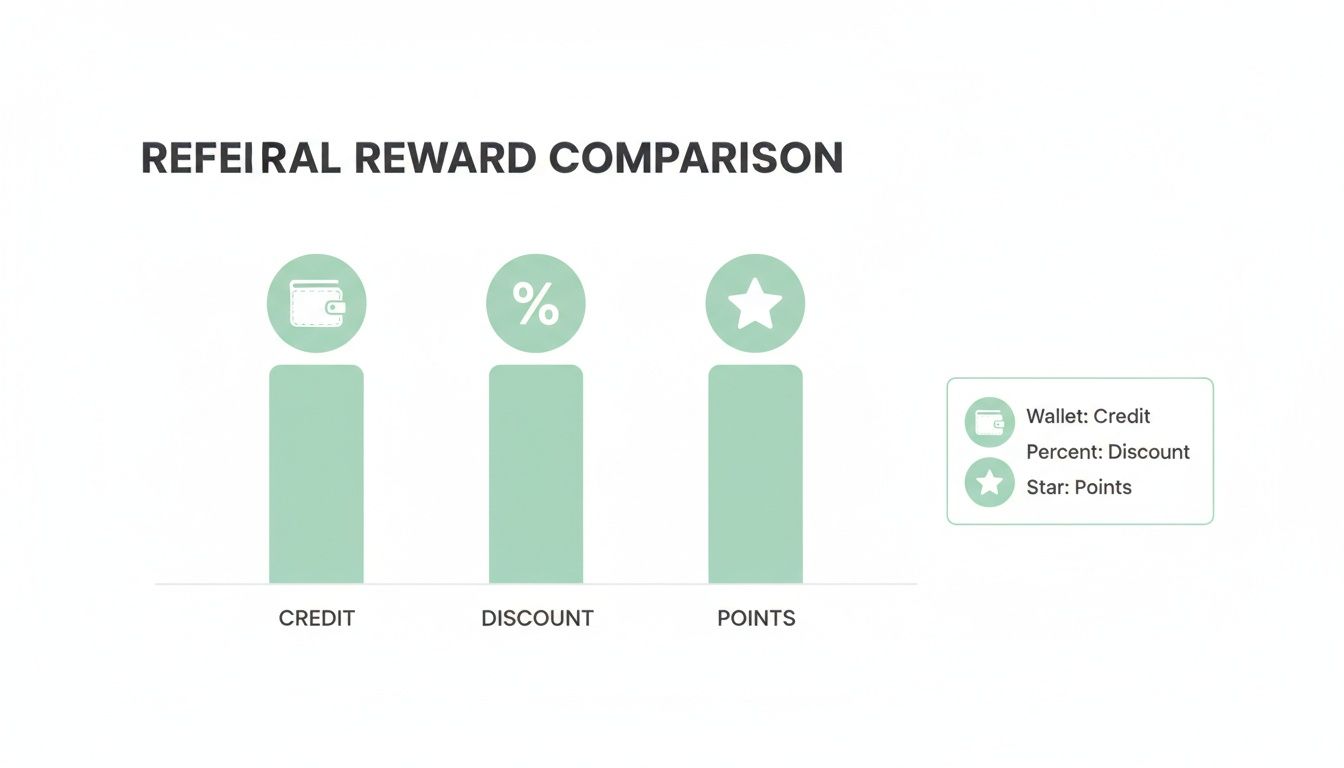
As you can see, store credit is built to create a cycle of repeat business, which has a massive impact on lifetime value.
Driving Higher Lifetime Value and Bigger Carts
At the end of the day, we're all trying to increase customer lifetime value (LTV) and average order value (AOV). This is where a store credit-based referral program truly excels.
When a customer comes back to spend their $20 credit, they almost never spend just $20. More often than not, they see that credit as a head start on a bigger purchase. They'll finally grab that $50 item they've been eyeing because, in their mind, it only costs $30. It lowers the barrier to spending more, directly increasing your average order value.
This creates a beautiful, sustainable growth loop. You acquire a new customer through a referral, reward the original advocate with store credit, and that credit ensures their next purchase is larger than it would have been otherwise. You're not just getting new customers; you're investing in the future spending of your best ones, maximizing their LTV.
By framing rewards as a cash-like asset, you move beyond one-off transactions and build a system that naturally encourages repeat business and higher spending. It turns your referral program from a cost center into a powerful profit driver focused on LTV.
This approach is about playing the long game. We know that for many established stores, returning customers can drive nearly 41% of total sales. When you pair a strong loyalty strategy with store credit rewards, you pour fuel on that fire and can boost repeat purchase rates even higher.
Store Credit vs Discounts vs Points for Shopify Referrals
To make it crystal clear, let's put these reward types head-to-head and see how they impact your business where it counts: LTV and AOV.
Metric | Store Credit (e.g., Redeemly) | Discount Codes | Points System |
|---|---|---|---|
Customer LTV | High Impact: Directly encourages repeat purchases and builds a long-term relationship, maximizing the value of each customer. | Low Impact: Often attracts one-time buyers focused on the deal, not the brand. LTV remains stagnant. | Medium Impact: Can work, but confusion and slow accumulation often limit engagement and LTV growth. |
Average Order Value (AOV) | Increases AOV: Customers treat credit as "house money" and spend more to "get the most out of it," leading to larger carts. | Decreases AOV: Attracts price-sensitive shoppers who may only buy the discounted item. | Neutral/Low Impact: The reward feels abstract, so it doesn't typically influence cart size. |
Profit Margins | Protects Margins: The full value of the credit is only realized on a future purchase, preserving initial sale profit. | Erodes Margins: You give away a percentage of revenue on the spot, directly cutting into profit. | Variable Impact: Depends entirely on redemption rates and the value assigned to points. |
Brand Perception | Builds Value: Positions your brand as premium and rewarding, akin to a gift card. | Devalues Brand: Can train customers to wait for sales, cheapening the product's perceived worth. | Can Feel Gimmicky: If not executed perfectly, it can feel like a complicated game rather than a genuine reward. |
The takeaway here is clear. While discounts and points have their place, store credit is purpose-built to drive the behaviors that lead to profitable, long-term growth for your Shopify store.
Ultimately, choosing store credit isn’t just another option—it’s a smarter strategy for building real brand loyalty and fueling sustainable growth. To dive deeper into this, you can learn more about the benefits of using Shopify store credit in our detailed guide.
Designing a Referral Program That Maximizes Lifetime Value
A great referral program isn't about giving away the farm—it's about creating a ton of value. To build a store credit program that actually drives LTV and AOV, you need to go beyond the generic advice and dig into the psychology behind your rewards.
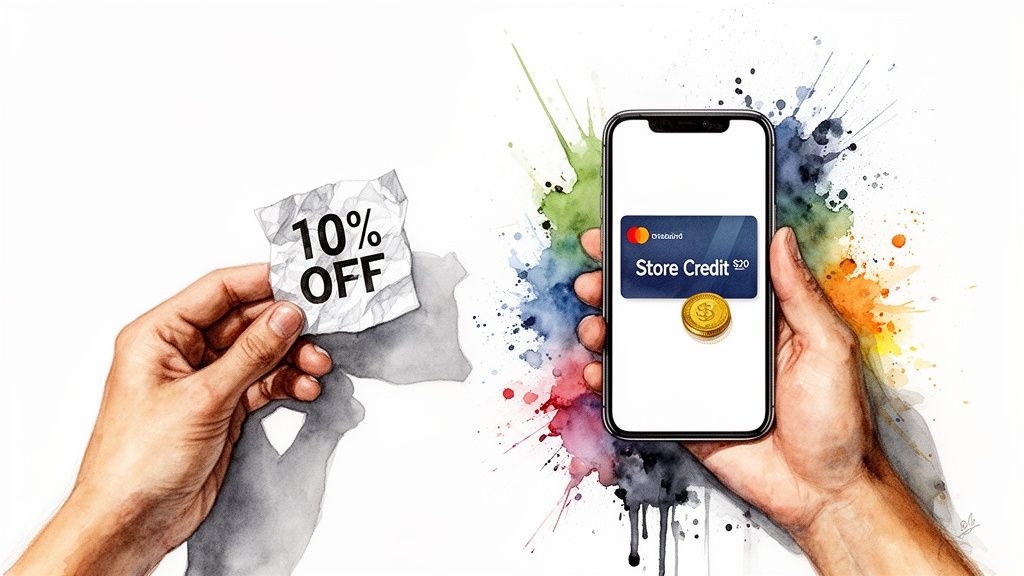
The design of your offer is the single most important piece of the puzzle. While a percentage-off discount might seem like a good idea, it just doesn’t have the same immediate punch as a specific dollar amount. An offer like "Give $20, Get $20" is simple, tangible, and customers get it instantly. It feels like real cash, not a calculation.
This dual-sided incentive is what makes the magic happen. It creates a win-win that motivates both your current customer (the referrer) and their friend (the new customer). The referrer gets to feel generous by giving a real gift, and their friend feels a strong pull to make that first purchase.
Crafting Simple and Transparent Rules
Complexity kills participation. Plain and simple. If your customers need to pull out a calculator or read a wall of text to understand the deal, they’re just going to tune out. Your rules should be so straightforward they can be explained in a single sentence.
Let’s imagine a boutique coffee roaster running on Shopify. Their average order value is around $50. Here’s how they could frame a clear, compelling offer:
The Offer: Give a friend $20 off their first order of $40 or more, and get $20 in store credit when they buy.
Why It Works: The rules are crystal clear. The minimum spend protects profitability on the new customer's order, while the $20 store credit for the advocate is a hefty reward that practically guarantees they'll come back to shop again, boosting their LTV.
That kind of transparency builds trust and makes sharing a no-brainer. You want customers to feel smart and generous for participating, not confused or like they're being tricked.
Setting Rewards to Boost Lifetime Value
This is where a store credit program really shines—its direct impact on customer lifetime value (LTV). The reward you choose needs to be generous enough to get people excited, but it should also be structured to encourage a second, larger purchase from your loyal advocate.
Giving a referrer $20 in store credit instead of a one-time discount code is a strategic move. When that customer comes back to spend their credit, they rarely stop at just $20. They see it as a perfect opportunity to finally buy that $60 item they've been eyeing, feeling like they're only paying $40 out of pocket. This tactic naturally bumps up your average order value on their next purchase.
The magic of store credit is that it transforms a customer acquisition cost into a retention investment. You're not just buying a new customer; you're funding the next purchase for one of your best existing customers, directly increasing their lifetime value.
This model is incredibly profitable when done right. We've seen Shopify referral programs deliver commissions between 5-30%, with some partners earning an average of $58 per referred subscription. This just shows the financial power of a well-thought-out incentive.
If you're looking for more ways to build loyalty, there are plenty of broader strategies you can use to increase customer lifetime value.
The Give and Get Balance
Finding that sweet spot for your "Give" and "Get" amounts is crucial. Symmetrical offers like "Give $20, Get $20" are popular for a reason—they feel fair and are dead simple to remember.
But don't be afraid to tweak the balance based on your goals.
Want more new customers? Lean into a higher "Give" amount (e.g., Give $25, Get $15). This makes the offer extra tempting for someone who's never shopped with you before.
Want to reward advocates & boost LTV? Try a higher "Get" amount (e.g., Give $15, Get $25). This gives your existing fans a stronger reason to spread the word and come back to spend their larger credit balance, likely increasing AOV on that next purchase.
The best approach is to test what clicks with your audience. The most effective Shopify referral programs are the ones that feel incredibly generous to customers while remaining wildly profitable for the business. By focusing on native store credit, you build a system that accomplishes both, creating a powerful engine for LTV growth.
Natively Integrating Your Store Credit Program in Shopify
Alright, let's move from theory to action. This is where you actually bring your high-LTV referral program to life, and the good news is you don't need to hire a developer or wrestle with custom code. The secret is choosing a solution that works natively within Shopify's own store credit system.
Using an app like Redeemly, which plugs right into the Shopify backend, is a game-changer. It sidesteps the clunky, external scripts that so many third-party apps rely on—the kind that bog down your site, frustrate customers, and can even hurt your conversion rates. A native solution is fast, lightweight, and feels completely seamless.
The Native Shopify Advantage
When a referral app is truly native, the store credit it issues isn't some weird, proprietary balance trapped inside that one app. It’s actual Shopify store credit. This is the same credit you'd issue for a return, and that distinction is absolutely critical.
This approach keeps the entire customer experience silky smooth. The credit balance shows up everywhere it should in Shopify, from the customer’s account page straight through to the checkout. No more asking customers to copy and paste confusing codes or apply a separate gift card. The credit is just there, ready to use.
A native integration makes your referral program feel like a core part of your brand, not some bolted-on widget. It respects your site's performance and gives your customers a frictionless journey—which is everything when it comes to building trust and increasing lifetime value.
One-Click Installation and Setup
Getting a native referral program for Shopify up and running should be a piece of cake. With a tool like Redeemly, it all starts with a simple one-click install from the Shopify App Store. Because it’s built specifically for Shopify, you don't have to mess around with any complicated setup or external accounts.
Once it's installed, your first job is to lay down the rules for your program. This is where you tell the system what triggers should automatically hand out store credit.
Set Your Reward Amounts: Decide on your "Give & Get" offer. A classic example is giving the new customer $20 off their first order, and rewarding the advocate with $20 in store credit once that purchase is complete.
Define Purchase Requirements: You can get more specific by adding conditions, like a minimum order value for the referred friend. This protects your margins and helps ensure you're attracting the right kind of customer.
Automate Credit Issuance: From there, the system takes over. When a referred friend makes a qualifying purchase, the app automatically drops the store credit right into the advocate's Shopify account.
This hands-off process lets your program scale effortlessly as more and more of your customers get involved. If you want to dive deeper into the nuts and bolts, you can learn all about the specifics of issuing store credit on Shopify in our guide.
Customizing On-Site Widgets for Maximum Impact
A referral program is only as good as its visibility. If customers don't know it exists—or forget about the credit they've earned—it's not going to do you much good. This is where on-site widgets become your secret weapon for driving engagement and bumping up your average order value.
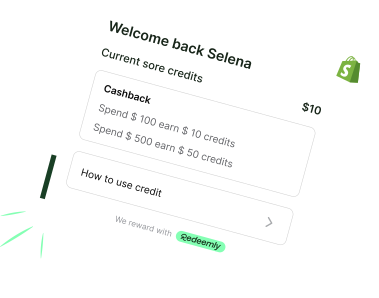
Here’s a look at how an on-site widget can serve as a constant, visible reminder for your customers.

The image above shows just how simple and effective a "Give & Get" offer can be. It's clean, easy to understand, and reinforces the value for both people involved.
Imagine a floating wallet that sits discreetly on every page of your store. This little widget constantly displays the customer's available store credit, acting as a persistent nudge to come back and spend it. Honestly, seeing that you have $20 sitting there waiting for you is a far more powerful motivator than some forgotten coupon code buried in an email inbox. It's a direct driver of repeat purchases and higher LTV.
Automating Notifications That Drive Action
The final piece of the puzzle is automating your communications. A native app can fire off emails based on key actions in the referral process, so your customers are always in the loop without you having to lift a finger.
You can set up notifications for all the key moments:
Credit Earned Confirmation: The second a friend makes a purchase, instantly email the advocate to let them know $20 in store credit just hit their account. That immediate feedback is huge for reinforcing the behavior you want to see.
Balance Reminders: If a customer has an unused balance for a while, a gentle reminder can work wonders. A simple, "Hey, you still have $20 waiting for you!" is often all it takes to pull them back to your store.
Friend's Welcome Email: When someone clicks a referral link, greet them with their exclusive offer and explain exactly how to claim their discount. Make it easy for them.
By setting up these simple, automated touchpoints, you create a self-sustaining system that nurtures both your advocates and the new customers they bring in. This hands-off approach ensures your Shopify referral program not only runs smoothly but actively works to increase customer lifetime value.
Promoting Your Referral Program to Drive Participation
Even the most generous, well-designed referral program will fall flat if your customers don't know it exists. The secret isn't just announcing it; it's about weaving the invitation to share so seamlessly into the customer journey that it feels like a natural, rewarding part of their experience.
This is your playbook for turning happy customers into your most powerful brand advocates. It’s about meeting them where they are—at just the right time—with an offer they can't wait to share.

Integrate Promotion Across the Entire Customer Journey
To get real traction, you have to make your referral program impossible to miss. Don't just stick it on a landing page and hope for the best. Instead, think about those moments of peak customer happiness—that's when you want to pop the question.
Here are the prime spots to place compelling calls-to-action:
Homepage Banners: A simple, clean banner at the top of your site keeps the offer front and center. Use benefit-driven language that gets straight to the point, like, "Give Friends $20, Get $20."
Post-Purchase Thank You Page: This is golden real estate. The customer just bought from you, and their excitement is at an all-time high. A prominent CTA here is your single best opportunity to convert them into an advocate.
Order Confirmation Emails: These emails have massive open rates. Slide in a section that clearly explains the referral offer, making it easy for them to share while still basking in that post-purchase glow.
Customer Account Page: Your loyal, repeat customers live here. Placing a dedicated referral section on their account page—showing their unique link and any earned credit—rewards their loyalty and encourages repeat sharing.
Leverage Your Post-Purchase Email Flows
Your automated emails are a secret weapon for promotion. Instead of just being transactional, they can become powerful touchpoints that drive both referrals and customer lifetime value.
Think about the shipping notification email. The customer is eagerly anticipating their package. A simple P.S. can plant the seed: "P.S. Love what you ordered? Once it arrives, give a friend $20 off their first order and get $20 in store credit on us!"
Then, a week or two after delivery, you can follow up with a dedicated email. Now's the time to be direct.
Example Post-Purchase Email Message
Subject: Loving your new [Product Name]? Share it and get $20!
Hi [Customer Name],
We hope you're enjoying your recent order. If you love it as much as we do, why not share it with a friend?
Give them $20 off their first purchase, and to say thanks, we'll add $20 in store credit to your account for your next one.
It’s a win-win!
[Share Your Link]
Craft Social Media Posts That Encourage Sharing
Social media is built for sharing, making it a perfect match for your Shopify referral program. Create sharp, eye-catching graphics that spell out the offer loud and clear ("Give $20, Get $20"). In your captions, tag your most vocal brand fans and prompt followers to tag friends who would love your products.
Don't underestimate the power of social proof. A recommendation from a friend carries so much more weight than an ad. It’s precisely why a well-executed referral program can boost sales by up to 30%. Because these leads come from a trusted source, they tend to result in conversions that are 4x higher than other marketing channels.
For even more inspiration, you can explore other successful referral program ideas in our comprehensive guide. By making your program a visible, easy-to-understand part of the customer experience, you’ll create a powerful, self-sustaining engine for growth.
Measuring Success and Optimizing for Profitability
Getting your Shopify referral program live is a huge win, but the real magic happens when you start connecting the dots to your bottom line. It's the difference between having a program and having a profitable one that actively increases LTV and AOV.
This isn't about chasing vanity metrics. It’s about diving into the numbers that actually move the needle for your business. When you know what’s working, what isn’t, and why, you can fine-tune your strategy and turn your referral program into a true growth engine.
Defining the KPIs That Truly Matter
Forget just counting shares. To really understand how your store credit referral program is performing, you need to look at the metrics that tell a story about business growth. These are the numbers that reveal the true health and profitability of your efforts.
Your app's dashboard is your command center. Get comfortable in there, and make these your core metrics:
Referral Rate: What percentage of your total sales are coming from referrals? A healthy program usually drives 1-5% of all orders, which is a great sign that your customers are actively participating.
Referred Customer Conversion Rate: How many people who click a referral link actually buy something? A high conversion rate here tells you two things: your offer is compelling and the friends being referred are a great fit for your brand.
Advocate Repeat Purchase Rate: This one is a goldmine for understanding LTV. It shows how often your advocates—the people doing the referring—come back to spend their store credit. This is where you see the loyalty loop in action.
Average Order Value (AOV) of Referred Customers: Are the new customers you're acquiring through referrals spending more than your average customer? They often do, because they’re coming in with a trusted recommendation.
AOV of Advocates Using Credit: When your advocates cash in their store credit, are they spending more than they usually would? You'll often find that the "free money" feeling of store credit encourages them to load up their cart.
From Data to Actionable Insights
Watching these numbers is one thing; doing something with them is where the growth is. Your dashboard isn't just a report card—it's a roadmap telling you where to go next.
So, let's play this out. You log in, look at your analytics, and spot a trend. Now what?
The goal is to create a constant feedback loop: analyze performance, come up with a hunch about how to improve it, test your change, and measure what happens. This is how you stack small wins that lead to huge gains in LTV and AOV over time.
For instance, if you notice your share rate is lower than you'd like, maybe your offer just isn't exciting enough. Or perhaps customers aren't seeing it at the right moment. That’s your cue to start experimenting with your messaging or tweaking where you place your promotional banners.
Optimizing Your Program for Higher Profits
Once you’re gathering this data, you can start making smart, targeted improvements. Every little tweak should be aimed at boosting one of your core KPIs, which ultimately drives up profitability across the board.
Here's a simple way to think about turning your data into dollars:
If You See This Problem... | Try This Solution... | The Goal Is To Improve... |
|---|---|---|
Low Share Rate | Bump up the offer. Is "Give $10, Get $10" falling flat? Test "Give $25, Get $25." Make sure you're promoting the program on your homepage and in post-purchase emails. | Advocate participation and get more referral links out into the world. |
Low Referred Friend Conversion | Sweeten the deal for the friend. Make the "Give" offer more generous and ensure your referral landing page is super clear about the benefit they're getting. | The conversion rate of new customers, which is the whole point of customer acquisition. |
Low Advocate Repeat Purchases | Don't let that store credit collect dust! Set up automated email reminders for advocates with an unused balance, maybe even featuring new products they could buy with it. | Customer Lifetime Value (LTV), by turning that earned credit into another sale. |
Low AOV on Credit Redemption | Introduce a small spending threshold. For example, offer a bonus $5 credit if they spend over $100 when redeeming their reward. | Average Order Value (AOV), by giving them a little nudge to add more to their cart. |
By keeping a close eye on your data and making these kinds of strategic adjustments, your referral program for Shopify becomes so much more than a marketing tactic. It becomes a predictable, scalable, and incredibly profitable channel for growing your business the right way.
Still Have a Few Lingering Questions?
Even with the perfect strategy on paper, it's natural to have a few last-minute "what ifs" before you launch. I get it. You want to make sure you’ve covered all your bases.
Let’s tackle some of the most common questions I hear from merchants just like you. Think of this as the final check-in to clear up any doubts and get you ready to go live with confidence.
"How Much Should I Actually Give as a Reward?"
This is always the first question, and the answer isn't one-size-fits-all. It really comes down to your numbers—specifically your average order value (AOV) and customer lifetime value (LTV).
A fantastic starting point for many brands is the classic "Give $20, Get $20" model. It's balanced, easy to remember, and feels significant enough to get both your customer and their friend to take action.
But you should definitely tailor it to your store:
Higher AOV (over $100)? You might want to bump that up to something like "Give $30, Get $30." The reward should feel proportional to what people are spending.
Lower AOV (under $50)? A "Give $10, Get $10" offer can be just as effective without eating into your margins. It’s still a compelling reason to share.
The trick is to make the reward feel like a genuine "thank you," not just a tiny, forgettable discount. Don't be shy about testing different reward amounts. You’re looking for that sweet spot that maximizes LTV and AOV.
"Is a Store Credit Program Expensive to Run?"
This is a totally fair question, but it comes from looking at store credit the wrong way. Unlike a straight discount that immediately slices into your profit, store credit is an investment in a future purchase.
Here’s how to reframe it: you aren’t just giving away money. You’re essentially pre-funding a loyal customer's next order. And more often than not, they’ll spend far more than the credit amount when they come back, boosting both AOV and their total LTV.
A store credit referral program isn't an expense; it's a self-liquidating investment in customer retention. The "cost" is directly tied to the profitable action of a loyal customer making another purchase.
"Will This Wreck My Bookkeeping?"
Not in the slightest, provided you use an app that integrates natively with Shopify. When a tool plugs directly into Shopify’s own store credit system, all the accounting is handled automatically.
The store credit simply sits as a gift card liability right within your Shopify admin—no clunky spreadsheets or third-party dashboards to reconcile. It’s all tracked cleanly in one place, which will make you (and your accountant) very happy.
As you plan your program, it's also smart to keep an eye on how these strategies align with broader trends in the ecommerce industry.
"How Do I Stop People from Gaming the System?"
Referral fraud is a real concern, but modern referral apps are built with this in mind. The right tool will have powerful, automated protections running in the background to keep everyone honest.
You don't have to play detective. Look for an app that includes these security features out of the box:
Self-Referral Blocking: Stops people from referring themselves just to snag a discount.
IP Address Monitoring: Flags suspicious activity, like multiple referrals coming from the same computer.
Minimum Purchase Requirements: Ensures the new customer makes a real purchase before any credit is issued.
These features work silently to protect your bottom line from abuse, so you can confidently run your referral program for Shopify knowing that only genuine brand advocates are getting rewarded.
Ready to turn your most loyal customers into your most powerful growth engine? With Redeemly, you can launch a store credit referral program that skyrockets lifetime value and keeps your margins healthy. It's time to stop handing out discounts and start building true loyalty.
Get started with Redeemly today and discover what a difference store credit can make.


Join 7000+ brands using our apps