Master the Lifetime Value of a Customer Calculation for Shopify
Dec 28, 2025
|
Published
The lifetime value of a customer is more than just a metric; it’s a mindset shift. It’s about understanding the total profit your business can expect from a single customer over their entire relationship with you.
Once you grasp this, you can stop chasing one-off sales with margin-killing discounts and start building a genuinely sustainable, profitable brand. The focus pivots from quick wins to fostering real loyalty and increasing repeat purchases, primarily by boosting your lifetime value (LTV) and average order value (AOV).
Why Ignoring LTV Is Costing Your Shopify Brand
So many Shopify stores fall into the same dangerous trap: they fixate on the first sale. This transactional thinking leads to a frantic, endless cycle of acquiring new customers, usually by dangling steep discounts and confusing points systems that absolutely crush profit margins. Sure, it might juice your short-term revenue, but it's a leaky bucket strategy that ignores the real engine of growth—repeat business from your best customers.
The secret to unlocking sustainable profitability is to shift your focus from single transactions to long-term relationships. It’s all about understanding the total value a customer brings to the table, not just what they spend on their first order. This is where calculating the lifetime value of a customer becomes your most powerful tool.
Moving Beyond First-Purchase AOV
Let’s imagine two different Shopify brands.
Brand A is obsessed with bumping up the Average Order Value (AOV) on that first purchase. They're constantly running "20% off!" promotions, which pulls in bargain hunters who buy once and then disappear forever.
Brand B, on the other hand, is laser-focused on LTV. Instead of discounts, they use Shopify's native store credit functionality, offering something simple and effective, like "$10 in store credit toward your next purchase."
This small change accomplishes two powerful things:
It protects their profit margins on that critical first sale.
It gives customers a real, tangible reason to come back for more.
By rewarding loyalty with store credit, you're not just making another sale; you're investing in a future revenue stream. This strategy is a direct lever for boosting purchase frequency and extending the customer lifespan—the very heart of a high LTV and a healthier AOV.
The Power of a North-Star Metric
When you truly understand LTV, you can make smarter decisions across your entire business. You’ll know exactly how much you can afford to spend on customer acquisition (CAC) and still stay profitable. To really see what's at stake, exploring effective strategies for improving retention rates and lowering churn is a crucial step toward building a more resilient brand.
As CMSWire points out, even a basic LTV formula (AOV x Purchase Frequency x Customer Lifespan) can reveal staggering potential. Think about it: a customer with a $72 AOV who buys from you quarterly for seven years is worth a whopping $1,680. That's why LTV, not first-sale AOV, should be the north-star metric guiding your growth.
And as you get better at keeping customers around, you'll naturally see your bottom line improve. You can also check out our guide to see how these tactics can help you improve profit margins in other areas of your business.
The Essential Formulas for LTV Calculation
If you're still fixated on one-off sales, you're missing the bigger picture. The real health of your brand isn't just about this month's revenue; it’s about the long-term profitability of your customer relationships. Calculating customer lifetime value (LTV) isn't just some abstract business school exercise—it's the tool that pulls back the curtain, showing you exactly what your customers are worth.
This shift in thinking is crucial. You're not just processing orders; you're building an asset. The goal is to move a customer from their first purchase to becoming a loyal advocate for your brand.
This is the journey that drives up LTV.
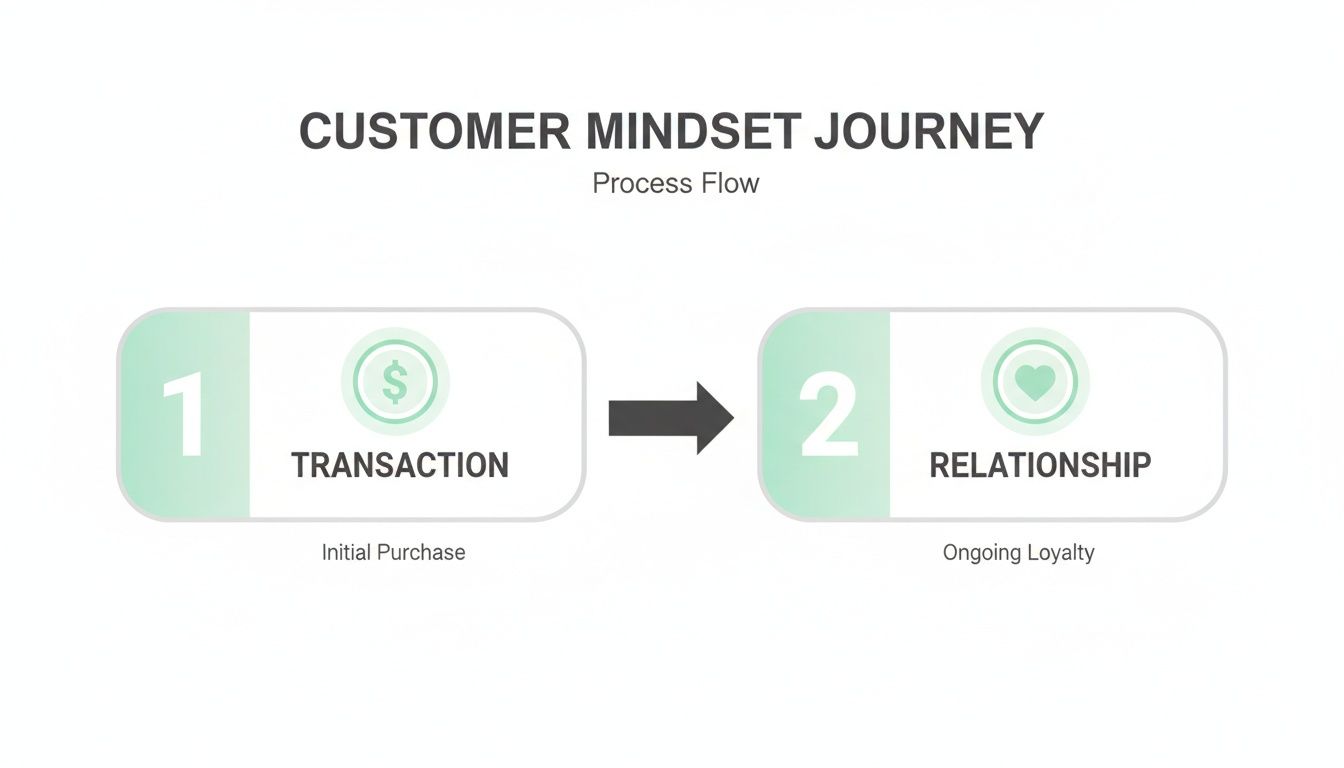
Let's break down how to actually put a number on that journey.
The Foundational LTV Formula
The simplest way to get a baseline LTV is with a straightforward formula. It multiplies three key metrics you can pull directly from your Shopify reports.
Average Order Value (AOV): How much does a customer typically spend in one transaction?
Purchase Frequency (F): In a given year, how many times do they come back to buy again?
Customer Lifespan (L): How many years do they stick around?
Put them together, and you get this:
LTV = AOV x F x L
Let's make this real. Imagine you run a DTC apparel brand. Your numbers show an Average Order Value of $80, customers typically buy 4 times a year, and the average relationship lasts for 3 years.
The math is simple: $80 x 4 x 3 = $960.
Just like that, you know that every new customer you bring in represents nearly a thousand dollars in future revenue. That's a powerful number.
Advancing to a Profit-Driven Formula
While the basic formula is a great starting point, it only tells you about revenue, not profit. To make smarter decisions about your ad spend and retention efforts, you need to know how much money you’re actually making from each customer.
This is where Gross Margin (GM) comes in. By adding it to the equation, you get a much clearer, more actionable LTV.
The profit-focused formula is:
LTV = (AOV x F x L) x GM
Let’s go back to our apparel brand. That $960 LTV is a top-line figure. If their gross margin is 60% (or 0.60), the profit-driven LTV looks very different:
$960 x 0.60 = $576
Now this is a number you can build a strategy around. It tells you that you can spend up to $576 to acquire a customer and still break even over their lifetime. Anything less is pure profit.
A Glance at LTV Calculation Methods
To help you decide which formula is right for you, here’s a quick comparison of the two main approaches we've covered.
Calculation Method | Formula | Best For | Key Limitation |
|---|---|---|---|
Basic LTV | AOV x F x L | Quick, high-level estimates of customer revenue. | Ignores profitability and cost of goods sold (COGS). |
Profit-Focused LTV | (AOV x F x L) x GM | Making strategic decisions on marketing spend and profitability. | Requires accurate gross margin data, which can be complex. |
Ultimately, the profit-focused formula gives you the most realistic and actionable insight, but the basic calculation is a perfectly fine place to start.
This profit-based approach is especially critical when you're evaluating retention strategies like store credit. Because native store credit programs avoid the deep margin cuts of traditional discounts, they directly protect and even enhance the "GM" part of your LTV calculation, making every customer more profitable from the start.
According to a guide from Shopify, the foundational formula has become essential for merchants aiming to outpace competitors who still rely on discounts. They point to a common scenario for B2C clothing retailers: if your AOV is $75, purchase frequency is 8 times a year, and lifespan is 3 years, your basic LTV is a substantial $1,800 before you even factor in costs. This highlights just how valuable understanding this metric can be for brand growth.
Finding the LTV Gold in Your Shopify Dashboard
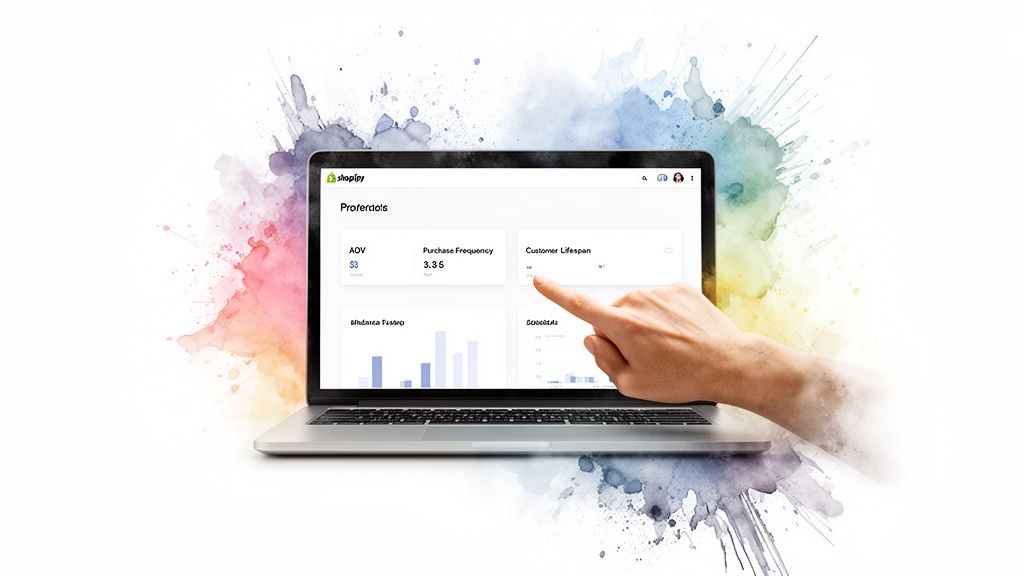
Knowing the LTV formulas is half the battle. The other half—the part where most people get stuck—is digging up the right data to plug into them. Your Shopify dashboard is a treasure trove, but you have to know where to look. Let's walk through exactly which reports to pull so you can stop guessing and start calculating LTV with confidence.
Getting this right gives you a crystal-clear, data-backed view of what a customer is actually worth to your business. That clarity is everything when you're making calls on ad budgets, marketing campaigns, and retention strategies.
Uncovering Your Average Order Value
First up is your Average Order Value (AOV). This is the bedrock of your LTV calculation and, thankfully, the easiest number to find.
Just head into your Shopify admin and navigate to Analytics > Reports. Pull up the "Sales over time" report. To get your AOV, all you have to do is divide your total sales by the total number of orders for that same period. Simple.
But here’s a pro tip: don't just use the generic, store-wide AOV. That's a rookie mistake that can throw off your entire calculation. You need to get more granular.
The AOV from a first-time buyer is almost always different—usually lower—than a loyal repeat customer. Run the 'First-time vs. returning customer sales' report to see the actual difference. This small step adds a layer of precision that makes your LTV so much more reliable.
Pinpointing Purchase Frequency and Lifespan
Next, we need to figure out how often customers are coming back to buy and for how long they stick around. This is where you get to play detective with Shopify's cohort analysis.
You’ll find this report under Analytics > Reports > Customer cohort analysis. It’s a powerful tool that groups your customers based on the month they first bought something and then tracks their buying habits over the following months. It shows you repeat purchase behavior in black and white.
Purchase Frequency: Dive into your cohorts. How many orders, on average, does a customer from a specific cohort place in their first year? That’s your number.
Customer Lifespan: Watch how long your cohorts stay active. If you notice a big drop-off after, say, 18 months, that’s a realistic customer lifespan you can use for your calculations.
This data is also where you’ll see the payoff from your retention efforts. If you launch a new native store credit program, you should see a tangible bump in repeat purchases within these cohorts, which directly translates to a higher LTV. While Shopify is your primary source, for an even deeper analysis, some businesses are leveraging bank statement converter software to pull in transaction data from other channels and get a truly complete LTV picture.
How Store Credit Can Transform Your LTV and Profitability
Knowing how to calculate your customer's lifetime value is one thing, but actually improving it is where the real growth happens. It’s time to connect the dots between the formulas and your bottom line.
If you want to move the needle on your key LTV metrics—Average Order Value, Purchase Frequency, and Customer Lifespan—you need to rethink how you approach customer loyalty. For years, the go-to has been margin-killing discount codes and complicated points systems. But there's a much smarter way.
The answer is a simple, powerful tool: native Shopify store credit. When you make this shift, you stop giving customers a one-off reason to buy and start giving them a compelling reason to come back again and again. You build true loyalty while protecting your profitability every step of the way.
A Simple Nudge to a Higher Average Order Value
The psychology here is incredibly effective. Instead of a generic "20% off" that trains customers to expect deals, you create tiered store credit rewards.
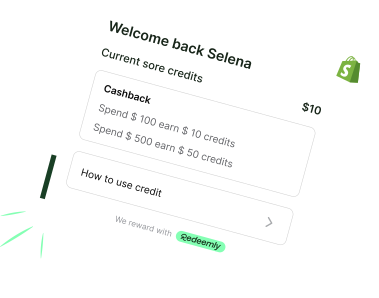
Imagine setting up a simple rule: "Spend $100, get $10 in store credit."
A customer with $85 in their cart now sees a clear path to a reward. They're no longer just buying products; they're actively trying to unlock what feels like free cash for their next purchase. This simple nudge is often all it takes for them to add one more item to their cart, directly boosting your AOV without the immediate margin hit of a discount code.
The Secret Hook for Driving Repeat Purchases
That earned store credit does more than just reward a purchase—it acts as a powerful hook. Unlike abstract points that get forgotten, a $10 credit balance feels like real money just sitting in their account, waiting to be spent.
This creates a powerful, built-in reason for them to return, directly increasing your purchase frequency. The customer's internal monologue shifts from, "Should I buy from this store again someday?" to "How can I spend the money I already have with them?" It’s a subtle but game-changing mental switch that keeps your brand top of mind and shortens the gap between orders.
Think of it this way: by issuing store credit, you're essentially pre-selling their next purchase. We've seen that customers are 73% more likely to buy again when they have a credit balance. That's a massive lift that extends their lifespan and sends your LTV soaring.
Before and After: The Store Credit Transformation
Let's look at the real-world financial impact. Here’s a side-by-side comparison of a brand running on traditional discounts versus the same brand after switching to a native Shopify store credit system.
Brand A (Stuck on Discounts & Points)
AOV: $75 (after a 25% discount is applied to a $100 cart)
Purchase Frequency: 2 times per year
Customer Lifespan: 1.5 years
Gross Margin: 50%
Profit-Focused LTV: ($75 x 2 x 1.5) x 0.50 = $112.50
Brand B (Powered by Native Store Credit)
AOV: $100 (customers spend more to earn their credit)
Purchase Frequency: 3 times per year (the credit balance brings them back)
Customer Lifespan: 2 years (loyalty is stronger and lasts longer)
Gross Margin: 60% (no upfront discount to eat into profit)
Profit-Focused LTV: ($100 x 3 x 2) x 0.60 = $360.00
The difference is night and day. By simply swapping out discounts for a smarter store credit strategy, the brand more than tripled its customer lifetime value. This isn't just a theoretical model; it's a proven blueprint for profitable, sustainable growth. You're no longer just acquiring customers—you're investing in relationships without sacrificing the very margin you need to scale.
Actionable Ways to Boost Your LTV with Store Credit
So, you've got a handle on calculating your customer lifetime value. What now? The next step is to actually grow that number. But this isn't about chasing endless repeat sales at any cost. The smartest strategies focus on improving the core drivers of LTV—your Average Order Value (AOV) and Purchase Frequency—without killing your margins.
This is exactly where a native Shopify store credit program, like Redeemly, really shines. It helps you break free from the race-to-the-bottom cycle of constant discounts and confusing points systems. Instead, you give customers a clear, compelling reason to spend more with you and come back sooner.
Let's get into the practical tactics you can put to work right away.
Use Tiered Rewards to Increase Average Order Value
One of the simplest ways to bump up your AOV is to give customers a clear target to shoot for. Forget flat rewards. Create simple, tiered incentives that encourage shoppers to add just one more item to their cart to unlock a better perk.
This approach subtly gamifies the shopping experience, turning a customer's focus from "How much can I save?" to "What reward can I earn?" It's a small psychological shift with a big impact on your bottom line.
Here’s what a simple, margin-friendly tier structure could look like:
Spend $75, get $5 in credit. A perfect entry-level reward to nudge smaller carts over a key threshold.
Spend $125, get $15 in credit. This tier offers a slightly better return, rewarding your bigger spenders and motivating others to reach for it.
The real genius here is how it protects your profitability. A 20% off coupon immediately slashes your revenue on that sale. Store credit, on the other hand, only becomes a cost when it's redeemed on a future purchase—a purchase that might never have happened without that credit sitting in their account.
Keep Credit Balances Top of Mind
Earned store credit is worthless if your customers forget they have it. Out of sight is truly out of mind in ecommerce. You have to make their credit balance a visible, persistent reminder of the value waiting for them at your store.
A customer with a store credit balance is a warm lead for a repeat purchase. By making that balance impossible to ignore, you create a powerful psychological pull that shortens the time between orders and directly boosts purchase frequency.
Use on-site widgets, like a floating wallet icon, to display the customer's available credit on every single page. This constant visibility turns their balance into a tangible asset they'll feel compelled to use. You can then reinforce this with smart email campaigns, like a monthly balance reminder or a "your credit is waiting" nudge for customers who've been away for a while.
For more hands-on ideas, you can explore our detailed guide on how to give store credit on Shopify and weave it seamlessly into your customer journey.
Run Strategic Bonus Credit Events
Finally, you can use store credit to create all the urgency of a flash sale without the deep margin cuts. Instead of a site-wide discount, try running a limited-time "Bonus Credit Weekend" or "Double Credit Day." These events are fantastic for generating buzz and driving a ton of traffic and sales.
For instance, you could offer $20 in credit for every $100 spent, but only for 48 hours. This tactic not only spikes your AOV during the event but also seeds your best customers' accounts with credit, giving them a powerful reason to return in the following weeks. It’s a brilliant one-two punch: boost sales now while fueling the repeat purchases that build a truly impressive LTV down the road.
To tie this all together, here’s a quick-reference table outlining how these store credit tactics directly influence your key growth metrics.
AOV and LTV Boosting Tactics with Store Credit
Tactic | Primary Goal | How It Works | Example Implementation |
|---|---|---|---|
Tiered Spend Thresholds | Increase AOV | Motivates customers to add more items to their cart to unlock a higher-value credit reward. | "Spend $75, get $5. Spend $125, get $15 in credit." |
Visible Credit Balance | Increase Purchase Frequency | Keeps their earned credit top-of-mind, creating a psychological incentive to return and spend it. | An on-site "wallet" widget showing the balance on all pages. |
Bonus Credit Events | Spike AOV & Frequency | Creates urgency and rewards high-value purchases with extra credit, encouraging a quick return visit. | "Double Credit Weekend: Earn $20 for every $100 spent." |
Proactive Returns Credit | Increase Retention & LTV | Offers instant store credit instead of a cash refund, keeping revenue in your business and simplifying the customer experience. | A returns portal that offers "Instant Store Credit" as the primary, easiest option. |
By implementing even one or two of these strategies, you can begin to see a meaningful lift in your customer lifetime value, all while protecting your hard-earned margins.
Answering Your Top LTV Questions
Getting into the weeds with LTV always brings up a few practical questions. Thinking through the timing of your analysis, how you stack up against industry standards, and the real power of segmentation is what turns LTV from just another number into a serious tool for growth.
How Often Should I Actually Calculate LTV?
For most stores, running your LTV numbers quarterly is the perfect sweet spot. It's frequent enough to see how your marketing and retention efforts are paying off—like that new store credit program you just launched—without drowning you in data.
That said, if you’ve just rolled out a massive campaign or made a big change to your customer experience, you might want to peek at the numbers monthly to get a quicker read on the impact.
The real key? Just be consistent. Sticking to a regular schedule is how you’ll spot the trends that matter, like seeing your average order value climb after you introduce a new loyalty tier.
What's a Good LTV to CAC Ratio Anyway?
You're looking for a magic number, right? For a healthy ecommerce brand, the gold standard is an LTV to Customer Acquisition Cost (CAC) ratio of 3:1 or higher.
Think of it this way: for every dollar you burn to get a new customer, you should be making at least three dollars back in profit from them over their entire relationship with you.
If you’re dipping below that 3:1 mark, it’s a red flag. You might be spending too much to get customers in the door, or you're struggling to keep them coming back. On the flip side, if your ratio is something crazy like 5:1, it’s a great sign—and it probably means you have a green light to get more aggressive with your growth budget.
Can I Calculate LTV for Different Types of Customers?
Not only can you, but you absolutely should. This is where the real magic happens.
Segmenting your LTV calculation unlocks incredibly valuable insights. You can slice your data by:
The first product a customer bought
Which marketing channel brought them to you (e.g., Facebook Ads vs. organic search)
Even where they live
This kind of analysis tells you exactly which channels bring in your VIPs and which products are the gateway to long-term loyalty. It’s the data you need to confidently double down on what’s working and fine-tune your marketing spend for maximum profit.
Ready to stop killing your margins with endless discounts? It's time to boost your LTV with a smarter, simpler way to build loyalty. With Redeemly, you can launch a native Shopify store credit program that increases average order value and drives profitable repeat purchases.
Discover how Redeemly can transform your customer loyalty today.


Join 7000+ brands using our apps