How to Improve Profit Margins on Shopify
Dec 3, 2025
|
Published
That constant cycle of flash sales and coupon codes feels like a win, doesn't it? But deep down, you know it's quietly eating away at your Shopify store's foundations. To truly improve your profit margins, you need to stop thinking in terms of short-term tactics and start building a long-term strategy. This means focusing on customer lifetime value and average order value, and creating incentives that don't slash your prices—like using native Shopify store credit instead of confusing points systems. It's a shift, but it’s one that builds sustainable profitability and genuine brand value.
Why Your Discount Strategy Is Killing Your Profit Margins
For so many Shopify stores, that "20% OFF" banner is the go-to marketing tool. It drives a bit of traffic, creates some urgency, and helps clear out old stock. But this quick revenue hit comes at a steep, often hidden, cost that chips away at the financial health of your brand. It’s a classic case of a short-term solution creating long-term problems that directly harms your lifetime value metrics.

Relying on discounts trains your customers to devalue what you sell. They quickly learn to wait for the next sale, which absolutely kills any chance of them paying full price. This creates a dangerous cycle where your brand becomes synonymous with "cheap," attracting one-off bargain hunters instead of loyal, high-value customers who drive a high lifetime value.
The Real Cost of a Coupon Code
Let's do some quick back-of-the-napkin maths on a seemingly harmless 20% discount. It doesn't just reduce your profit by 20%—the real impact is far more damaging.
Imagine you sell a product for £100 with a healthy 40% gross margin, giving you a £40 profit. Offering a 20% discount drops the price to £80. Your cost of goods sold hasn't changed, so your profit per unit plummets from £40 to just £20.
You’ve just halved your profit margin to secure one sale. To make the same £40 profit you would have on a single full-price purchase, you now need to sell two discounted items. This dramatically increases your customer acquisition costs and operational load, all while destroying your average order value and lifetime value potential.
Eroding Brand Value and Customer Loyalty
Beyond the cold, hard numbers, a constant discount strategy slowly cheapens your brand's perceived value. When your products are always on sale, customers naturally begin to question their actual worth. This makes it incredibly difficult to ever command premium pricing or establish your brand as a high-quality option in the market.
This approach also poisons customer loyalty and lifetime value in a few key ways:
It attracts the wrong crowd: You end up with a customer base of deal-seekers who have zero allegiance to your brand, only to the next lowest price. Their lifetime value will always be low.
It punishes your best customers: Think about it. Your most loyal customers, the ones willing to pay full price, end up feeling like mugs when they see a sale pop up a week after their purchase.
It complicates the buying journey: Confusing point systems and coupon hunts add friction. Instead of focusing on the amazing value of your products, shoppers are focused on gaming the system, which detracts from the brand experience.
The goal is to break free from this transactional, discount-driven mindset. The most profitable brands focus on building a sustainable model centered on customer lifetime value and increasing average order value. They do this not by slashing prices, but by offering value-added incentives—like a native Shopify store credit programme—that encourage repeat business without sacrificing the margin on every single sale.
It's about building a predictable revenue stream from happy, repeat customers, not chasing fleeting cash from one-time shoppers.
Wean Yourself Off Discounts: Optimise Your Pricing and Product Mix Instead
If your first instinct to boost sales is to slash prices, it's time for a rethink. Moving away from a discount-first mindset opens the door to far more sustainable ways to improve your profit margins. Instead of just cutting prices, the most successful brands strategically analyse their entire product catalogue and pricing structure to maximise both average order value and lifetime value. This isn't about guesswork; it's about making intelligent, data-driven decisions that line up your price with what your customers truly value.
First things first: you need to get intimate with your own product data. Every Shopify store has a unique mix of items, and I guarantee not all of them contribute equally to your bottom line. It’s absolutely crucial to identify which are your 'profit heroes' and which are the 'margin drains'.
A 'profit hero' isn't necessarily your bestseller. It's an item with a killer profit margin that contributes significantly to your overall profitability. A 'margin drain' might sell like hotcakes, but its low margin means you're working much, much harder for every pound you earn.
Once you’ve got your products properly categorised, you can start building a much smarter strategy. The real goal here is to guide customers towards more profitable purchases that increase your average order value without them ever feeling like they're being pushed.
Adopt Value-Based and Psychological Pricing
I see so many brands stick with cost-plus pricing, where they simply add a percentage markup to their COGS. It's the most basic approach, sure, but it completely ignores the most important factor: what your customer is actually willing to pay.
This is where value-based pricing comes in. You set prices based on the perceived value of a product to the customer, not just its cost. If your product solves a huge problem, is crafted from premium materials, or offers a unique experience, customers will often pay more. Your pricing should absolutely reflect that value.
Then, you can layer on some classic psychological pricing tactics to make your offers even more appealing.
Charm Pricing: The age-old trick of ending prices in .99 (e.g., £29.99 instead of £30.00). The "left-digit effect" is a real phenomenon that makes the price seem significantly lower.
Price Anchoring: Displaying a higher original price next to the current price (£50 £35) creates a powerful perception of a good deal, even when there's no discount code involved.
These small tweaks can seriously influence purchasing decisions and bump up conversion rates without you having to sacrifice your base margin on a big, store-wide sale.
Curate Your Product Mix for Higher Margins
Think of your product catalogue as your most powerful tool for shaping profitability and increasing average order value. When you understand how each item performs, you can strategically guide shoppers toward higher-margin sales. This involves more than just promoting certain products; it’s about structuring your offers intelligently.
Just look at the UK retail sector—there are massive differences in profit margins based on product category. Data shows that large non-grocery retailers can hit margins over 50%, while grocery stores often have to work with much tighter margins between 30-35%. It just goes to show the power of focusing on high-margin categories and optimising your product mix to boost overall profitability.
To really nail this, you need to consider all your operational costs. For instance, using clever tools that help you cut content creation costs with AI can free up a surprising amount of capital. That's cash you can then reinvest into high-margin inventory.
Here are a few ways to start engineering your product mix:
Strategic Bundling: Try pairing a high-margin 'profit hero' with a popular, lower-margin bestseller. This instantly increases the average order value and lifts the average margin of the entire sale.
Introduce Premium Tiers: Create "good, better, best" options for a key product line. The higher-priced "best" tier, with its enhanced features or materials, will naturally carry a better margin and makes the mid-tier option look like fantastic value by comparison.
Smart Cross-Selling: As customers head to checkout, suggest complementary, high-margin accessories or add-ons. Someone buying a handbag might easily be tempted by a leather care kit—a small add-on that can significantly boost the order's profit.
By actively curating how your products are presented and sold together, you shift from being a passive seller to an active architect of your store's profitability. You’re no longer just selling products; you’re engineering more profitable transactions that boost your AOV.
Increase Average Order Value Without Giving Away Margin
Every DTC owner knows that boosting your Average Order Value (AOV) is a straight line to better profit margins. The real trick is doing it without just throwing discounts at the problem. Slashing prices to get a bigger basket is a classic rookie mistake—it might lift your revenue number, but it demolishes the very margin you’re trying to build.
A much smarter play is to increase the value of each transaction, not just the top-line number.
This is about making the shopping experience better with offers that genuinely help the customer. When you get this right, people want to spend more because they see the clear benefit. And you? You get to protect your profitability on every single order, directly improving your lifetime value.
Set a Strategic Free Shipping Threshold
Let’s be honest, "Free Shipping" is one of the most powerful phrases in ecommerce. But offering it carte blanche is a surefire way to drain your profits. The secret is to use it as a strategic lever to nudge customers into spending more.
First, figure out your current AOV. Then, set your free shipping threshold just a bit higher—say, 15-20% more. This simple move creates a powerful psychological incentive. Suddenly, a customer who’s a few pounds shy of the goal is looking for one more thing to add to their cart. It turns checking out into a mini-game where they win a tangible prize, all while you lock in a healthier, more profitable sale.
Setting a free shipping threshold isn't just a shipping tactic; it's a core AOV strategy. By calculating a threshold that is slightly above your current average order, you create a psychological nudge that encourages customers to add more to their cart to "unlock" the benefit, directly boosting order value and margin.
Master the Art of Upsells and Cross-sells
Upselling and cross-selling, when done badly, feel pushy and desperate. But when done well, they feel like you’re a trusted expert offering a helpful recommendation. It’s all about timing and relevance.
Upsells: This is your chance to offer a better, higher-margin version of what they’re already looking at. Think of it as an upgrade. If someone’s viewing a standard backpack, you could show them a premium version made from waterproof, tougher material for an extra £20.
Cross-sells: Here, you suggest things that go perfectly with their chosen item. Someone buying a new camera? They're practically asking for a memory card, a protective case, or a lens cleaning kit. These are often high-margin accessories that can seriously bump up an order’s profitability.
The sweet spots for these offers are on the product page and during the Shopify checkout flow. That’s when buying intent is off the charts, making it the perfect time to increase your AOV.
Create Irresistible Product Bundles
Bundling is a brilliant way to increase perceived value and steer customers toward a bigger spend. The idea is to group complementary products—usually a hero product with a few high-margin accessories—and offer them as a convenient package.
A skincare brand, for example, could bundle its best-selling moisturiser with a high-margin serum and a cleanser. The bundle price is a little less than buying everything separately, so the customer feels like they’ve snagged a great deal. In reality, you’ve just increased the transaction value and moved more stock without running a site-wide sale.
These value-first tactics are the bedrock of a truly profitable business. They’re all about making the customer experience richer and getting more value from each order, which feeds directly into the powerful retention marketing strategies that create loyal, high-LTV customers.
Play the Long Game: Boost Lifetime Value with a Native Store Credit Programme
If bumping up your average order value is the sprint, then boosting customer lifetime value (LTV) is the marathon. It’s what builds a truly sustainable, profitable brand. The frantic cycle of launching discount codes and managing complex points systems might feel productive, but it’s a short-sighted game. To genuinely improve your profit margins for the long haul, you need to shift your focus from one-off transactions to building lasting customer relationships.
https://www.youtube.com/embed/fLaZBuGP9kU
The single most effective way I’ve seen brands do this is by ditching margin-killing coupons for a simple, powerful native Shopify store credit system. It’s a complete mindset shift. A discount just carves a chunk out of your revenue. Store credit, on the other hand, is a compelling reason for a customer to come back. It’s a strategic investment in their next purchase, creating a ‘loyalty loop’ that locks in future revenue and keeps cash flowing within your business, not out of it.
Why Store Credit Crushes Discounts and Confusing Points Systems
Let’s be honest, most traditional loyalty programmes are a bit of a mess. With their confusing tiers and point-conversion maths, they often create more friction than actual loyalty. Customers can’t figure out what their points are worth, so they don’t bother. Engagement plummets, redemption rates are abysmal, and the whole thing becomes a complicated liability on your books instead of a driver of repeat business and higher lifetime value.
Discount codes are even worse. They train your customers to wait for sales, cheapen your brand’s perceived value, and attract bargain hunters who have zero allegiance to you.
Store credit operates on a completely different psychological level.
Store credit feels like real money waiting to be spent. It’s a tangible balance sitting in a customer's account, a sunk benefit that creates a powerful psychological pull to come back and use it. This transforms the customer relationship from a transactional one into a reciprocal one, directly boosting LTV.
This approach directly attacks two of the biggest margin killers: customer acquisition costs (CAC) and customer churn. By encouraging repeat purchases, you get so much more value from your initial marketing spend. You also reduce the need to constantly be out there acquiring new, expensive customers just to replace the ones who’ve left. Understanding this dynamic is a game-changer, and you can dive deeper into how to calculate customer LTV to see the direct financial impact.
How to Actually Use Native Store Credit to Boost LTV
A native store credit programme, like the one powered by Redeemly, isn't just a single-use tool. It’s a flexible asset you can deploy all across the customer journey to protect your margins and seriously enhance customer lifetime value.
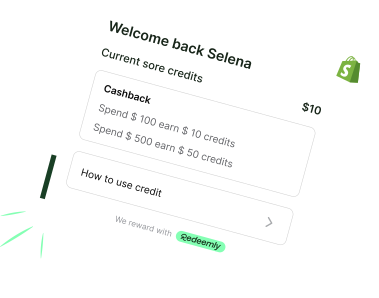
Here’s a glimpse of what a native system looks like right inside the Shopify ecosystem. It’s seamless for you and for the customer, eliminating the confusion of external points platforms.
The screenshot shows just how clean and intuitive the interface is. You can easily issue and manage store credit without ever leaving your Shopify admin, which is exactly why a native solution is so powerful for driving loyalty.
This tight integration opens up a few high-impact strategies:
Turn Returns into Repurchases: When a customer wants a return, offer them store credit—with a 10% bonus—as an alternative to a cash refund. This keeps revenue in your business and almost guarantees a future sale, increasing their lifetime value. Often, they spend more than the credit amount on their next purchase.
Proactive Customer Appreciation: Instead of another "20% OFF" email, surprise your best customers with £10 in store credit as a thank you. It feels like a gift, not a sales gimmick. This builds incredible goodwill and encourages them to come back and spend more, solidifying a high-LTV relationship.
Smart Post-Purchase Rewards: Set up automated rules to issue store credit after a purchase. For example, "Spend £100, get £10 back in store credit." This incentivises a higher initial AOV and gives them a concrete reason to place their next order with you, boosting their LTV.
Discount Coupons vs. Native Store Credit: A Comparison
To really see the difference, it helps to put the two approaches side-by-side. The impact on your margins, customer lifetime value, and even your workload is stark.
Metric | Discount Coupons & Points Systems | Native Store Credit (e.g., Redeemly) |
|---|---|---|
Profit Margins | Directly reduces revenue and profit on every transaction. Trains customers to buy only at a discount. | Keeps cash in the business. Encourages full-price purchases on subsequent orders, protecting margins. |
Customer Loyalty | Attracts one-off deal seekers. Confusing points systems create friction and low engagement. | Fosters genuine loyalty and reciprocity. Feels like a tangible benefit and a reason to return. |
Customer Lifetime Value (LTV) | Often leads to lower LTV as customers churn in search of the next best deal or lose interest in complex points. | Significantly increases LTV by driving repeat purchases and building a loyal customer base. |
Operational Complexity | Can be messy to manage (code abuse, point conversion maths, expiration tracking). | Simple and automated. Natively integrated into Shopify for easy management and a seamless customer experience. |
Cash Flow | Pulls cash out of the business immediately through lower sale prices and refunds. | Keeps cash in the business by converting refunds into future sales. Creates a predictable revenue stream. |
Ultimately, the choice comes down to your long-term vision. While discounts provide a short-term sales spike, a native Shopify store credit system builds a foundation for sustainable, profitable growth driven by high LTV.
Make Your Service So Good, People Forget to Compare Prices
Your profit margin isn't just a number on a spreadsheet; it's a direct reflection of how your customers feel about your brand. In a sea of lookalike products, exceptional customer service is one of the only real moats you can build. It’s what allows you to confidently price your products for what they're worth and sidestep the soul-crushing race to the bottom.
When customers feel genuinely cared for, price slowly fades into the background. Their focus shifts from "how much is this?" to "how much value am I getting?" This is the moment your support team stops being a cost centre and starts becoming your most powerful profit and lifetime value engine.
Stop Just Answering Tickets—Start Adding Value
World-class service isn’t about how fast you can close a ticket. It's about proactively creating moments of delight, turning potential headaches into genuine loyalty, and showing customers you’re invested in their success. It all comes down to making your expertise accessible.
Take a look at the professional services sector in the UK. These firms often hit gross margins between 55-65%, and some specialist dental practices can even reach an eye-watering 79.9%. How? By selling deep expertise and building rock-solid client relationships. You can find more on these profitability trends on ONS.gov.uk. Your brand can do the same by treating support as a value-add, not a cost.
Here are a few ways to bring that expert-led service to life:
Offer Personalised Consultations: For more complex or expensive products, offer a quick one-on-one video call or a dedicated live chat to help customers find the perfect fit.
Empower an Expert Support Team: Train your people to go off-script. They should know your products inside and out, offering detailed advice on use, care, and what other items would complement a purchase.
Solve Problems Before They Happen: Is there a shipping delay? Don't wait for the angry email. Reach out first, explain what's going on, and offer a small gesture like native store credit for the trouble. You’ve just turned a potential one-star review into a moment of trust and increased their potential lifetime value.
When your customer service feels less like a generic help desk and more like a personal consultation, you’re no longer just selling a product. You’re selling confidence, expertise, and peace of mind—all of which justify a premium price point and build lasting trust.
Turn Returns into Revenue with Native Store Credit
The returns process is a make-or-break moment for any customer relationship. It’s messy, expensive, and often painful. But it’s also a massive, overlooked opportunity to protect your margins and lock in a future purchase, boosting customer lifetime value. Instead of watching cash walk out the door with every refund, make native Shopify store credit your default.
It’s a simple but powerful shift. By offering store credit—and maybe nudging customers with a small 5-10% bonus to choose it—you achieve two critical goals. First, you keep the revenue inside your business. Second, you give that customer a compelling reason to come back. This is a foundational strategy for brands that want to improve their customer retention and grow LTV without torching their margins on discounts.
Think about it. A customer returns a £50 jumper. Instead of refunding the £50 directly to their bank, you offer them £55 in store credit. Not only have you held onto that initial revenue, but when they come back to spend their credit, chances are they'll add another item or two to their cart. Suddenly, a lost sale has become a higher-AOV repeat purchase.
This one change transforms a transactional headache into a chance to build a stronger relationship, proving to your customers that you'll always take care of them.
Your Profitability Playbook: Putting It All Together
Right, let's get down to brass tacks. Turning all these margin-boosting ideas into real-world results is where the magic happens. The goal is to shift your Shopify store's focus from just chasing revenue to building a genuinely profitable, sustainable business based on high average order value and lifetime value. This isn't about theory; it's a playbook of actionable steps you can start on today. We're moving away from that endless cycle of discounts and towards a model that truly values customer loyalty and protects your bottom line.
Before you jump in, you need to know exactly where you stand. You can't improve what you don't measure. If you're not 100% confident in your numbers, understanding how to calculate profit margins is your essential first read. Once you have that solid financial baseline, you can start making smarter, more informed decisions on everything from pricing to promotions.
Your Action Checklist for Margin Growth
To really move the needle on your profit margins, you need to systematically look at what you’re doing now and start layering in more effective tactics. This isn't about a massive, overnight overhaul. It’s about making a series of smart, deliberate changes that will add up over time.
A quick audit is the best place to start:
Analyse Your Discount Habit: Pull up your data for the last quarter. What percentage of your orders used a discount code? That single number will tell you how reliant you've become on these margin-killers.
Find Your Profit Champions: It's easy to focus on best-sellers, but they aren't always your most profitable products. Run a report to find the items with the fattest margins and start thinking about how to push them into the spotlight to improve AOV.
Map Out the Discount Trail: Where are you currently throwing discounts at customers? Look at every touchpoint – your welcome series, abandoned cart emails, exit-intent pop-ups. Each one is an opportunity for a smarter, native store credit strategy.
This kind of thinking turns customer service from a simple cost centre into a genuine profit driver, all by focusing on support, delivering real value, and earning loyalty.
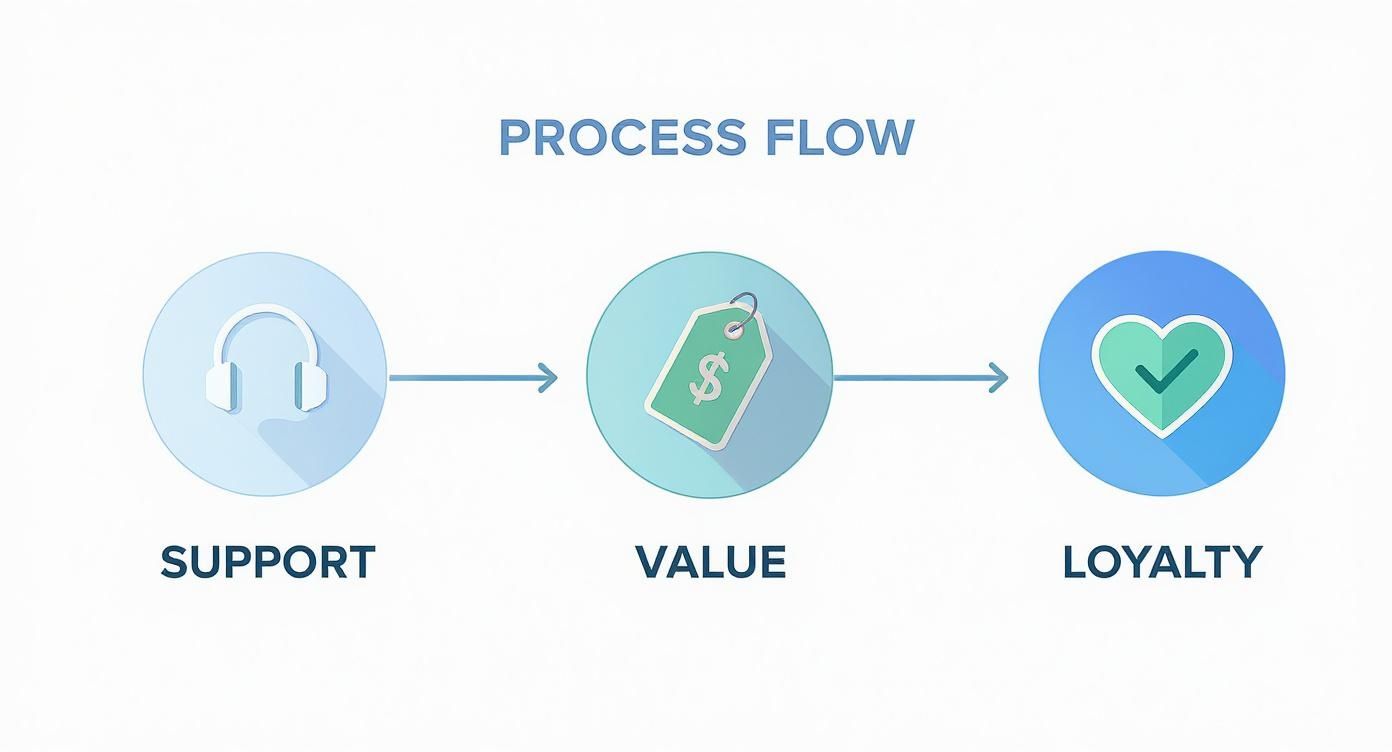
As you can see, great support builds a sense of value in the customer's mind, and that perception is the bedrock of long-term loyalty and high lifetime value.
Launching Your First Native Store Credit Campaign
Swapping discounts for a native Shopify store credit system is one of the most powerful moves you can make. The key is to start small, build some momentum, and prove the concept works for your brand.
Your immediate goal is to replace a margin-eroding tactic with a value-adding incentive. For instance, instead of tempting abandoned carts back with a 15% off coupon, try offering a £5 store credit towards their next purchase after they complete their first one. This still encourages the initial sale but cleverly builds a bridge to their second order, boosting LTV.
This one small tweak begins the crucial process of re-educating your customers. You're subtly teaching them that the best value comes from being a loyal customer, not from constantly hunting for the next promo code or deciphering a confusing points system. It’s a foundational step towards building a much smarter, and far more profitable, business.
Got Questions? We've Got Answers
We hear these questions all the time from Shopify brands trying to dial in their profitability. Let's tackle some of the most common ones.
How Can I Move Away From Discounts Without Losing Sales?
This is the big one, isn't it? The secret isn't to eliminate incentives entirely, but to swap them for something smarter and native to Shopify. Instead of a 15% off coupon that eats into your margin, offer 10% back as store credit for their next purchase.
You still give them a compelling reason to buy now, but you're building a bridge to their next order—which is far more likely to be at full price. This directly improves your customer lifetime value. It’s a shift from chasing one-off bargains to rewarding genuine loyalty.
Shifting away from discounts and confusing points systems is all about re-educating your customers. You need to teach them that real value lies in being a loyal, repeat shopper, not just hunting for the next coupon code.
What's The Best Way To Justify My Prices?
It comes down to making the price feel like a small part of a much bigger, better experience that increases lifetime value. When you deliver exceptional service—expert advice, personalised support, and a seamless checkout—the price becomes less of a sticking point.
A customer who feels understood and well-cared for is much less likely to quibble over a few pounds. Using native store credit for returns is a great play here. Offering their refund as credit, maybe with a bonus on top, shows you’re flexible and customer-focused. That adds value far beyond the product itself.
How Do I Measure The Success of a Native Store Credit Programme?
You need to look past simple sales figures and focus on the metrics that really drive profitability. The two most important ones are Customer Lifetime Value (LTV) and Repeat Purchase Rate.
Once you roll out a native Shopify store credit system, keep a close eye on these numbers. Are customers who use store credit coming back to shop more often? Are they spending more with you over time? The data will give you a clear answer, showing you're not just making sales, but building a far more profitable and sustainable business with a higher LTV.
Ready to protect your margins and see what a smart store credit programme can do for your LTV? See how Redeemly helps you swap out costly discounts for a native Shopify solution that drives real growth. Learn more at redeemly.ai.


Join 7000+ brands using our apps