How to Set Up Referral Program on Shopify: A Step-by-Step Guide to Boost LTV
Feb 7, 2026
|
Published
If you're looking to turn your best customers into your most powerful sales channel, a referral program on Shopify is a no-brainer. But let's be honest, the old way of doing things—just handing out discount codes—is getting tired. A far smarter approach is to reward your customers with something that feels like real cash and keeps them coming back: native Shopify store credit.
This isn't just about rewarding a referral; it's about fundamentally changing the customer relationship to boost lifetime value and protect your hard-earned margins.
Move Beyond Discounts with a Store Credit Referral Program

For years, the default reward for referrals has been a simple discount code. It seems easy, but this tactic often trains your customers to wait for a sale, eroding your profit margins with every transaction. You end up in a constant promotional cycle that can devalue your brand and attract bargain hunters, not the loyal, repeat buyers you really want.
It's time for a shift in strategy. Instead of just giving away a percentage of a sale, what if you gave customers a reason to return? That's the whole idea behind using native Shopify store credit. It’s not just another coupon; it's a balance in their account, ready and waiting to be spent on their next purchase, directly driving up their lifetime value.
The Power of Store Credit for LTV and AOV
Receiving store credit feels completely different than getting a discount. Psychologically, it’s not a temporary sale—it's earned money. This subtle but powerful shift directly impacts two of the most critical metrics for any e-commerce brand:
Increased Average Order Value (AOV): Think about it. A customer with $10 in store credit is far more likely to spend $60 to "use" their credit, rather than just looking for a $10 item. The credit acts as a launchpad, encouraging them to add more to their cart and pushing the total order value way up.
Boosted Customer Lifetime Value (LTV): A discount code might get lost in an inbox and never used. Store credit, on the other hand, sits in a customer's account as a constant, gentle reminder to come back and shop. It virtually guarantees a future purchase, building a stronger, more profitable long-term relationship.
By issuing store credit, you're not just rewarding a past action—you're pre-funding a future one. It transforms your referral program from a simple acquisition channel into a powerful retention engine focused squarely on lifetime value.
It’s a true win-win. Your customers feel genuinely valued with a tangible reward, and your business reaps the benefits of higher spending and rock-solid loyalty. You can get a much deeper look into how Shopify store credit works and the advantages it brings to the table.
Why It Outperforms Other Reward Systems
So, what about the other options? Let's break down why native store credit consistently comes out on top for brands focused on lifetime value and average order value.
Store Credit vs Discounts vs Points Systems
Feature | Store Credit (Native Integration) | Discount Codes | Points Programs |
|---|---|---|---|
Customer Perception | Feels like cash; a tangible asset | A temporary sale or promotion | Abstract; requires mental math |
Impact on AOV | High - encourages spending more to "use" the credit | Low - often used for the cheapest qualifying item | Moderate - depends on reward thresholds |
Impact on LTV | High - guarantees a repeat visit to spend the balance | Low to None - easily forgotten or never used | Moderate - can build loyalty if the system is clear |
Simplicity | Extremely simple: $1 credit = $1 value | Simple to use, but can be confusing with exclusions | Often complex; confusing conversion rates |
Brand Value | Protects brand value by avoiding a "discount" culture | Can devalue the brand and erode margins | Neutral; can feel like a game rather than a reward |
As you can see, confusing points systems are another common pitfall. Customers often get lost trying to figure out the conversion rate ("Wait, how many points is a dollar?"), which creates friction and kills participation. Native store credit is beautifully simple: $1 in credit equals $1 to spend. No mental gymnastics required.
When done right, a Shopify referral program can boost sales by up to 30%. We know that recommendations from friends carry real weight and deliver much higher conversion rates than traditional ads. For direct-to-consumer brands tired of watching discounts eat into their profits, tying referrals to a store credit system just makes sense.
Ultimately, choosing store credit helps you build a healthier, more sustainable growth model. You acquire new, high-intent customers through trusted recommendations and immediately start them on a journey toward becoming loyal, high-value shoppers. It’s the smartest way to grow your Shopify store without giving away the farm.
Designing a Referral Program That Actually Converts
A great referral program isn't just about giving things away—it's a carefully engineered growth engine. The secret sauce is making participation feel both effortless and genuinely valuable for everyone involved. To build a program that truly converts, you have to nail the incentive structure, the clarity of the rules, and the simplicity of the customer journey.
When you get this right, you create a system that runs on its own momentum. The person referring feels generous for sharing a real benefit, and their friend feels like they've stumbled upon an amazing deal. That's what separates a forgotten program from one that drives real, sustainable revenue.
Structuring Your Store Credit Rewards
The most powerful referral programs I've seen are built on a simple foundation: two-sided rewards. This just means both the person making the referral (the Advocate) and the new customer they bring in (the Friend) get a reward. It’s a game-changer.
Why? Because it reframes the act of sharing. Your advocate isn't just spamming a link for their own gain; they're gifting a legitimate discount to a friend. The data backs this up, too. Programs that reward both sides see 2.3x more shares and 1.8x higher conversions than their one-sided counterparts.
For Shopify merchants using native store credit, this is incredibly easy to set up. With an app like Redeemly, you can create rules like, "Give $10 in store credit to the Advocate when their Friend spends $50." The credit then appears in their on-site wallet automatically.
When figuring out how much to give, you generally have two solid options:
Symmetrical Rewards: Keep it simple and fair by offering the same amount to both people (e.g., "$15 for you, $15 for your friend"). This is super easy to communicate and feels balanced.
Asymmetrical Rewards: Tilt the scale in favor of the new customer (e.g., "$10 for you, $20 for your friend"). This can be a potent acquisition strategy, as the larger upfront offer for the friend removes more friction from that critical first purchase.
Remember, the goal isn't just to reward an existing customer; it's to acquire a new one profitably. Your rewards should be generous enough to get people excited but sustainable enough that you're not losing money on every new customer.
Establishing Clear and Simple Rules
Complexity kills conversions. If your customers have to pull out a calculator or read a wall of legal text to understand your program, they'll just give up. The rules need to be so simple that someone can grasp the entire concept in five seconds.
The most critical rule you need to implement is a minimum purchase requirement for the referred friend. This one little condition is your best defense against margin erosion and is essential for boosting your average order value. It ensures you’re acquiring customers who are genuinely interested in your products, not just someone trying to snag a freebie.
For example, frame your offer like this: "Your friend gets $20 in store credit on their first order over $75, and you get $20 in credit once their purchase is complete."
This simple sentence does so much work:
It protects your Average Order Value (AOV) by setting a clear spending floor.
It qualifies the new lead as someone willing to spend a reasonable amount.
It perfectly manages the advocate's expectations about when they'll get their reward.
Need a little more inspiration? Check out our guide for some more brilliant referral program ideas to get your creative juices flowing.
Mapping the Ideal Customer Journey
The final piece of this puzzle is making the entire process ridiculously smooth. A clunky user experience can sabotage even the most enticing offer. The referral flow should feel like a natural part of shopping on your site, not some complicated side quest.
Let’s walk through what this looks like in practice.
Effortless Sharing for the Advocate: Your loyal customer needs to find their unique referral link without having to hunt for it. Put it right in their account dashboard, in a post-purchase email, or in a little on-site widget. A single click should let them copy the link or share it directly to social media. Frictionless is the key.
A Welcoming Experience for the Friend: When the friend clicks that link, they should land on a page that immediately confirms they're in the right place. A big, friendly welcome message like, "Your friend Jane sent you $20 in store credit!" does the trick. It instantly builds trust and highlights the value they're about to receive.
Seamless Reward Redemption: This is where native Shopify store credit really shines. The credit should be automatically available or dead simple to apply at checkout. No one wants to remember and type in a long, clunky coupon code. A balance that's just there in their account is the ideal experience.
Instant Gratification for the Advocate: As soon as their friend's purchase is confirmed (and clears any holding period you set for returns), the advocate should get an email notification. "Success! $20 in store credit has been added to your account." This immediate positive feedback loop is what encourages them to do it all over again.
Your Step-by-Step Guide to Going Live
Alright, enough with the theory—let's get our hands dirty. This is where we take all that strategy and turn it into a real, revenue-generating machine for your Shopify store. We're going to walk through the exact steps to launch a store credit referral program using a native Shopify app, from the initial install to flipping the "on" switch.
The real magic of using a truly native app is how ridiculously simple it is. You can forget about hiring a developer or wrestling with your theme's code. The whole process is designed to be dead simple, getting you from zero to a fully-functioning program in minutes, not days. This is the modern way to build a referral program on Shopify.
From App Store to First Campaign
Your journey kicks off in the Shopify App Store. The first move is just installing an app built specifically for store credit referrals. Once you approve the permissions, you’ll be dropped right into a guided onboarding that practically holds your hand through the initial setup.
This isn’t some clunky dashboard with a million confusing settings. Instead, you'll just be asked to make a few key decisions that will define how your entire program runs. This is where you bring that reward structure we planned earlier to life.
You’ll be prompted to set:
The Advocate's Reward: How much store credit does your loyal customer get for a successful referral? A solid starting point is a flat amount, like $15 in credit.
The Friend's Reward: What's in it for the new customer? Offering them $15 off their first purchase (usually with a minimum spend) creates a powerful, balanced incentive.
Once you lock in these core rules, the app’s logic is good to go. The system now knows precisely who gets paid, how much, and when to drop that sweet store credit into their account.
This whole flow is actually quite elegant. It's all about making it a no-brainer for your customers.
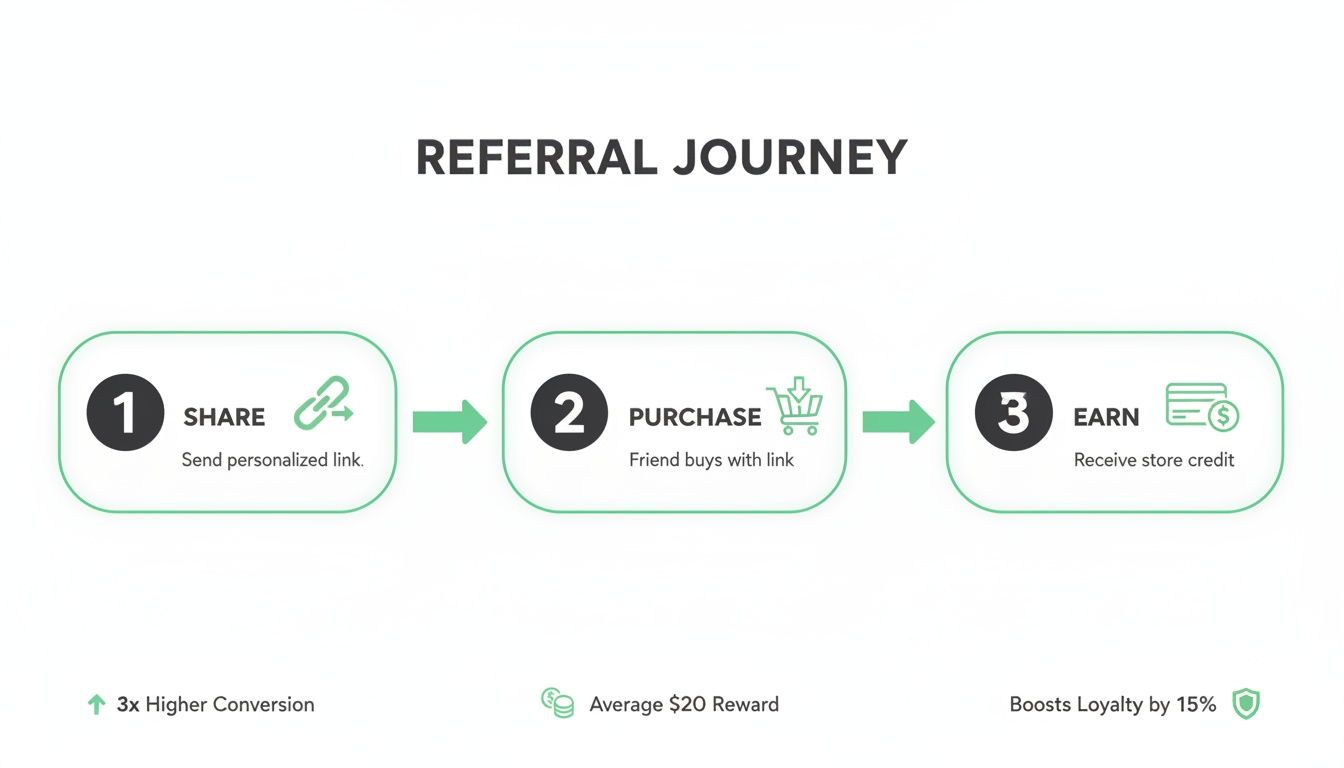
As you can see, a successful program really just boils down to three frictionless steps for your customers: Share, Purchase, and Earn. Simple.
Customizing the On-Site Experience
Let's be real: your referral program shouldn't look like some generic, third-party plugin slapped onto your site. It needs to feel like a natural part of your brand's world. This is where you customize the on-site widgets—and it’s surprisingly easy to get it just right.
You won't need to write a single line of CSS. A good native app will let you upload your logo, pop in your brand’s hex codes, and tweak the font to match your store’s look, all from the dashboard. This makes sure every customer touchpoint, from the post-purchase pop-up to the floating wallet widget, is perfectly on-brand.
A referral program that looks and feels native to your store builds trust instantly. When the design is seamless, customers are far more likely to engage because it doesn't feel like an advertisement; it feels like an integrated feature of their account.
This level of integration is what separates the good from the great. When a customer sees their store credit balance displayed in a widget that mirrors your site’s design, it reinforces the idea that this is their money to spend with your brand. That connection is what drives the repeat purchases that skyrocket customer lifetime value. If you're weighing your options, understanding the differences between an app like ReferralCandy and a native store credit approach really highlights the power of this seamless experience.
Activating and Testing Your Program Flow
With your rewards dialed in and your widgets looking sharp, you’re just one click away from going live. But before you shout it from the rooftops, it's absolutely crucial to run a quick test drive to make sure the entire customer journey is flawless.
Don't worry, this isn't complicated. You can do it yourself in about two minutes by placing a small test order on your own store.
Here’s the simple checklist to run through:
Be the Advocate: Place a test order (even for just $1) to see the post-purchase experience. Does the referral pop-up show up? Good. Now copy your unique referral link.
Be the Friend: Open an incognito browser window and paste in the referral link. You should be greeted with a welcome message confirming the friend offer.
Complete the Friend's Purchase: Add something to your cart that meets the minimum spend and check out. Did the discount for the friend apply correctly?
Check the Advocate's Reward: Head back to your original account. You should get an email notification confirming your friend's purchase and letting you know your store credit has been issued (or is pending, if you set up a delay for returns).
Once you've confirmed this entire flow works like a charm, you can confidently activate the program for all your customers. The entire setup, from install to launch, can seriously be done in under an hour. You've now built a powerful, automated growth engine that turns your happiest customers into your best marketers—all without killing your margins.
How to Promote Your Program and Drive Participation
You’ve put in the work to build a powerful, margin-friendly referral program. Great. But now comes the most important part: making sure your customers actually know it exists.
A referral program that operates in secret is just a wasted opportunity. The launch and the ongoing promotion are every bit as critical as the reward structure itself. Your real goal is to weave the program into the fabric of the customer journey, making it an unmissable and genuinely exciting feature of shopping with you.
Get this right, and you’ll turn your happy customers into a volunteer army of advocates driving truly profitable growth.
Announce Your Program Across High-Impact Channels
A big, splashy launch is the best way to get initial momentum. Don't just send one email and hope for the best. You need a coordinated, multi-channel campaign that builds buzz and makes your program impossible to ignore. I've seen brands jump from a 4% to a 12% referral share rate just by using on-site widgets and consistent email promotion.
Here are the essential channels you need to hit from day one:
The Dedicated Email Blast: Craft a standalone email that’s all about the new program. Be crystal clear on the two-sided benefit: "Give $15, Get $15 in Store Credit." Keep the energy high and focus on the value for both your customer and their friends.
A Prominent Website Banner: For the first week, slap a banner right on your homepage where no one can miss it. Something punchy like "Share the Love, Earn Store Credit" gets the point across instantly.
The Social Media Launch: Announce the program across all your active social channels. Create clean, shareable graphics that quickly explain how it works. Go a step further and encourage followers to tag friends who would love your products—this kickstarts the referral loop right out in the open.
Your launch isn’t just about informing customers—it’s about generating excitement. Frame the program as an exclusive perk for being part of your community, a way for them to share a brand they already love and get rewarded with real value.
Integrate Promotion Into the Customer Journey
While a big launch gets you off the starting blocks, the real magic happens when your referral program becomes a permanent, visible part of the customer experience. This is how you drive consistent, long-term participation.
The key is to ask for the referral at moments when customers are feeling most positive about your brand. You want sharing to feel like a natural next step, not a chore you're asking them to do.
Making Referrals Impossible to Miss
To really get the flywheel spinning, you need to embed referral CTAs into these key touchpoints:
The Post-Purchase Experience: This is your golden moment. A customer just bought something, and their excitement is at an all-time high. Hit them with a post-purchase pop-up or a dedicated section on the order confirmation page. A message like, "Love your new purchase? Give a friend $20 off and get $20 in store credit when they shop!" is incredibly effective here.
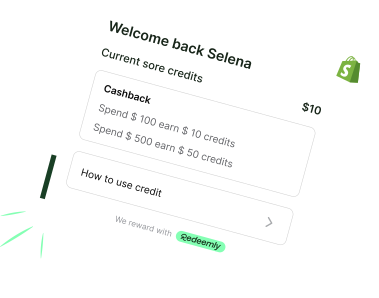
The Customer Account Page: This is the logical home for your program. Add a permanent, easy-to-find section in the customer account dashboard. It should display their unique referral link, track their referred friends, and show their current store credit balance. It becomes their reliable referral hub.
Transactional Emails: Your automated emails are promotional goldmines. Think about it—order confirmations, shipping notifications, and delivery updates have insanely high open rates. Add a simple, branded block to the bottom of these emails to consistently and freely remind customers about the program.
Beyond these initial promotions, you can even think about formalizing your top advocates into official Brand Ambassador Programs for even deeper engagement. By making promotion a core, ongoing part of your strategy, you ensure your program doesn't just launch; it thrives.
Measuring Success and Optimizing for LTV
Getting your referral program live is a fantastic milestone, but the real work—and the real growth—starts now. The best programs aren't set-it-and-forget-it; they're constantly tweaked and refined based on what the data is telling you.
To see if you’re actually driving profitable growth, you have to look past vanity metrics like social shares. It's all about focusing on the numbers that directly impact your bottom line. We need to make sure every dollar of store credit you hand out is coming back to you through loyal, high-spending customers.
Key Performance Indicators That Actually Matter
Your referral app’s dashboard is your command center, but it’s easy to get lost in all the charts and numbers. To really understand what’s going on, you only need to focus on a handful of key performance indicators (KPIs) that tell the true story.
These are the metrics that give you a real-time pulse on your program's health.
Participation Rate: What percentage of your customers are actually sharing their referral link? If this number is low, it's a huge red flag that people either don't know about your program or aren't motivated to share.
Friend Conversion Rate: This is critical. Of all the people who click a referral link, how many end up making a purchase? This tells you exactly how compelling your friend's offer is.
Average Order Value (AOV) of Referred Customers: Compare the AOV of customers who came from a referral to your store's overall AOV. If it's higher, you have concrete proof that your store credit incentive is working to encourage bigger first-time purchases.
When you track these specific data points, you stop guessing and start knowing. You can see precisely how the program is performing and where your biggest opportunities are hiding.
When you prioritize metrics tied to LTV and AOV, you stop asking, "Is my program popular?" and start asking, "Is my program profitable?" This shift in perspective is the key to building a sustainable, long-term growth channel.
Benchmarking Your Program for Success
Okay, so you have your numbers. But are they any good? To put your performance into context, you need to see how you stack up against industry benchmarks.
The global median referral conversion rate for eCommerce usually sits around 3-5%. But here's the exciting part: highly-tuned programs on Shopify can push past 8% by obsessively tracking and refining their rewards. These referred customers are pure gold—they retain at a 37% higher rate and spend 25% more over their lifetime. That's a direct boost to your LTV.
For a deeper dive, check out these comprehensive referral program benchmarks.
Optimizing Your Program for Higher LTV
With a baseline established, it's time to start optimizing. The goal isn't just to get more referrals; it's to attract more high-value customers who will stick around for the long haul.
Think of your launch as version 1.0. The real gains are found in versions 1.1, 1.2, and beyond.
Here are a few practical optimization tactics you can try right away:
A/B Test Your Rewards: Is a balanced "$15 for you, $15 for them" offer really the sweet spot? Try running an asymmetrical offer like "$10 for you, $20 for them" for a month. A juicier upfront discount for the new customer can often give your conversion rate a serious kick.
Refine Your Promotional Copy: Play with the wording in your post-purchase pop-ups and emails. Does "Get $15 in store credit" perform better than "Get $15 off"? Does framing it as a gift for their friend increase sharing? Tiny tweaks to your messaging can have a surprisingly big impact.
Segment Your Superfans: Go find your top referrers—the people who are consistently sending new business your way. Shoot them a personal email and maybe even bump up their reward as a special thank you. This simple gesture can turn your best advocates into unstoppable promoters.
By constantly testing these elements, you’ll uncover the perfect cocktail of rewards and messaging that clicks with your audience. This data-driven approach is how you turn a good referral program into a great one—and build a predictable, profitable engine for growth.
Got Questions About Your Shopify Referral Program? We've Got Answers
Even with a perfect plan, a few questions always crop up when you’re in the trenches setting up a new referral program. Getting these details ironed out is the difference between a program that sputters and one that drives serious, profitable growth.
Let's dive into the most common questions we hear from merchants just like you.
What's the Real Difference Between Store Credit and a Gift Card?
This is a big one, and the distinction is more important than you might think. While they both reduce a customer's total at checkout, Shopify treats them in completely different ways.
A Shopify gift card is basically digital cash. It acts as its own payment method, has a distinct value, and can be passed around from person to person. It's not tied to any single customer.
On the other hand, native store credit is welded to a specific customer's account. It's a non-transferable balance that only they can use. This makes it the ideal vehicle for referral and loyalty rewards because you know the credit is going right back to the person you intended to reward—your advocate or the new customer they brought in. It's designed to bring them back to your store, directly boosting their lifetime value.
Can I Run a Referral Program at the Same Time as Other Sales?
You bet. In fact, this is one of the biggest wins of using a store credit system. It plays nicely with everything else you have going on.
Because store credit works more like cash than a coupon code, it avoids the messy "discount stacking" headaches that can torpedo your margins and confuse your customers. A customer's store credit balance is usually applied at the very end of the checkout process, after any other promo codes have been punched in. This keeps things clean and simple.
Think of it this way: a store credit program doesn't compete with your other marketing. It complements it. It builds a foundational layer of loyalty that hums along in the background, supporting your big seasonal sales and helping lift both your average order value and repeat purchase rate.
What if the Referred Friend Returns Their Purchase?
An excellent and crucial question. The last thing you want is to hand out rewards for sales that don't stick around. The solution is simple: a reward pending period.
Any solid referral app will let you set a delay—a holding period—before an advocate’s store credit reward is actually issued. The trick is to match this pending period to your store's return policy. If you have a 30-day return window, set your reward pending period to 30 days.
The store credit only hits the advocate’s account after the chance for a return has passed. This small but mighty feature prevents fraud and ensures you're only rewarding real, finalized sales, protecting your program's integrity and your bottom line.
Ready to swap out confusing discount codes for a system that actually grows LTV and AOV? Redeemly makes it incredibly easy to launch a powerful store credit referral program right within Shopify. Get started today and turn your best customers into your most profitable growth channel.


Join 7000+ brands using our apps