Referral Candy Shopify Guide to Maximize Customer LTV
Jan 4, 2026
|
Published

If you're like many Shopify merchants, you're constantly fighting to bring in new customers without giving away the farm through endless discounts. You've probably looked at apps like Referral Candy for Shopify, which offer a direct route to word-of-mouth marketing. But here's the real question: are coupon-based rewards actually building long-term value, or just a short-term sugar rush?
There’s a more sustainable way to grow, and it’s centered on native store credit—a strategy designed to boost both customer lifetime value (LTV) and average order value (AOV).
Rethinking Your Shopify Referral Strategy for Growth

For any growing Shopify store, customer acquisition feels like a constant battle against skyrocketing ad costs and relentless competition. This is where a well-oiled referral program can become your secret weapon. It transforms your happy customers into a genuine, motivated sales force, bringing in new shoppers who already have a reason to trust you. The goal isn't just to get one new sale, but to acquire a customer who returns again and again, significantly increasing their lifetime value.
Referral programs on Shopify have been a massive win for direct-to-consumer brands looking to scale. Take Galen Leather Co., for example. They launched a referral program that pulled in over $350,000 in sales and attracted more than 2,000 new customers, all from shared referral codes. This isn't just a one-off success story; on average, referred customers are known to make about twice as many purchases and can be up to 25x cheaper to acquire than someone you find through paid ads.
Discounts vs. Store Credit: A Core Decision
The real conversation in referral marketing today isn't about if you need a program, but how you reward people. The two main paths—discounts versus native store credit—have wildly different effects on your profit margins, lifetime value, and how customers see your brand.
Metric | Discount Codes (Referral Candy) | Native Store Credit |
|---|---|---|
Customer Psychology | Trains customers to look for a deal and encourages a one-off purchase. | Feels like having cash in an account, creating a strong pull for a repeat purchase and higher LTV. |
Profit Margin Impact | Immediately eats into the margin on the initial sale. | The cost is only realized when the credit is spent, protecting your initial profit. |
Repeat Purchase Rate | Lower. Why buy now when another discount might be around the corner? | Higher. The credit creates a powerful, built-in reason to make a second purchase. |
Average Order Value | Often lower, as the discount is applied directly to the cart total. | Can actually increase AOV as customers often spend more to use their credit balance. |
The choice between discount codes and store credit is a strategic one. One trains customers to look for deals, while the other builds a foundation for repeat, full-price purchases and higher lifetime value.
To truly rethink your approach for long-term growth, it helps to look at the bigger picture. Exploring comprehensive Shopify loyalty programs can offer some incredible insights. This guide is all about helping you challenge your current strategy and discover a more profitable, retention-first solution.
How to Configure ReferralCandy for Shopify

Getting ReferralCandy up and running on your Shopify store is refreshingly quick. Seriously, you can go from installation to a live, functioning referral program in under an hour, which is a huge plus for busy store owners. The first move is to simply install the app from the Shopify App Store.
Once it’s in, ReferralCandy kicks off a guided setup wizard. This is where you'll make the foundational decisions that shape how your entire program will work, starting with the most important part: the rewards. You have to decide what’s in it for your existing customer (the advocate) and the new person they bring in.
Setting Your Initial Rewards
Your main reward options with ReferralCandy are pretty standard: percentage discounts, fixed-amount coupons, or straight-up cash. While they technically support store credit, the platform is fundamentally built to generate and sling coupon codes. This choice will have a direct impact on your customer's lifetime value and, of course, your profitability.
A classic, battle-tested setup usually looks something like this:
Advocate Reward: A $20 coupon for their next purchase.
Friend Reward: A 15% discount on their first order.
This is a powerful way to get new customers in the door, but it comes with a trade-off. You risk training your audience to wait for discounts, which can slowly chip away at your brand's perceived value and suppress long-term customer lifetime value. It’s a balancing act—you have to weigh the immediate win of a new sale against your long-term margins.
Customizing the Customer Experience
With rewards locked in, the next step is to make the program look and feel like your brand. ReferralCandy lets you upload your logo and splash your brand colors across all the customer-facing pieces. This creates a much more integrated and trustworthy experience.
You’ll be customizing:
The Post-Purchase Popup: This little widget pops up right after a customer buys something, asking them to join the referral program. It’s your best shot at getting high enrollment numbers.
Referral Emails: These are the automated messages that keep the program top-of-mind, reminding customers to share and celebrating their successful referrals.
Sharing Widgets and Landing Pages: These are the actual tools your customers use to copy their unique referral links and send them out into the world.
While you can brand these elements, the core experience is still about sharing a link to get a discount. This is a totally different psychological trigger than a native store credit system, where rewards feel like earned cash sitting in an account. That approach often nudges customers toward a higher average order value on their next full-price purchase, rather than just redeeming a coupon.
The final steps are just flipping the switch to enable your widgets and running a test order to make sure everything fires correctly. Following this playbook gets you a solid ReferralCandy Shopify program that can start generating word-of-mouth sales. The real strategic question you need to ask yourself, though, is whether this discount-first model is the best way to build genuine lifetime value.
Comparing Referral Rewards: Discount Codes vs. Store Credit
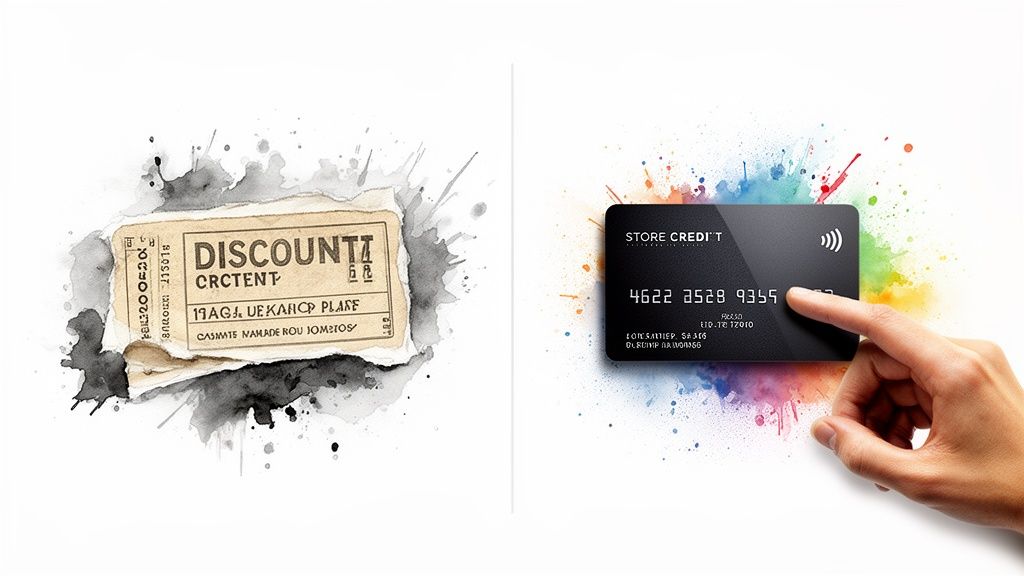
When setting up your Referral Candy Shopify program, one of the most important calls you'll make is choosing between discount codes and native store credit. This isn't just a minor detail—it’s a strategic decision that directly influences customer behavior, average order value, and ultimately, your bottom line.
Discount codes are great for a quick hit of new traffic. They're simple and familiar. The problem? They often attract one-time bargain hunters who are conditioned to chase the next deal, not build a relationship with you. Over-relying on discounts can slowly eat away at your margins and train your audience to wait for a sale, making it harder to ever sell at full price and depressing customer LTV.
Native Shopify store credit, on the other hand, plays a completely different psychological game. It isn't a temporary coupon. It feels like real money sitting in a customer’s account, creating a powerful, built-in reason to come back and shop again, directly fueling a higher lifetime value.
The Psychology of Ownership: Store Credit vs. Discounts
Think about it from your customer's perspective. Seeing a $20 store credit balance triggers something called the "endowment effect"—a real sense of ownership over that value. This makes them far more motivated to use it.
And what happens when they do? They often spend more than the credit amount just to "unlock" its full value, boosting your average order value. A 20% off coupon doesn’t have the same magic. It just lowers the price tag and doesn't create that compelling feeling of having "money to spend."
This is a huge deal for boosting lifetime value (LTV). Store credit fuels a cycle of repeat purchases, turning a new referral into a loyal regular. The referral becomes the start of their journey, not the end. If you want to go deeper on this, we break it all down in our guide on using Shopify store credit to build loyalty.
Impact on Key Business Metrics
So, how does this choice actually affect your store's financial health? Let's get practical and compare the two side-by-side, focusing on LTV and AOV.
Reward Type Comparison: Discount Codes vs. Native Store Credit
The table below breaks down the real-world impact of each reward type on the metrics that matter most to your business.
Metric | Discount Codes (Referral Candy) | Native Store Credit |
|---|---|---|
Customer LTV | Lower. Attracts transactional buyers who may not return without another discount. | Higher. The credit acts as a built-in reason for a second, third, and fourth purchase. |
Average Order Value | Often lower. Customers focus on minimizing their immediate out-of-pocket cost. | Higher. Customers frequently spend above their credit balance to get "more for their money." |
Profit Margins | Immediately reduced on the first purchase, training customers to expect lower prices. | Protected on the first purchase. The cost is realized on a future sale, essentially funding retention. |
Brand Perception | Can position the brand as discount-oriented, potentially cheapening its value over time. | Reinforces brand value by rewarding loyalty without constant sales or devaluing products. |
This comparison makes the core difference crystal clear.
The fundamental difference is this: Discount codes are a tool for acquisition that can hurt margins. Native store credit is a tool for retention that protects margins and drives lifetime value.
Since Shopify doesn't have a built-in referral system, apps are the key to unlocking word-of-mouth marketing. Take the fashion brand LIVELY. They offered a 15% off reward for both the referrer and the friend. The results were staggering: in just 48 hours, they racked up 133,000 email sign-ups and 300,000 online sessions. It just goes to show the explosive power of a well-run program.
Now, imagine if they had used store credit. That massive wave of initial traffic could have been converted into an even stronger, more loyal base of repeat buyers with a much higher lifetime value.
Measuring the True ROI of Your Referral Program
Success with a ReferralCandy Shopify program isn't just about counting how many people share a link. To really grasp its value, you have to look past vanity metrics like clicks and focus on the numbers that actually drive profitability and long-term growth. The two most critical metrics here are Customer Lifetime Value (LTV) and Average Order Value (AOV).
The real acid test for your program is whether it attracts high-value customers who actually stick around. Are the folks coming from referrals spending more per order than customers you paid for through ads? And more importantly, are they coming back to make repeat, full-price purchases? Answering these questions is what separates a genuine growth engine from a discount machine that just drains your margins.
Key Metrics to Focus On
To really analyze your referral program, you need to get your hands dirty in your Shopify data and compare different customer groups. Don't stop at the first sale; you have to look at the entire customer journey to see what’s really happening.
LTV of Referred Customers: Figure out the total revenue a referred customer brings in over their entire time with your brand. Then, put that number right up against the LTV of customers from paid ads, social media, or organic search. A higher LTV for referred customers proves the program's long-term worth.
AOV of Referred Customers: What’s the average cart size for a first-time order from a referral? You should also track the AOV on their second and third purchases to see if incentives like store credit are encouraging bigger spending later on, directly impacting your cash flow.
Repeat Purchase Rate: Look at what percentage of referred customers come back to buy again within a set period, like 90 days. This is a dead-simple indicator of loyalty and a primary driver of increased LTV.
We're seeing a referral revolution on Shopify, and the hard numbers show its impact on customer retention. Referred customers are twice as likely to convert as leads from paid channels and are known to refer 30%-57% more of their friends, which creates a powerful compounding effect that drives up lifetime value. Since Shopify doesn't have a built-in referral system, apps have stepped in to deliver referral rates of 2%-5%—that translates to thousands of extra orders for growing stores.
The ultimate goal is to prove that your referral program isn't just another expense—it's a profitable investment. By focusing on LTV and AOV, you change the conversation from "how many new customers did we get?" to "how much long-term value did we create?"
To properly measure the ROI of your program and set it up for long-term success, you need a solid handle on the relevant digital marketing performance metrics. Getting comfortable with these deeper analytics gives you the proof you need to show the true financial return of your efforts.
For a complete breakdown, check out our guide on how to calculate customer LTV. This data is your secret weapon for fine-tuning your rewards and building a more profitable, sustainable growth channel.
Choosing the Right Referral System for Your Brand
Picking the right referral strategy for your Shopify store goes way beyond just choosing an app with a long feature list. It’s a strategic move that needs to line up with where your brand is right now and where you want it to go. The path you choose—whether it’s a discount-heavy model like ReferralCandy’s or a native store credit system—will directly shape your profitability and customer loyalty.
To get this right, you have to be honest about your main goal. This simple decision tree should help you see which path makes the most sense for your acquisition and profitability targets.

As you can see, if your only mission is to get as many new customers as possible, a discount system is a fine place to start. But if you’re playing the long game with a focus on profitability and retention, store credit is the more durable path forward.
When to Use a Discount-Based Model
A coupon-centric platform like ReferralCandy for Shopify can be a real powerhouse for brands at a certain stage. This approach really shines when your business is all-in on pure, top-of-the-funnel acquisition, and not much else.
A discount-based referral program might be your best bet if you are:
A new brand launching in a crowded space. When you just need to make noise and get some initial momentum, discounts can create that immediate buzz to pull in your first wave of customers.
Prioritizing rapid user growth over profit margins. For some venture-backed startups or high-volume, low-margin brands, grabbing market share fast is the name of the game. Discounts are a tried-and-true way to do just that.
The real power of a discount model lies in its simplicity. Everyone understands a coupon. It’s a low-friction way to get new shoppers in the door, but it comes with a catch: you might train your customers to only buy when there's a sale, which can eat away at your lifetime value.
The Case for Native Shopify Store Credit
For most established brands, the goal eventually shifts from just getting customers to growing profitably and sustainably. This is exactly where a native store credit system proves its worth. This model isn’t just built to bring people in; it’s designed to keep them coming back and spending more over time.
A store credit system is the clear winner for:
Established brands that need to protect their profit margins. Store credit is an investment in retention, not a direct cut from your initial sale's margin. This protects your brand's perceived value and keeps you out of a race to the bottom on price.
Businesses focused on increasing average order value (AOV). When customers have what feels like free money in their account, they almost always spend more than the credit amount to "make it worthwhile," which directly boosts your AOV on their next purchase.
Merchants who want to build a real community. Store credit rewards genuine loyalty and encourages a much deeper connection with your brand. It helps build a base of repeat buyers who love your products, not just your promotions, maximizing their lifetime value.
By understanding these different scenarios, you can pick the system that will actually help you hit your business goals. To see how these ideas look in the real world, check out our in-depth guide on building an effective Shopify reward program.
Common Questions About Shopify Referral Programs
Let's be honest, diving into referral marketing on Shopify can feel like a minefield. You've got questions, and getting the right answers is the difference between a program that eats your profits and one that actually builds a loyal customer base with a high LTV. We've seen it all, so let's tackle the questions we hear most often from store owners.
How Should I Reward Advocates for Referrals?
This is the big one, and the best answer usually circles back to your main goal: maximizing lifetime value. While cash and discount coupons are common, native Shopify store credit is almost always the smarter move for sustainable growth. Think of it as cash that only works in your store—it’s a powerful magnet for a repeat purchase.
This simple switch directly pumps up your customer lifetime value (LTV). Why? Because it brings your best customers back to shop again, and they almost always spend more than just their credit balance. A one-off discount is a transaction; store credit is an investment in your brand's future.
Which Reward Drives a Higher Average Order Value?
Hands down, store credit. We’ve seen it time and time again. When a customer has a $20 credit sitting in their account, it creates a psychological itch to spend it. They don't just want to use the credit; they want to make it worthwhile. This little mental trick encourages them to pile more into their cart, pushing their total spend way past the original credit amount.
A 20% off coupon, on the other hand, just shrinks the total. It often attracts bargain hunters who are laser-focused on one thing: spending as little as possible. A great referral program isn't just about getting a new customer—it's about getting a profitable one with a high potential LTV and AOV.
How Can I Best Promote My New Referral Program?
You've built it, now you need to shout about it. Start with your warmest audience: your email list and social media followers. They already like you, so they're the most likely to start sharing. Then, add a clean, can't-miss-it banner to your site's header or footer. Something simple like, "Give $15, Get $15 in Store Credit" works wonders.
But your secret weapon? The post-purchase popup. This is, without a doubt, the single most effective way to get sign-ups. You're catching customers right when they're happiest with their purchase, making it a no-brainer for them to become an advocate with a single click.
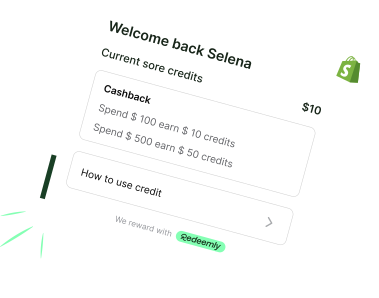
Ready to grow your Shopify store with a loyalty program that actually protects your margins and boosts lifetime value? Redeemly ditches the confusing points and profit-killing discounts for native store credit, driving repeat purchases and higher AOV. Start growing profitably today.


Join 7000+ brands using our apps