Boost Lifetime Value with Customer Retention Programs Using Shopify Store Credit
Jan 19, 2026
|
Published
Every Shopify merchant is chasing customer loyalty, but the truth is, many of the go-to customer retention programs are silent profit killers. It's easy to fall back on traditional methods like discount codes or points systems, but these often erode your margins, train customers to wait for sales, and fail to build the lasting value your business needs to actually grow.
The Hidden Costs of Traditional Loyalty Programs
Think of your customer base like a bucket of water. You spend a ton on marketing to fill it up, but every time you offer a discount, you're poking another hole in the bottom. This is the "leaky bucket" reality for so many ecommerce brands. You pour money into ads to get a new shopper, then immediately hand back your profit with a "15% off" coupon to seal the deal.
What this really does is teach customers to devalue your products. They learn to wait for the next sale. Instead of building real loyalty to your brand, you create a dependency on the deal itself. This torpedoes two of your most important growth metrics:
Customer Lifetime Value (LTV): When people only buy during a sale, their total spend over time flatlines. You're putting a ceiling on how valuable they can be to your business.
Average Order Value (AOV): Discounts don't inspire customers to add more to their cart; they encourage them to spend just enough to get the deal.
The Problem with Points and Complicated Tiers
Points-based systems seem like a smart fix, but they often just trade one problem for another: confusion. Let's be honest, nobody wants to do math to figure out their reward. Rules like "earn 10 points for every dollar, redeem 1,000 points for $5 off" create friction and kill engagement.
It’s no wonder that as much as 54% of loyalty memberships are inactive. The perceived value feels low because the effort required to understand it is too high.
The whole point of a loyalty program is to make customers feel valued and make it a no-brainer for them to buy again. If they need a calculator to figure out what they've earned, you've already lost the emotional connection.
And then there are the complex tiered systems. While tiers can work wonders when done right, they can also feel completely out of reach for new or casual shoppers, discouraging the very people you want to nurture. (We actually break down how to properly structure loyalty program tiers in our detailed guide).
Ultimately, these old-school retention programs corner you into a tough choice. You either sacrifice your margins with constant discounts or you risk confusing customers with abstract points. This dilemma is exactly why it's time for a smarter, more profitable approach—one that protects your bottom line while giving customers a reward they instantly get and love.
A Breakdown of Common Customer Loyalty Models
To break free from the margin-killing tactics we've been talking about, you first have to understand the lay of the land when it comes to customer retention programs. Most Shopify merchants have run into the two big, traditional models. Each has its pros, but they also carry some serious baggage that can hurt both the customer experience and your bottom line.
This diagram breaks down how old-school loyalty programs are almost always built on either discounts or points—both of which can feel like trying to fill a leaky bucket when it comes to your profits.
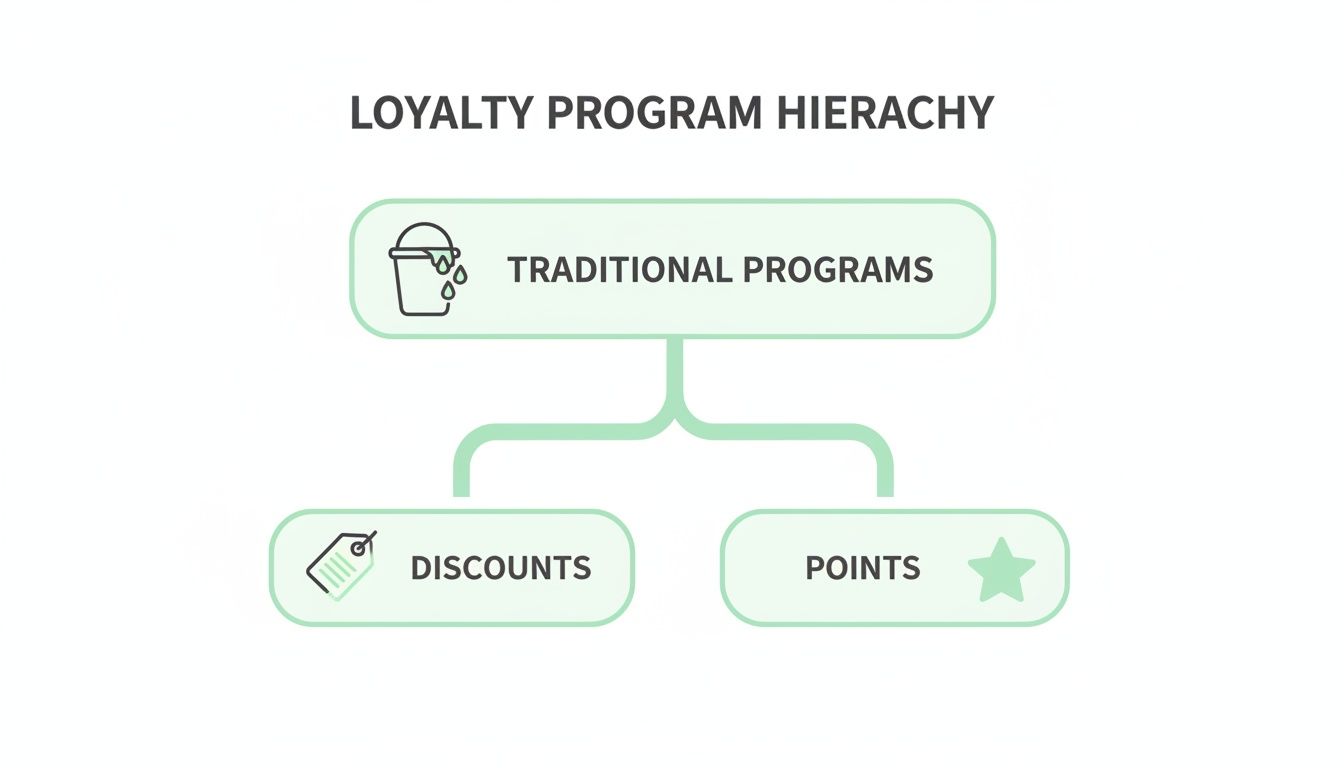
As you can see, these legacy systems often push you into a corner. You’re either forced to slash your prices directly or pile on complexity. Neither is a great path to building long-term brand value.
Discount and Coupon-Based Programs
The most common model out there is the simple discount. It’s easy to set up, and customers get it instantly. You offer a percentage or a dollar amount off their next purchase, giving them a clear reason to come back. Simple, right?
But that simplicity comes at a steep price. As we covered, endless discounts train your customers to see your products as less valuable and to just wait for the next sale. This is a direct hit to your Average Order Value (AOV) because shoppers get conditioned to never pay full price. The whole relationship shifts from one of brand loyalty to pure deal-hunting, which is a shaky foundation to build a business on.
The Gamified World of Points Systems
Points systems were invented to solve the margin problem that discounts created. Instead of just giving away money, you reward customers with points for things like making a purchase, writing a review, or following you on social media. They can then cash in those points for rewards.
The goal is to gamify the experience, making it feel more like an engaging challenge than a straight-up price cut. Sounds great in theory. In practice, it often just builds a wall of complexity that stops people from participating before they even start.
When a customer needs a calculator to figure out the value of their loyalty, the emotional connection is lost. The program becomes a chore rather than a reward, defeating its entire purpose.
Confusing rules like "Earn 5 points for every $1 spent, then redeem 1,000 points for a $5 coupon" create too much mental friction. Shoppers don't feel that immediate hit of value, which is exactly why so many of these programs have depressingly low engagement rates. All that complexity also makes it much harder to see a real increase in Lifetime Value (LTV) because the path to getting a reward feels vague and far away.
Comparing Common Customer Retention Models
Let’s lay out the trade-offs of these traditional programs side-by-side. Seeing them this way makes it clear why they often fall short for both merchants and customers.
Program Type | Impact on Margin | Customer Experience | Best For |
|---|---|---|---|
Traditional Loyalty | High Impact. Direct discounts and coupon redemptions directly reduce profit margins on every transaction. | Simple but Conditional. Easy for customers to understand, but trains them to wait for sales, devaluing the brand. | Quick, short-term traffic boosts or clearing out old inventory. Not ideal for building sustainable loyalty. |
Store Credit System | Low Impact. Credit is a liability, not a direct cost. It encourages repeat purchases at full price, protecting margins. | Seamless and Valuable. Feels like cash in hand. No complex rules or calculations, just clear value they can spend. | Merchants focused on building long-term relationships, protecting margins, and increasing customer lifetime value. |
The takeaway here is that you're usually forced to choose between a simple program that bleeds margin and a more complex one that customers ignore. Neither is a winning strategy.
The Tradeoffs in Plain Sight
When you step back and look at these common models, the core problems become painfully obvious. Each one forces merchants to make a tough compromise.
Discount Programs: You get simplicity and everyone understands them right away, but you absolutely shred your profit margins and teach customers your brand isn't worth full price.
Points Programs: You do a better job of protecting margins than with direct discounts, but you introduce a layer of complexity that confuses customers and kills engagement.
This is the bind that so many Shopify merchants find themselves in. In today’s crowded ecommerce space, a whopping 59% of sales leaders agree loyalty programs reign supreme for retention, blowing other tactics out of the water. With global 30-day repeat purchase rates lagging, brands need a margin-safe engine to compete. You can dive deeper into these numbers with this report from The Sales Collective.
This pressing need for a better way—a system that is both dead simple for the customer and profitable for the merchant—is precisely what has led to the rise of a modern, more effective alternative. A native store credit system offers a powerful solution that combines the clarity of a cash discount with the margin protection of a points program, all while directly boosting both AOV and LTV. It provides real, tangible value without the confusing math or brand-eroding sales cycles, setting the stage for true, sustainable loyalty.
Why Shopify Native Store Credit is Your Most Profitable Retention Tool
After sorting through the usual loyalty programs, it’s easy to see their flaws. They can be a real drag on your margins and often leave customers confused. It’s time for a different approach—one that keeps shoppers happy without killing your bottom line.
This is where a native Shopify store credit program completely changes the game. It’s not just another discount code or a confusing points system. It's a modern, profit-friendly way to turn customer loyalty into a real, measurable revenue driver by focusing on lifetime value.
Think of store credit as giving your customers cash that can only be spent with you. The psychology behind this is incredibly powerful. Unlike abstract points that make people do mental gymnastics, or discount codes that cheapen your brand, store credit feels real and valuable. It’s a balance in their account, a number that represents actual spending power just waiting to be used.
That tangible value creates a powerful hook. When customers have money to spend, it creates a gentle but constant pull back to your store. This is the heart of a great retention strategy: making that next purchase feel like a no-brainer for the customer.
Protect Your Profits While Driving Repeat Business
One of the biggest wins with a store credit system is how it protects your profit margins. A discount code is an instant hit to your revenue—you lose that money the second the sale is made. Store credit, on the other hand, is accounted for as a liability, not an immediate loss. The cost only hits your books when the customer actually redeems it on a future purchase.
That’s a critical difference. You aren’t just giving away your margin; you’re investing in a future, full-priced sale.
Store credit flips the script on loyalty rewards. Instead of eroding the value of the current transaction with a discount, you’re creating stored value that guarantees a future transaction—often at a higher AOV.
This model lets you build a powerful loyalty engine without the financial drain of running constant sales. The focus shifts from chasing short-term transaction volume to building long-term customer lifetime value (LTV). You’re cultivating a base of engaged shoppers who are financially motivated to stick around. For a closer look at the mechanics, our guide explains in detail what is store credit and how it works as a strategic asset.
Naturally Boost Your Average Order Value
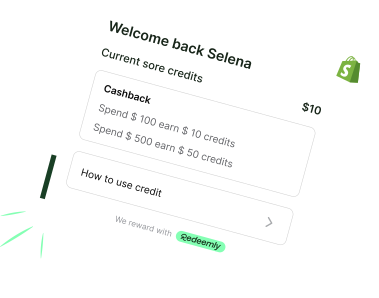
Store credit programs are also uniquely good at bumping up your Average Order Value (AOV). When you set simple earning rules—like, "Get $10 in credit for every $100 you spend"—you give customers a clear and motivating target to aim for.
Shoppers can easily see that adding just one more item to their cart could unlock a nice reward for their next visit. That simple psychological nudge encourages them to spend a little more right now, which directly lifts your AOV. A discount might cap what someone is willing to spend, but a store credit milestone actually encourages more spending.
Here’s how it usually plays out:
They see the offer: A clear banner on your site says, "Spend $100, get $10."
They fill their cart: Their subtotal hits $85.
They make a choice: Instead of heading to checkout, they realize they're just $15 away from a reward. They find one more thing to add, pushing their order over the threshold.
This exact scenario plays out all the time, and it’s a perfect illustration of how store credit turns your loyalty program into a revenue-generating tool on every single transaction.
This powerful recall mechanism is why so many savvy merchants are making the switch. In fact, research popularized by Bain & Company shows that even a modest 5% increase in customer retention can lead to a whopping 25% jump in profits. This really drives home why smarter retention tools are so essential. Just look at a real-world powerhouse like Starbucks Rewards—its members now drive an incredible 53% of all US store spend, proving the immense power of a well-executed loyalty system.
By using a Shopify-native store credit solution, you can build a simple, effective, and profitable customer retention program that works for both you and your shoppers. It gets rid of the confusion, protects your margins, and gives customers a clear, valuable reason to choose your brand again and again.
How To Design a High-Impact Store Credit Program
Let's get practical. Turning the idea of a retention program into a real, money-making asset is easier than you might think. A great store credit system doesn't need a convoluted rulebook or a confusing points-to-dollars conversion chart. Its magic lies in its simplicity—creating a crystal-clear, motivating reason for customers to spend a little more today and come back a lot sooner.
The real secret sauce? Keeping the experience native to your Shopify store. Forget those clunky, third-party widgets that slow your site down and feel completely disconnected from your brand. A native solution just works. It feels like a natural part of the shopping experience, removing any friction that might make a customer give up. You're making loyalty effortless.
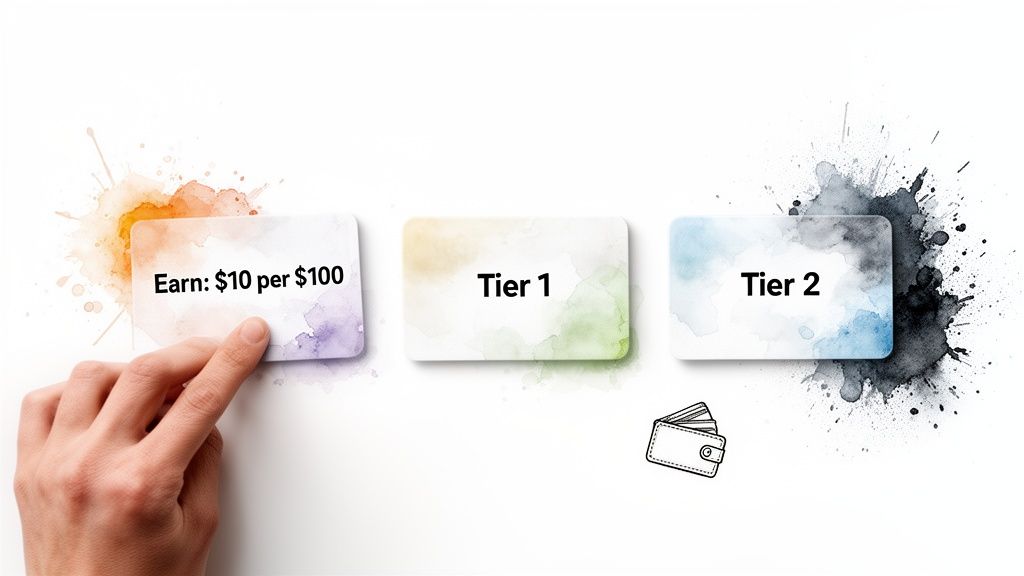
When the experience is this seamless, it directly fuels a higher repeat purchase rate and a much healthier Customer Lifetime Value (LTV).
Set Simple and Motivating Earning Rules
The bedrock of any successful store credit program is clarity. Your customers need to "get it" in a split second. Complicated systems make people pause and think, but simple rules make them act.
Start with a straightforward rule that’s directly tied to how much they spend. A classic, high-performing example is: "Get $10 in store credit for every $100 you spend." That one sentence is a powerhouse.
It’s dead simple: No mental gymnastics required. The value is obvious.
It naturally boosts Average Order Value (AOV): A customer with $85 in their cart feels an almost irresistible pull to find a $15 item to hit that reward milestone.
This simple, milestone-driven approach transforms your program from a passive, long-term reward into an active tool that increases AOV on nearly every single order.
Create Attainable Reward Tiers
While your base rule keeps things simple for everyone, adding tiers can create a sense of aspiration. It gives your best customers a reason to become even better customers. The trick is to make these tiers feel both achievable and genuinely rewarding. Forget a dozen confusing levels; just stick to two or three that matter.
Tier 1 (Everyone): Get $10 for every $100 spent.
Tier 2 (VIP Status): Spend $500 in a year and start earning $15 for every $100 spent.
This structure rewards your most dedicated fans without making newcomers feel left out. It gives every shopper a clear path forward and provides a powerful incentive for your top spenders to stick with your brand for the long haul.
Communicate the Value Everywhere
Your program is only as good as its visibility. If shoppers don't know about it, it doesn't exist. This means weaving the message into the entire customer journey, making your store credit feel like an unmissable perk of shopping with you. As you design the program, it's also smart to understand the underlying mechanics; getting the technical side right requires solid payment processing expertise.
A customer's store credit balance is a powerful psychological hook. It's not a coupon they might lose; it's their money sitting in their account. Reminding them of it is one of the most effective ways to drive a repeat purchase.
Here’s where you need to show them the money:
On-Site Wallet: Use a floating widget or a prominent section on the account page that constantly displays their available credit.
Product & Cart Pages: Display dynamic messages like, "You're just $25 away from earning $10 in credit!" to nudge that AOV higher.
Checkout Integration: Let them apply their credit with a single click. Make redeeming it the easiest thing they do all day.
Email Campaigns: Fire off an automated email the second they earn credit, and send gentle reminders when they have a balance just waiting to be spent.
By making your store credit program visible, valuable, and ridiculously easy to use, you build a powerful retention engine that protects your margins and fuels truly profitable growth.
Measuring The True Success of Your Retention Program
A great store credit program feels good, but great data is what truly proves its worth. To show a real return on your efforts, you have to look past the surface-level numbers and drill down into the metrics that directly impact your store's health and profitability. It's all about connecting your store credit strategy to the numbers that actually move the needle.
The goal isn't just to see if people are using the program. It's to figure out how it's fundamentally changing customer behavior for the better. Are they spending more? Coming back sooner? Sticking around longer? Answering these questions is how you know your retention plan is really working.
Focusing on Customer Lifetime Value
Customer Lifetime Value (LTV) is the big one. It’s the total profit you can reasonably expect from a single customer over their entire relationship with your brand. Honestly, it's probably the most important metric for building a sustainable business. A store credit program is built to boost LTV by giving customers a concrete reason to make that second, third, and fourth purchase.
Instead of a one-and-done transaction driven by a temporary discount, you’re building a cycle of repeat business. The credit they earn acts like a magnet, pulling them back to your store. Over time, this simple shift turns casual shoppers into loyal fans, dramatically increasing their total value to your business. To really get a handle on this, a conversion rate calculator can be a handy tool for tracking changes in customer behavior.
Driving a Higher Average Order Value
Next up is Average Order Value (AOV), which is simply how much a customer spends each time they check out. While discounts often train customers to spend just enough to get the deal, store credit flips the script. By setting a simple rule like, "Get $10 for every $100 you spend," you give shoppers a clear target to aim for.
This little psychological nudge works wonders. A customer with $87 in their cart is suddenly motivated to find one more item to hit that $100 mark. This behavior directly lifts your AOV, making every single transaction more profitable without having to slash your margins.
The true power of a store credit system is its ability to influence both present and future behavior. It increases what a customer spends today (AOV) while ensuring they have a reason to come back and spend again tomorrow (LTV).
Tracking Your Repeat Purchase Rate
Finally, the Repeat Purchase Rate tells you what percentage of your customers come back to buy again. This metric is a direct reflection of loyalty. A well-designed store credit program makes that number climb by making the decision to return almost a no-brainer. When a customer knows they have a balance just waiting for them, your store immediately jumps to the top of their list.
These programs aren't just a nice-to-have; they are serious revenue drivers. Top-tier loyalty programs can boost spending from members by 15-25% each year. For merchants struggling with low retention, that's a game-changer. In fact, a massive 83% of shoppers say loyalty programs make them more likely to buy from a brand again.
By zeroing in on these three core metrics—LTV, AOV, and Repeat Purchase Rate—you can see the real, tangible impact of your customer retention program. You can also dive deeper into user retention metrics with our complete guide.
Common Store Credit Program Mistakes To Avoid
Launching a store credit program is a fantastic move, but a few common missteps can easily trip you up and undermine all your hard work. The single biggest mistake we see merchants make? Recreating the same old problems from other loyalty systems. They get bogged down in complex rules, turning what should be simple store credit into something that feels just as confusing as a traditional points program. When that happens, you kill customer motivation before it even has a chance to start.
Another major pitfall is setting the bar for rewards way too high. If a customer has to spend a fortune just to get a tiny kickback, they won't even bother trying. That's a surefire way to create a program that just sits there, collecting dust and doing nothing for your lifetime value. Simplicity is your secret weapon here; a clear, achievable path to a reward is what actually gets people excited and encourages them to make that next purchase.
Creating a Disjointed User Experience
Many Shopify merchants reach for non-native apps to run their loyalty programs, but this often creates more problems than it solves. These external apps can be a real drag on your site's performance, creating a sluggish experience that frustrates shoppers and sends your conversion rates plummeting. In the world of ecommerce, site speed is everything—a clunky loyalty widget just isn't worth the trade-off.
Worse yet, these apps often feel completely disconnected from your brand. They shoehorn a jarring, third-party interface into your customer's journey, right at the moment you want them to feel most connected to your store. This kind of friction doesn't just feel cheap; it leads to lower participation and makes your entire program feel like an afterthought, not a core benefit of being a loyal customer.
A seamless, native Shopify experience is non-negotiable. When earning and redeeming credit feels like a natural part of your checkout process, customers are far more likely to engage. This is how you boost repeat purchase rates and AOV without adding any complexity to the experience.
Forgetting to Talk About It
Finally, one of the easiest traps to fall into is the "set it and forget it" mindset. You can design the most brilliant program in the world, but if your customers don't know it exists or don't understand how it works, it's completely useless. You have to be its biggest cheerleader, constantly communicating the value it offers.
To get this right, make sure you're talking about your program at every key moment in the customer journey:
Make a Big Splash: Announce the launch with an email campaign and social media posts to get your existing customers excited from day one.
Keep It Visible: Use prominent banners and on-site widgets that clearly display a customer’s available credit balance. Out of sight, out of mind.
Nudge at Checkout: Remind shoppers exactly how they can use their credit to save money on the order they're about to place.
By sidestepping these common blunders—keeping your rules simple, choosing a native solution, and shouting about your program from the rooftops—you can build a store credit program that truly delights customers, protects your margins, and delivers a powerful return on investment.
Common Questions About Store Credit Programs
Many Shopify merchants I talk to are tired of the discount race. They know there has to be a better way, but they're not always sure how store credit works in the real world. Let's tackle some of the most common questions head-on.
How Is Store Credit Different From a Gift Card?
This is a great question because they seem similar on the surface. Think of it this way: a gift card is all about acquisition. Someone buys it for a friend, bringing a new face to your store.
Store credit, however, is a retention powerhouse. It’s a reward you give your existing customers, a "thank you" for their loyalty that gives them a fantastic reason to come back and shop with you again. One brings new people in; the other keeps your best customers close.
Will a Store Credit Program Eat Into My Profit Margins?
This is where store credit really shines. A 10% discount code is a direct, immediate hit to your profit on that specific sale. You lose that money instantly.
Store credit is much smarter. It’s an earned reward that encourages a future, full-priced purchase. You're not cutting the price of the current sale; you're investing a small amount to secure a much larger, more profitable sale down the road.
By rewarding past purchases instead of discounting present ones, you protect your margins on every single transaction. You're building a powerful incentive for repeat business that boosts your average order value and protects your bottom line at the same time.
Can I Let Customers Use Store Credit With Other Discounts?
You can, but I'd strongly advise against it. The whole point of a strong store credit program is to break the cycle of constant, margin-killing sales.
If you let customers stack discounts on top of their credit, you're training them to wait for the "perfect storm" to buy. This just delays sales and hurts your profitability, which is exactly what we're trying to avoid. Keep it simple: let store credit be the primary, high-value reward.
Ready to stop sacrificing your margins and start building real, profitable loyalty? Redeemly helps you launch a native Shopify store credit program that boosts LTV and AOV without the usual headaches. Start growing profitably with Redeemly.


Join 7000+ brands using our apps