What Is Store Credit and How It Unlocks Higher Shopify LTV
Dec 10, 2025
|
Published
Store credit is an in-store currency that customers can only spend with your brand. Unlike generic discount coupons or confusing points systems, it's a powerful tool designed to lock in a customer's next purchase and keep them coming back. For Shopify merchants, it's a native solution that transforms returns and rewards from a cost center into a direct driver of customer lifetime value (LTV) and average order value (AOV).
What Store Credit Really Means for Your Shopify Store
Stop thinking about store credit as just a tool for handling returns. It’s so much more than that. Imagine it as a private, closed-loop economy for your brand. When you issue store credit instead of a cash refund, you're not just processing a return; you're guaranteeing a future sale and keeping that hard-earned revenue right where it belongs—inside your business.
This shift in perspective turns store credit from a reactive measure into a proactive strategy to boost lifetime value. It's about moving away from margin-killing discounts and creating a sustainable cycle of repeat business that directly improves your most important growth metrics.
Your Store's Exclusive Bank Account
The best way to grasp its power is to picture store credit as an exclusive "in-store bank account" for each of your customers. Every time you issue credit, you're making a deposit into this account, giving them flexible spending money they can only use at your store. This simple act achieves several critical goals all at once:
It boosts lifetime value (LTV): That balance sitting in their account is a constant nudge to come back and shop again.
It preserves your cash flow: Revenue stays in your pocket instead of walking out the door as a cash refund.
It increases average order value (AOV): Customers often spend more than their credit balance, using it as a down payment on a larger purchase.
This approach flips a potentially negative experience, like a product return, into a positive one. Instead of losing a customer, you're giving them a compelling reason to stick around, explore other products, and make another purchase, ultimately increasing their LTV.
Let's break down the real-world impact with a quick comparison.
Cash Refund vs Store Credit: A Strategic Comparison
Here’s a quick look at how native store credit transforms key business metrics compared to traditional cash refunds.
Business Metric | Impact of Cash Refund | Impact of Store Credit |
|---|---|---|
Cash Flow | Negative. Cash immediately leaves the business, creating a direct loss. | Neutral/Positive. Revenue is retained, protecting cash flow and securing a future sale. |
Customer Lifetime Value | Low. The transaction is over. The customer has no incentive to return. | High. The customer is locked in for a repeat purchase, directly boosting their LTV. |
Average Order Value | N/A. No guaranteed next purchase. | Often Increased. Customers frequently spend more than their credit balance, boosting AOV. |
Brand Loyalty | Weakened. A refund can feel like a final, impersonal transaction. | Strengthened. Turns a negative experience into a positive reason to engage again. |
The difference is clear. While a cash refund ends the customer relationship for that transaction, store credit extends it, creating a bridge to the next sale.
Ultimately, this strategic tool turns costly returns into golden opportunities to boost lifetime value and average order value. By ditching one-off discounts and confusing points programs, you create a sustainable cycle of repeat business that fuels real, long-term growth for your Shopify store.
Why Store Credit Beats Discounts and Loyalty Points
It’s a classic story for Shopify merchants: you’re hooked on discount coupons. Slapping a 20% off banner on your site feels like an easy win, and sure, it can goose your sales numbers for a day or two. But it often brings in the wrong crowd—the one-and-done deal hunters who disappear the second the sale is over, contributing nothing to your customer lifetime value.
This cycle becomes a race to the bottom, accidentally training your best customers to just wait for the next promotion. You end up eroding the very brand value you worked so hard to build.
On the other hand, you have those convoluted loyalty point systems. They often feel like a math test nobody signed up for. Customers get stuck wondering if 500 points equals $5 or $10, and that initial spark of motivation just fizzles out.
A native Shopify store credit system cuts right through all that noise. It’s clean, simple, and delivers real, tangible value that drives LTV without the complexity.
The Power of Simplicity and Direct Value
The psychology here is incredibly straightforward: $15 in store credit is always worth $15. There’s no mental math, no confusing tiers, and no hoops to jump through. It feels like cash sitting in a customer’s pocket, just waiting to be spent at your store.
That kind of clarity is far more persuasive than a percentage-off coupon that doesn’t apply to certain items or a points balance that feels like a foreign currency.
Store credit transforms a transactional relationship into a relational one. Instead of just offering a discount to close a sale, you're providing a concrete reason for a customer to return, effectively pre-selling their next purchase and increasing their lifetime value.
By giving customers a direct monetary value, you’re not just rewarding them; you’re empowering them. This is a cornerstone of effective retention marketing strategies, which are all about building lasting relationships, not just chasing one-time sales. You’re reinvesting in your best people, which is the surest way to grow your customer lifetime value (LTV).
Protecting Margins and Boosting Average Order Value
Let’s talk numbers. Every discount coupon you offer is a direct cut from your profit margin. Store credit, however, plays a different game. It sits on your books as a liability until it's used to drive a repeat purchase—a purchase that likely wouldn't have happened otherwise and often for a higher amount.
But here’s where it gets really interesting for your average order value (AOV). A customer with a $20 credit balance almost never goes looking for a $20 item. Instead, they see it as a head start on something bigger they really want, like that $75 jacket they’ve been eyeing.
This little psychological trick is fantastic for your average order value (AOV). The credit nudges them to spend more out of their own pocket to get the product they truly desire. When you compare the options, the winner is clear:
Discounts: Shrink your margins and attract bargain hunters with low LTV.
Loyalty Points: Often create confusion and lead to low engagement.
Store Credit: Protects your margins, simplifies rewards, and directly boosts AOV and LTV.
This approach stops you from teaching customers to devalue your products and instead builds a sustainable growth loop. If you're curious about how other incentives perform, it's worth exploring the impact of discounts and promotions on cart recovery.
At the end of the day, store credit builds real loyalty by offering a benefit that’s simple, valuable, and keeps your customers invested in your brand for the long haul.
Driving LTV and AOV with a Smart Store Credit Strategy
Stop thinking about store credit as just a refund tool. It's one of the most powerful, yet overlooked, growth engines you can have in your Shopify store. When you flip the script and use it proactively, store credit transforms from a reactive customer service fix into a strategic driver of two key metrics: customer lifetime value (LTV) and average order value (AOV).
This isn't just about managing problems; it's about creating moments of genuine delight that build real loyalty. Instead of a generic apology for a shipping delay, imagine instantly dropping $10 of store credit into that customer's account. You've just turned a frustrating experience into a surprisingly positive one, forging an emotional connection that a simple discount code could never replicate.
Boosting Customer Lifetime Value Proactively
LTV is the true north of a healthy customer relationship. Discount coupons might get you a quick sale, but they often attract one-and-done shoppers. Store credit, on the other hand, builds commitment. By issuing credit proactively, you give customers a compelling reason to come back, essentially pre-selling their next purchase before they even think about going to a competitor.
Think about how you can put this into action:
Surprise and Delight: A loyal customer hits their one-year anniversary with your brand. Boom. Surprise them with a $15 credit.
Service Recovery: Instead of just closing a support ticket, resolve it by adding credit directly to their account. It shows you value their business, not just their transaction.
Win-Back Campaigns: Got a list of customers who haven't shopped in a while? Re-engage them with a small credit balance that's "waiting for them."
Every one of these moves is a direct investment in your customer relationships and a lever for increasing lifetime value. Of course, to see the real impact, you need to be tracking the right numbers, which is why it's so important to know how to calculate customer LTV properly.
For a deeper dive into building these kinds of long-term relationships, exploring different marketing strategies is key to improving Customer Lifetime Value.
The Upsell Psychology Driving Higher AOV
The effect store credit has on AOV is just as powerful, and it all comes down to basic human psychology. When a customer has a $20 credit, they almost never look for an item that costs exactly $20. What do they do instead? They see that credit as a discount on something they really want—like that $60 item they've had their eye on for weeks.
The credit doesn't just cover a cost; it lowers the mental barrier to a larger purchase. The customer feels like they're only spending $40 of their "own" money to get the $60 product, which makes the upsell feel like a savvy move.
This dynamic naturally nudges customers to spend more than their credit balance, giving your AOV a healthy lift without you having to slash your margins with site-wide discounts. This is a game-changer in industries like apparel and electronics, where return rates can easily hit 20% to 30%. Offering native store credit is the smartest way to handle those returns while encouraging a bigger follow-up purchase.
By turning returns into upsell opportunities, you create a sustainable growth loop where every transaction reinforces loyalty and drives higher spending.
How to Implement a Seamless Store Credit System on Shopify
Getting a native store credit system up and running on Shopify means moving past clunky, manual workarounds. You could issue gift cards as a substitute for credit, but it's a disjointed experience for everyone involved and lacks the professional feel needed to truly boost lifetime value.
The real goal here is to build a frictionless loop where your customers earn and spend credit without even thinking about it. No weird codes to copy-paste. No waiting on your support team to send a manual email. A proper native system turns store credit from a simple refund tool into a powerful engine for increasing AOV and LTV.
This is what that "frictionless loop" looks like in action. When you proactively give credit, it almost always leads to a bigger next purchase and a more valuable customer over time.
As you can see, once that credit hits a customer's account, it acts like a magnet, pulling them back to your store and encouraging them to spend more than they otherwise would have, directly impacting AOV and LTV.
Moving Beyond Shopify’s Native Limitations
Shopify’s built-in tools are a decent start, but they don't offer a true, integrated store credit program right out of the box. Manually creating gift cards for every return or reward is a huge time-sink and feels impersonal to your customers. It's a temporary fix, not a scalable growth strategy.
To build a program that actually improves the customer journey and moves your key metrics, you need a dedicated app. A solution like Redeemly is built directly on Shopify’s own store credit system, which means it’s lightweight and provides a truly native experience without slowing down your site.
A dedicated app handles all the heavy lifting for you:
Automatic Credit Issuance: Credit for returns or rewards is instantly added to a customer's account. No more manual data entry.
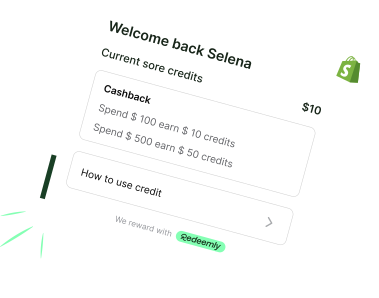
Clear Balance Display: Customers can always see their available credit right on their account page or through on-site widgets.
Effortless Redemption: At checkout, credit can be applied with a single click, feeling just like any other payment option.
This kind of deep, native integration makes using store credit feel like a natural part of shopping with your brand.
Creating a Frictionless Customer Experience
Ultimately, the success of your store credit program comes down to one thing: how easy is it to use? When a customer gets credit, it should feel like finding cash in their wallet, not like being handed a puzzle they have to solve.
The entire point of an app like Redeemly is to make this process completely intuitive. The setup is designed to be clean and straightforward, letting you manage and issue credit without any technical headaches. This simplicity means your team can finally stop focusing on tedious execution and start thinking strategically—turning store credit into a program that actively drives lifetime value and average order value.
Best Practices for Your Store Credit Program
A great store credit program isn't just about the software—it's about the strategy behind it. Just flipping a switch and hoping for the best is a surefire way to miss out on the LTV and AOV benefits.
The goal is to make store credit feel like a genuine perk for your customers, not some confusing consolation prize.
It all starts with a simple, fair, and transparent store credit policy. Your customers should never have to wonder how it works. Clearly lay out when and how they get credit, whether it expires, and exactly how they can use it. This clarity builds trust and eliminates the friction that kills conversions and clogs up your support inbox.
Once your policy is solid, the real magic begins when you empower your team to use store credit to solve problems and create happy customers. This is where you can seriously boost your customer lifetime value (LTV).
Empower Your Team to Create Delight
Your customer support team is on the front lines, and they have a golden opportunity to turn a bad day into a brand-loving moment. Instead of just a canned apology for a late shipment, train them to issue store credit on the spot.
That simple gesture completely flips the script. It takes a negative experience and turns it into a positive one, all while locking in their next purchase and boosting their lifetime value.
A proactive $10 in store credit often feels more valuable to a customer than a reactive 20% off coupon. It shows you’re invested in the relationship, not just the transaction.
This is a cornerstone of smart retention. We dig much deeper into this in our guide on how to improve customer retention if you're looking for more ideas.
Use Credit as a Precision Marketing Tool
Store credit isn't just a customer service tool. It's also an incredibly effective marketing lever for increasing customer lifetime value. A surprise credit drop can bring a lapsed customer back into the fold way more effectively than yet another "we miss you" email with a generic discount coupon.
Think about running high-impact campaigns like these:
Anniversary Rewards: Surprise a loyal customer with credit on the anniversary of their first purchase to boost LTV.
Win-Back Offers: Target customers who haven't bought anything in 90 days with a small, expiring credit to create urgency.
Post-Purchase Bonuses: After a big purchase, drop a small credit into their account to encourage a quick follow-up visit and increase their AOV on the next order.
Avoid These Common Program Pitfalls
Even with the best strategy, a clumsy execution can sink your efforts. To ensure your native store credit program drives repeat business and boosts your average order value (AOV), sidestep these common mistakes:
Confusing Redemption: If a customer can't figure out how to apply their credit at checkout, they’re gone. The process needs to be dead simple—ideally, a single click that feels like a native part of the Shopify experience.
Hidden Balances: Customers can't spend money they don't know they have. Their credit balance needs to be front-and-center in their account profile and maybe even pop up in on-site reminders. Out of sight truly is out of mind here.
Poor Communication: Never assume your customers know what their credit is for or how valuable it is. Use your email and on-site messaging to gently remind them about their balance and even suggest a few products they might like.
By sticking to these practices, you can build a native Shopify store credit program that does more than just fix problems—it will actively drive growth, boost lifetime value, and make your brand more profitable.
Got Questions About Shopify Store Credit? We've Got Answers.
Jumping into a new customer retention strategy always sparks a few questions. So, let's clear the air on some of the most common things Shopify merchants ask when they're thinking about switching from discounts and points to a native store credit system. My goal here is to give you straight, simple answers to help you build a program that really works for your customers and your profit margins.
How Does Shopify Actually Handle Store Credit?
This is a great first question. Shopify’s main platform doesn't have a big, flashy feature called "Store Credit." Instead, it cleverly uses its existing gift card system to get the job done. When an app like Redeemly issues credit to a customer, it's actually creating a special gift card linked directly to that person's account, all happening seamlessly in the background.
This native approach is brilliant because it's lightweight, incredibly reliable, and plays perfectly with Shopify's checkout and reporting. Your customers just see a credit balance in their account—it feels totally integrated, not like some clunky, bolted-on third-party tool.
Is Store Credit Really More Profitable Than a Discount?
Without a doubt. The difference is all about long-term value versus a short-term hit. Slapping a 20% discount on a purchase is a guaranteed loss of margin, right then and there. It's a magnet for bargain hunters who were probably never going to shop with you again anyway.
Store credit flips that script completely. It's an investment in a future sale, keeping that revenue locked inside your ecosystem. Plus, it drives up your average order value. A customer with a $15 credit doesn't just buy a $15 item; they're far more likely to grab that $50 thing they've been eyeing, spending more of their own cash to make up the difference. This single dynamic protects your margins and builds a real, sustainable cycle of repeat business that boosts lifetime value.
Will My Customers Get It, or Are Points Better?
Let's be honest: points systems are often a headache. Customers have to do mental math to figure out what their points are actually worth, and that confusion leads to them just ignoring the program altogether.
The beauty of a native store credit system is its radical simplicity. One dollar in credit is one dollar to spend. That's it.
It’s an instantly understandable value proposition. You're basically handing them cash that's only good in your store. That feels way more tangible and valuable than some abstract number of points, creating real loyalty without making your customers work for it.
Can I Use Store Credit for Things Besides Returns?
Yes! And you absolutely should. While it's a fantastic way to turn a potentially negative return experience into a future purchase, its true power lies in being proactive. Think of it as your secret weapon for boosting customer lifetime value.
Instead of just reacting to problems, use store credit to create moments of delight. A surprise credit for a loyal customer's birthday or as a "thank you" for a large purchase can forge a stronger emotional connection than any marketing email.
When you start using it this way, store credit transforms from a simple operational tool into a powerful engine for your customer lifetime value strategy. You stop just processing transactions and start building a loyal community of customers who feel seen and appreciated.
Ready to transform your retention strategy? Redeemly helps you replace margin-eroding discounts with a native Shopify store credit program that boosts LTV and AOV, creating profitable, long-term customer relationships. Get started with Redeemly today.



Join 7000+ brands using our apps