A Guide to Customer Retention and Customer Loyalty for Shopify
Feb 23, 2026
|
Published
When we talk about growing an ecommerce brand, two terms come up constantly: customer retention and customer loyalty. They’re the twin engines of sustainable growth, the difference between a one-hit-wonder and a brand that lasts.
Think of it this way: retention is the act of keeping a customer, while loyalty is the feeling that makes them want to stay. They’ll stick with you even when a competitor dangles a shiny discount in front of them. For any brand on Shopify, nailing both isn't just a "nice to have"—it's the only way to build a profitable, long-term business with a high customer lifetime value.
Your Ecommerce Store Has a Leaky Bucket Problem
Picture your Shopify store as a big bucket. Your marketing team is working around the clock—running ads, posting on social, optimizing SEO—pouring new customers in the top. That's acquisition, and it feels productive.
But there's a problem. For most stores, that bucket is riddled with holes.
Those holes are customer churn. They represent all the hard-won customers who make a single purchase and then vanish, never to be seen again. This "leaky bucket" traps you in a hamster wheel of constant, expensive acquisition just to tread water. You're pouring more and more in, but the level never seems to rise. In the cut-throat DTC world, where a competitor is always just one click away, patching those holes is a matter of survival.
The Real Cost of Customer Churn
The data on this is pretty sobering. The average customer retention rate in ecommerce is a measly 38%. That means most brands lose almost two-thirds of their customers after just one sale. This churn leads to a median customer lifetime of only 18 months, and in the U.S. alone, it costs brands a staggering $168 billion every single year.
But here’s the flip side, and it's a big one: just a 5% improvement in retention can boost your profits by 25% to 95%. That's a massive return. You can find out more about industry retention rates to see how you stack up.
The real issue isn’t just losing one sale. It’s losing the entire future stream of revenue that customer represented—all the repeat purchases, the bigger carts, and the priceless word-of-mouth marketing they would have generated.
This is why focusing on customer retention and loyalty is so critical. It's the art of patching the leaks in your bucket. It’s about giving people a compelling reason to stick around, turning your business from a leaky container into a deep reservoir of predictable, profitable revenue. Instead of just chasing the next transaction, you start thinking about the lifetime value (LTV) of every single person you bring into your brand's world.
To really get this right, you need to understand the fundamentals. You can explore a deeper definition of customer retention in our guide to build that solid foundation.
It's easy to use the terms "customer retention" and "customer loyalty" interchangeably, but they're actually two different sides of the same coin. Both are crucial for growth, but they operate on very different levels.
Think of it this way: retention is about getting that next purchase. It’s a tactical game, often driven by a well-timed offer or a bit of native Shopify store credit to nudge a customer back to your site. It's about behavior.
Loyalty, on the other hand, is a much deeper connection. It's the emotional pull that makes a customer choose your brand even when a competitor is a few dollars cheaper. It's about belief.
Retention is transactional—it answers the what and the when of a customer's journey. Loyalty is all about the why. It's built on trust, shared values, and a genuine connection to your brand. A good retention strategy using tools like store credit will absolutely secure that second sale and help you boost lifetime value without just handing out discounts.
But a loyalty-focused approach? That’s how you create true brand advocates. These are the people who not only bring in predictable revenue but also become your most powerful marketing channel. They tell their friends. They defend you online. And they do it because they feel a part of something, not because you dangled a 10% off coupon.
Retention vs. Loyalty At A Glance
To make this crystal clear, let's break down the fundamental differences between the transactional nature of retention and the emotional foundation of loyalty.
Aspect | Customer Retention | Customer Loyalty |
|---|---|---|
Focus | Transactional—the what and when of a purchase. | Relational—the emotional why behind their choice. |
Driver | Incentives like timely offers or native Shopify store credit. | Brand affinity, trust, shared values, and community. |
Outcome | More repeat purchases and a higher average order value (AOV). | True brand advocates and a much higher lifetime value (LTV). |
At the end of the day, you need both. Retention is your defense, plugging the holes in your revenue bucket. Loyalty is your offense, building an army of fans who actively help you grow.
The Leaky Bucket Problem
Every DTC brand owner knows the pain of the "leaky bucket." You spend a fortune on ads to pour new customers in the top, only to watch them trickle out the bottom as churn. Without a solid retention plan, it's a constant, exhausting cycle.
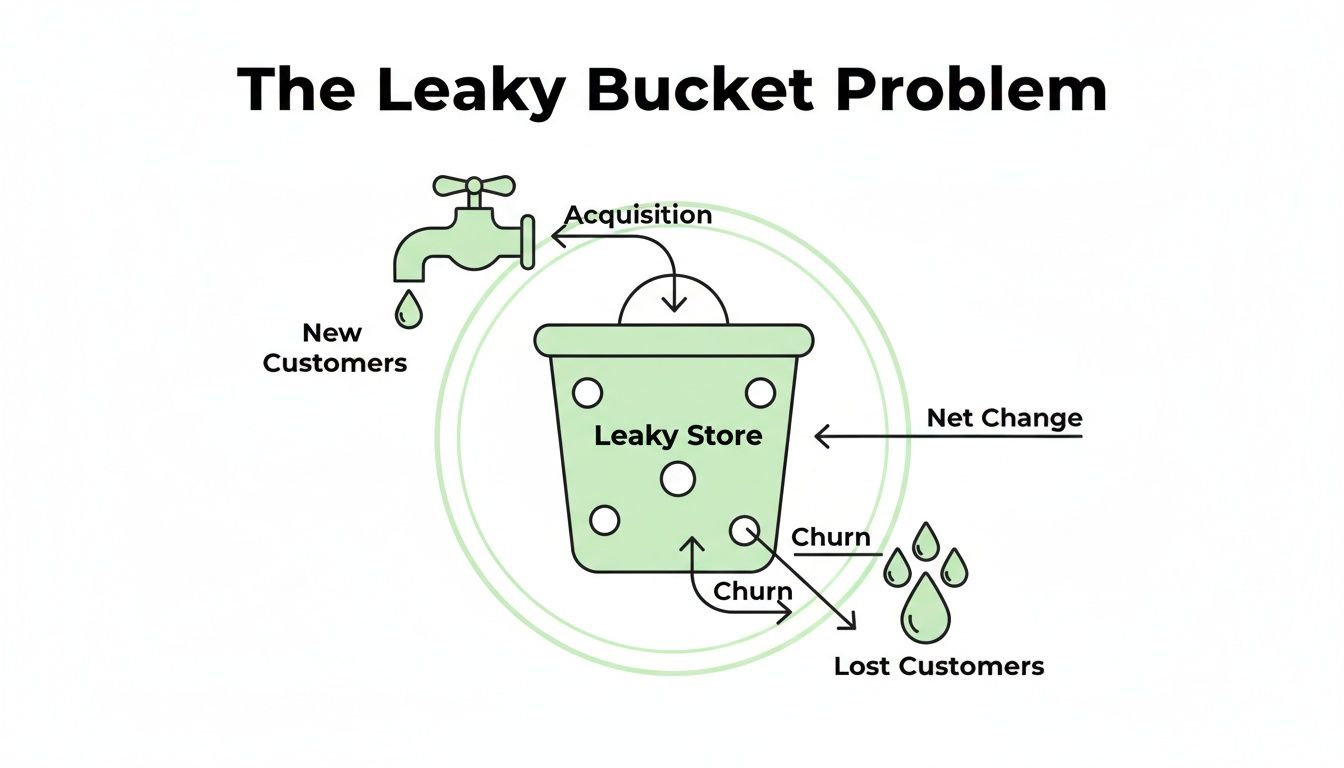
This visual really drives the point home. The faucet represents all your hard work acquiring customers. The holes are where they slip away, and those lost droplets are pure profit disappearing.
This isn't just a conceptual problem; it has a massive financial impact.
The numbers don't lie: Increasing customer retention by just 5% can boost your profits by a staggering 25–95%. This is why margin-safe tools like native Shopify store credit are so powerful—they deliver an incredible ROI.
True loyalty turns this whole dynamic on its head. Your most loyal customers don't just stay in the bucket; they actively help you refill it with referrals and consistent repeat business. This is where tactics beyond simple discounts, like building a real community through social media community management, pay off in the long run.
By bridging the gap between retention tactics and loyalty-building, you can create a far more resilient business that isn't constantly dependent on the next big sale. Up next, we'll get into the specifics of how you can use one of the most effective tools for this: Shopify native store credit.
Why Traditional Loyalty Programs Are Broken
For years, the standard ecommerce playbook has been stuck on a loop. When we talk about customer retention and customer loyalty, two things usually come to mind: aggressive discounts and complicated points systems. Brands have sunk millions into these programs, chasing repeat business. But what have they gotten in return?
More often than not, they’ve created a vicious cycle that devalues their brand and eats away at their profits. The hard truth is that these old-school methods don't build real loyalty. They just rent it. You end up with a customer base full of deal-hunters who are loyal to the lowest price, not to you. The moment a competitor dangles a slightly better coupon, they're gone.
This leaves you with shrinking margins and an audience you've trained to never, ever pay full price. It's the central problem that modern brands have to solve.
The Problem with Discount-Driven Loyalty
Blasting out sales and coupon codes feels like a quick and easy way to get a sales spike. And it is. But it’s a sugar rush—a short-term fix with some serious long-term side effects. This strategy literally trains your customers to wait for a sale, creating a downward spiral known as discount fatigue.
Before you know it, your full price becomes a meaningless number. It’s just a suggestion. And that slowly chips away at the perceived value of everything you sell.
This approach actively sabotages a sustainable business by:
Crushing Profit Margins: Every single discount is a direct hit to your profit on a sale. That’s less money to invest back into better products, top-notch service, and actual growth.
Attracting the Wrong Customers: Your email list swells with bargain shoppers, not true brand advocates who believe in what you’re doing and why it matters.
Killing Lifetime Value (LTV): By fixating on the immediate transaction, you completely miss the chance to build the emotional connection that underpins a high-value, long-term customer relationship.
Ultimately, a discount-first strategy teaches your audience to care about one thing: price. It’s a race to the bottom, and that’s a race nobody wins.
Why Points Systems Create Friction
The other go-to tactic is the classic points-based loyalty program. On paper, the idea makes sense: spend money, earn points, and cash them in for rewards. But in the real world, these systems are often a confusing, frustrating mess for the customer. They completely fail to inspire the loyalty they were built for.
Points are basically a confusing second currency. Your customer is forced to become a mental accountant, constantly asking, "Okay, how many points is this worth?" or "What can I actually get with 500 points?" This mental gymnastics adds friction and makes the whole reward feel abstract and way less valuable.
Instead of a genuine "thank you," points often feel like a gimmick. Customers can't easily track their balance, the redemption rules are a mystery, and most of the time, they forget they even have points to begin with.
This complexity tanks engagement and does nothing to drive the repeat purchases you need to boost average order value and LTV. A loyalty program should feel simple, generous, and rewarding—not like a homework assignment.
Using Store Credit to Drive Profitability
Let's be honest: the old playbook of endless discounts and complicated points systems is a race to the bottom for Shopify brands. It's a strategy that just eats away at your margins and tends to attract one-and-done bargain hunters, not true fans of your brand.
It's time for a smarter approach—one that builds both customer retention and customer loyalty while actually protecting your bottom line. Enter native Shopify store credit. It completely flips the script.
Instead of a discount that immediately slashes your revenue, store credit is more like a cash incentive that brings customers back for their next purchase. From an accounting perspective, it sits on your books as a liability, only becoming a cost when an engaged, happy customer returns to your store to spend it. This simple shift is a total game-changer for your unit economics.
Boosting Average Order Value and Lifetime Value
One of the best things about a store credit program is how it naturally nudges up your Average Order Value (AOV). Think about it. When you offer a reward like, "Spend $100, get $10 in credit," you create a powerful psychological pull. Shoppers are far more likely to toss another item into their cart just to cross that threshold and unlock the reward, boosting your AOV right then and there.
This kicks off a fantastic cycle. A bigger first purchase earns a more valuable credit reward, which then becomes a compelling reason for that customer to shop with you again. Every purchase after that reinforces the habit, laying the groundwork for a much higher Customer Lifetime Value (LTV). You’re not just chasing a second sale; you’re building a sustainable engine for repeat business.
Store credit transforms a loyalty program from a cost center into a profit driver. It rewards your best customers for spending more and coming back, all without sacrificing the margin you need to grow.
This is all about creating a retention strategy that rewards customers without forcing you to rely on constant sales. It shifts the focus from the one-time transaction to the long-term relationship. You can learn more about what store credit is and how it works to see exactly how it could fit into your brand's strategy.
Protecting Your Margins
The numbers behind store credit just make sense. It’s a well-known fact in business that getting a new customer costs 5-7 times more than keeping an existing one. It's a staggering difference, and it contributes to a $1.6 trillion global annual loss from customer churn. Meanwhile, 65% of a typical company's business comes from its repeat buyers, who also spend 67% more on average. If you want to dig into these numbers, you can discover more customer retention statistics on Marketing LTB.
Unlike a 20% off coupon that vanishes into thin air, store credit guarantees that the value you give away comes right back to your business. It can only be redeemed on a future purchase, ensuring you get that follow-up transaction and drive more revenue.
This approach is the perfect way to patch the "leaky bucket" of customer churn, strengthening both customer retention and customer loyalty. By making your customers feel genuinely valued with a real, cash-like reward, you build a more resilient business that thrives on repeat revenue, not fleeting promotions.
How to Build Your Store Credit Program
Turning store credit from a nice idea into a real growth driver for your Shopify store isn’t about complex tech. It’s all about strategy. The goal isn't just to hand out credits; it's to build a system that naturally improves both customer retention and customer loyalty. Let's walk through how to actually get it done right.
It all starts with a reward structure that’s both generous and smart—one designed to bump up your average order value (AOV). The simplest, most effective model you can use is a "Spend X, Get Y" offer.
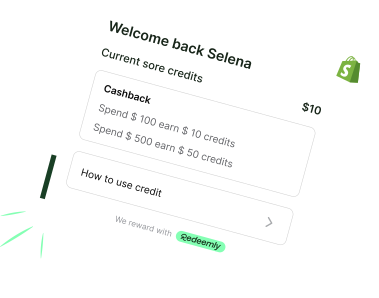
Think about it: an offer like "Spend $100, get $10 in store credit" gives customers a clear, compelling target. Shoppers hovering around that $100 mark are suddenly motivated to add one more thing to their cart to hit the goal. Just like that, you’ve increased that order's value.
Define Your Reward Tiers
The trick here is to look at your data. Start by figuring out your current AOV and then set your first reward tier just a little bit higher. This makes the incentive feel within reach and nudges people to spend just a bit more than they usually would.
Tier 1 (The Hook): If your average order is $85, set your first tier at "Spend $100, Get $10." It’s an easy jump for most customers.
Tier 2 (The Upsell): Don't forget your bigger spenders. Add a higher tier, like "Spend $200, Get $25," to encourage larger carts and reward those who are already spending more.
Keep it Simple: The magic of native Shopify store credit is that everyone gets it instantly. Avoid complicated points or confusing rules. Stick to a clear, cash-like value that feels real.
Your goal is to make the reward feel like a genuine bonus, not a complex game. This clarity is what separates a high-performing store credit program from a points system that just creates friction.
Automate Your Communication
Okay, so a customer earned some credit. Now what? The follow-up is everything. You absolutely need automated post-purchase emails to remind shoppers about their balance and pull them back in.
Frame it as "cash in your account" just waiting for them. Make the message exciting and urgent.
There's a reason 59% of sales leaders say loyalty programs are their number one retention tool—they build the kind of connection that actually drives revenue. Just look at giants like Starbucks, where Rewards members are responsible for a staggering 60% of sales. As you can review the full findings on The Sales Collective, the proof is in the numbers.
For Shopify merchants, a dead-simple store credit system is your ticket to that same kind of success. To get into the nuts and bolts, you can check out our guide on how to give store credit on Shopify for the step-by-step.
How to Know If Your Retention Strategy Is Actually Working
You've launched a native Shopify store credit program, which is a fantastic first step. But how do you prove it’s actually making a difference? To really see the impact, you need to have some proven customer retention strategies in place first. That foundation gives you solid data to track.
This is where we move past vanity metrics and zero in on the Key Performance Indicators (KPIs) that tell you the real story about your business's health.
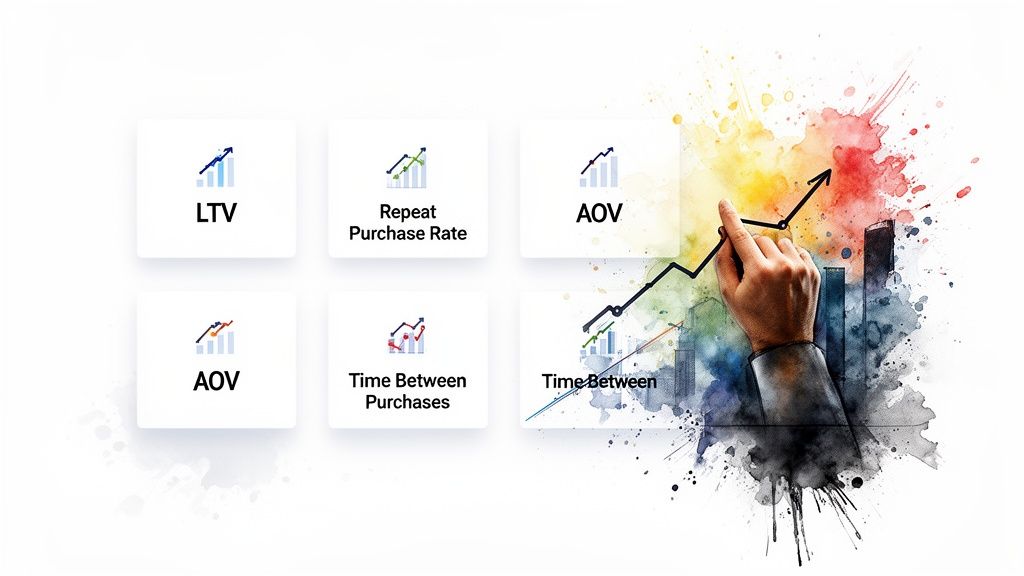
When you make the smart move to swap out discounts for store credit, you're playing the long game for profitability. These are the numbers that will prove your bet is paying off by building both customer retention and customer loyalty.
The Core Metrics for Your Store Credit Program
Don't get buried in a mountain of spreadsheets. Tracking just a few key numbers will give you a crystal-clear picture of your program's ROI and tell the true story of its success.
Customer Lifetime Value (LTV): Think of this as your North Star for retention. When your LTV is climbing, it's the most definitive sign that your customers are sticking around longer and spending more money with you over time. A successful store credit program directly contributes to LTV growth.
Repeat Purchase Rate: This one is simple but powerful. It tells you what percentage of your customers are coming back to buy again. If this rate is on the rise, it’s direct evidence that your store credit is doing its job of bringing people back.
Average Order Value (AOV): Are those store credit rewards actually encouraging bigger purchases? Your AOV will tell you. If customers are tossing a few extra items in their cart to reach a reward threshold, you'll see it here. It’s a crucial sign that your incentives are working as planned.
Time Between Purchases: A great store credit program should make customers want to buy again sooner. If you notice the average time between a customer's first and second purchase starting to shrink, you know your rewards are creating a sense of urgency and driving quicker sales.
Focusing on these four KPIs means you're no longer just hoping for loyalty—you're actively measuring and building it. These aren't just feel-good numbers; they translate directly into a more profitable and sustainable Shopify business.
Got Questions About Store Credit? We’ve Got Answers.
Making the switch to a new way of rewarding customers can feel like a big step. We get it. Let’s clear up some of the most common questions brands have when they move from old-school points and discounts to a smarter store credit system.
"Isn't Store Credit Just Another Discount?"
Not even close. Think of it this way: a discount is a one-time transaction. You give away 10% of your margin, and that money is gone forever. Poof.
Store credit, on the other hand, is an investment in a future relationship. You're giving your customer a balance that they can only spend with you. It’s like putting cash directly into their pocket that’s earmarked for your store, ensuring they come back without you having to slash your prices. It's a tool to build a higher lifetime value, not just close a single sale.
"My Customers Are Used to Points. Won't This Be Confusing?"
Actually, it's the exact opposite. Points systems are often a huge source of friction. How many times have you wondered, "What are 500 points even worth?" It requires mental gymnastics nobody wants to do.
Store credit is brilliantly simple because it speaks a language everyone understands: money. Seeing a clear “$10.00 available” feels real and instantly valuable. There’s no confusion, no math—just a compelling reason for your customer to come back and treat themselves.
"How Does This Actually Help Increase My AOV?"
This is where the magic really happens. Store credit is a powerful tool for nudging customers to spend just a little bit more. It works by setting a clear, achievable goal.
Picture this offer: "Spend $100, get $10 in credit." A shopper with $85 in their cart sees that and thinks, "Wait, if I just add one more thing, I get $10 back for next time." It's a no-brainer. They add that extra item, and you've just boosted your Average Order Value (AOV) on the spot.
This simple, powerful incentive turns a regular purchase into a strategic win. You’re not just making a sale; you’re increasing its value and paving the way for a higher customer lifetime value.
Ready to stop burning through your profits with endless discounts? See how Redeemly uses native Shopify store credit to build a loyalty system that actually adds to your bottom line. Find out how at Redeemly.ai.


Join 7000+ brands using our apps