The Real Definition of Customer Retention for DTC Brands
Jan 10, 2026
|
Published
Let’s cut through the noise. Customer retention isn't just about a percentage on your dashboard; it’s the active, deliberate work of turning first-time buyers into loyal, repeat customers. More importantly, it's the engine that drives a higher customer lifetime value (LTV) and average order value (AOV), creating profitable, long-term growth.
What Is Customer Retention in Ecommerce?
Think of your business as a bucket. You spend a ton of money on ads and marketing to fill that bucket with new customers. But what if the bucket has holes? If customers buy once and never come back, you're constantly spending just to stay afloat, forever trapped in the acquisition game.
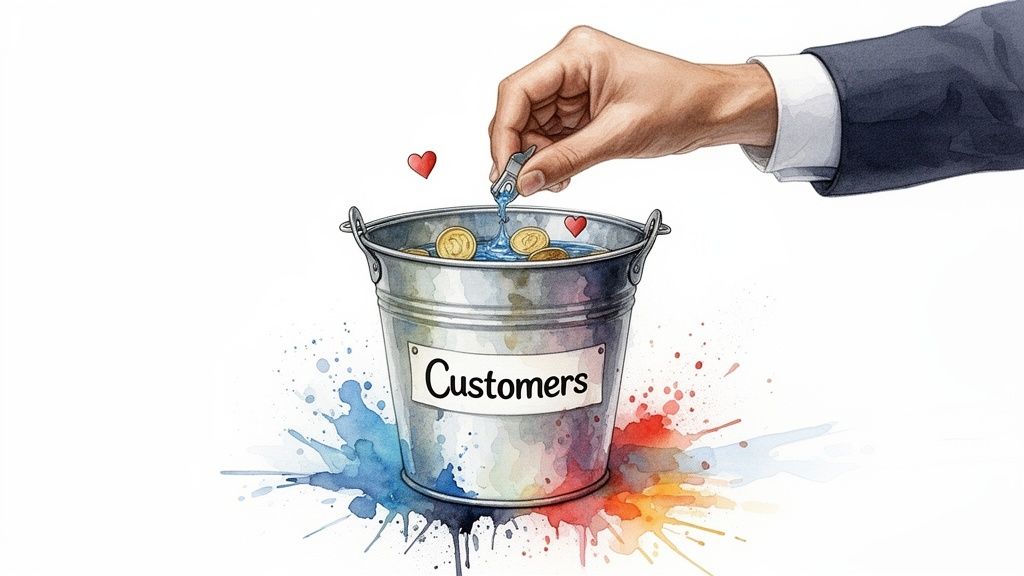
Customer retention is all about plugging those leaks. For a modern ecommerce brand, it’s not just a nice-to-have—it’s a core growth engine. It's the sum of every action you take to make sure the customers you fought so hard to win actually stick around, spend more, and tell their friends about you.
It’s More Than Just a Number
If you're only looking at a retention rate, you're missing the forest for the trees. A high retention rate is the outcome of an amazing customer experience, not the goal itself. The real goal is to build a business where your existing customers fuel sustainable, profitable growth by increasing two critical metrics:
Higher Customer Lifetime Value (LTV): When customers stick with you, they buy again and again. This massively increases the total revenue you'll see from each person over their entire journey with your brand.
Increased Average Order Value (AOV): Trust is a powerful thing. Loyal customers trust your recommendations, making them far more likely to add that extra item to their cart or try a new product line.
The math doesn't lie. It costs about 5x more to acquire a new customer than to keep an existing one. And what do those existing customers do? They spend 67% more on average than first-time buyers. The impact is staggering: research shows that a tiny 5% lift in retention can boost your profitability by as much as 100%. (You can dive into more stats like these in Sprinklr's research).
Ultimately, a smart retention strategy creates a powerful growth loop. You become less dependent on expensive, unpredictable ad platforms. You generate more predictable revenue. And you build a genuine community around your brand that insulates you from the chaos of the market.
Why Retention Is Your Most Profitable Growth Lever
It’s easy to get caught up in the thrill of acquiring new customers. That constant influx feels like progress, right? But the brands that truly last—the ones that build empires—aren't just chasing newness. They're built on retention.
Retention is the single most powerful and profitable growth lever you can pull. It’s about shifting your focus from expensive, one-time sales to creating valuable, long-term relationships that directly boost LTV and AOV. Think of it less as a defensive move and more as your best offensive strategy for sustainable profit.
Happy, returning customers are the foundation of a healthy business for two simple reasons: they’re cheaper to keep, and they spend more money over time. Instead of dumping your entire budget into the ever-rising costs of ads to find new buyers, you're investing in the people who already know and trust you. That difference goes straight to your bottom line.
The Math Behind Margin-Safe Growth
Let's imagine two Shopify stores for a moment.
Store A goes all-in on aggressive, margin-slashing discounts to drive growth. They attract a ton of one-and-done deal hunters who vanish as soon as the sale is over. Store B, on the other hand, focuses on delivering value, using margin-friendly rewards like native Shopify store credit to bring people back.
At first glance, Store A might even look more successful with its flashy top-line revenue. But its profits are razor-thin, and its customer base is completely disloyal. Store B is playing a different game—it’s building a predictable, reliable engine for income.
By the end of the year, Store B’s customers don't just come back more often; their Average Order Value (AOV) is higher because they trust the brand and feel valued. As a result, their Customer Lifetime Value (LTV) soars, creating a powerful buffer against unpredictable market shifts and rising acquisition costs.
For any brand serious about long-term success, understanding how to increase customer lifetime value isn't just a nice-to-have; it's essential. This strategic focus on turning one-time buyers into a loyal community is what separates the fleeting trends from the enduring icons. The math is undeniable: a dollar spent on retention will always work harder for your business than a dollar spent on acquisition.
How to Measure Customer Retention the Right Way
You can't improve what you don't measure. If you're serious about customer retention, you need to move beyond guesswork and start tracking the numbers that truly matter. We're not talking about vanity metrics here—this is about getting a clear, honest picture of how well you're turning one-time buyers into high-value repeat customers.
The process isn't as intimidating as it sounds. It all starts with one core formula: your Customer Retention Rate (CRR). This simple calculation gives you the percentage of customers who stick around over a set period, providing a crucial baseline for every retention effort you make.
But CRR is just the beginning. The real insights come when you connect retention to your bottom line through two powerhouse metrics: Customer Lifetime Value (LTV) and Average Order Value (AOV).
Linking Retention to Profitability
Think of it this way: a good retention strategy is a direct lever for pulling both LTV and AOV higher. When customers keep coming back, they naturally spend more with your brand over their lifetime. That's the LTV boost.
At the same time, these repeat customers trust you. They believe in your products and are more open to your recommendations, making them far more likely to add that extra item to their cart. And just like that, their average order size goes up.
This isn't just theory. You can see how focusing on keeping customers happy directly fuels these critical growth metrics.
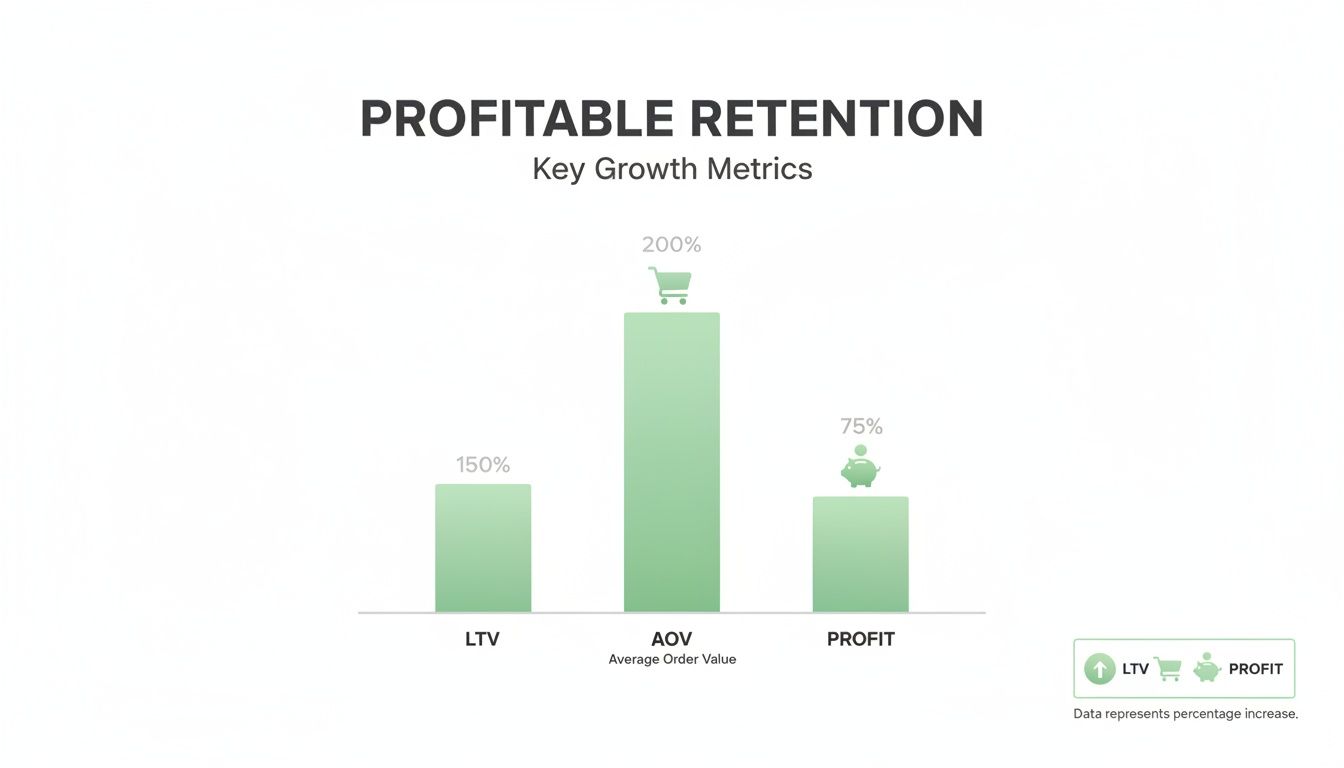
As you can see, a solid retention program creates a beautiful feedback loop where LTV, AOV, and, most importantly, profit all grow in lockstep.
For any Shopify brand, the most powerful way to think about customer retention is this: it's the engine that drives predictable increases in both lifetime value and average order value, creating a more resilient and profitable business.
Tracking these numbers is non-negotiable for long-term, sustainable growth. For a deeper look, check out our guide on how to calculate customer lifetime value to really get a handle on this foundational metric. By measuring what matters, you can finally stop hoping for loyalty and start building it with intention.
Common Retention Mistakes That Erode Your Margins
Are your retention efforts secretly eating away at your profits? It’s a surprisingly common problem. Many brands, with the best of intentions, fall into traps that train customers to devalue their products and wait for the next sale.
The biggest offender, by far, is the overuse of discount codes. Sure, a flash sale can give you a quick revenue bump. But when your inbox is a constant parade of "20% OFF!" emails, you're teaching your customers one thing: never pay full price. This slowly chips away at your brand's perceived value and cannibalizes future, full-margin sales.
The Problem with Points and Complexity
Another classic misstep is the overly complicated, points-based loyalty program. You know the type—"Earn 17 points for every dollar, redeem 1,342 points for a travel-size moisturizer!" The idea is sound, but the execution often creates more of a headache than a hook.
Customers get confused. They don't know what their points are worth, how to cash them in, or if the effort is even worth it.
When a loyalty program feels like a math quiz, it’s already failed. The goal is an emotional connection, not a cognitive burden. It should feel like a reward, not homework.
This kind of complexity completely misses the point. A great retention strategy should be simple, intuitive, and feel instantly valuable. A much better approach is to offer simple, tangible rewards that feel like cash in hand—like native Shopify store credit. It encourages another purchase without devaluing your products, protecting your margins while building real, profitable loyalty.
Using Store Credit As Your Smartest Retention Strategy
So, you’ve dodged the common traps of endless discounts and confusing loyalty points. What’s next? Let’s talk about a smarter, more elegant approach. For any modern Shopify brand, real retention is about giving customers a compelling reason to come back. And the most powerful tool in your arsenal is native Shopify store credit. It’s a brilliant alternative that builds genuine loyalty without torching your profit margins.
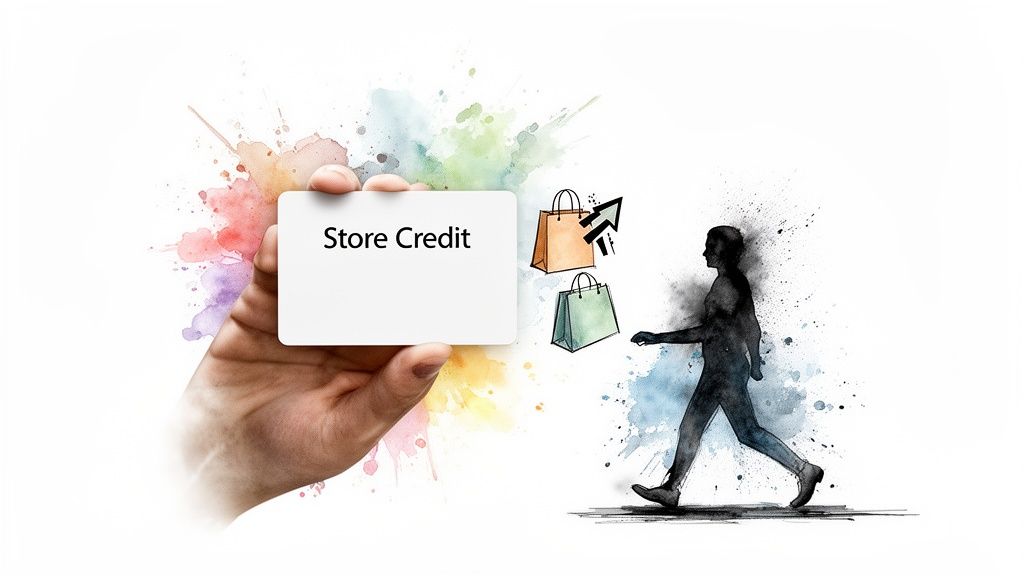
Think of it this way: a one-off coupon is fleeting, but store credit feels like cash. It sits in a customer's account, creating a subtle but powerful psychological nudge. This isn't just another discount—it feels like "found money," a real balance just waiting to be spent. That simple mental shift can turn a one-and-done shopper into an active, engaged customer who can’t wait to come back and use their reward.
Boosting AOV and LTV With Every Purchase
This strategy doesn't just make customers happy; it has a direct, measurable impact on your most important growth metrics. When a customer knows they can earn credit by spending a little more, they’re naturally encouraged to increase their Average Order Value (AOV). Suddenly, tossing that extra item into the cart feels less like a splurge and more like an investment in their next purchase.
Store credit flips the definition of customer retention from a passive metric into an active strategy. It’s the deliberate practice of using margin-safe rewards to prompt the second, third, and fourth purchase, fundamentally growing Lifetime Value (LTV).
This isn’t just a theory; it’s what sales leaders are putting into practice. Recent surveys show that 59% of sales leaders see loyalty programs as their most effective retention tool, but how you run that program is what separates the winners from the rest. Cash-like store credit doesn't just reward loyalty—it creates a sustainable financial loop that keeps customers coming back for more. You can discover more insights about these loyalty trends from The Sales Collective.
Because it's so straightforward, store credit cuts through the noise of complex point systems. It's the most direct path to boosting repeat purchases and nurturing a customer base that becomes more valuable over time. If you want to get into the nuts and bolts, our guide explaining what is store credit is the perfect place to start.
Turning Retention Theory Into Profitable Reality
Knowing the numbers is one thing. Actually doing something with them is what separates the brands that thrive from those that just survive. It’s time to move beyond the spreadsheets and build a real, profitable retention engine fueled by native Shopify store credit.
Here’s a simple roadmap to get you started.
First things first: you need a baseline. You can’t know if you’re improving if you don’t know where you’re starting from. So, before you do anything else, calculate your current Customer Retention Rate (CRR) and Customer Lifetime Value (LTV). This gives you a clear benchmark to measure your success against.
With your numbers in hand, it’s time to make a strategic shift. Step away from the endless cycle of margin-killing discounts and confusing points. Instead of constantly slashing prices, embrace incentives that add value without devaluing your products. The answer is native Shopify store credit—a simple change that encourages repeat purchases and boosts AOV.
Communicate Value at Every Step
Once you have a better system in place, shout about it from the rooftops. Let customers know how they can earn and spend their store credit at every single touchpoint. We're talking product pages, post-purchase emails, your homepage—everywhere.
When a program is this visible, it stops feeling like a marketing gimmick and starts feeling like a genuine perk of shopping with you.
As you grow, you'll find that managing these relationships at scale requires the right tools. Exploring how to go about implementing enterprise loyalty software can give you a solid framework for what comes next.
True customer retention isn't just a metric; it's a business philosophy. It champions long-term customer relationships as the foundation for profitability and resilience, turning one-time buyers into lifelong advocates for your brand.
This proactive approach doesn’t just build loyalty; it builds a powerful, predictable revenue stream that grows both LTV and AOV. For more actionable strategies, you can explore our detailed guide on how to improve customer retention and start seeing results today.
Ready to replace margin-killing discounts with a loyalty program that actually grows your bottom line? Discover how Redeemly uses native Shopify store credit to boost LTV and AOV. Get started with Redeemly today.
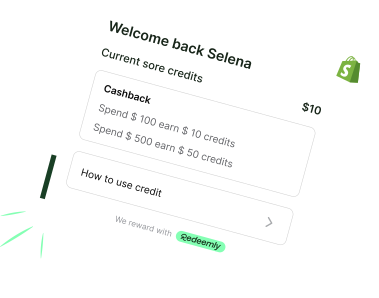


Join 7000+ brands using our apps