Targeting in Marketing Definition Driving LTV and AOV
Dec 30, 2025
|
Published
Let's cut through the jargon. Targeting in marketing is the art of focusing your time, money, and energy on the exact people most likely to fall in love with your brand and become your best customers. It's about precision over raw power, and profitability over just making noise.
What Is Targeting in Marketing, Really?
Imagine a skilled archer versus someone with a shotgun.
The shotgun approach is mass marketing. You spray your message everywhere, hoping a few pellets hit a target—any target. It's loud and messy, but mostly you just waste a ton of ammo (and marketing budget) on people who were never going to buy anyway.
The archer, on the other hand, represents targeted marketing. They pick a single, high-value target, take careful aim, and release. Every shot is deliberate, efficient, and designed for maximum impact. This is the heart of what targeting in marketing truly means.
For anyone running a Shopify store, this difference is everything. Constantly blasting sitewide discounts is the shotgun approach. Sure, you'll hit a few one-time bargain hunters, but you're also torching your profit margins and training customers to never pay full price. It's a race to the bottom that kills your customer lifetime value (LTV) and keeps your average order value (AOV) stagnant.
Effective targeting is your way out of that cycle.
Shifting from Discounts to Real Value
The goal isn't just to make a sale; it's to build a profitable, long-term relationship that grows both lifetime value and average order value. And that starts with knowing exactly who you're talking to.
At its core, targeting in marketing is the strategic process of picking your battles. After you've grouped your audience into different segments, you decide which of those groups are worth your focus. You zero in on the people whose problems and desires your products are uniquely suited to solve. This laser focus is what prevents you from wasting resources chasing low-value leads.
This is what allows you to deliver the right message to the right person at the right time. For example, a key part of modern marketing is understanding tactics like behavioral targeting, where you use a customer's past actions—like pages visited or products added to their cart—to show them ads they'll actually care about.
For ecommerce brands, effective targeting means identifying high-potential customers and giving them a reason to stay loyal—without sacrificing your profit margins on every single order.
This is a perfect lead-in to smarter incentives. Instead of those generic 20% off coupons or confusing point systems that devalue your brand, you can offer targeted rewards like native Shopify store credit. This simple shift encourages customers to come back and spend more to use their credit, naturally boosting your average order value (AOV) and lifetime value (LTV). It’s a sustainable growth model built on precision, not just endless promotion.
Here’s a quick breakdown of how these two approaches stack up. It really highlights why the "archer" mindset wins in the long run for modern ecommerce.
Targeted Marketing vs. Mass Marketing Key Differences
Aspect | Mass Marketing (Shotgun Approach) | Targeted Marketing (Archer Approach) |
|---|---|---|
Audience | Everyone, undefined | Specific, well-defined segments |
Message | Generic, one-size-fits-all | Personalized and highly relevant |
Cost | High spend, low ROI | Efficient spend, high ROI |
Goal | Brand awareness, short-term sales | Customer loyalty, high LTV & AOV |
Customer Type | Attracts discount seekers | Builds relationships with ideal customers |
Outcome | High churn, margin erosion | Sustainable growth, brand equity |
As you can see, one path is about burning cash for fleeting attention, while the other is about strategically investing in profitable, long-term relationships. For a growing brand, the choice is clear.
The Six Core Methods of Customer Targeting
Once you know your goal is to find your ideal customer, the next question is obvious: how do you actually do it? Effective targeting isn't a shot in the dark. It's about using proven methods to group customers into segments that make sense, allowing you to ditch generic campaigns and start building real, profitable relationships.
Think of yourself as a detective. You wouldn't just wander around hoping to find a suspect. You'd gather specific clues—where they live, what they care about, how they behave—to build a clear profile. The same principle applies here.
This diagram nails the core concept: targeting is all about delivering the right message to the right person at just the right time.
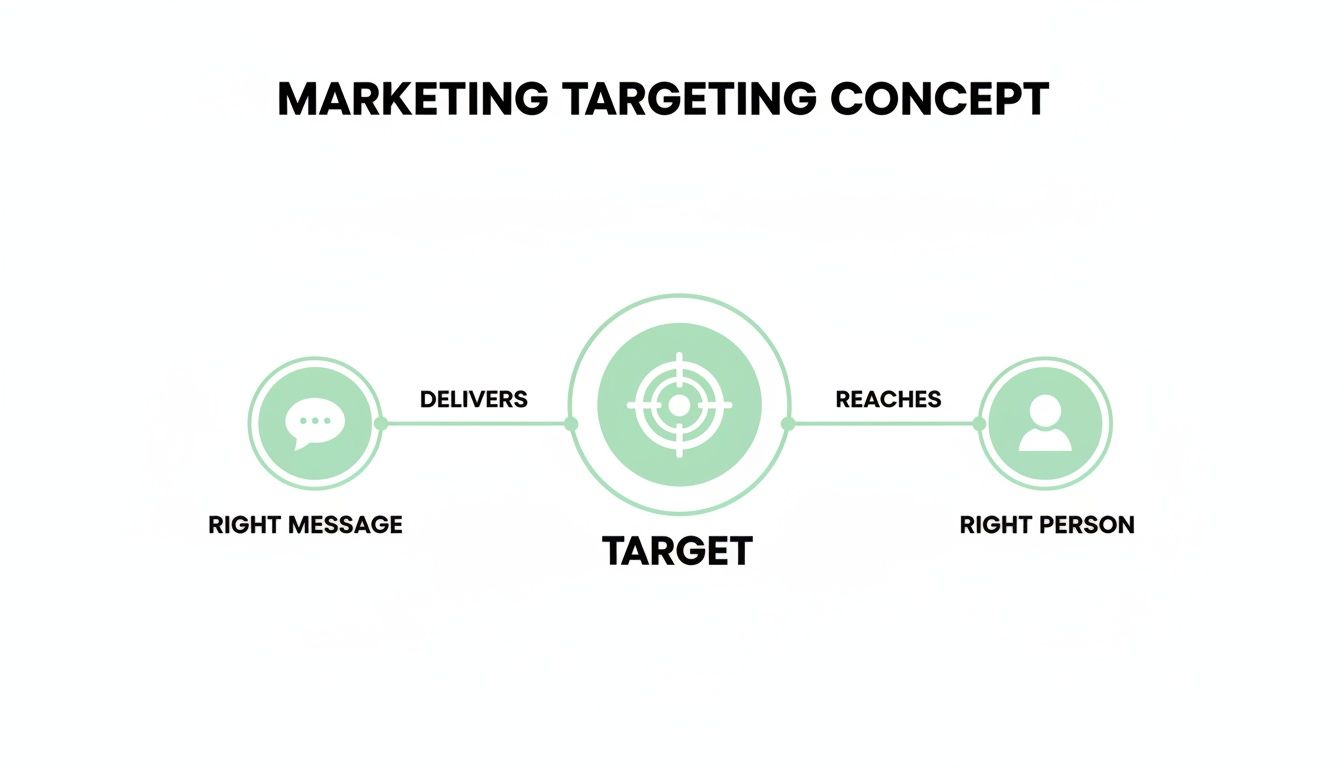
Ultimately, every method we're about to cover is just a different tool to help you hit that bullseye with greater and greater precision.
Demographic and Psychographic Targeting
Let's start with the classics. These two approaches help you define who your customers are and why they buy from you.
Demographic Targeting: This is the foundational layer, focusing on objective, factual data. It answers the "who" by looking at clear-cut traits like age, gender, income level, education, and location. For a Shopify store, this could mean targeting ads for a new line of premium skincare to women aged 30-50 with a higher household income. Simple and straightforward.
Psychographic Targeting: This is where things get interesting. This method digs into the "why" behind a purchase, segmenting customers based on their values, attitudes, interests, and lifestyle choices. A brand selling sustainable activewear would use psychographics to connect with people who value eco-friendly products, lead an active life, and see wellness as a priority.
While demographics sketch the outline, psychographics color in the picture, helping you craft messages that resonate on a much deeper, more emotional level.
Key Takeaway: The magic happens when you combine them. Knowing you’re targeting "35-year-old urban mothers" is good. But knowing you’re targeting "35-year-old urban mothers who value organic products and community events" is a game-changer.
Behavioral and Contextual Targeting
Next up are two methods that pivot from who people are to what they do and where they do it. These are powerful indicators of intent.
Behavioral Targeting: This is all about action. It segments users based on their past interactions with your brand—things like their purchase history, which pages they visited, or items they added to a cart. It’s a goldmine for increasing LTV. For instance, you could identify customers who bought twice but haven't been back in 90 days and send them a "We Miss You" store credit offer to bring them back.
Contextual Targeting: With this method, you place your message in a relevant environment. Instead of targeting the person directly, you target the context. If you sell hiking gear, you could place ads on blogs that review hiking trails or in articles about outdoor adventures. Your message shows up at the exact moment the user is already engaged with that topic.
Behavioral data is your key to unlocking more customer lifetime value, while contextual targeting is a brilliant way to discover new, highly relevant audiences. For a deeper dive into how these groupings work, check out our complete guide on market segmentation strategies for ecommerce.
Lifecycle and Lookalike Targeting
Finally, we have two more advanced methods. These help you understand where a customer is in their journey with you and how to find more people just like your very best ones.
RFM/Lifecycle Targeting: This approach segments customers based on their stage in the customer lifecycle, often using RFM analysis (Recency, Frequency, Monetary value). Are they a brand-new buyer, a loyal VIP, or an at-risk customer who might be about to churn? Each group needs a completely different message. A new customer might get a store credit offer to lock in that second purchase and boost their LTV, while a VIP gets exclusive early access to a new collection.
Lookalike Targeting: This is a seriously powerful tool for customer acquisition. It works by taking data from your best existing customers and using it to find new people with similar characteristics on platforms like Facebook or Google. By creating a Lookalike Audience based on your high-LTV customers, you can focus your ad spend on prospects who are statistically much more likely to convert and become valuable customers themselves.
As you explore more advanced segmentation, understanding specific CTV targeting options is also becoming crucial as video platforms continue to grow.
How Targeting Directly Boosts Your Profitability
Think of great targeting as a direct lever on your store's financial health. It’s the difference between asking, “How many sales can we make?” and asking the much smarter question, “How much profit can we generate from each customer?”
The answer to that second question reveals everything about your two most important ecommerce metrics: Average Order Value (AOV) and Customer Lifetime Value (LTV).
Broad, sitewide promotions and complicated loyalty programs are a fast track to killing your margins. They’re a magnet for bargain hunters who buy once, disappear forever, and teach your real customers to just wait for the next sale. This isn't growth; it's training your audience to devalue your products, actively hurting your LTV for a quick, fleeting bump in revenue.
The Tale of Two Shopify Stores
Let's paint a picture. Imagine two Shopify stores, both selling similar products.
Store A (The Discounter): Their go-to move is a generic “20% OFF EVERYTHING!” sale or a confusing points program. Sure, they see a spike in orders, but their AOV never really grows and their LTV is low. Why? Because their customers aren't loyal to the brand—they're loyal to the discount or gimmick.
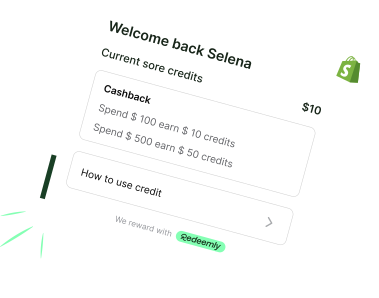
Store B (The Strategist): This store is different. They use targeting to understand who their customers are. Instead of blanket discounts, they issue native Shopify store credit with a tool like Redeemly. A new customer might get a $10 credit right after their first purchase, giving them a compelling reason to come back and increasing their potential lifetime value from day one.
Store B's strategy nails two critical goals at once. First, the store credit encourages customers to spend a little more on their next order to "use up" their balance, which naturally lifts AOV. Second, it creates a powerful, built-in reason for them to return, directly boosting their LTV.
This is how you build real brand advocates, not just a list of one-off deal seekers. If you want to dive deeper into this crucial metric, check out our guide on how to calculate customer LTV.
Targeted rewards protect your margins and build a loyal customer base that spends more over time. Store credit acts like cash in a customer's pocket, encouraging repeat purchases and higher spending, which is the direct path to a better LTV and AOV.
Connecting Targeting to Real Revenue Growth
This isn't just a theory; the numbers back it up. For some businesses, personalized product recommendations—a direct result of good targeting—are responsible for a staggering 26% of all revenue.
It’s proof that focusing on specific customer behaviors, like how often they buy or what they’ve shown interest in, is a far more powerful way to lift your AOV and LTV than just slashing prices. This is the perfect environment for incentives like native Shopify store credit, which are designed to nudge that next purchase forward and increase the customer's overall spend. You can dig into more stats on how targeting drives revenue at waalaxy.com.
Once you grasp the true targeting in marketing definition—not as a buzzword, but as an engine for LTV and AOV growth—you can finally shift away from costly, generic promotions. You’ll start building a healthier, more predictable business on a foundation of loyal, high-value customers.
Using Store Credit for Smarter Targeted Campaigns
Knowing the different ways to target customers is one thing. Actually putting that knowledge into practice with a tool that grows your bottom line? That’s a different ball game entirely.
This is where you need to move away from the old playbook of margin-killing discounts and clunky points systems. Instead, think about using native Shopify store credit. It's a surprisingly powerful and simple way to run targeted campaigns that directly boost lifetime value and average order value.
Unlike generic discount codes that just attract bargain hunters, store credit is an incentive that builds a real, sustainable growth engine. It's a simple, dollar-for-dollar value that feels less like a flimsy coupon and more like cash in their pocket, giving them a real reason to come back and spend more.
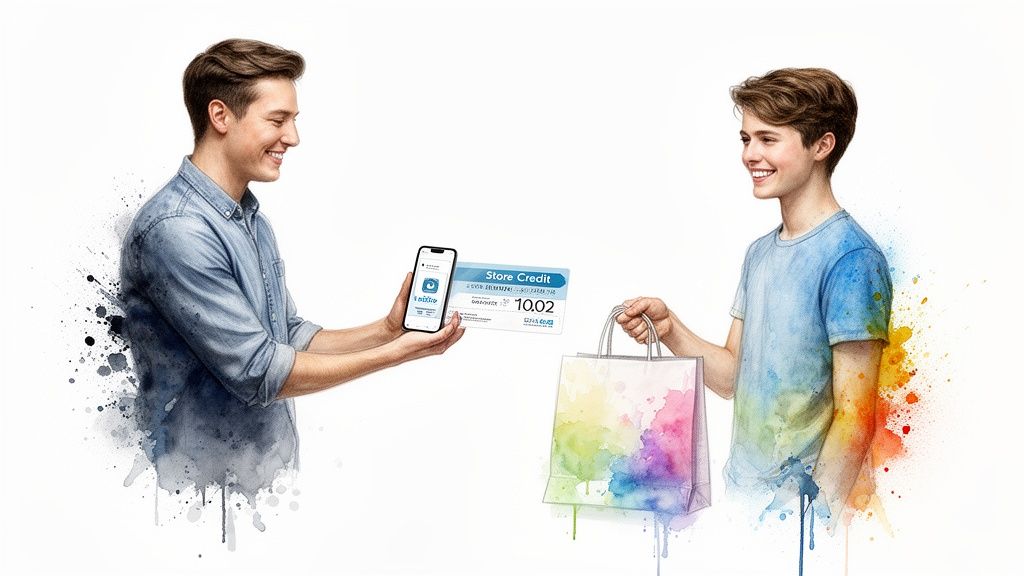
When you get this right, you directly boost two of your most important metrics: Average Order Value (AOV) and Customer Lifetime Value (LTV).
Targeting Key Segments With Store Credit
So, what does this look like in the real world? Here’s a practical playbook for using store credit to engage different customer groups you've identified.
First-Time Buyers (Behavioral Targeting): Let’s be honest, the most crucial sale is the second one. You can set up an automatic "Welcome Credit" that hits every new customer's account right after their first purchase. It gives them an immediate, tangible reason to return, turning a one-time buyer into a repeat customer and increasing their LTV.
VIP Customers (RFM Targeting): Your best customers earned that title, so treat them like it. Use RFM analysis to pinpoint your top-tier shoppers and surprise them with exclusive "credit drops" as a thank you. This isn't some generic points program; it’s a personal touch that reinforces their value and encourages them to keep their AOV high.
At-Risk Customers (Lifecycle Targeting): We all have them—customers who used to be regulars but have gone quiet. A targeted "We Miss You" campaign with a small store credit can be the perfect nudge to win them back. It’s far more effective than a steep discount that just cheapens your brand and is a smart way to protect LTV.
Store credit is a margin-safe incentive. It only becomes a cost to your business when a customer returns and redeems it on a new purchase, directly tying your investment to a repeat sale and higher LTV.
Why Store Credit Beats Traditional Discounts
When you compare store credit to the old way of doing things, the strategic advantage for boosting LTV and AOV becomes crystal clear. A generic discount is an upfront cost with no guarantee they'll ever come back. Targeted store credit, on the other hand, is a direct investment in your next sale.
If you want to dive deeper, you can learn more in our guide to implementing Shopify store credit for your brand.
Here’s a simple breakdown of how the two approaches stack up when you’re trying to hit common marketing goals.
Targeted Store Credit vs Generic Discount Codes
Campaign Goal | Generic Discount Approach | Targeted Store Credit Approach |
|---|---|---|
Encourage a Second Purchase | Offer a 15% off coupon, which often gets forgotten or lost in an inbox. | Issue $10 in store credit, creating a tangible incentive that feels like found money and boosts LTV. |
Reward VIP Customers | Send a special VIP discount code that can be shared or leaked online, diluting its exclusivity. | Drop exclusive store credit directly into their account, making it personal and non-transferable. |
Increase Average Order Value | Relies on the customer buying more just to "make the discount worth it." | Customers almost always spend more than their credit balance, naturally lifting AOV. |
Protect Profit Margins | Immediately slashes the margin on the initial sale, whether they return or not. | The cost is deferred until a future purchase is made, protecting your unit economics. |
The choice is pretty clear. While discounts have their place, native store credit is a far more strategic tool for building long-term, profitable customer relationships. It shifts the focus from one-off transactions to sustainable LTV and AOV growth.
Ditch the Gimmicks: Targeting Modern Shoppers with Simplicity
Let's be honest. Today's shoppers, especially the Millennial and Gen Z crowds who hold the most purchasing power, are over complicated marketing. They have a built-in radar for confusing loyalty programs and inauthentic sales pitches. This isn't just a preference; it's a core psychographic trait that should fundamentally change how you think about targeting.
They don't want to calculate points or jump through hoops for a reward. They want real, straightforward value. This is exactly why native Shopify store credit is making such a comeback. It’s not a gimmick. It’s a clean, cash-like reward that just makes sense to a generation that values transparency above all else.
When you offer store credit, you're aligning your brand with their demand for a no-nonsense, modern shopping experience. This simple shift is a game-changer for how the smartest ecommerce brands are growing today.
Meeting a New Generation on Their Terms
To actually connect with these shoppers, you have to get inside their heads. They're not chasing fleeting discounts; they're looking to build relationships with brands that truly understand them. A timely store credit offer doesn't feel like a marketing blast—it feels like a genuine, personal thank you.
This is how you build real brand affinity that drives high lifetime value. Think about it: a customer gets $10 in store credit right after their first purchase. That’s a powerful, tangible reason to come back. It's a direct investment in their next order, which feels a lot more valuable than a generic 20% off coupon that will probably just get buried in their inbox.
By simplifying your rewards, you're not just giving an incentive—you're speaking their language. That clarity builds trust, and in ecommerce, trust is a currency far more valuable than any single sale.
This isn’t just a passing trend; it's a strategic necessity for any brand that wants to grow. The data is clear: in 2025, successful targeting strategies will be laser-focused on Gen Z and Millennials. In fact, more than 70% of marketers now view millennials as the primary decision-makers in the market, a shift that is forcing Shopify merchants to completely rethink loyalty and retention. You can dive deeper into future marketing trends at markestac.com.
By aligning your loyalty strategy with what these shoppers actually want, you're not just adapting—you're future-proofing your business. Store credit stops being just a reward and becomes a powerful tool for building the lasting, profitable customer relationships that will drive your brand's success for years to come.
The Future of Targeting: AI Meets Your First-Party Data
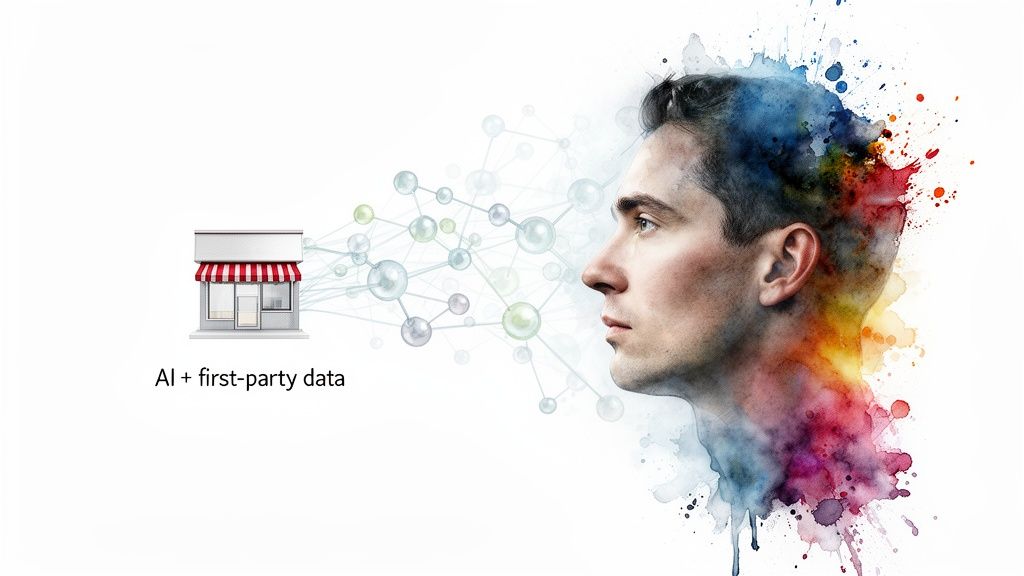
Marketing targeting isn't what it used to be. We're moving past broad, clunky segments and into an era of sharp, predictive, and automated personalization. This isn't magic; it's the powerful combination of Artificial Intelligence (AI) and the data you already own—your first-party data.
With the slow death of third-party cookies, the customer data you collect directly is no longer just a nice bonus. It’s your single biggest competitive edge. This is where tools like a native Shopify store credit program stop being just a loyalty perk and become the engine for a smarter, more resilient marketing strategy that boosts LTV and AOV.
Unlocking Predictive Insights With AI
What if you could spot your next VIP customer before they even make their second purchase? Or better yet, what if you could identify a shopper who's about to drift away and give them the perfect reason to stay? That's the power AI brings to the table.
AI algorithms are designed to dig deep into your first-party data—think purchase history, browsing habits, and every past interaction—to find subtle patterns a human could never see. From there, they can predict what a customer will do next with stunning accuracy.
By forecasting who is likely to churn or become a high-value customer, you can automate highly targeted store credit offers. This turns your retention marketing from a reactive guessing game into a proactive system for growing lifetime value.
This isn't some far-off concept; it’s happening right now. The blend of AI and smart data has already changed the game. In fact, over 70% of marketers are already using AI for incredibly precise audience selection. They’re mixing behavioral, contextual, and identity data to predict customer actions and personalize on a massive scale. You can dig into more of these targeted advertising statistics at newswirejet.com.
Why First-Party Data is Your Sustainable Advantage
As privacy rules get stricter and third-party cookies crumble, brands that have been renting their audience data are going to feel the pain. But Shopify merchants who use a native app for store credit are in a perfect position to win. Every single interaction—every purchase, every credit earned, every credit spent—adds another valuable piece to your private dataset.
This creates a self-fuelling cycle of growth:
You collect rich first-party data directly through your store credit program.
AI models analyze this data to pinpoint high-impact targeting opportunities.
You launch targeted store credit campaigns that drive up LTV and AOV.
These campaigns generate even more data, making every future effort smarter than the last.
This virtuous cycle builds a protective moat around your business. While your competitors are stuck battling rising ad costs and less effective campaigns, you’ll be using your own clean, reliable data to forge stronger customer relationships and drive truly sustainable growth.
Ready to build a future-proof loyalty strategy? Redeemly helps you ditch margin-killing discounts and confusing points by using native Shopify store credit to boost LTV and AOV.
Discover how Redeemly can transform your retention marketing


Join 7000+ brands using our apps