Shopify With Facebook Ads: The LTV-First Growth Playbook
Mar 7, 2026
|
Published
Let’s be honest. Combining Shopify with Facebook Ads has long been the go-to growth recipe for ecommerce brands. But the old strategy of just driving traffic and slashing prices with endless discounts is completely broken.
Looking toward 2026, the brands that will truly thrive are the ones who get off the discount treadmill. They're shifting their focus from chasing cheap, one-off sales to acquiring high-value customers who become genuine fans of the brand by focusing on Lifetime Value (LTV) and Average Order Value (AOV).
The New Playbook For Profitable Shopify Growth
If you're running a Shopify store, you know the grind. You pour money into Facebook ad campaigns, and it feels like the only way to get those clicks to convert is by plastering a "20% OFF" coupon on everything.
The problem with this approach is that you end up just renting customers. You attract bargain-hunters who disappear the second the sale is over, your profit margins get shredded, and you're left building a business on a foundation of quicksand. It's time for a much smarter way to scale.
The new model is beautifully simple: you pair the powerful reach of Facebook Ads with a smart customer retention strategy built on native Shopify store credit. Instead of offering a generic "10% Off" code that just eats into your revenue, you give new customers a compelling reason to come back and shop again, directly boosting your LTV.
Shifting From Discounts to Native Store Credit
Think about it from a customer's perspective. Complicated loyalty programs with confusing points systems often feel like more trouble than they're worth. People don't want to do math to figure out their reward.
Native Shopify store credit, on the other hand, is refreshingly direct. It feels like finding cash in your pocket—money they can only spend with you.
This is the heart of the new playbook:
Instantly Boost Your Average Order Value (AOV): You can run offers like, "Spend $100, Get $10 in Store Credit." This simple incentive nudges shoppers to add just one more item to their cart to hit that threshold. Your AOV goes up on the very first purchase.
Massively Increase Customer Lifetime Value (LTV): That earned credit acts like a powerful magnet. A customer who has $10 waiting for them in their account is dramatically more likely to return for a second purchase. Suddenly, your ad spend isn't just a cost for one transaction; it's an investment in a long-term relationship.
The goal is to stop renting customers with discounts and start owning the relationship by providing real value. Native store credit protects your margins on the first sale and directly funds the second one, creating a powerful, self-sustaining growth loop that increases AOV and LTV.
By connecting Facebook's massive audience with a retention-focused store credit system, you build a far more predictable and profitable brand. This guide will walk you through setting up this exact system, step-by-step. You'll learn how to turn your ad spend into a driver of both AOV and LTV, creating a loyal customer base that will fuel your growth for years to come.
Laying the Right Technical Foundation
Let's be blunt: running Facebook Ads without rock-solid tracking is just throwing money away. You're flying blind, spending cash without knowing what’s actually driving sales. Before we even think about funnels or creatives, we have to get this part right. It’s the bedrock of any profitable strategy, especially when you’re trying to measure the real impact of a store credit program like Redeemly on your AOV and LTV.
Pixel and CAPI: Your Data Power Couple
Your entire measurement system for Shopify with Facebook Ads boils down to two key pieces of tech: the Meta Pixel and the Conversions API (CAPI).
Think of the Meta Pixel as your frontline data collector. It's a bit of code on your site that watches what visitors do—what pages they see, what products they click, what they add to their cart. It’s essential, but with privacy changes like iOS 14 and the rise of ad blockers, it has some serious blind spots.
That’s where the Conversions API (CAPI) comes in. This is your direct, server-to-server connection to Meta. It sends crucial data (like actual purchases) from your Shopify backend straight to Facebook, bypassing the browser entirely. CAPI catches what the Pixel misses, giving you a much truer picture of your ad performance and feeding Meta's algorithm the high-quality sales data it needs to find you more customers.
Connect Your Catalog for Smarter Ads
With your data flowing reliably, it’s time to give Meta’s algorithm the fuel it needs to work its magic: your product catalog. Syncing your Shopify products with your Facebook Commerce Manager is what powers your most effective retargeting ads.
This connection is what unlocks Dynamic Product Ads (DPAs). These aren't your average ads; they're hyper-personalized and automated reminders that are absolute workhorses for e-commerce.
With a synced catalog, you can automatically:
Show someone the exact product they were just looking at.
Retarget shoppers who abandoned their carts with those specific items.
Cross-sell or upsell related products to people who have already bought from you.
This level of personalization is what turns casual browsers into paying customers.
The diagram below shows the growth loop we're aiming for. It’s not just about a single sale; it’s about using ads to generate customers who then come back for more, funded by the store credit they've earned, which ultimately grows their lifetime value.
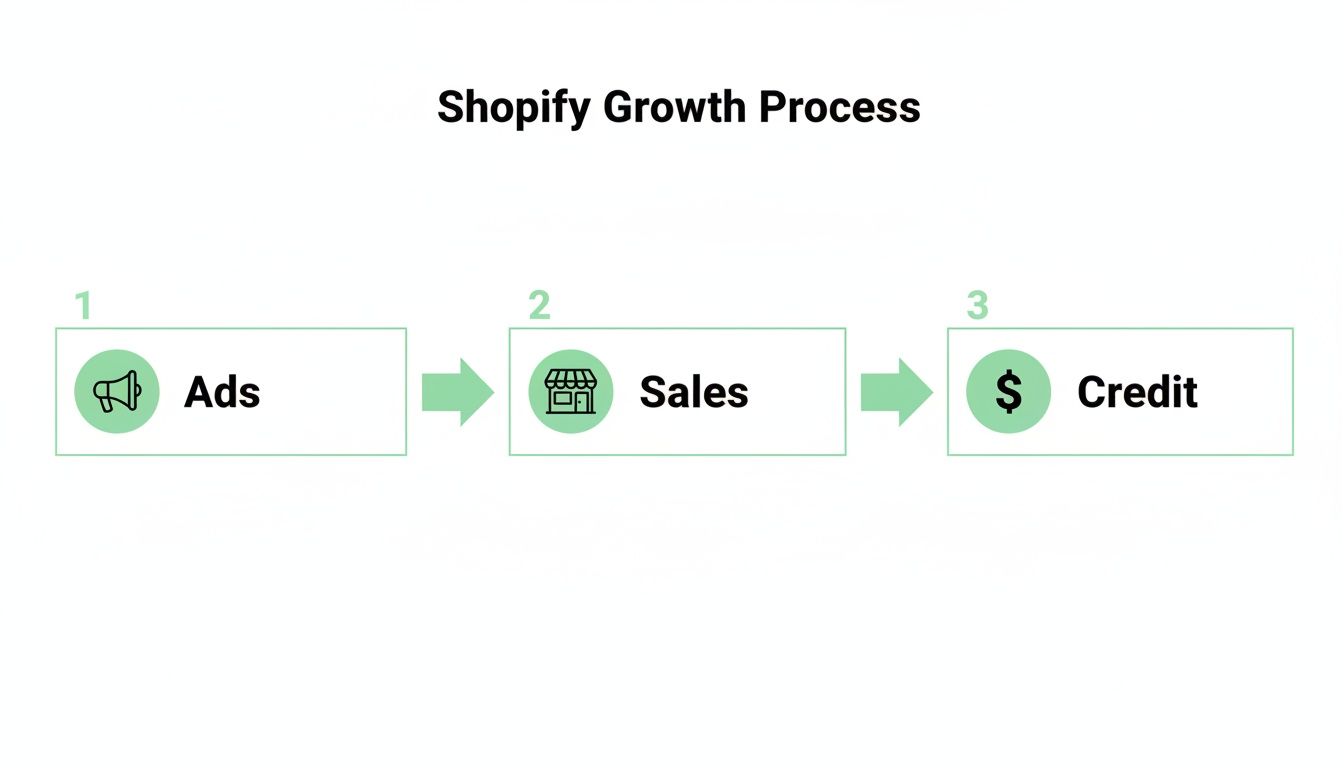
Getting this technical setup right from the start means you can actually see this cycle in action, accurately tracking how your ad spend leads to repeat business and a higher lifetime value.
When you have both Pixel and CAPI working together, you can finally trust your numbers. This confidence is what allows you to measure the true return on offering store credit—its effect on your Average Order Value (AOV) and Customer Lifetime Value (LTV)—instead of just guessing based on incomplete data. Without it, you're just lighting money on fire.
Designing Your Full-Funnel Facebook Ad Strategy
A profitable Facebook Ads strategy isn't about one-off campaigns and hoping for the best. It's about building a predictable machine that turns complete strangers into your most loyal customers with a high LTV. We do this by guiding them through a journey—what marketers call a full-funnel strategy.
This approach has three distinct stages: Top of Funnel (TOF), Middle of Funnel (MOF), and Bottom of Funnel (BOF). By tailoring your message and targeting for each stage, you create a seamless experience that not only drives sales but also builds a brand people want to buy from again and again.
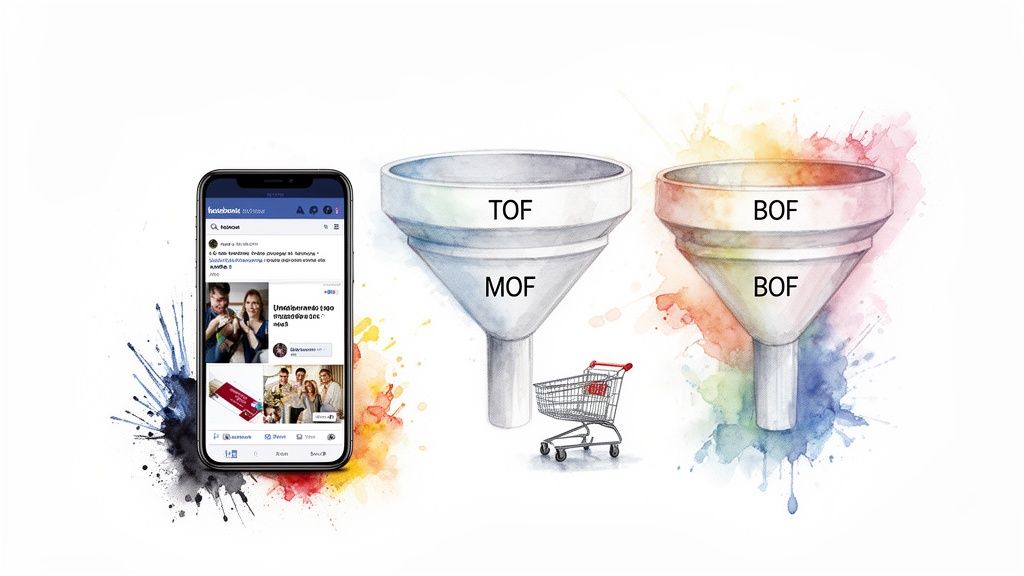
Let's walk through how to build this for your Shopify store, one stage at a time.
Top of Funnel: Attracting New Shoppers
Think of the Top of Funnel (TOF) as your first handshake. You're reaching out to "cold" audiences—people who have probably never heard of you. The goal here isn't an immediate sale. It's to make a great first impression and bring high-quality traffic to your site.
The secret to TOF is reaching the right people without blowing your budget. I’ve seen two audience types work wonders here:
Broad Audiences: It’s tempting to get super specific with dozens of interest layers, but you're often better off trusting Meta's algorithm. Define a wide audience (like women aged 25-54 in the US interested in sustainable fashion) and let the machine learning do the heavy lifting to find your customers.
Lookalike Audiences: This is where your existing customer data becomes pure gold. Upload a list of your best customers—think repeat buyers or those with the highest lifetime value—and tell Facebook to find more people just like them. It's incredibly effective.
Your ads at this stage need to be thumb-stopping. Focus on brand storytelling, educational content, or visually stunning carousels that show off a best-selling collection.
Middle of Funnel: Nurturing Warm Leads
Welcome to the Middle of Funnel (MOF). These are people who’ve shown interest—they’ve visited your site, watched a video, or liked a TOF ad—but they haven't pulled the trigger yet. Your job is to build trust and gently nudge them toward making a purchase.
This is all about smart retargeting. You’ll create custom audiences of people who have recently interacted with your brand. Now, you pivot your messaging from broad awareness to specific benefits and social proof.
For example, if you sell skincare, you could retarget recent website visitors with a video testimonial from a customer with glowing skin. Or, a fashion brand could show a carousel of user-generated photos featuring the exact dress that person was just looking at.
This is your chance to handle objections, answer unspoken questions, and prove your products are the real deal.
Bottom of Funnel: Driving Action with Store Credit
This is where you close the deal. The Bottom of Funnel (BOF) targets your hottest prospects: people who added items to their cart or even started checkout but got distracted. The knee-jerk reaction for many brands is to blast them with a "10% Off!" discount. Please don't. You're just cutting into your margins and teaching customers to wait for sales.
There's a much smarter, LTV-focused way.
Instead of a generic discount, what if your retargeting ad featured your native store credit offer? The ad copy could be as simple as: "Spend a little more to earn credit on your next purchase!" Or, for an even more direct approach, "Complete your order and get $10 in store credit."
This simple switch changes everything. It reframes the decision from saving a small percentage now to earning a real dollar amount for later. You not only recover the abandoned cart but also encourage shoppers to add items to hit a spend threshold, which bumps up your Average Order Value (AOV).
This strategy turns your BOF ads from a margin-killing expense into a powerful customer retention engine focused on boosting LTV. You're building a relationship, not just processing a transaction. To learn more about creating these kinds of compelling offers, check out these persuasive advertising techniques that drive action without giving away the farm.
There's a reason over 28% of all Shopify stores rely on Facebook Ads for growth. When you re-engage cart abandoners and past customers with powerful incentives like native store credit, you create a cycle of repeat purchases that protects your margins and boosts Lifetime Value (LTV).
Using Store Credit to Boost AOV and LTV
This is where we get to the good stuff—the part of the playbook that actually pads your profit margins. We're going to ditch the race-to-the-bottom discount strategy and replace it with a native Shopify store credit system. The idea is to turn your hard-won Facebook ad traffic into a predictable revenue engine, not just a stream of one-off, low-margin sales.
Forget confusing points systems or promo codes that bleed you dry. This is about giving customers real, tangible value that keeps them coming back for more, directly boosting your AOV and LTV.
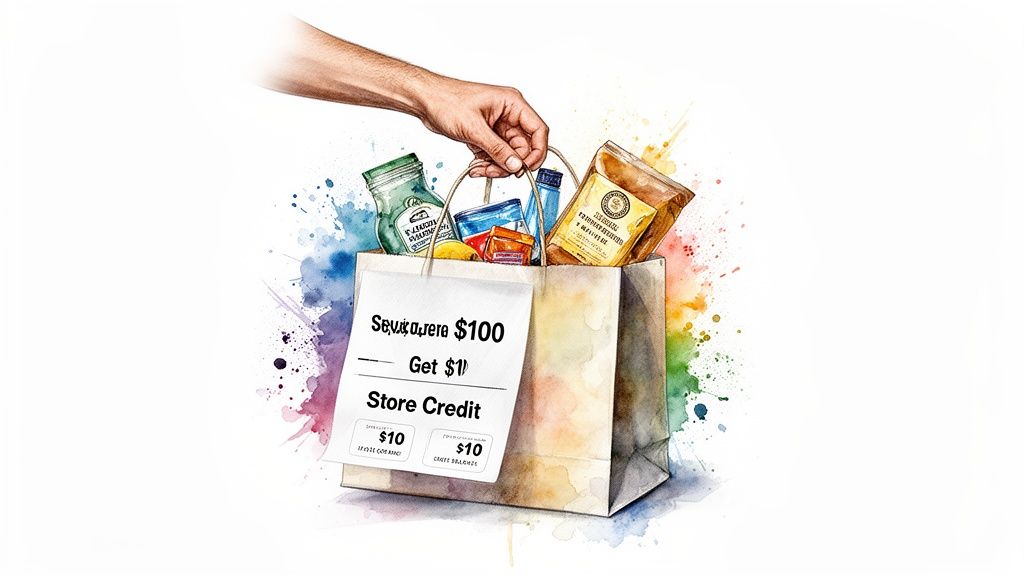
What we're doing here is connecting your Shopify with Facebook Ads customer acquisition with a powerful, built-in retention tool. The tactic is simple: get customers to spend more on their first purchase to fund their second one.
Crafting AOV-Boosting Offers
The first move is to set up a compelling "spend and get" offer. This isn't some passive loyalty program buried on a separate page; it's an active incentive you present right in the middle of their shopping journey.
For instance, an offer like "Spend $100, Get $10 in Store Credit" completely changes the game. It shifts the customer's mindset from "How much can I save today?" to "What extra value can I earn?" You’re tapping into loss aversion—that powerful feeling of not wanting to miss out on the credit they could get by adding just one more item to their cart.
This has an immediate and direct impact on your Average Order Value (AOV), making every dollar of your Facebook ad spend work harder right from the start.
A discount is a guaranteed cost you eat on every single transaction. Native store credit, on the other hand, only becomes a cost when a customer returns to redeem it—which means you've already secured a second purchase. This protects your margins and cash flow in a way discounts never can, all while building your LTV.
To truly understand the bottom-line difference, let's compare the two strategies head-to-head.
Discount Codes vs. Store Credit Rewards Impact On Profitability
Metric | Discount Code Strategy | Native Store Credit Reward Strategy |
|---|---|---|
Initial AOV | Often suppressed as customers buy just enough to use the code. | Increased as customers add items to their cart to meet the reward threshold. |
Profit Margin | Immediately reduced by the discount percentage on every sale. | Protected on the first sale; cost is deferred until a second purchase is made. |
Customer LTV | Low. Encourages one-time, transactional behavior. Customers hunt for the next deal. | High. Earned credit acts as a powerful incentive to return, driving repeat purchases. |
Brand Perception | Can devalue the brand, training customers to wait for sales. | Builds loyalty and positions the brand as generous and value-focused. |
Cash Flow | Reduced instantly with each discounted transaction. | Improved. Cash from the full-priced first order is collected upfront. |
The table makes it clear: while discounts offer a quick conversion, native store credit builds a more profitable and sustainable business model focused on AOV and LTV.
Turning Credit into a Retention Magnet
Once that customer has earned their credit, it becomes a powerful reason for them to come back. Think about it: a shopper with $10 of store credit sitting in their account is far more motivated to return than someone who used a one-time 10% off code weeks ago. That credit feels like their money, just waiting to be spent.
Of course, you can't just hope they remember it. You have to actively remind them.
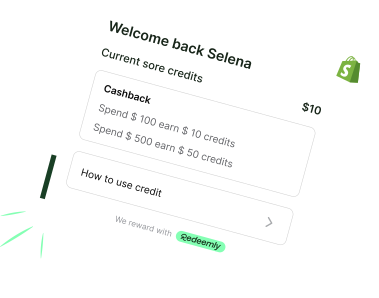
On-Site Reminders: Use a floating wallet display or on-site notifications to constantly show customers their available balance. Seeing "You have $10.00" every time they land on your store is a persistent and effective nudge to start shopping.
Ad Copy & Retargeting: This is where your BOF ad campaigns get a serious upgrade. Instead of a generic "Still thinking about it?" message, your ad copy can now say, "Hey [Name], you have $10 in store credit waiting for you!" This turns a standard cart abandonment ad into a hyper-personalized and urgent invitation.
By using a native store credit app like Redeemly, this whole process feels completely natural for the customer. It's built right on top of Shopify’s own store credit functionality, so there are no clunky pop-ups or confusing third-party dashboards. Customers see their credit and apply it right at checkout, just like a gift card.
To see how this works in more detail, you can explore our full guide on implementing Shopify store credit for your store. This creates a brilliant, self-funding loop where your ad spend drives higher AOV, and the credit you issue drives the repeat business that boosts LTV.
Measuring Success Beyond ROAS
Let's be honest, every marketer is obsessed with Return On Ad Spend (ROAS). It's a clean, simple metric that feels good to track. But I’ve seen countless brands chase a high ROAS right off a cliff. Focusing on it alone is a trap.
When you're running a Shopify with Facebook Ads strategy, especially one using native store credit offers instead of discounts, your campaign-level ROAS tells a dangerously incomplete story. Real success isn’t about that first sale; it's about building a fortress of a business. To do that, we have to look past the vanity metrics and dial in on the numbers that actually predict long-term profitability: AOV and LTV.
Focusing on AOV and Repeat Purchases
The first mental shift is to look at the immediate impact your Facebook ads have on Average Order Value (AOV). Think about it: if you're running an offer like "Spend $100, Get $10 in store credit," you are actively nudging shoppers to spend more. You need to know if it's working.
Jump into your Shopify analytics and create a customer segment for everyone whose first purchase originated from a Facebook ad. Now, you can watch two critical metrics for this specific group:
Average Order Value (AOV): Is the AOV for your Facebook-acquired customers higher than your store-wide average? This is your proof that the store credit incentive is doing its job and creating bigger baskets.
Repeat Purchase Rate: How many of these new customers come back to spend their credit and make a second purchase within 60 or 90 days? This is where you see the "stickiness" of your loyalty-based strategy and the direct impact on LTV.
A high repeat purchase rate from this cohort is a massive win. It’s a clear signal that your native store credit strategy isn’t just buying one-time customers—it's building a base of loyal fans. Of course, you still need to be profitable on the front end. It's crucial to calculate break-even ROAS to know your baseline for success while you focus on these deeper, more valuable metrics.
Calculating Customer Lifetime Value
This brings us to the ultimate metric: Customer Lifetime Value (LTV). This number represents the total profit you can expect to make from a customer over their entire relationship with your brand. A consistently rising LTV is the single best indicator that you're building a sustainable business, not just a traffic-generating machine.
By prioritizing LTV, you stop asking, "How much did this campaign make today?" and start asking, "How valuable are the customers this campaign is bringing me for the long haul?" This is the fundamental mindset shift from a discount-driven model to a profit-first strategy built on genuine loyalty.
Calculating LTV might seem daunting at first, but it’s the key to making intelligent decisions about your ad spend. It finally answers the most important question in ecommerce: how much can I really afford to acquire a customer and still be wildly profitable over time? If you're ready to get this dialed in, our guide breaks down exactly how to calculate customer LTV for your Shopify store.
When you build a simple dashboard tracking AOV, repeat purchase rate, and LTV specifically for your Facebook cohort, you create undeniable proof of concept. You can confidently show how your ads and store credit offers are working together to build a more predictable and valuable brand—one that keeps winning long after that first click.
Common Questions About Shopify Ads And Store Credit
Thinking about ditching the familiar world of discount codes for a native store credit model? It can feel like a big leap, especially when you're tying it directly to your paid acquisition efforts on Shopify with Facebook Ads.
I get it. It’s a change in strategy, and it’s smart to have questions. Let's walk through the most common concerns I hear from merchants so you can build a more profitable growth engine with total confidence.
Is Native Store Credit More Effective Than A Traditional Points-Based Loyalty Program?
Without a doubt. The problem with most points-based programs is that they add a layer of friction. Customers have to do the mental math—"Okay, so 100 points equals $1, and I need 500 points to get $5 off..."—and that confusion often leads to them just ignoring the program altogether.
Native Shopify store credit, on the other hand, is crystal clear. It feels like real cash.
A message that says, "You have $10 to spend," hits differently. It’s a direct, powerful incentive that creates a sense of ownership and urgency. That clarity is why we see much higher redemption rates with store credit, which directly fuels the repeat purchases that skyrocket your customer lifetime value.
Will Offering Store Credit Hurt My Profit Margins Like Discounts Do?
This is the most important question, and the answer is a firm no. In fact, it's specifically designed to protect your margins and increase lifetime value.
When you offer a 20% discount, you're guaranteeing a loss on that margin the second the code is used. The cost is immediate. Native store credit flips that model on its head. It only becomes a cost when a customer returns to make a second purchase.
You get to keep your full margin and cash flow on the initial sale. You only "pay" for the reward once you've successfully turned a one-time buyer into a repeat customer. It basically transforms a marketing expense into a self-funding retention machine that is laser-focused on increasing LTV.
How Do I Advertise My Store Credit Offer On Facebook?
This is where it gets fun. You don’t just run an ad; you weave the store credit offer into your entire funnel. Your ad creative and copy should be built around the incredible value you’re giving, not just the product.
Here’s a quick breakdown of how we approach it:
Top/Middle of Funnel (Acquisition): Your goal is to stand out. Frame the offer as a smart shopping perk that increases AOV. Try ad copy like, "Get $10 back in store credit on your first order over $75." This immediately signals value and encourages a higher AOV right out of the gate.
Bottom of Funnel (Retargeting): Now you can get personal and create urgency. Use dynamic ads that speak directly to customers about the credit they’ve already earned. Imagine an ad popping up in their feed saying, “Hey Jane, your $15 in store credit is waiting! Don’t let it expire.” It feels less like an ad and more like a helpful reminder from a brand that values them.
By testing messaging that positions native store credit as a reward for shopping with you, you shift the entire conversation from "how can I get this cheaper?" to "look what I get for being a loyal customer." This is the secret to using Shopify with Facebook Ads to build a real community, not just a list of one-off discount hunters.
Ready to stop burning through your profits with endless discounts and start building a genuinely loyal customer base? With Redeemly, you can launch a store credit program that's seamlessly integrated into Shopify's native functionality, boosting both AOV and LTV from your very first campaign. It’s the simplest, most profit-friendly way to grow your brand.
Start your free trial today at Redeemly.ai and see the difference for yourself.


Join 7000+ brands using our apps