Shopify Rewards Programs: A Guide to Boosting LTV with Store Credit
Feb 10, 2026
|
Published
It’s a tale as old as e-commerce: you launch a Shopify rewards program to boost customer loyalty, but all it really does is hand out discount codes and create a confusing mess of points. Pretty soon, you've just trained your best customers to wait for the next sale, slicing into your margins without building any real, lasting connection.
Why Traditional Shopify Rewards Programs Are Leaking Profit
Let's get real for a moment—your current rewards program might be a bigger liability than an asset. So many brands fall into the trap of using old-school loyalty tactics that sacrifice profit for what looks like customer retention. The problem isn’t that you're rewarding customers; it's how you're doing it.
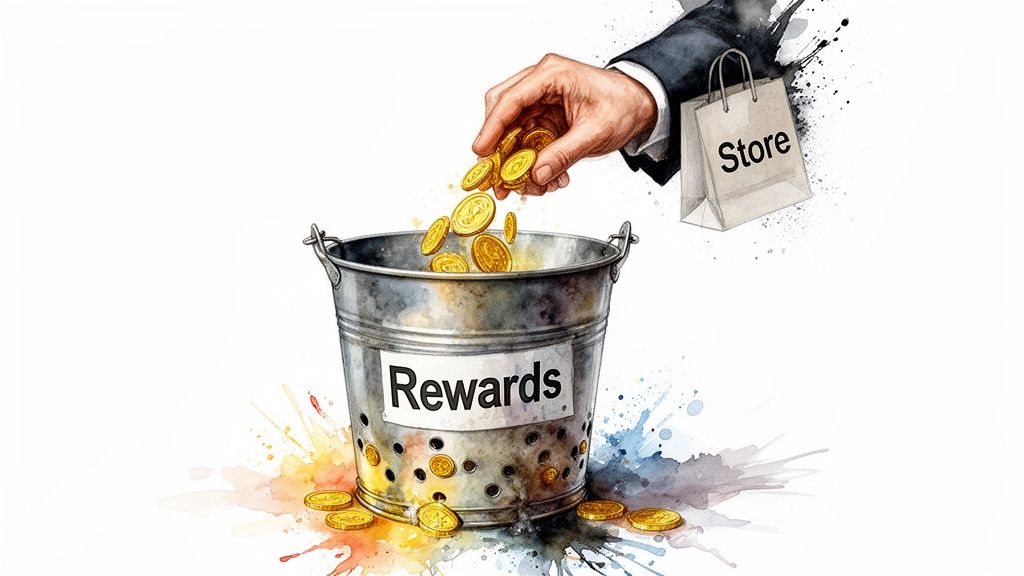
Think of your marketing spend as water you pour into a bucket. A healthy rewards program should keep that bucket full, representing a thriving community of repeat buyers. But most programs, built on a foundation of constant discounts and complicated points, are more like a leaky bucket. You keep pouring money in, only to watch your hard-won customers drip out, coming back only when you dangle another price cut in front of them.
The Hidden Costs of Discounts and Points
When you lean on discounts, you create a dangerous cycle. You attract bargain hunters, not brand fans, and teach your audience that your products aren't worth full price. This constant promotional pressure hammers your average order value (AOV). After all, why would anyone buy today if they know a 20% off code is just around the corner?
Points systems aren't much better. They often feel like a math quiz nobody wants to take. When a shopper has to stop and figure out what their points are actually worth ("Wait, so 1,000 points is... $5?"), the magic is gone. The reward feels cheap, the process is confusing, and redemption rates plummet. You end up with a program that just sits there, not actually driving behavior.
The real issue here is that these models reward transactions, not loyalty. They give you a quick sales bump but sabotage long-term relationships and healthy profit margins.
Shifting Focus to Sustainable Growth
Building a loyalty strategy that actually works means shifting our focus from quick, transactional wins to sustainable, long-term growth. The goal is to build a system that not only brings people back but also inspires them to spend more each time they do. That means ditching the margin-killing tactics and embracing a model that genuinely boosts customer lifetime value (LTV).
A smarter approach starts by completely rethinking what a "reward" is. Instead of a one-and-done discount, what if a reward was an investment in the customer's next purchase? That single change separates a profitable loyalty engine from that leaky bucket. By rethinking the very mechanics of our Shopify rewards programs, we can finally plug the leaks and start building a customer base that's both loyal and profitable. This often starts with a new way of thinking, centered on native store credit and well-designed incentives. You can learn more about how to structure these by exploring different loyalty program tiers in our detailed guide.
The Hidden Psychology of Native Store Credit
Think about the difference between a coupon and cash. A coupon for your next coffee feels like a conditional offer, something you might use. But a $5 bill in your hand? That's yours. It has real, immediate value.
This is the exact psychological shift that happens when you use native Shopify store credit. A discount code is temporary and easily forgotten, lost in a sea of promotional emails. Store credit, on the other hand, feels like money a customer already owns—it's a tangible asset sitting in their account.
That feeling of ownership is incredibly powerful. It triggers a psychological quirk known as the endowment effect, where we instinctively value things we own more highly. Suddenly, that credit isn't just a potential discount; it's their money, waiting to be spent. This creates a compelling reason to come back, not just for a deal, but to use what’s rightfully theirs.
From One-Off Transaction to Lasting Relationship
By moving away from simple discounts, you completely reframe the customer relationship. Instead of training shoppers to wait for the next big sale, you reward their loyalty with a balance they can spend whenever they want. This simple change builds a genuine sense of reciprocity.
Store credit doesn't just incentivize another purchase; it creates a subtle obligation to return. It's 'money in the bank' that pulls customers back, shortening the time between orders and boosting their overall spend.
This dynamic has a direct and measurable impact on your bottom line:
Drives More Repeat Purchases: An unused balance creates a mental itch that customers want to scratch, bringing them back to your store much faster.
Boosts Average Order Value (AOV): When a customer comes back to spend their $10 credit, they almost never spend just $10. The credit acts as a down payment on a larger purchase.
Protects Your Margins: Unlike a blanket discount that devalues your entire brand, store credit is only "cashed in" when a customer makes another purchase. You tie your marketing cost directly to a successful retention event.
The Power of a Simple, Tangible Reward
Let's be honest: modern shoppers are smart. They can see through complicated points systems that create more friction than value. Store credit is refreshingly simple. What you see is what you get.
The data backs this up. An impressive 74% of customers are far more likely to stick with brands that have loyalty programs. But what kind of programs? The ones with clear, easy-to-understand value. A Shopify retail analysis found that 86% of shoppers rate good offers as 'very important,' and 81% prioritize the ease of collecting rewards.
Native store credit nails both of these. It's straightforward, it feels valuable, and it creates a powerful psychological hook for loyalty. When you build one of the best Shopify rewards programs on this model, you’re not just giving away value—you’re embedding it directly into your customer relationships. If you want to see this in action, check out these compelling examples of reciprocity in marketing.
Comparing the Unit Economics of Modern Loyalty
When you’re picking a Shopify rewards program, you have to look past the shiny features and get down to the numbers. A loyalty strategy shouldn't just feel good—it needs to make financial sense. Let’s break down the unit economics of the big three—discounts, points, and native store credit—to see which one actually builds profitable, long-term relationships instead of just giving away margin.
A discount code is the simplest tool in the box, but it’s also the most damaging to your bottom line. When you offer 15% off, you’re taking an immediate and irreversible 15% hit to your gross margin on that sale. There’s zero guarantee of a second purchase. You're just sacrificing profit hoping to close one deal, and in the process, you're training customers to devalue your products and wait for the next sale.
Points systems seem a lot smarter on the surface, but they often stumble on a critical flaw: customer confusion. When a shopper has to do mental math to figure out what their points are actually worth ("Wait, so 200 points is...$2?"), the perceived value plummets. This friction leads to terrible engagement and even worse redemption rates, meaning the program fails to drive the very behavior it was built to inspire.
Store Credit as a Retention Investment
This is where native store credit changes the game entirely. Unlike a one-off discount, store credit is only "spent" when a customer makes a second purchase. This is a crucial distinction. You aren't just losing margin on a single sale; you're investing in a confirmed repeat customer. The cost is directly tied to a win—a customer coming back for more.
Store credit transforms a promotional expense into a strategic asset. The liability on your books (the issued credit) only becomes a cost when a customer demonstrates loyalty by returning to your store.
To really see which loyalty programs are working and which are just leaking profit, you have to get disciplined about how you calculate marketing ROI for all your efforts. This is the only way to ensure every dollar you put into rewards is actively driving profitable growth, not just subsidizing sales.
This chart drives home what truly keeps shoppers coming back. It’s all about valuable, easy-to-understand offers and rewards.
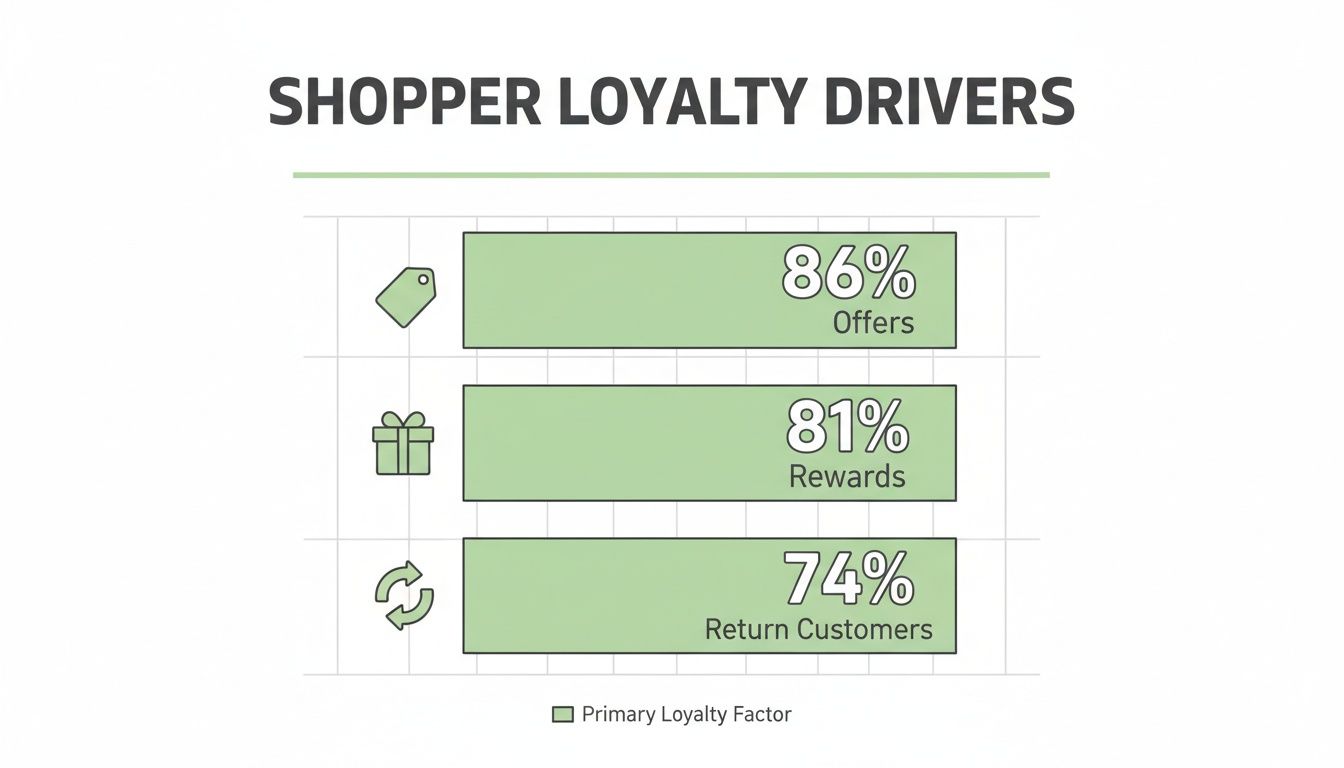
As you can see, customers crave clear value. The tangible nature of store credit ("Here's $10 for your next order") lines up perfectly with what they want, unlike abstract points systems that create guesswork.
Comparing the Impact on Key Metrics
The loyalty model you choose for your Shopify rewards program will have a direct and measurable impact on your store's most important financial metrics. The differences become crystal clear when you put them side-by-side.
Loyalty Model Impact on Key Financial Metrics
Here’s a breakdown of how each model stacks up when it comes to the numbers that really matter.
Metric | Discount Codes | Points Systems | Native Store Credit |
|---|---|---|---|
Margin Impact | Immediate, irreversible loss on the initial sale. | Delayed cost, but low engagement often means wasted potential. | Cost is only realized upon a second purchase, securing retention. |
AOV Impact | Can suppress AOV as customers buy only what's needed for the discount. | Minimal direct impact; doesn't incentivize spending more now. | Often boosts AOV as customers spend beyond their credit balance on a return visit. |
LTV Impact | Attracts one-time bargain hunters, leading to lower overall LTV. | Moderate, but confusion can limit long-term engagement and value. | Directly increases LTV by ensuring repeat purchases are part of the reward cycle. |
When you look at it this way, the answer is pretty obvious. Store credit creates a much healthier financial loop for your business. It protects your margins on the first sale and uses the reward to lock in a second one—the absolute cornerstone of building high customer lifetime value. For a deeper dive, you can learn how to calculate customer LTV and see exactly how a smart loyalty strategy feeds into it.
Using Tiered Rewards to Increase Average Order Value
Getting customers to stick around is one part of the puzzle, but encouraging them to spend more each time they visit? That’s where you start seeing real, profitable growth. A tiered "spend and get" model using native store credit is the most powerful tool for this. Forget about complicated points systems—this strategy is direct, easy to understand, and incredibly effective at boosting your Average Order Value (AOV).
The whole idea is simple: you reward customers with store credit based on how much they spend in a single checkout. It basically turns shopping into a mini-game. Imagine a customer at checkout seeing a little nudge that says, "You're only $15 away from earning $10 in store credit!" Suddenly, tossing one more item into their cart doesn’t feel like an extra cost; it feels like a smart move.
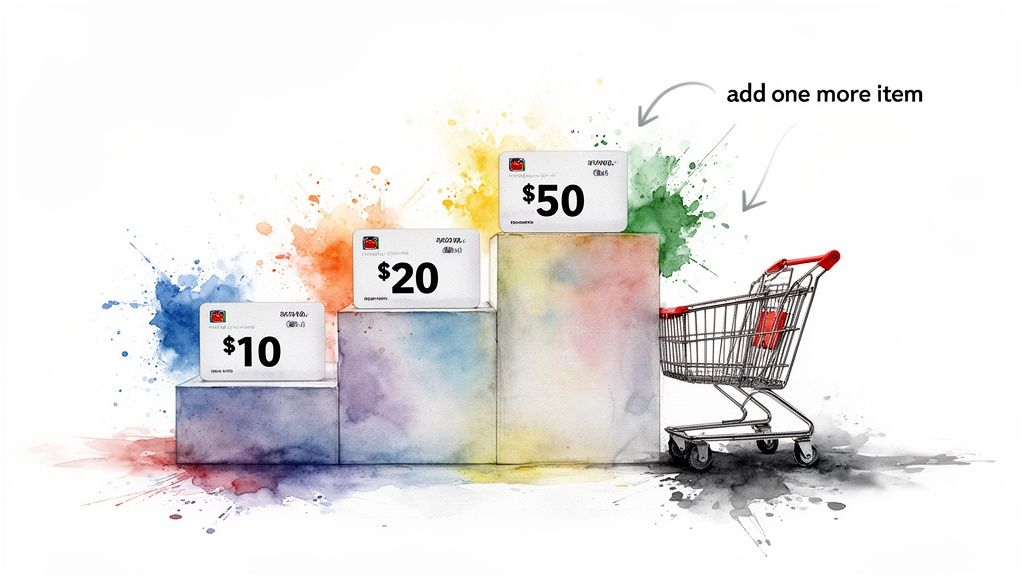
That bit of gamification creates a compelling reason for shoppers to bump their order total just a little higher to hit that next reward level. And unlike a one-off discount code that’s gone in a flash, the store credit they earn is a real asset. It's an investment they’ve made in their next purchase, which is a brilliant way to reinforce the loyalty loop and give them a concrete reason to come back.
Crafting Profitable Tiers
The secret to making this work is finding the sweet spot between an offer that's too good to pass up and one that protects your margins. Your goal is to set spending thresholds just a bit higher than your current AOV, giving customers that little push to spend more without you giving away the farm.
If you're looking for more comprehensive strategies on this, learning how to increase Average Order Value is the perfect next step after setting up your tiers.
Here’s a simple framework you can put into action today:
Tier 1: Spend $75, Get $5 in Credit. This is for your typical customer. It’s a small but satisfying thank-you for making a standard purchase.
Tier 2: Spend $125, Get $15 in Credit. This tier is designed to get your average spenders to add just one more item to their cart, which can make a huge difference to your AOV.
Tier 3: Spend $200, Get $30 in Credit. This one’s for your VIPs. You’re rewarding their larger carts with a significant credit that almost guarantees they’ll be back soon.
A structure like this transforms every single transaction into a chance to drive immediate revenue. Each tier acts as a clear, achievable goal, making the decision to spend more feel both logical and rewarding.
The beauty of a tiered store credit system is its dual impact. It increases the value of the current order while simultaneously funding the customer's next purchase, creating a self-sustaining cycle of repeat business.
Why This Beats Discounts for AOV
Let’s be honest, a blanket "20% off" coupon often does the opposite of what you want for AOV. It trains customers to buy only what they came for at the lowest price possible. There’s zero incentive to add more to the cart; the only goal is to apply the discount and get out.
Tiered store credit completely flips that script. The reward is earned, not just given away, and it’s tied directly to a higher spend. By building this into your Shopify rewards programs, you shift the entire customer mindset from cost-cutting to value-building. You aren't just making a sale; you're nurturing a more valuable customer who is actively motivated to spend more with you, both now and in the future.
Bringing a Store Credit Program to Life in Shopify
Ready to ditch the confusing points and margin-crushing discounts? You might be surprised at how simple it is to launch a native store credit program. This isn't about bringing in developers or installing clunky scripts that drag your site speed down. It’s about tapping into Shopify’s own powerful features, usually with a lightweight app, to build a loyalty system that feels seamless—and actually adds to your bottom line.
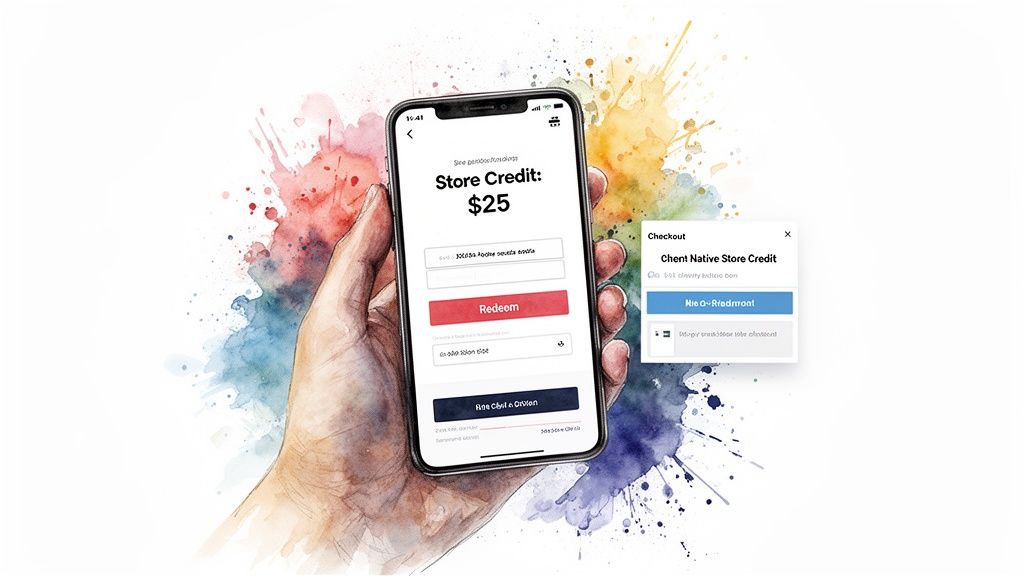
The whole point of a native approach is to make your rewards feel like they belong there, not like some bolted-on third-party widget. When a customer earns credit, it should just show up in their account. And when they’re ready to buy again, using that credit should be an obvious, one-click step. This simple change removes friction, which is the biggest enemy of participation and profit.
The Key Steps to Getting It Live
Getting your program off the ground is all about clarity and creating a great customer experience. When done right, a native store credit system integrates so well it feels like it’s been part of your Shopify store all along.
Here's a quick rundown on how to roll it out:
Pick a Native App: Find an app like Redeemly that hooks directly into Shopify’s native store credit and gift card functions. This is crucial for making your program fast, reliable, and manageable without needing to learn a whole new dashboard.
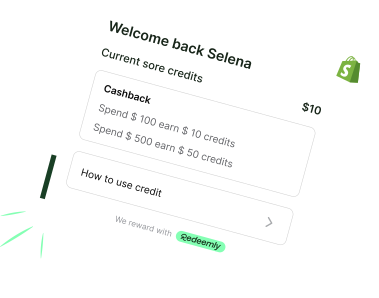
Set Your Earning Rules: Figure out how customers will earn their credit. A tiered "spend and get" model is a classic for a reason—it’s a fantastic way to bump up your Average Order Value (AOV). Think simple: "Spend $100, Get $10 in credit."
Make It Visible On-Site: Use clean, simple widgets to show a customer's available credit balance. A little floating wallet icon or a slim notification bar keeps their "money in the bank" top-of-mind while they browse.
Announce the "Upgrade": Let your existing customers know you’re making things better. Position it as an upgrade from a complicated points system to straightforward, cash-like rewards they can actually use.
The Power of a Seamless Checkout
This is where the magic really happens. With a native system, a customer’s store credit shows up as a payment option right at checkout, sitting alongside their credit card and Shop Pay. No more scrambling for coupon codes or trying to remember how to convert points.
A native program makes redemption frictionless. Customers see their balance and can apply it with a single click, which dramatically increases the chances they'll complete their purchase and feel great about their reward.
That ease-of-use is the secret sauce for driving repeat purchases and boosting your customer lifetime value (LTV). For established Shopify stores, returning customers already account for a staggering 41% of total sales. As you can see from digging into more Shopify statistics, this proves just how much effective loyalty programs can fuel your revenue by turning one-time buyers into dependable, long-term fans.
Why "Native" Is a Big Deal for Performance and Profit
Choosing a native solution for your Shopify rewards program isn't just about a better user experience—it's a smart business move that protects your site's performance and your profits. Heavy, third-party loyalty apps can be notorious for slowing down your site, which is a killer for both conversions and SEO.
By building on top of Shopify's core infrastructure, a native program delivers:
Lightning-Fast Speed: Your site stays quick and responsive, just like it should.
Rock-Solid Reliability: You sidestep the glitches and downtime that can plague external platforms.
True Simplicity: You manage everything right from your Shopify dashboard.
This lean approach gives you peace of mind, knowing your new loyalty program isn't just more profitable—it's also ridiculously simple to run.
Tracking the Metrics That Actually Matter
Launching your new Shopify rewards program is just the beginning. A great strategy is only as good as the numbers that prove it's actually working. To see the real impact, you have to cut through the vanity metrics and focus on the KPIs that tell the true story of profitable growth.
Instead of getting bogged down in clicks or sign-ups, let’s zero in on the numbers that draw a straight line between your store credit program and your bottom line. These are the metrics that will prove the ROI to yourself and your team, showing everyone you're building a healthier, more sustainable business.
Customer Lifetime Value (LTV)
Customer Lifetime Value (LTV) is the north star of any rewards program. It’s the total profit you can realistically expect from a single customer over the entire time they shop with you. When LTV is climbing, you know your retention strategy is hitting the mark.
Store credit programs are built from the ground up to make this number grow. By giving customers a tangible reason to come back—their own money just sitting in their account—you're paving the way for those second, third, and fourth purchases that extend their value over time.
Average Order Value (AOV)
Next up, keep a sharp eye on your Average Order Value (AOV). This one’s simple: it’s the average amount a customer spends every time they check out. When you build tiered rewards where customers get more credit for spending more, you’re giving them a real incentive to add that extra item to their cart.
This nudge directly pushes AOV upward. A flat discount often encourages people to spend just enough to get the deal, but store credit gamifies the experience. A higher AOV makes every single transaction more profitable, strengthening your margins with every sale.
By focusing on LTV and AOV, you shift your measurement of success from short-term sales to long-term profitability. You're no longer just asking "Did they buy?" but rather "How much value are we creating over time?"
Repeat Purchase Rate
Your Repeat Purchase Rate is the engine room of customer retention. It measures the percentage of your customers who come back to buy from you again. A strong repeat purchase rate is the difference between a one-hit-wonder and a brand with a truly loyal following.
Store credit pours fuel on this fire. That "money in the bank" feeling creates a powerful psychological pull, making a second purchase feel less like a new decision and more like an obvious next step. Watching this number will show you exactly how well your program is turning one-time buyers into loyal regulars.
Key Metrics to Monitor for Your Shopify Rewards Programs
To make sure your store credit system is firing on all cylinders, you need a clear dashboard. Think of these as the vital signs of your program's health.
Here are the core metrics you should be tracking:
Credit Redemption Rate: What percentage of the store credit you issue is actually being spent? A high redemption rate tells you that customers find the reward valuable and that your checkout process is smooth.
Time Between Purchases: Is the gap between a customer's first and second purchase getting shorter? This is a fantastic sign that your program is accelerating the buying cycle.
Purchase Frequency: How often are your best customers buying from you within a set period, like a quarter or a year? An uptick here is a direct result of building real loyalty.
Of course. Here is the rewritten section with a more natural, human-written tone, following all the provided guidelines.
Common Questions About Store Credit Rewards
Switching your loyalty strategy from the familiar world of discounts and points to a store-credit-first model is a big move. I get it. It’s natural to have questions about how it all works, what it costs, and—most importantly—how your customers will react.
Let's walk through the most common concerns I hear from merchants when they’re thinking about a more modern, profitable approach to their Shopify rewards program. Once you see the mechanics, you can move forward with confidence, knowing you’re making a smart play for better margins and higher customer lifetime value.
Is a Store Credit Program More Expensive than Using Discounts?
This is always the first question, and the answer really comes down to the unit economics. Think about it this way: a 10% discount is an immediate and permanent 10% hit to your margin on that sale. Poof. That money is just gone.
A 10% store credit reward, on the other hand, only becomes a "cost" when the customer comes back to make their next purchase. That’s a massive difference. You’re tying your marketing spend directly to a successful retention event, guaranteeing you get that second sale. And more often than not, that returning shopper spends way more than their credit balance, boosting both your AOV and LTV.
Store credit shifts the cost from a promotional expense on the first sale to a retention investment on the second. It’s not about spending less; it’s about spending smarter to secure future revenue.
Will My Customers Understand Store Credit Instead of Points?
Absolutely. In fact, they’ll probably thank you for the simplicity. Store credit is real and easy to understand; $10 in credit means $10 to spend. There’s no fuzzy math needed.
Points systems, by contrast, often feel like a chore. When a customer sees "1,000 points," they have to stop and try to figure out what that's actually worth. That friction creates a mental barrier that can kill engagement. Store credit feels like cash waiting in their account, which is a much stronger and clearer reason to come back and shop.
How Do I Migrate from My Current Points-Based Loyalty App?
This is more straightforward than you might think, especially if you choose a solution built natively for Shopify. The whole process really boils down to clear communication and a clean technical handoff.
Here’s how it usually plays out:
Communicate the "Upgrade": Don't call it a "change"—frame it as an upgrade for your customers. You're moving to a simpler, more valuable rewards program that's easier for them to use.
Convert Existing Balances: A good store credit app can help you convert everyone's existing points into their equivalent store credit value. This is critical—you want to make sure no one feels like they've lost out.
Seamless Transition: You’ll simply disable your old app and activate the new one. Because native solutions plug right into Shopify's own system, the customer experience stays smooth and you won't disrupt your store’s performance.
Can I Still Run Special Promotions with a Store Credit Program?
Yes, and you absolutely should! Your store credit program is your evergreen loyalty engine. It's the steady, reliable system that works in the background to drive retention and profit day in and day out. It’s not meant to replace your entire promotional calendar.
You can still run your big seasonal sales, offer one-off discount codes for new customer acquisition campaigns, or launch a flash promo to move old inventory. The key difference is that your core, day-to-day loyalty is finally built on a profitable foundation instead of a constant drip of margin-killing discounts.
Ready to build a more profitable loyalty program that delights customers without sacrificing your margins? Redeemly replaces confusing points and discounts with simple, cash-like store credit rewards that boost LTV and AOV.
Learn how Redeemly can transform your retention strategy today.


Join 7000+ brands using our apps