Profitable Shopify Facebook Ads That Actually Work in 2026
Mar 6, 2026
|
Published
Let's get real for a second. If you're running a Shopify store, you've felt the sting of skyrocketing Facebook ad costs. It feels like you're stuck in a vicious cycle, constantly slashing prices with coupons and discounts just to make a sale. This isn't just a headache; it's a direct attack on your profitability, lifetime value, and brand integrity.
But what if the problem isn't what you think it is? What if you could break this cycle and build a truly sustainable growth engine by focusing on lifetime value (LTV) and average order value (AOV)?
The Real Reason Your Shopify Facebook Ads Are Failing
When your Facebook ads aren't performing, it's easy to blame your targeting or your creative. But I've seen it time and time again: the real culprit is usually the offer itself.
For years, the go-to strategy has been to slap a "10% OFF!" banner on an ad and hope for the best. Sure, it might snag you a quick conversion, but it's a race to the bottom. This approach butchers your margins and, even worse, attracts an audience of one-off bargain hunters, not the loyal, repeat customers your brand needs to thrive and increase lifetime value.
The goal of advertising shouldn't be to just get one cheap sale. It's about acquiring a customer who will stick around and generate immense value over the long haul. This means we have to start asking a different question. Instead of, "How cheaply can I get a customer?" we need to be asking, "How can I maximize what this customer is worth over their lifetime?"
Shifting from Discounts to Lifetime Value
The answer is to ditch the confusing point systems and margin-killing coupons. The most profitable brands are now using native Shopify store credit as a reward instead.
Think about running an ad with an offer like this: "Spend $100, Get $15 Back in Store Credit." It seems simple, but this one small change has a massive impact on your key metrics.
It immediately boosts your Average Order Value (AOV). Customers will naturally toss another item in their cart to hit that $100 spending threshold. That initial lift in AOV often pays for the future cost of the credit on its own.
It protects your margins. A discount is an instant loss on that first sale. Store credit, on the other hand, is a liability that only becomes a real cost when the customer returns to make a second purchase. You're not giving money away; you're securing a future sale.
It builds a real, loyal customer base and skyrockets LTV. That store credit acts as a powerful psychological hook. It feels like "free money" just waiting to be spent, giving customers a powerful reason to come back to your store instead of a competitor's. This is the foundation of high lifetime value.
This is how you re-frame your entire advertising strategy from just processing transactions to building genuine relationships. You stop paying for clicks and start investing in customers who will return again and again.
The core issue with many Shopify Facebook Ads campaigns is a weak offer that prioritizes a single, low-margin sale over long-term customer value. By replacing discounts with store credit, you change the economic model of your advertising from a cost center to a profit driver focused on AOV and LTV.
Of course, a great offer is only half the battle. If your store itself isn't optimized to turn visitors into buyers, even the best ad campaign will fall flat. Learning how to improve your ecommerce conversion rate is absolutely essential for making your ad spend profitable.
With over three billion active monthly users and an advertising revenue that hit nearly $165 billion in 2024, Facebook remains one of the most powerful growth channels available. It's no wonder over 80% of Shopify stores use it for their marketing. Now, let’s dive into how you can finally make that massive audience work for your bottom line.
Laying a Rock-Solid Foundation for Your Shopify Ads
Look, before you even think about putting a single dollar into Facebook Ads, we need to talk about the "plumbing." It’s the unsexy but absolutely critical technical setup that most new advertisers either mess up or skip entirely. They end up pouring money down the drain because Meta's algorithm is essentially flying blind.
Getting your tracking right isn't just a technical checkbox. It's about feeding the machine clean, reliable data so it can go out and find the people who will actually buy your products and become high-LTV customers. The most profitable campaigns are always built on a foundation of solid data. Without it, you're just gambling.
The Pixel and Conversions API: Your Non-Negotiables
Your first move is always the same: get the Meta Pixel and the Conversions API (CAPI) working in tandem. The Pixel is a small piece of code on your site that watches what users do, while CAPI sends data directly from Shopify’s servers to Meta’s.
Why both? Because together, they create a powerful, resilient tracking system. It’s your best defense against the signal loss that comes from ad blockers, cookie restrictions, and Apple's iOS updates.
A proper setup is the backbone for everything else you want to do:
Tracking That Actually Works: You have to know that key events like
ViewContent,AddToCart,InitiateCheckout, and most importantly,Purchaseare firing correctly. These signals are how Meta learns who your customers are and where they are in their buying journey.Retargeting That Converts: Clean event data is what lets you build those high-intent Custom Audiences. Think about it: you can create a campaign that specifically targets everyone who added a product to their cart in the last 14 days but didn’t finish checking out. That’s gold.
Powerful Lookalike Audiences: The quality of your
Purchaseevent data directly affects how well Meta can build Lookalike Audiences. This is your primary tool for scaling, as Meta finds brand-new customers who look and act just like your best existing ones—the ones with the highest potential LTV.
Think of your Pixel and CAPI as the eyes and ears of your ad account. If they can’t see or hear what’s happening on your store, the brain (Meta's algorithm) can't make smart decisions on where to spend your budget.
For Shopify store owners, this is thankfully pretty straightforward. You'll use the official Facebook & Instagram app right within your Shopify admin. Once you connect your accounts, it handles the heavy lifting of sending that event data. Just be sure to pop into Meta's Events Manager to verify everything is firing as expected.
Connect Your Product Catalog for Dynamic Ads
Next up, you absolutely must connect your Shopify product catalog to Meta's Commerce Manager. This isn't optional if you want to run one of the most powerful ad formats available for ecommerce: Dynamic Product Ads (DPAs).
DPAs are your secret weapon for personalization at scale. They automatically show specific products to people who have already shown interest in them. For instance, if a shopper browsed your new collection of leather boots but left without buying, a DPA can show them an ad featuring those exact boots when they're scrolling through Instagram later that day. It’s incredibly effective because it’s so relevant.
But even the best-targeted ad can't save a bad offer. This is where many campaigns quietly die.
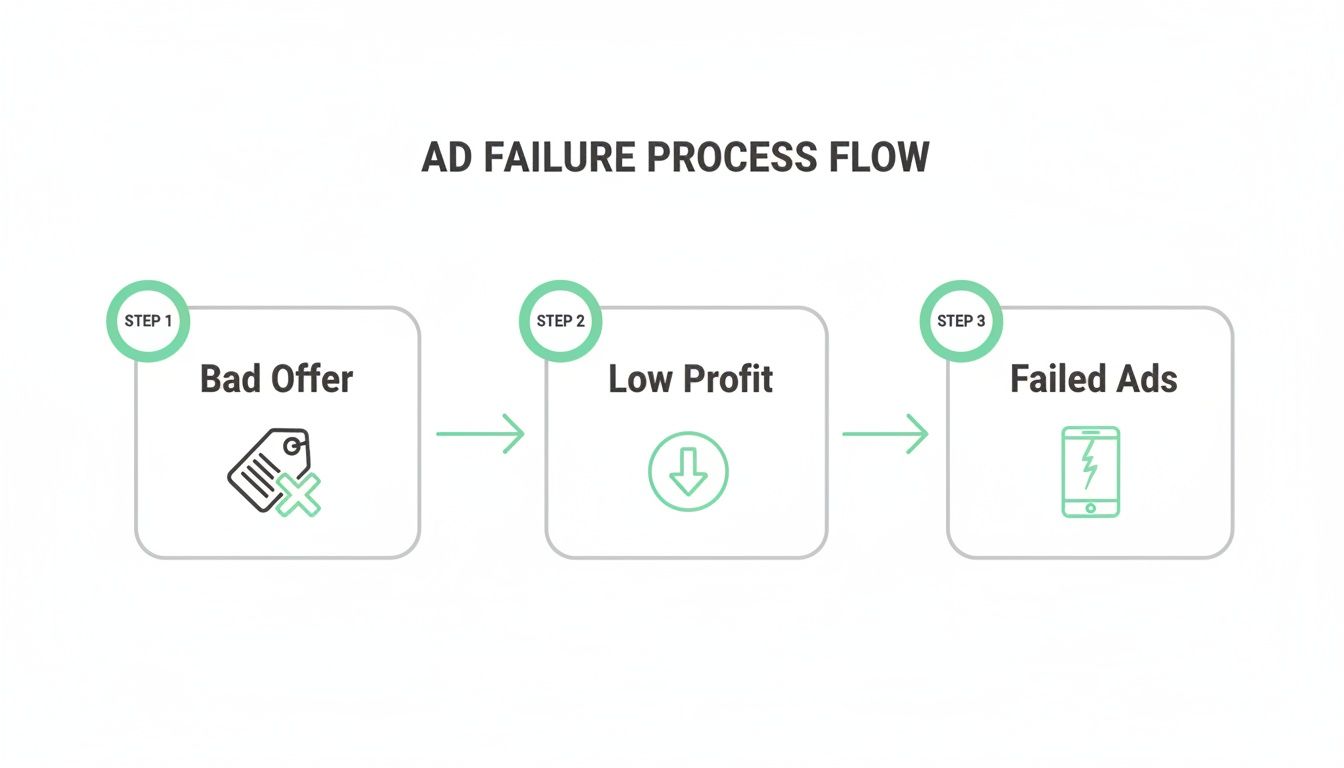
The real takeaway here is that ad failure often begins long before you write a single piece of copy or choose an image. It starts with an unprofitable offer. While a solid technical foundation ensures your ads reach the right audience, an offer focused on building AOV and LTV has to be profitable and sustainable.
If you’re feeling overwhelmed by the technical details or just want an expert eye on your strategy, exploring professional Facebook Ads services can ensure your entire funnel—from the offer to the ad to the checkout—is built for profit from day one.
Structuring Ad Campaigns for LTV Not Just Clicks
Alright, now that your tracking and pixel are locked in, it’s time for the fun part: building campaigns that actually make you money. Forget what you’ve heard about complicated, seven-step funnels or confusing point systems. The most profitable Facebook ads for Shopify stores today are built around one simple, powerful idea: maximizing customer lifetime value (LTV) right from the start.
This isn't about chasing cheap clicks or one-off sales. It's a fundamental shift in strategy. We're going to build a campaign structure that aligns with the entire customer journey, using Shopify's native store credit as a powerful incentive to boost both average order value (AOV) and repeat purchases.
I find it's best to stop thinking in terms of convoluted funnels and instead focus on three distinct customer groups: brand new prospects, interested shoppers who haven't bought yet, and your existing customers. Each group needs its own message, its own offer, and its own slice of your budget.
Top of Funnel (TOFU): Acquiring New Customers Profitably
At the top of the funnel, your entire mission is to attract brand-new customers who are genuinely excited by your store credit offer. This is where you give Meta's algorithm the fuel it needs to find those hidden pockets of high-value buyers for you.
Your absolute best friend here is an Advantage+ Shopping Campaign (ASC). Don't overcomplicate it with dozens of layered interests. Let ASC do the heavy lifting. This campaign type uses Meta's powerful machine learning to find people ready to buy, often better than we can manually. Just give it a broad audience and a compelling offer.
Speaking of the offer, it's everything at this stage. You need to test ads that clearly shout the value of your store credit reward. Think along these lines:
"Spend $75, Get $10 in Store Credit on Us"
"Ready for a Reward? Unlock $15 Back on Orders Over $100"
This immediately frames your brand as one that gives back, nudging shoppers to spend a little more to hit that reward threshold. The goal isn't just a sale; it's a more profitable first sale with a higher AOV that sets the stage for high lifetime value.
Middle and Bottom of Funnel (MOFU/BOFU): Driving Action and Retention
This is where the store credit strategy truly shines. Your re-engagement and retention campaigns are where you turn casual browsers into first-time buyers and those first-time buyers into loyal, repeat customers who drive your LTV through the roof.
MOFU: Retargeting the Undecided
This is all about your warm audiences—the people who’ve visited your site, looked at products, or even added to their cart but got distracted. Your ads here need to give them a compelling reason to come back and finish what they started. An ad that says, "Don't Forget! Get $10 Back in Store Credit on Your First Order" is often far more effective than just another generic 10% off coupon.
BOFU: The Retention Engine
This is where you make your real money. The most powerful campaigns you can run are those that specifically target customers who already have an active store credit balance. These ads create an almost irresistible sense of urgency by reminding shoppers they have "free money" just waiting to be spent in their Shopify account.
Imagine running an ad to a custom audience of 'Customers with >$10 in Unspent Credit'. Your copy can be hyper-personalized: "You have $15 waiting! Come back and treat yourself." This turns a standard retargeting ad into a powerful psychological nudge that drives immediate repeat purchases and boosts LTV.
This bottom-of-funnel strategy is the engine for explosive LTV growth. By consistently reminding customers of the rewards they’ve earned, you create a powerful cycle that pulls them back for their second, third, and fourth purchases, effectively multiplying the return on your initial ad spend. If you want to get a better handle on this crucial metric, check out our guide on how to calculate customer LTV.
A Smart Budget for a Smarter Ad Strategy
So, how much should you actually plan to spend? Let's be realistic: running successful Shopify Facebook ads requires a real financial commitment. Across Shopify merchants, social media ads typically take up 35% of the total marketing budget. While this investment often brings in a solid 3.2x return, most experts I talk to recommend dedicating between 10% and 30% of your store's total revenue to properly fuel the ad algorithm and see real growth.
When you're optimizing for LTV, your budget needs to reflect a balance between finding new customers and nurturing the ones you already have. Here's a simple, effective way to think about allocating your funds.
Sample Facebook Ad Budget Allocation for LTV
This table shows a recommended budget split across the advertising funnel to balance new customer acquisition with profitable retention.
Funnel Stage | Target Audience | Campaign Goal | Budget Allocation (%) |
|---|---|---|---|
TOFU | Broad Audiences (Advantage+) | New Customer Acquisition | 60% |
MOFU | Website Visitors, Cart Abandoners | First-Time Conversion | 20% |
BOFU | Existing Customers with Credit | Repeat Purchases (LTV) | 20% |
This framework dedicates a healthy majority of your budget (60%) to finding those valuable new customers with your store credit offer. The other 40% is put to work on the highly profitable job of converting interested shoppers and bringing back existing customers. This creates a sustainable, profitable growth loop that will power your store for the long haul.
Crafting Ad Copy and Creative That Sells a Smarter Offer
You’ve got the technical plumbing in place and a campaign structure ready to go. Now comes the fun part—and arguably the most important one. We need to nail the message. Because even the most perfectly targeted ad campaign will fall flat if the copy and creative don't make people feel the value of your offer.
This is where we move beyond just offering store credit and start actually selling it.
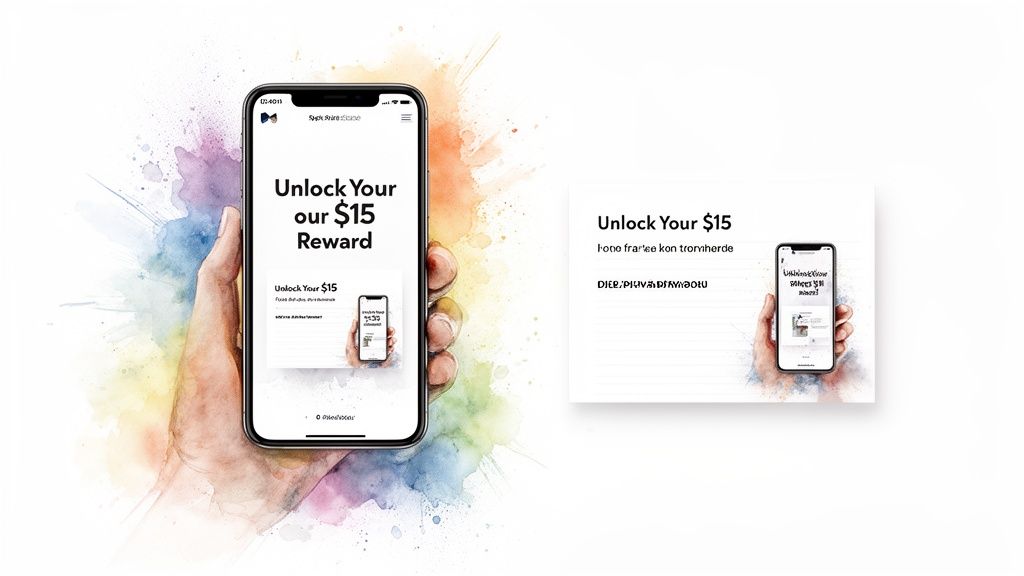
The trick is to stop thinking like a discount brand. You're not just running a sale; you're inviting customers into a relationship where their loyalty genuinely pays off. This calls for a completely different approach to your ads than a simple "15% Off" banner or a confusing points system.
From Discounts to Rewards: The Language of Value
The words you choose have a direct, almost subconscious, impact on how customers perceive your offer. A percentage-off discount feels cheap and temporary. It’s transactional.
Store credit, on the other hand, can feel like earned cash—a tangible reward they can spend however they want. It’s a powerful psychological shift from "saving money" to "earning money."
Stop talking about discounts or points. Instead, use language that frames the offer as a reward being unlocked or a balance being added to their native Shopify account.
Instead of: "15% Off Your Next Order"
Try: "Get $15 Back in Store Credit"
Instead of: "Save 20% Today"
Try: "Unlock Your $20 Shopping Reward"
Instead of: "Flash Sale! 25% Off Everything"
Try: "Spend $100, Earn a $25 Credit Instantly"
This "cash back" angle is incredibly effective. It encourages customers to add more to their cart to hit that reward threshold, which is a fantastic way to drive up your average order value (AOV) right from the first click. Building AOV is a non-negotiable for profitable ads, and this strategy bakes it right into your offer.
The best ad copy frames store credit as a tangible reward, not just another discount or some abstract points. You shift the customer's mindset from "How much can I save?" to "How much can I earn?" This subtle change in language protects your brand from that dreaded "always-on-sale" perception and makes the offer feel far more valuable, driving higher AOV and LTV.
Visuals That Make the Offer Impossible to Miss
Let's be real: in a crowded social feed, your visual does all the initial heavy lifting. It has to stop the scroll. For a store credit offer to hit home, it needs to be the star of your ad creative. Don't hide the reward in the last line of your copy; put it front and center.
Here are a few visual tactics I’ve seen work time and time again:
Bold Text Overlays: Take one of your best lifestyle or product shots and slap some simple, bold text over it. A beautiful photo of your product with the words "Get $15 Back" is impossible to misunderstand.
Show, Don't Just Tell: Create a quick video or GIF that visualizes the reward. Think of a simple animation showing a virtual credit card with "$15" being added to a customer's account. It makes the abstract feel concrete.
The AOV "Nudge" Carousel: Use a carousel ad to walk them through the logic. Card one could show a cart at $65. Card two could show the same cart but with one more item, bringing the total to $80, alongside a banner that screams, "You've Unlocked a $10 Reward!"
The goal here is brutal clarity. A user should get the entire value proposition within the first two seconds. If they have to search for the offer, you've already lost them. These visual cues work with your copy to make the offer the undeniable hero of the ad.
Bringing It All Together: An Ad Example
Let's say you sell sustainable home goods. Here’s a simple but effective way to structure a Facebook ad around your store credit offer.
Primary Text: Ready to refresh your space? For a limited time, get $20 back in store credit when you spend $100+. It's our simple way of saying thanks for choosing sustainable style. Tap to shop the collection and earn your reward!
Image/Video: A high-quality lifestyle video showing your products in a beautifully decorated room. Have bold text fade in: "Spend $100. Get $20 Back."
Headline: Your $20 Reward is Waiting
See how it all works together? Every single element hammers home the same message. It's clear, it’s compelling, and it focuses on what the customer gets, not just what they save. This is just one of many persuasive advertising techniques you can use, but it's a powerful one.
When you craft your ads this way, you're doing more than just running another Shopify Facebook ad—you're building a system that boosts AOV, protects your brand, and sets the stage for incredible lifetime value.
Using Store Credit to Supercharge Your Retargeting
Alright, your top-of-funnel ads are humming along, pulling in fresh faces with a tempting store credit offer. This is where the real fun begins—and where this whole strategy starts printing money. Retargeting is almost always your most profitable ad segment, but when you weave in native Shopify store credit, you can turn it into an absolute machine for driving up AOV and lifetime value.
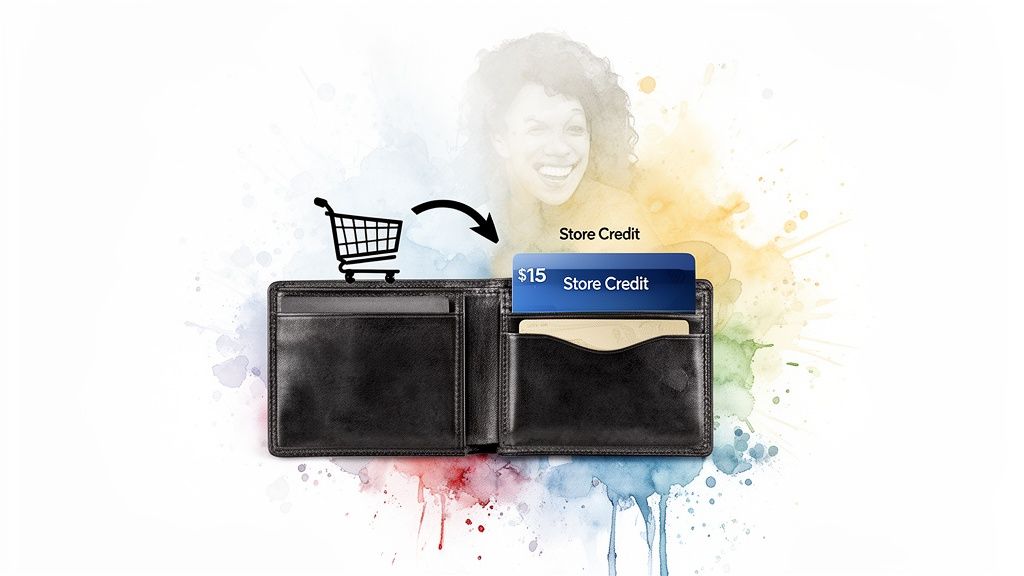
The secret sauce is combining the power of Dynamic Product Ads (DPAs) with custom audiences you build around your Shopify store credit program. This lets you move way beyond generic "Hey, you forgot this!" messages. Instead, you can hit people with hyper-personalized, urgent reminders that are incredibly difficult to ignore.
Building Audiences Around "Found Money"
This is a complete game-changer for your Meta ads. If you're using a native Shopify app like Redeemly, which syncs directly with your store, you can build custom audiences based on who has credit and how much they have. Suddenly, you're not just chasing down cart abandoners; you're creating laser-focused segments of people who are already primed to buy.
These are the audiences that will become the workhorses of your LTV strategy:
Customers with an Unspent Credit Balance: This is your goldmine. These are shoppers who have already bought from you and now have "free money" just sitting in their Shopify account.
High-Balance Customers (> $10): Segmenting by the credit amount lets you fine-tune the urgency. Someone with $20 in their account is way more motivated to come back than someone with $2.
Cart Abandoners with Active Credit: This is the warmest audience you'll ever find. They've shown direct interest in a specific product and they have a balance that can lower the price. It's a slam dunk.
Recently Earned Credit: Target customers who just made a purchase and earned credit within the last 7-14 days. You want to strike while the excitement of their last purchase is still fresh.
Writing Ad Copy That Triggers Urgency and Loss Aversion
Once these audiences are built, the ad copy practically writes itself. You're not just sending a product reminder; you’re telling them they have a real asset they're in danger of losing. This taps directly into a powerful psychological trigger called loss aversion—we’re often more motivated by the fear of losing something than the pleasure of gaining something new.
Your ad copy should feel less like an ad and more like a helpful account balance notification. A simple headline like, "You Have $15 Waiting in Your Account" completely reframes the ad from an interruption into a valuable piece of information.
Think about how much harder these messages hit compared to a generic "10% off" coupon or points reminder:
For Customers with Unspent Credit: "Don't let your $15 reward expire! You earned it—come back and treat yourself."
For Cart Abandoners with Credit: "Still thinking it over? Good news! You have $10 in store credit you can use on the items in your cart right now."
This approach flips the entire dynamic of your retargeting. You're no longer just trying to sell them something; you're helping them spend money they already feel like they own.
The AOV and LTV Multiplier Effect
This is where the numbers start getting really exciting. This strategy doesn't just lock in a second sale; it often leads to a higher average order value (AOV) on that repeat purchase. I've seen it time and time again: when a customer knows they have a $15 credit, they're far more likely to buy a $60 item instead of a $30 one. The credit makes the higher-ticket item feel like a smarter, more attainable purchase.
This kicks off a powerful LTV growth loop:
A customer makes their first purchase, often spending more to hit the threshold for earning that initial credit (Higher AOV).
They're retargeted with ads reminding them of their "free money" in their Shopify account.
They return to make a second purchase, usually spending well above their credit amount to make it "worth it."
They earn more credit on that second purchase, which starts the entire LTV cycle all over again.
This is how you systematically turn one-time buyers into loyal, repeat customers, dramatically increasing their lifetime value. If you want to dive deeper into the psychology behind this, you can learn more about what store credit truly is and the profound effect it has on customer behavior.
In a market where Shopify's ecosystem has roughly 2.83 million live stores all fighting for the same eyeballs, this kind of efficient, high-return advertising is non-negotiable. Data consistently shows that retargeting conversions on Facebook cost less and perform better than campaigns targeting cold traffic. By layering store credit psychology onto your Shopify Facebook ads, you're not just reducing customer acquisition costs; you're building a profitable retention engine that gives you a sharp competitive edge. To get a better sense of how brands are succeeding, you can discover more insights about Facebook advertising for Shopify and its growing importance.
Your Questions on Shopify Ads and Store Credit, Answered
So, you’re thinking about swapping out those tired discount codes and confusing point systems for a store credit strategy? Smart move. But I get it—it’s a different way of thinking, moving from the short-term sugar high of a sale to building real, long-term brand equity and lifetime value.
Let's walk through the most common concerns I hear from merchants. I'll give you the straight answers you need to feel confident about making this shift with your Facebook ads.
How Do I Measure the True ROAS of My Ads When Using Store Credit?
This is the big one. If you're only looking at the ROAS column inside Meta Ads Manager after the first sale, you're missing the entire point of a store credit offer. That initial purchase isn't the end goal; it's the beginning of a profitable, high-LTV relationship.
The real money is made on the second, third, and fourth purchases that your store credit incentive brings back.
To see the full impact, you have to shift your focus from single-session ROAS to the ratio of Customer Lifetime Value (LTV) to Customer Acquisition Cost (CAC). Dive into your Shopify analytics and compare the total amount spent over 60 or 90 days by customers who came from your "store credit" ads versus those from your old "discount" ads.
Your new north star becomes the LTV:CAC ratio. A strong ratio is concrete proof that you're acquiring customers who stick around and spend more, demonstrating profitability far more accurately than any single-sale metric ever could.
Won't Giving Store Credit Just Hurt My Margins Like a Discount?
I hear this all the time, and it's a fair question. But the answer is a hard no. In fact, native Shopify store credit is infinitely healthier for your margins.
A standard discount is a guaranteed loss. You give away 15% of your revenue on the spot, and that cash is gone for good. You've simply paid a customer to make one purchase.
Store credit works completely differently. It’s a liability on your books, but it only becomes a real cost when the customer comes back to make a second purchase. This is the key. You're not giving money away; you're funding a future sale you might never have gotten otherwise, which is the core of increasing LTV.
Think of it this way: a discount is a bribe for one sale. Store credit is an investment in the next one. You protect your initial profit margin while giving customers a powerful reason to come back.
Even better, offers like "Spend $100, Get $15 Back" actively push shoppers to add more to their cart. This immediate bump in your Average Order Value (AOV) often completely offsets the future cost of the credit, making your first sale more profitable while locking in the next one.
Can I Run Store Credit Ads Alongside My Normal Discount Ads?
Technically, yes. But you absolutely shouldn't. It's a terrible idea.
Running both at the same time creates a muddled, confusing message. It makes your brand look inconsistent and desperate. Are you a premium brand that rewards loyalty with store credit, or a discount brand that's always on sale? Customers won't know, and that confusion kills conversions.
Consistency is everything. When you commit to store credit as your primary offer, you train your audience to look for value in a rewarding experience, not to just sit around and wait for the next 20% off coupon. A single, clear, compelling offer is always easier for a customer to understand and for Meta's algorithm to optimize.
What's the Best Audience to Test This Store Credit Strategy On First?
Want a quick, decisive win to prove the model? Start with your hottest audience: your middle-of-funnel (MOFU) users who are right on the edge of buying.
I'm talking about a retargeting campaign aimed at people who have Added to Cart or Initiated Checkout in the last 14-30 days but never pulled the trigger. They already want what you're selling; they just need one last, compelling nudge over the finish line.
Instead of hitting them with the same old "10% Off To Complete Your Order!" ad they see everywhere, serve them an ad that says, "Complete your order now and get $10 in store credit for your next purchase." It feels like a bonus, not a bargain-bin tactic.
This is the perfect low-risk, high-impact test. Measure the conversion rate and AOV lift against your standard abandoned cart ads. The results will speak for themselves and show you the power of focusing on AOV and LTV.
Ready to stop burning money on discounts and start building real, profitable customer relationships? Redeemly makes it simple. Replace confusing points and margin-killing coupons with native Shopify store credit rewards that boost AOV and LTV from day one. It's the smarter way to grow.
Start your free trial of Redeemly today and see the difference for yourself.
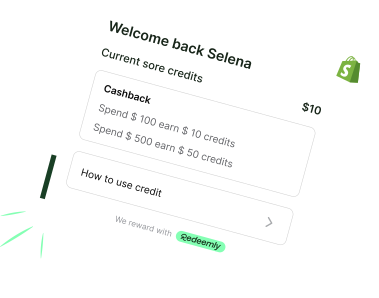


Join 7000+ brands using our apps