Fix Your Shopify Conversion Rate By Focusing on LTV and AOV
Feb 17, 2026
|
Published
That 1.5% average Shopify conversion rate you're chasing? It’s hiding a dangerous truth.
A lot of stores hit that number by constantly running sales. They attract an army of bargain hunters who grab a deal and never come back, all while their profit margins get thinner and thinner. This isn't growth; it's a race to the bottom, creating a nasty cycle where your brand can't survive without the next discount.
Why Your Shopify Conversion Rate Is a Flawed Metric
Let’s be real. The goal isn't just to convert more visitors today—it's to build a profitable business that lasts. A high conversion rate looks great on a dashboard, but if it's propped up by endless discounts, it’s a trap. It gives you the illusion of success while you're actually attracting the wrong kind of customer and eroding the very foundation of your business.
Instead of obsessing over a single, often misleading, number, there's a much smarter way to grow. It starts by shifting your focus to the two metrics that truly define a healthy ecommerce brand:
Customer Lifetime Value (LTV): This is the total amount of money a customer will spend with you over their entire relationship with your brand. Think long-term loyalty and repeat purchases.
Average Order Value (AOV): This is simply the average amount spent each time a customer checks out. Encouraging customers to add more to their cart is key.
When you focus on improving LTV and AOV, you're building a business on repeat purchases from loyal customers, not just one-off sales from deal-seekers. That's sustainable. That's real growth.
The Problem with Chasing Industry Averages
It's so easy to get caught up in industry benchmarks. We all do it. The data, pulled from millions of stores, shows the average Shopify conversion rate sits somewhere between 1.4% to 1.8%. The top 20% of stores might hit over 3.2%, but even that benchmark means for every 100 visitors, nearly 99 are walking away empty-handed.
The problem isn't the number itself. It's how brands try to bump it up. They reach for the quickest, easiest fix they can find: discounts. Sure, a 20% off coupon might give you a temporary lift, but it comes at a steep price.
The relentless pursuit of a higher conversion rate through discounting trains customers to wait for sales, devalues your products, and attracts an audience loyal only to the lowest price—not to your brand.
This strategy actively works against you. It kills your margins and makes it nearly impossible to build a loyal community that's happy to pay full price. This is exactly why a strategic shift away from coupons and confusing points systems is so critical for boosting LTV and AOV.
A New Path Forward: Native Store Credit
So, what's the alternative to this endless discount cycle? Imagine this: instead of another temporary coupon, you reward customers with native Shopify store credit.
This isn't just another discount. It's a direct, tangible incentive for their next purchase. It feels like cash sitting in their digital wallet, encouraging them to come back and spend more. By focusing on profit-safe incentives like store credit, you can boost AOV and LTV—the metrics that actually move the needle. For a deeper dive into this key metric, check out our guide on how to calculate customer LTV.
Find the Leaks Where Your Conversions Are Really Lost
A low Shopify conversion rate is just a symptom. The real disease is hiding somewhere in your customer’s journey, causing them to abandon their carts and leave your site for good. Before you can apply any fix, you have to play detective and find where your profits are leaking out.
Think of your store as a pipeline. Visitors flow in one end, and paying customers should flow out the other. If you have a leak, just adding more water (traffic) is a losing game—you’ll just waste more resources. Your job is to walk the length of that pipeline and find the cracks.
This whole process is about understanding the why behind the numbers. A crucial first step is a thorough Conversion rate optimisation audit. This isn't about guesswork. It's a systematic review of your entire customer experience to pinpoint exactly where shoppers are dropping off and, more importantly, why.
Starting Your Conversion Audit
Your first stop should always be your Shopify Analytics dashboard. This is your command center for seeing what people are actually doing on your site. The "Online store conversion" report is your goldmine here, breaking down the funnel into key stages:
Added to Cart: This tells you how many sessions led to a product getting tossed in the cart. A low number here might signal that your product pages aren't convincing or your navigation is clunky.
Reached Checkout: This tracks how many people who added an item to their cart actually started the checkout process. A big drop-off here often means you're hitting them with unexpected costs or a confusing cart experience.
Sessions Converted: The finish line. This is the final number of sessions that ended in a sale.
If you spot a massive gap between Added to Cart and Reached Checkout, you’ve just found a major leak. It could be caused by surprise shipping fees that only show up at the last second, a demand to create an account, or just a poorly designed cart page. Each stage tells a story about what’s stopping your visitors from becoming customers.
A high "Add to Cart" rate paired with a low "Sessions Converted" rate is the classic sign of checkout friction. Your customers want to buy, but something in those final steps is pushing them away.
This decision tree helps you visualize how to read your conversion rate and decide what to do next.
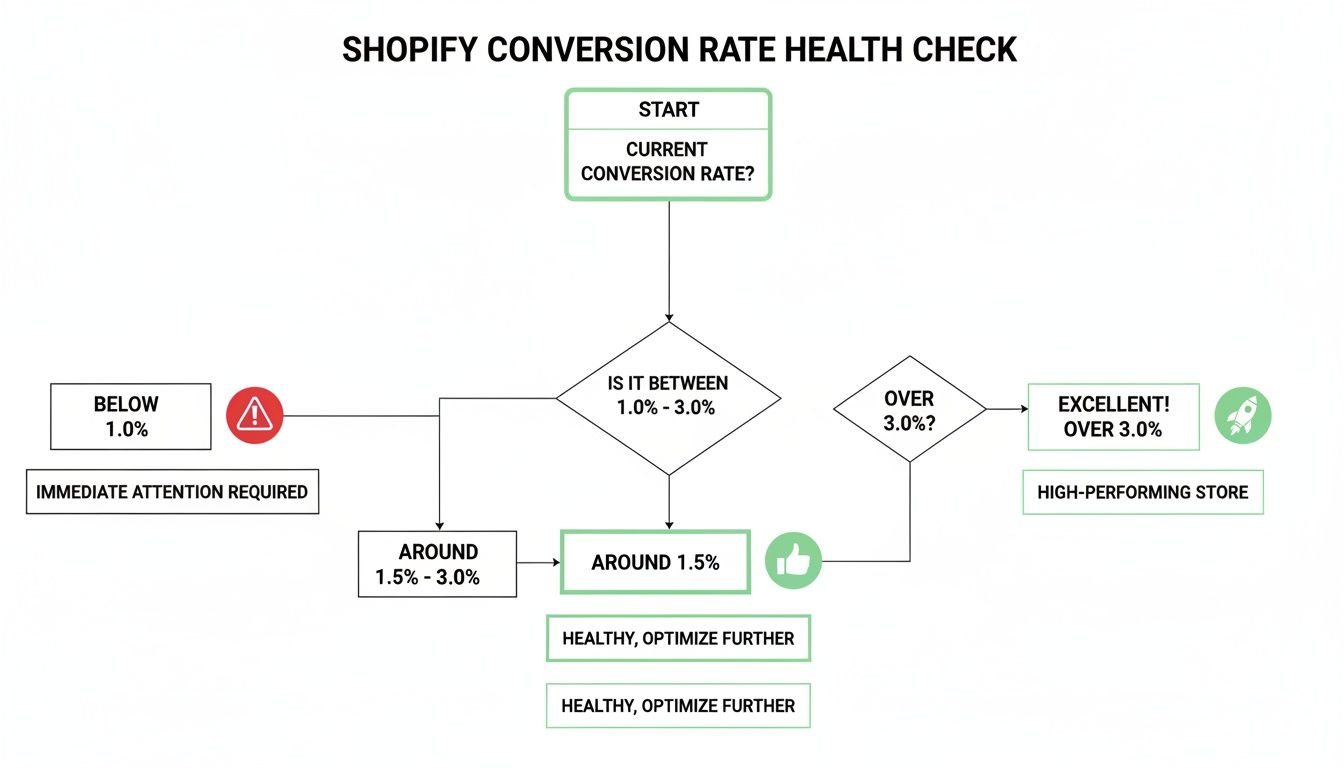
The flowchart makes it clear: a rate below 1% means you need to fix foundational issues right away, while a rate over 3% suggests you're ready to move on to more advanced optimizations.
Uncovering the Common Conversion Killers
Once your analytics point you toward a problem area, you can start hunting for the usual suspects. These issues are often responsible for the biggest leaks in an ecommerce funnel.
1. Page Speed and Mobile Experience
In ecommerce, speed is everything. It's not an exaggeration. Nearly 80% of retail website visits now happen on a phone. If your site is slow to load or a pain to navigate with a thumb, you are actively losing sales. Go run your site through Google's PageSpeed Insights and see what it says. Pay very close attention to that mobile score—it's where most of your customers live.
2. Confusing Navigation and Site Search
It's simple: shoppers who can't find what they're looking for can't buy it. A clunky menu or a useless search bar is a recipe for frustration and an instant exit. Try this yourself: can you find a specific product on your own site in three clicks or less? Does your search bar handle typos or offer helpful suggestions?
3. Lack of Trust Signals
Customers are about to hand over their money and personal information. They need to trust you. Missing trust signals are a huge conversion killer, yet they're often overlooked. Make sure your store includes:
High-quality product reviews, especially those with photos.
Crystal-clear shipping and return policies.
Professional branding and a genuine "About Us" page.
Secure payment badges (like Shop Pay, Visa, etc.) displayed prominently.
By systematically auditing these areas, you move from guessing what’s wrong to knowing where to focus your efforts. This diagnostic work is the foundation for any targeted, effective solution that will genuinely move the needle on your Shopify conversion rate.
The Profit-Safe Fix: Shifting from Discounts to Store Credit
Let's talk about the elephant in the room for so many Shopify stores: the addiction to discount codes. They feel good, right? You launch a sale, see a quick bump in conversions, and it feels like a win. But this quick fix is quietly killing your business. It attracts one-time buyers who vanish the moment the sale ends, slowly chipping away at your brand’s value and gutting your profit margins.
It's a race to the bottom, and nobody ever really wins. Every discount you offer trains your customers to wait for the next sale, conditioning them to never pay full price. What you're left with is a customer base loyal only to the lowest price tag, not to your brand.
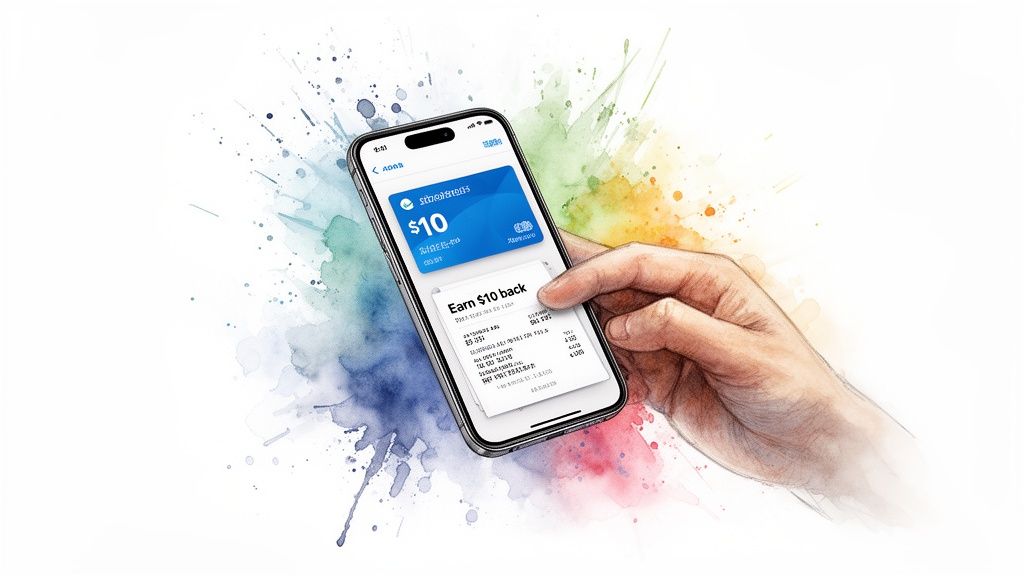
Now, let's imagine a different way. Instead of slapping a 10% off coupon on an order, you give that same customer $10 in store credit toward their next purchase. This isn’t just another discount—it’s a powerful psychological shift. It's a promise of future value, a direct incentive to come back, and it turns a single transaction into the start of a long-term relationship. This is how you boost Lifetime Value (LTV).
The Psychology of Cash in a Digital Wallet
The magic here is all about perception. A discount code feels transactional and cheapens the product right now. A confusing point system makes customers do math. Native Shopify store credit, on the other hand, feels like a gift. It’s a tangible asset the customer now owns.
Suddenly, it’s cash in their digital wallet, just waiting to be spent.
This creates a powerful sense of ownership and urgency. The customer isn't just getting a deal; they've received a balance they don’t want to go to waste. That feeling is a huge motivator that drives repeat business and builds the foundation for a much, much higher customer lifetime value (LTV).
Store credit reframes the entire customer relationship. It moves from a transactional discount to a rewarding partnership. The customer's mindset shifts from, "How much can I save today?" to "What will I buy next with my rewards?"
This is how you break the toxic discount cycle. You get to protect your profit margins while still giving customers real, undeniable value. It improves your Shopify conversion rate for returning visitors and makes your business far more profitable in the long run by focusing on LTV.
Boosting Average Order Value Organically
Beyond just building loyalty, native store credit is an incredible tool for nudging up your Average Order Value (AOV). Think about a simple campaign: "Spend $100, earn $10 in store credit." This kind of offer is a gentle, natural push for customers to add just one more thing to their cart.
A shopper with $85 worth of items is far more likely to toss in another $15 product to unlock that future reward. They aren't just spending more; they're investing in their next purchase with you. It turns a standard checkout into a smart, strategic move for both you and your customer, directly increasing your AOV.
This is fundamentally different from a discount. A coupon rips revenue right out of the current sale. A store credit reward only becomes a "cost" when it's redeemed on a future purchase—a purchase that probably wouldn't have happened without it.
Discount Coupons vs. Native Store Credit
When you put these two strategies head-to-head, the impact on the metrics that actually matter for a healthy ecommerce business becomes crystal clear. Native store credit is the clear winner for building a sustainable brand.
Metric | Discount Coupons | Native Store Credit |
|---|---|---|
Profit Margin | Immediately slashed on the initial sale, often attracting low-margin shoppers. | Fully protected on the first purchase; becomes a cost only on a future, repeat sale. |
Customer LTV | Attracts one-time "deal hunters" who rarely return, leading to a low LTV. | Directly incentivizes repeat buys, building a loyal base and dramatically increasing LTV. |
Average Order Value | Little to no impact, and can even lower AOV if the discount has no minimum spend. | Naturally increases AOV as customers spend more to unlock reward tiers. |
Brand Perception | Devalues the brand over time and creates an expectation for constant sales. | Strengthens loyalty by making customers feel valued and rewarded for choosing you. |
The verdict is in. While discounts can give you a short-term sugar rush, native store credit builds a much more resilient and profitable business. It's a strategic investment in keeping your best customers around. To see how this powerful tool works inside Shopify, you can learn more about the benefits of native Shopify store credit.
How Store Credit Performs Across Industries
Of course, knowing your industry's benchmarks is key. For example, recent data shows Shopify conversion rates can vary wildly, with beauty averaging 2.0% while electronics sits closer to 1.0%. These differences often come down to things like price points and how much impulse buying happens in a category.
But here’s the thing: store credit works across all of them because its appeal is universal.
Whether a customer is buying a $20 lipstick or a $500 gadget, the feeling of earning "free money" for their next purchase is a powerful motivator. It’s a versatile tool that adapts to different products and buying cycles, making it a smart move for any Shopify merchant who wants to build a more sustainable brand by boosting LTV and AOV.
How to Launch Your Store Credit Program
Ready to turn theory into action? Getting a native store credit program up and running on Shopify is far simpler—and more powerful—than you might imagine. We're not talking about complicated point systems or an endless stream of discount codes. The real goal here is to build a straightforward, profit-safe rewards system that starts boosting your LTV and AOV from day one.
The magic of a native store credit program is its seamlessness. It feels like a natural part of your store, not some clunky, third-party app bolted on as an afterthought. This creates a smooth experience for you and, more importantly, for your customers, eliminating the friction that kills so many traditional loyalty programs.
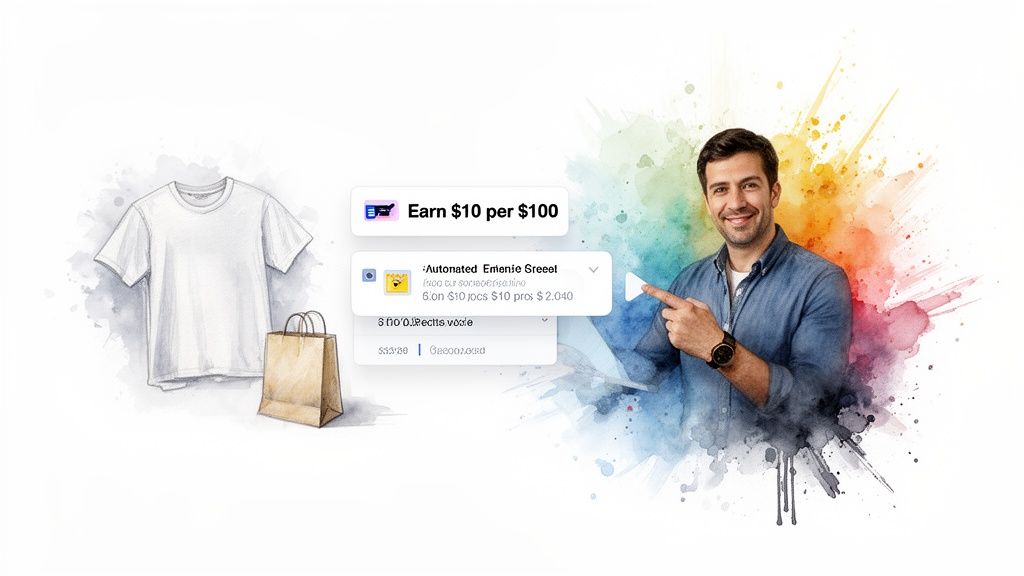
This entire approach is designed to build sustainable growth by directly moving the needle on the metrics that actually matter: Average Order Value (AOV) and Customer Lifetime Value (LTV).
Step 1: Create Your Strategic Earning Rules
The engine of your program is its earning rules. You need to strike that perfect balance where the offer feels generous to the customer but is still smart for your bottom line. I've found the most effective model is a simple, spend-based reward that nudges customers to buy more without you giving away the farm.
A fantastic place to start is the classic "spend-and-earn" model. An offer like “$10 in store credit for every $100 spent” is clear, easy for anyone to grasp, and incredibly effective. This one rule immediately gives customers a reason to increase their cart size to hit that threshold, directly boosting your AOV on that very first purchase.
Here’s why this approach works so well for LTV and AOV:
It’s Simple: Customers get it instantly. No confusing points to calculate or tiers to figure out.
It Protects Margins: The reward is a future credit, not a discount on the current sale. It brings them back for a second purchase that might never have happened otherwise, increasing LTV.
It Drives Repeat Business: That earned credit feels like real money sitting in their digital wallet, giving them a powerful reason to return and increase their LTV.
Step 2: Communicate the Program Everywhere
A rewards program that nobody knows about is just a line of code. It can't influence behavior if it's a secret. You need to weave the message of your store credit program into every key touchpoint of the customer journey.
Start by putting an eye-catching widget or banner on your homepage and product pages. Make the value proposition impossible to miss: "Earn Rewards on Every Purchase." This plants the seed right away, reframing every potential sale as a chance for the customer to earn future value.
Your store credit program shouldn't be a secret handshake for loyal customers. It should be a public declaration of how you value their business, visible at every step from their first visit to their final checkout.
To really nail this, keep your messaging consistent and visible:
On-Site Widgets: A floating wallet or a clear banner is a constant, gentle reminder of the rewards they can earn as they browse.
Product Pages: A simple line like "Buy now and earn $5 toward your next order" reinforces the benefit right at the moment of decision.
Post-Purchase Emails: As soon as they buy, send an email confirming the credit they just earned. This small, automated touch turns a boring transaction receipt into an exciting reason to plan their next visit and boost LTV.
Step 3: Automate Reminders to Bring Customers Back
The final, crucial piece of the puzzle is automation. Life is busy. Even your best customers can forget they have store credit waiting for them. Automated email reminders are your secret weapon for reactivating these shoppers and driving that all-important second sale.
Just set up a simple email flow that triggers 30 or 60 days after a customer earns credit but hasn't used it. A friendly nudge like, "Hey, you still have $10 in store credit waiting for you!" can be wildly effective at pulling them right back to your store. This is how you close the loop and guarantee your program is actively building a higher LTV.
For a deeper dive into the mechanics of setting this all up, you can check out our complete guide on how to give store credit on Shopify.
Case Study: An Apparel Store in Action
Let's look at a real-world scenario. Imagine a Shopify apparel store with a $75 AOV and a 15% repeat purchase rate. They decide to launch a "Spend $100, Earn $10" store credit program.
Right away, they see customers who have $80 in their cart start adding a $25 accessory just to unlock that $10 reward. Bam—their AOV starts climbing. Even better, those automated email reminders start bringing back customers who would have otherwise been one-and-done shoppers.
After just three months, their repeat purchase rate jumps from 15% to over 20%, directly increasing their Customer Lifetime Value. That’s a massive lift, driven entirely by this simple, native store credit solution. This proves you don’t need a complicated, points-based mess to build powerful, profitable customer loyalty.
How to Measure the ROI of Your New Strategy
A great strategy is only as good as the results you can prove. After making the leap from profit-eating discounts to a native store credit program, you need hard data to back up that decision. This means looking past a surface-level obsession with the overall Shopify conversion rate and digging into the metrics that truly signal a healthy, growing business: LTV and AOV.
The real goal isn't just watching numbers go up; it's about making sure the right numbers are climbing. We’re talking about the key performance indicators that show your new approach is building long-term value, not just chasing quick, one-off sales. This is how you tie your strategy directly to financial impact.
Moving Beyond the Basic Conversion Rate
Your Shopify dashboard is a goldmine, but you need to know where to dig. Instead of just glancing at the main conversion rate, you have to track the metrics that tell the complete story of customer loyalty and profitability.
These are the numbers that will prove the real power of your store credit program:
Average Order Value (AOV): This is often the first place you'll see a lift. Are customers tossing a little extra into their carts to hit your "spend-and-earn" thresholds? A rising AOV is a fantastic early sign that your incentives are hitting the mark.
Customer Lifetime Value (LTV): This is the ultimate report card for any retention strategy. As more customers return to spend their credit, their total worth to your business skyrockets. This metric proves you're building relationships, not just processing transactions.
Repeat Purchase Rate: This is loyalty in its purest form. A native store credit program is built from the ground up to drive that second, third, and fourth purchase. Tracking this percentage shows you exactly how well your program is bringing people back into the fold.
Conducting a Before-and-After Analysis
To really grasp the impact of your new strategy, you need a clear baseline. This simple, data-driven framework will give you the concrete proof needed to validate your efforts.
Start by pulling data for the 90 days before you launched your store credit program. Then, once your new program has been running for 90 days, pull the exact same reports. The comparison will reveal the tangible lift in revenue and profitability.
A cornerstone of understanding the true return on investment for your initiatives is to properly grasp what conversion tracking is and how it functions. This ensures you are measuring the right actions and attributing success to the correct strategies.
Set up a simple table to compare your key metrics side-by-side. It makes the story jump right off the page.
Metric | 90 Days (Before Store Credit) | 90 Days (After Store Credit) | Percentage Change |
|---|---|---|---|
Average Order Value | $85 | $98 | +15.3% |
Repeat Purchase Rate | 12% | 18% | +50% |
Customer Lifetime Value | $150 | $195 | +30% |
Overall Conversion Rate | 1.6% | 1.7% | +6.25% |
In this example, the data tells a powerful story. While the overall Shopify conversion rate saw a respectable bump, the metrics tied directly to profitability and loyalty exploded. A 15.3% increase in AOV and a massive 50% jump in repeat purchases are the kind of results that prove the financial wisdom of your move.
This data-driven approach gives you undeniable proof that your strategy is a winner. It builds the confidence to double down on what’s working and makes it easy to communicate the value of your retention efforts to your team, stakeholders, or investors. This is how you start making smarter, more profitable decisions for the future.
Build a Brand People Love to Come Back To
Look, chasing a higher Shopify conversion rate with a constant stream of discounts is a losing battle. It's a short-term sugar high that builds your business on quicksand, attracting one-and-done bargain hunters instead of true fans. If you want sustainable, profitable growth, you have to build a community of customers who stick around because they feel valued, not because you’re the cheapest option.
This requires a real shift in mindset. You need to stop renting customers with temporary deals and start owning those relationships for the long haul.
The Modern Retention Engine
So, how do you do that? Native Shopify store credit is your secret weapon. Forget confusing point systems or coupons that slash your margins. Store credit is dead simple, profit-safe, and customers get it instantly. It gives them a direct, tangible reason to come back and shop again.
Stop renting customers with discounts and start owning those relationships with rewards that matter. The result is a healthier, more predictable business built for the long haul.
When a customer gets store credit, they have a real asset—actual money to spend in your store. It feels like a gift, a reason to return. This simple mechanic is incredibly powerful and works on multiple levels to grow your business.
Tying It All Together for Profitable Growth
This whole strategy is designed to create a positive feedback loop, a virtuous cycle that strengthens your brand and your bank account at the same time by focusing on what matters: LTV and AOV.
Boosts Average Order Value (AOV): You'll see customers spending just a little bit more to hit that next reward threshold, bumping up the value of their current cart.
Multiplies Customer Lifetime Value (LTV): That store credit sitting in their account is a powerful magnet pulling them back for another purchase. Repeat business is the lifeblood of a healthy brand, and this drives it.
Creates Real Brand Loyalty: By rewarding customers for their business, you’re building a relationship on mutual appreciation, not just a race to the bottom on price.
When you lean into a native store credit program, you're doing more than just tweaking a metric. You're building a more resilient, predictable, and profitable business. You’re building a brand that people actually want to come back to.
Got Questions? We've Got Answers.
Pivoting your retention strategy always brings up a few questions. Let's tackle the most common ones we hear from Shopify merchants who are moving away from constant discounts and embracing native store credit to boost their LTV and AOV.
Will My Customers Actually Bother with Store Credit?
You bet they will. The secret is making it dead simple and impossible to forget.
Unlike a confusing points system where you need a calculator to figure out what you've earned, store credit is just money. It's a digital wallet for your store, and when a customer sees a real dollar balance sitting there at checkout, the urge to use it is powerful.
We also find that automated email reminders are a game-changer. A friendly nudge reminding a shopper they have, say, $15 waiting for them is often all it takes to bring them back. This combo of simplicity and smart communication gets people using their credit and making repeat purchases, which is exactly how you grow customer lifetime value.
Isn't Store Credit Just a Glorified Discount?
Not even close. It's a much smarter, more profit-friendly way to incentivize your customers.
Think about it: a 10% off coupon immediately cuts into your revenue on this sale. Native store credit, on the other hand, only gets applied to a future purchase—a sale you might not have gotten otherwise.
Store credit is an investment in your next sale, not a cost on your last one.
It protects your profit on the initial order while giving customers a compelling reason to come back. This completely changes the financial dynamic, turning a potential loss into a tool for building a loyal customer base and increasing your average order value over the long haul.
Ready to stop the discount death spiral and start building profitable relationships? With Redeemly, you can launch a native Shopify store credit program that protects your margins, boosts AOV, and turns first-time buyers into lifelong fans. Learn more and get started at Redeemly.ai.


Join 7000+ brands using our apps