Shopify and Facebook Ads: A Guide to Boosting LTV and AOV with Store Credit
Mar 8, 2026
|
Published
Running profitable ads on Shopify and Facebook can feel like you're stuck in a loop. You’re constantly chasing sales, but the only way to get them seems to be by slashing your prices. This race to the bottom, fueled by endless discount codes, eats into your margins and, worse, attracts customers who will never buy from you again at full price.
This guide is about breaking that cycle. We're going to shift the focus from cheap, one-off transactions to building a genuinely profitable and sustainable business powered by customer lifetime value (LTV) and a higher average order value (AOV).
The Profitability Puzzle Of Shopify And Facebook Ads
For so many Shopify brands I've worked with, the relationship with Facebook ads is a love-hate one. You pour money in, dangle a flashy discount, and hope the sales notifications start rolling in. The problem? With ad costs always on the rise and shoppers trained to expect a deal, the math rarely works out in your favor.
This constant cycle of discounting doesn't just chip away at your profits; it attracts the wrong kind of customer—the deal-hunter who is loyal only to the next sale.
Sure, it's important to know how to calculate Return on Ad Spend, but ROAS is just one piece of the puzzle. If your Average Order Value (AOV) is tanking and customers never return, are you really building a brand, or are you just buying transactions?
Moving Beyond The Discount Trap
That "20% Off" coupon you're running? It’s a direct hit to your bottom line on the very first sale. It feels like an easy win, but it's a short-term fix that creates a long-term headache and diminishes customer lifetime value.
Instead of devaluing your products, let's reframe the offer. There’s a powerful alternative that protects your margins and starts building loyalty from day one: Shopify native store credit.
Imagine your next Facebook ad doesn't scream "20% Off!" but instead offers something like, "Spend $100, Get $20 Back." This simple twist completely changes the dynamic. You get a full-price initial purchase, which immediately boosts your AOV and safeguards your profit. The customer gets a valuable reward that feels like cash in their pocket—a powerful, built-in reason to come back.
The uncomfortable truth for most Shopify stores is that roughly 80% of customers will only ever make a single purchase. This makes first-purchase profitability and a clear path to a second sale absolutely critical for boosting lifetime value.
A Smarter Acquisition Strategy
This native store-credit model turns your customer acquisition on its head. You're no longer just paying for one sale; you're investing in a future relationship and higher LTV. That earned credit acts as a magnet, pulling customers back to your store for their next purchase without you having to spend another dime on ads to re-acquire them. It’s an automated retention loop baked right into your acquisition strategy.
When you look at the numbers, the story becomes even clearer. The average Facebook ad conversion rate is around 9.21%, with anything over 10% considered fantastic. If you're stuck under 3%, it's a massive red flag that your offer isn't connecting.
Shifting from a straight discount to a store credit incentive is one of the smartest ways to improve not just your conversion rate, but the quality of those conversions. You stop bleeding margin and start turning clicks into valuable, repeat customers with high lifetime value. For more performance benchmarks, the Shopify blog is a great resource for seeing how you stack up.
Incentive Strategy Showdown: Discount Codes vs. Store Credit
When you're deciding on an incentive for your ad campaigns, it's easy to default to what's familiar. But the financial impact of your choice is significant. Here's a direct comparison of how traditional discounts stack up against a native store credit system like Redeemly.
Metric | Discount Codes | Native Store Credit (e.g., Redeemly) |
|---|---|---|
Initial Profit Margin | Immediately reduced by the discount percentage (e.g., 20% lower). | Protected. The initial sale is at full price, maximizing immediate profit. |
Average Order Value (AOV) | Often lower, as customers may only buy the discounted item. | Typically higher. The offer encourages spending more to earn a bigger credit. |
Customer LTV | Lower. Attracts one-time deal-seekers with low brand loyalty. | Significantly higher. Creates a built-in incentive for a second purchase. |
Repeat Purchase Rate | Low. No built-in reason for the customer to return. | High. The earned credit acts as a powerful "pull" for a return visit. |
Brand Perception | Can devalue the brand, training customers to wait for sales. | Strengthens the brand by rewarding full-price purchases and loyalty. |
The choice is clear. While discounts provide a quick, temporary sales bump, they do so at the expense of long-term brand health and profitability. A native store credit strategy, on the other hand, builds a foundation for sustainable growth by turning your acquisition spend into a powerful retention engine that drives LTV.
Building Your LTV Tracking Foundation in Shopify
Before you even think about spending a single dollar on Shopify and Facebook ads, we need to talk about data. So many store owners get fixated on the first sale, but the real money is made on the second, third, and fourth. To get there, you need a tracking setup that tells the whole story, not just the first chapter.
This means shifting your focus away from simple vanity metrics like clicks or even single-purchase ROAS. Profitable growth comes from acquiring customers who stick around. A solid understanding of customer lifetime value calculation is what separates the stores that scale from those that stall out.
The Non-Negotiable Dual Tracking Setup
In the old days, you could just slap the Meta Pixel on your site and call it a day. Those days are long gone. Relying only on the pixel today is like flying blind—you're missing a huge chunk of your conversion data thanks to browser restrictions and privacy updates.
This is where the Conversions API (CAPI) comes in as your new best friend. It’s not a replacement for the pixel; it’s a partner. CAPI sends conversion data directly from your Shopify server to Meta's, completely bypassing the browser. It's a server-to-server connection that’s far more reliable and doesn't get blocked.
Here’s how they work together:
Meta Pixel (Client-Side): This is the code on your website that tracks what people do in their browser—viewing pages, adding items to their cart. It’s still essential for building retargeting audiences.
Conversions API (Server-Side): This is the direct line from your Shopify server to Meta's. It securely reports the big-ticket events, like actual purchases, making sure nothing gets lost in translation.
When you run both, Meta gets two signals for the same event and can use the most accurate one after "de-duplicating" them. I can't stress this enough: for anyone serious about Shopify and Facebook ads, this dual setup is absolutely non-negotiable.
This whole process is about turning an ad impression into a long-term, valuable customer.
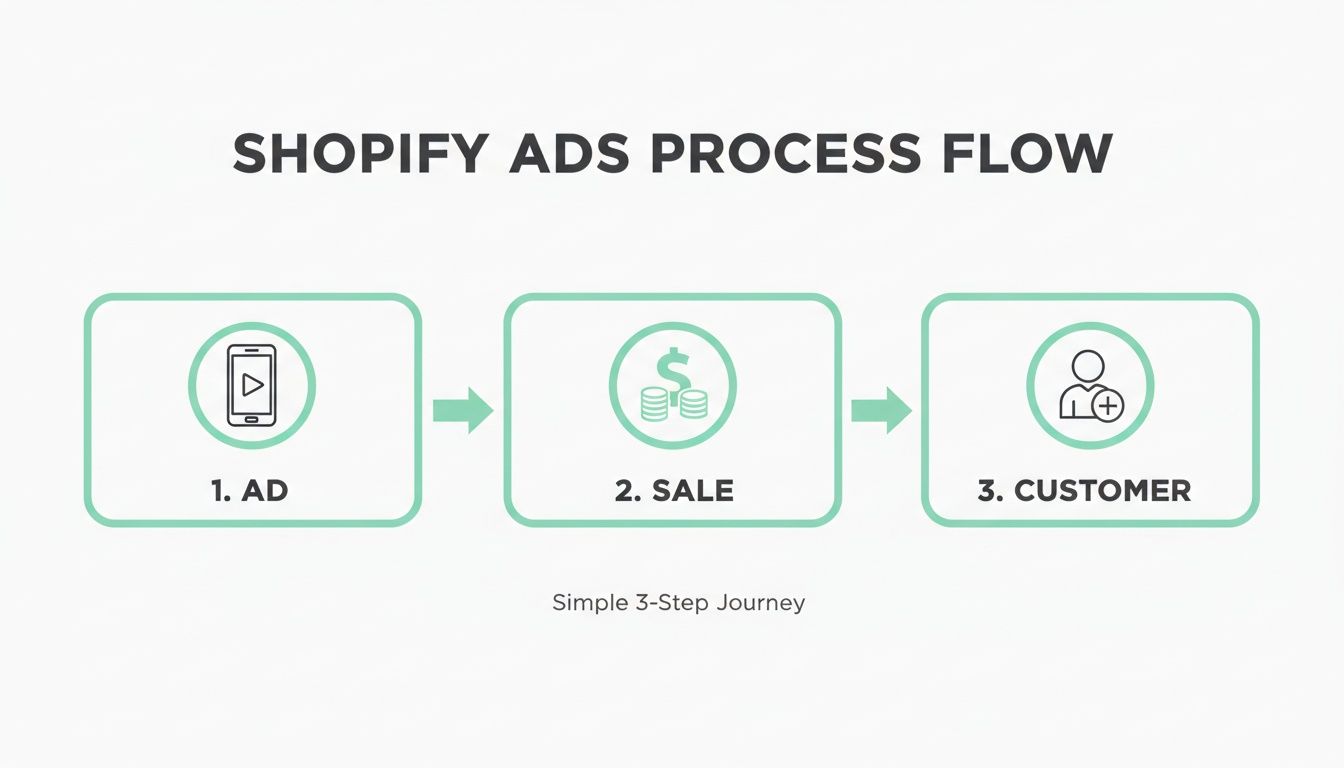
The goal isn't just that one sale. It's acquiring a customer you can bring back for more, maximizing their lifetime value.
Configuring Your Events for LTV
Once your tracking is solid, you need to tell Meta what actions actually matter to your business. This involves two key steps: Domain Verification and Aggregated Event Measurement (AEM). First, you have to verify your domain in Meta Business Manager to prove you own your store. It’s a prerequisite for everything that follows.
Next up is AEM, where you get to prioritize up to eight conversion events. If you're focused on LTV (and you should be), the Purchase event must be your number one priority. No question.
An accurate Purchase event is the bedrock of your entire LTV strategy. If you can't reliably track the first sale, you have zero chance of measuring the long-term value your ads are creating.
A smart event priority stack for most e-commerce stores looks like this:
Purchase: The ultimate goal. This is what pays the bills.
Initiate Checkout: A powerful signal of high purchase intent.
Add to Cart: Shows clear interest in a specific product.
View Content: Great for top-of-funnel engagement and retargeting.
By setting up this hierarchy, you're training Meta’s algorithm to hunt for people who are most likely to complete a purchase, not just browse. This foundational work gives you the confidence that you're measuring the real, long-term impact of your ad spend.
If you want to go deeper on this, check out our full guide on how to calculate customer LTV to sharpen your understanding of this core metric.
Structuring Your Facebook Campaigns for High AOV
Alright, with your tracking properly set up, it's time for the fun part. We’re moving from the technical setup to building the actual campaigns that will drive sales. This is where we design a Facebook ad strategy built specifically to boost your Average Order Value (AOV) from the very first purchase.
Forget the generic campaign structures you’ve seen a hundred times. We're going to build a full-funnel machine that revolves entirely around your Shopify native store credit offer.
The magic here is all about psychology. An ad screaming "15% Off" attracts bargain hunters looking for a quick, cheap win. But an ad offering "Spend $100, Get $15 Back" in store credit? That encourages a different kind of customer—one who is ready to invest in your brand and has a higher potential lifetime value. You're not just selling a product; you’re selling a smarter way to shop. This simple shift is the key to driving a higher cart value right from the start.
The Full-Funnel Store Credit Strategy
A winning campaign is never just a single ad. It's a carefully crafted customer journey. We need to guide people from total strangers to loyal customers, using your store credit offer as the consistent, compelling reason to take the next step.
Here’s how we map this out across the funnel:
Top of Funnel (Prospecting): This is your first impression. The goal is to reach new audiences who’ve never heard of you. Your ads should be broad, focus on the benefits of your products, and clearly introduce the "earn credit" offer as a core perk of shopping with you.
Middle of Funnel (Consideration): Now you're talking to people who've shown some interest—they’ve visited your site, watched an ad, or engaged with your page. Here, you can get more specific. Show them products they might like and gently remind them of the credit they stand to earn.
Bottom of Funnel (Conversion): These are your hottest leads—people who have added items to their cart or started the checkout process. The message needs to be urgent and direct: "Complete your purchase now to lock in your store credit!"
For anyone juggling Shopify and Facebook ads, this tiered system ensures you're always delivering the right message at the perfect time. It’s a framework designed to build momentum and smoothly guide shoppers toward a bigger, more valuable purchase, maximizing AOV and LTV.
Using Advantage+ for Maximum Impact
Meta's Advantage+ Shopping Campaigns (ASC) can be an absolute powerhouse when you pair them with a strong native store credit offer. These AI-driven campaigns are built to sniff out high-intent buyers with very little manual targeting.
When you feed an ASC campaign a compelling, value-packed offer like store credit, you give the algorithm a much clearer signal. Instead of just optimizing for any conversion, Meta's AI can now hunt for users who are more likely to spend more to hit your credit threshold. This is exactly what you need to boost AOV. As you start seeing results, our guide on how to calculate AOV will become your best friend for tracking progress.
Running an Advantage+ campaign with a "Spend $100, Get $15 Back" offer is like giving Meta’s AI a treasure map. You're not just telling it to "find customers." You're telling it to "find customers who are willing to spend at least $100," which completely changes the quality of the traffic and potential lifetime value.
Real-World Campaign Structure Example
Let's make this concrete. Imagine you run a skincare brand where the average product is about $40. Your goal is to get people to buy three items instead of just one or two to increase AOV.
You create a compelling offer: "Spend $120, Get $20 in Store Credit."
Here’s a simple but powerful campaign setup you could run:
1. Prospecting Campaign (Advantage+ Shopping)
Objective: Sales
Audience: Broad. You'll trust the Advantage+ algorithm to find your ideal customers.
Creative: Run a mix of your best video and image ads. Every single ad—in both the copy and the visual—needs to prominently feature the "Spend $120, Get $20 Back" message. Make it impossible to miss.
2. Retargeting Campaign (Standard Manual Campaign)
Objective: Sales
Audience: Target website visitors from the last 30 days who haven't made a purchase yet.
Creative: Use Carousel ads to show them the exact products they viewed. Pair it with a headline like, "You're so close! Get $20 back on your order." This reminds them of the specific reward waiting for them and creates a sense of urgency.
This two-part structure keeps your funnel full of new prospects while expertly converting the people who are already close to buying.
It's a fact: Meta's platforms are non-negotiable for Shopify merchants. Over 65% of stores run paid ads on Facebook and Instagram, and these channels account for more than 40% of all paid traffic. With over three billion active users and an average CPC of just $1.72, the opportunity is massive. But you have to be smart about it. You can see more compelling data in these current Shopify statistics on wiserreview.com.
A well-designed campaign structure like this isn't just a suggestion—it’s how you stand out from the noise and build a truly profitable brand with high AOV and LTV.
Crafting Ad Creative That Actually Sells Your Store Credit Offer
A store credit strategy is one thing on paper, but your ad creative is where it either takes off or falls flat. In the noisy world of Shopify and Facebook ads, just announcing your offer won’t cut it. You have to frame it so customers feel like they’re getting a premium perk that rewards them for their loyalty, not just another cheap discount.
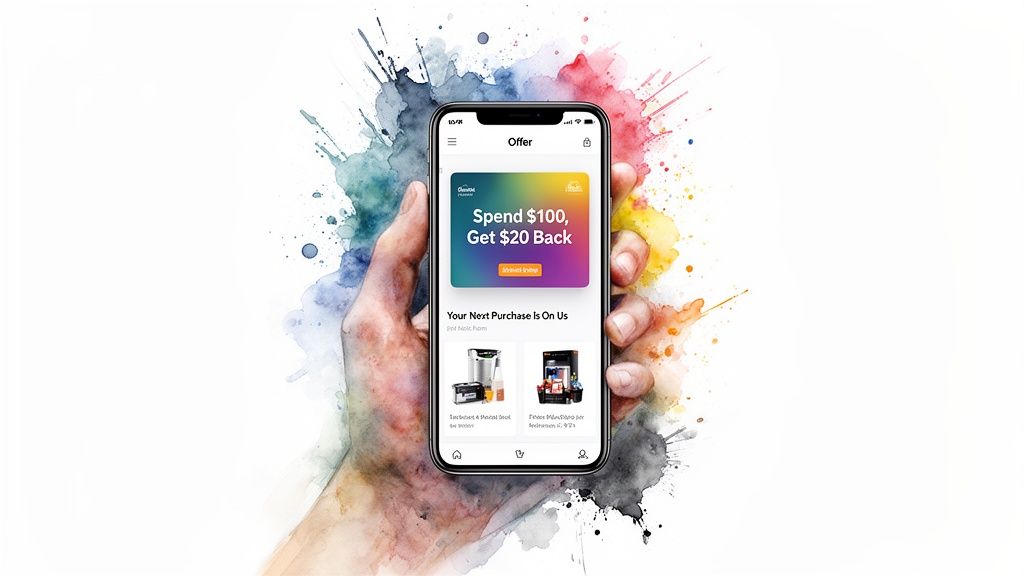
This means you’ve got to ditch those tired, red-and-yellow "SALE" graphics. They just scream desperation. Instead, your visuals and copy need to team up to communicate a sense of smart, elevated value. The real goal here is to shift the customer's mindset from "How much can I save right now?" to "How much am I earning for my next purchase?" This is the key to boosting AOV and LTV.
Showing the Value, Not Just the Discount
Telling people they can earn credit is one thing. Showing them is what makes the offer feel real and genuinely exciting. Your visuals have to instantly connect with that "cash-back" feeling.
Here are a few visual approaches I’ve seen work wonders:
On-Site Wallet Mockups: Don't just talk about credit. Show it. Create a simple graphic that looks like a customer's account on your Shopify store, with the earned native store credit displayed like a cash balance. Seeing “$20.00 Available” hits way harder than a generic coupon code.
Animated Tally Graphics: For video ads, this is gold. Use a simple animation that shows the cart total going up, with a "Credit Earned" counter ticking up right beside it. This visually cements the connection: a higher AOV means earning a bigger reward.
Premium "Cash-Back" Branding: Treat your store credit offer like a VIP program, not a clearance sale. Develop a clean, sophisticated look for it using your brand's colors and fonts. Think exclusive rewards club, not a public fire sale.
These visual cues are everything. They position your offer as a genuine value-add, making customers feel like they're making a savvy investment in their future with your brand. That's the first step toward building much higher lifetime value.
Writing Copy That Frames the Smart Choice
Your ad copy has to be just as intentional as your visuals. The words you choose frame the entire offer. Ditch generic phrases like "Great Deal!" or "Special Offer." We need to do better. Focus your copy on highlighting how smart and exclusive this deal really is.
I've tested a ton of angles, and these formulas consistently deliver:
Angle 1: The "Future Purchase" Hook
Headline: Your Next Purchase Is On Us
Primary Text: Why just buy once? Shop our new collection today and earn $20 in store credit to use on your next order. It's the smarter way to build your wardrobe and increase your lifetime value.
Angle 2: The "Financial Hack" Hook
Headline: The Smart Way to Shop [Your Brand]
Primary Text: Don't just spend—invest. For a limited time, get $20 back in store credit for every $100 you spend. Your future self will thank you.
Angle 3: The "Direct Value" Hook
Headline: Turn Today's Order Into $20
Primary Text: Your cart is waiting. Complete your purchase now and we’ll automatically add a $20 credit to your account for your next visit. No codes, no hassle.
See the common thread? The copy doesn't devalue the product. It elevates the customer. You're positioning them as a savvy shopper who knows how to get more for their money. By focusing on the reward, you encourage a higher initial AOV and plant the seed for that all-important second purchase.
If you want to go even deeper, you can find more on persuasive advertising techniques to really sharpen your copy. This kind of strategic messaging is a cornerstone of a profitable Shopify and Facebook ads program.
Closing The Loop with Store Credit Retargeting
Getting that first sale feels good, but let's be honest—the real money for your Shopify store is made on the second, third, and fourth purchase. That’s how you build a real brand with loyal customers and an enviable Lifetime Value (LTV).
Now, we’re going to build a retargeting loop that actually works. It feels less like a desperate, creepy ad and more like a helpful nudge that customers genuinely appreciate.
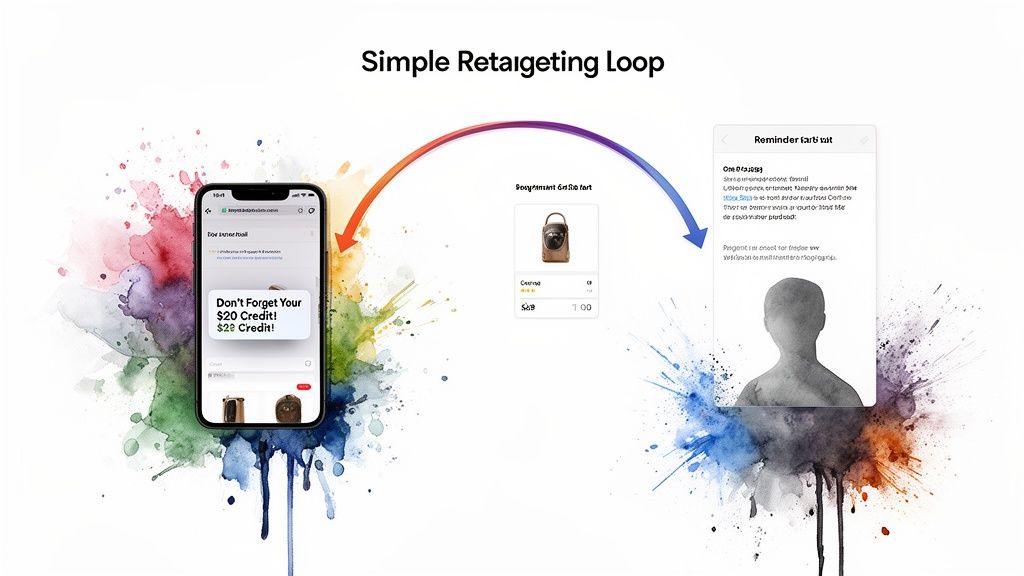
The secret weapon here is moving past basic dynamic product ads. Instead of just showing them the same product they looked at three days ago, you’re going to remind them about the Shopify native store credit they already have. It's a tangible reward that gives them a concrete, compelling reason to come back and shop.
Building Your Store Credit Custom Audiences
First things first, you need to isolate the exact people who need this reminder. Inside Meta Ads Manager, we'll create a Custom Audience of customers who have earned store credit but haven't spent it yet. This laser-focus is what makes the whole thing click.
Since this customer data is sitting in your Shopify store, you’ll need to do a quick export. Most store credit apps, like Redeemly, make this super simple. Just generate a CSV file of all the customers who have an active credit balance.
With that list in hand, head back to Meta and create a "Customer List" Custom Audience. You can now serve hyper-relevant ads only to people with money waiting for them. This isn't just another ad in their feed—it’s a personal alert about value they already own.
Think about it: this is infinitely more powerful than standard retargeting. You're not just saying, "Hey, remember this t-shirt?" You're saying, "Hey, you have $20 waiting for you." That kind of specific message cuts through all the noise and creates an immediate reason to act, boosting your LTV.
Crafting High-Impact Retargeting Campaigns
Once your audience is loaded and ready, it’s time to build the campaign itself. The objective is dead simple: get these customers back to your store by telling them directly about their credit. Make it impossible for them to forget they have free money to spend with you.
Your campaign setup can be pretty straightforward:
Campaign Objective: Go with Sales. We're chasing direct conversions here.
Audience: Select that shiny new "Store Credit Holders" Custom Audience you just made.
Placements: You can start with automatic placements, but I’d keep a close eye on your results. In my experience, Facebook and Instagram Feeds and Stories almost always deliver the best bang for your buck.
This highly targeted setup means every ad dollar is spent on someone who already has a powerful incentive to buy again. You're not trying to find new customers; you're just activating the value you've already created to increase their lifetime value.
Ad Copy That Reminds and Motivates
Your ad copy needs to be direct and to the point. This is not the time to be clever or vague. The customer needs to see the ad and instantly get it.
Here are a few ad copy angles that I’ve seen work wonders for this kind of campaign:
The Direct Reminder:
Headline: Don't Forget Your $20 Credit!
Primary Text: You have store credit waiting in your account. Don't let it go to waste! Use it today on your next favorite find.
The "Money Waiting" Angle:
Headline: You Have Money Waiting
Primary Text: Your recent purchase earned you a credit. Come back and treat yourself—it's already paid for.
The Urgency Play:
Headline: Your Store Credit Is Waiting
Primary Text: Ready for your next order? Your exclusive store credit is in your account and ready to be used. Shop now before you forget!
This isn't complicated, but it’s powerful. You're tapping into a core psychological trigger: loss aversion. People hate losing something they feel they already possess. That credit is theirs, and the thought of it expiring feels like a real loss, motivating them far more than a generic 10% off coupon ever could.
By closing this loop, you turn your Shopify and Facebook ads into a self-sustaining engine for profitable growth, systematically boosting your repeat purchase rate and driving up your LTV.
Thinking about swapping your usual discount codes for a native store credit offer on your Facebook ads? It's a smart move for boosting AOV and LTV, but I get it—it can also feel like a leap into the unknown.
You're right to have questions. This isn't just a small tweak; it changes how you think about your ad performance, cash flow, and overall customer value. I've guided countless Shopify stores through this exact transition, so let's walk through the most common concerns I hear and get you the clear, practical answers you need.
How Do I Actually Measure the LTV Impact of My Store Credit Ads?
First thing's first: you have to look beyond the Meta Ads Manager. The initial ROAS is only chapter one. The real story of your success unfolds inside your Shopify Analytics.
The trick is to isolate and compare customer groups. It’s a simple but powerful way to see what’s really working.
Here’s how you do it:
Create a new customer segment for everyone who made their first purchase through one of your new store credit campaigns. Use the UTM tags from your ads to make this easy.
Next, create another segment for customers you acquired with your old discount-based ads during a similar timeframe.
Now, pit them against each other. Watch these two groups over the next 30, 60, and 90 days. You’re looking for two things: the average customer lifetime value and the average orders per customer.
This direct comparison will give you undeniable proof. More often than not, you'll see the store credit group pulling away with more repeat purchases and a higher overall spend, validating the entire strategy.
Is Native Store Credit Really Better Than a Points Program for Ad Offers?
For grabbing a new customer from a paid ad? Absolutely, and it’s not even close. When someone is scrolling through their feed, simplicity and clarity win every single time.
A $10 store credit is an offer anyone can understand in a split second. It’s real value. There’s no mental gymnastics required. In contrast, "Get 100 points!" makes people pause and think, "Okay, but what's a point worth? How much do I have to spend to use them?" That tiny moment of hesitation is all it takes to lose the click and a potential high-LTV customer.
A native store credit system, like the one Redeemly adds to Shopify, feels seamless. The credit applies right at checkout like a gift card, making the reward feel instant and valuable. That clarity is why it's a much stronger hook for your Facebook ad campaigns.
Points systems can be great for building long-term loyalty with existing fans, but for turning a cold prospect into a first-time buyer with a high AOV, the instant gratification and simplicity of native store credit is your best bet.
Will Offering Store Credit Hurt My Short-Term Cash Flow?
This is probably the biggest fear I hear from merchants, but the reality is the exact opposite. Native store credit actually protects your immediate cash flow and gives you much healthier unit economics from day one.
Think about it. A 20% discount is an immediate hit to your revenue and margin. You get 20% less cash in your pocket on that very first sale.
Store credit completely flips the script. Your customer pays full price on their first order, maximizing your upfront cash and Average Order Value. The credit you issue is just a liability on your books until the customer comes back and uses it. You’re essentially front-loading your cash and deferring the "cost" of the offer to a future purchase—a second purchase that boosts LTV and that you might never have gotten otherwise.
What Kind of ROAS Should I Expect From These Campaigns?
You need to start thinking about your Return on Ad Spend (ROAS) in two stages: your immediate ROAS and your blended, lifetime ROAS.
On day one, your first-purchase ROAS might look pretty similar to your old discount campaigns. The key difference you'll notice right away, however, is a higher AOV since people are buying at full price to earn that credit.
The real win comes when you look at your 60 or 90-day LTV:ROAS. This is where the magic happens.
Because you’re systematically encouraging that second purchase, the total revenue you generate from that one initial ad click grows dramatically. A campaign that starts with a decent 1.8x ROAS on the first sale can easily climb to a 3x blended ROAS or higher once those customers return to spend their credit. This is how you build a truly profitable and scalable ad account—by investing in customers who come back again and again.
Ready to stop burning through your margins with endless discounts? Redeemly makes it incredibly simple to launch a native store credit program on Shopify that's built to boost both AOV and LTV from your very first campaign. Find out how it works at Redeemly.ai.
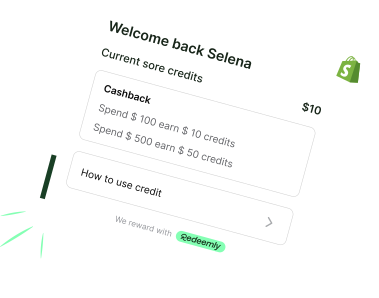


Join 7000+ brands using our apps