Increasing Customer Loyalty With Shopify Store Credit
Feb 18, 2026
|
Published
If you want to truly increase customer loyalty, you need to create a rewarding experience that doesn't simultaneously devalue your brand. The best way to do this is to get away from the endless cycle of discounts and overly complicated points systems.
Instead, the focus should be on Shopify native store credit—a simple, cash-like reward that gives customers a real reason to come back and spend more. It’s a powerful tool for boosting lifetime value (LTV) and average order value (AOV) without killing your margins.
The Hidden Costs of Discounts and Points
For years, merchants have leaned on two main tools to keep customers coming back: discount codes and points-based programs. On the surface, they seem to work. But dig a little deeper, and you'll find they often trap brands in an unprofitable loop that can erode margins, cheapen your products, and ultimately create a frustrating experience for everyone.
Think about it. Constant discounting just trains your customers to wait for the next sale. Why would they ever buy at full price when they know a 15% or 20% off coupon is just around the corner? This behavior absolutely crushes your margins, lowers the perceived value of what you sell, and decimates your average order value over time.
The Problem With Confusing Point Systems
Points systems aren't much better. They introduce a layer of friction that most customers don't have the patience for. Suddenly, your shoppers have to become mathematicians, trying to figure out, "How many points do I need for a dollar off?" or "What convoluted thing do I have to do to earn them?"
This confusion almost always leads to apathy. When the path to a reward is a confusing mess, people just stop caring. Your loyalty program sits there, unused and completely ineffective at increasing lifetime value.
The real problem is that both discounts and points programs build a transactional relationship, not a relational one. They're all about cheapening the immediate sale instead of investing in the customer's long-term value.
This is a trap I see brands fall into all the time. They focus so much on the next conversion that they forget about the bigger picture: building a sustainable business on the back of repeat, high-LTV customers.
This visual really breaks down the core issues with these common loyalty tactics.
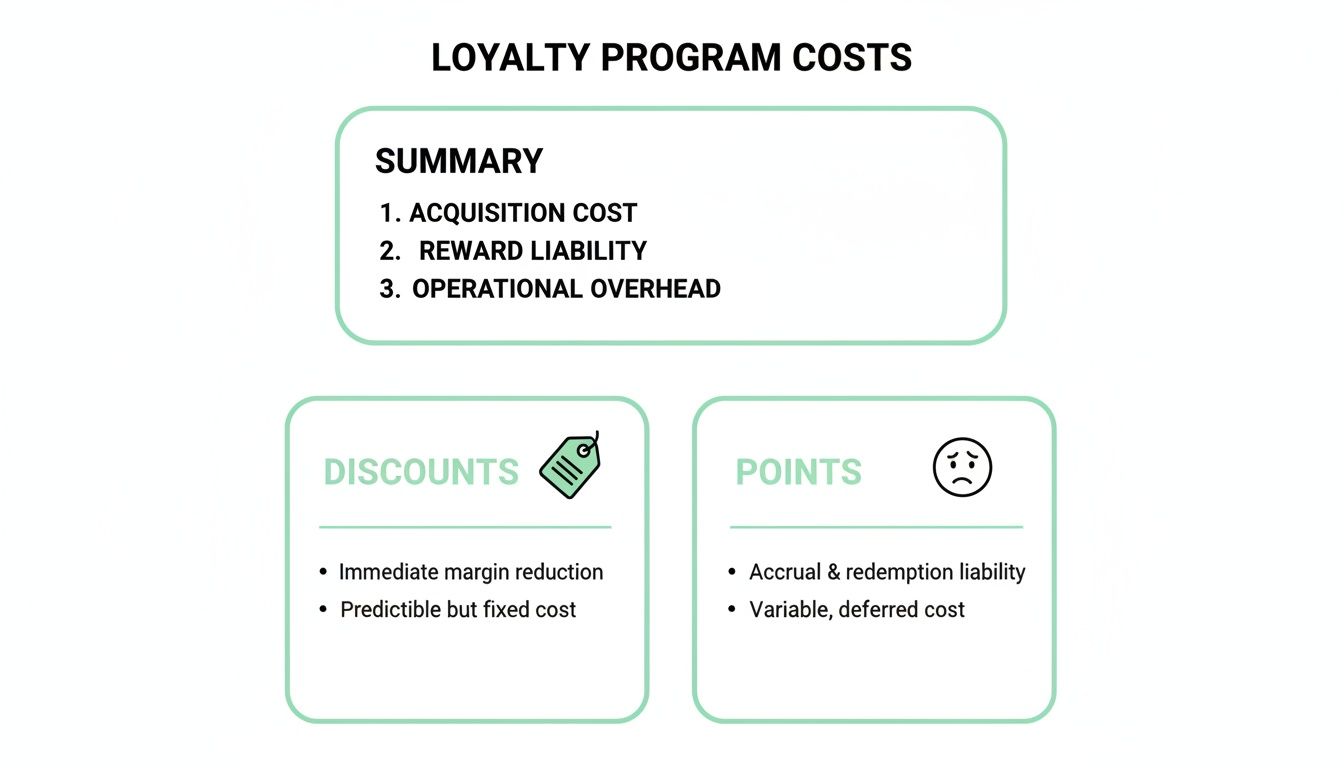
As you can see, both discounts and points come with some serious hidden costs that hit everything from your profit margins to your customers' motivation. The goal is to build something better that focuses on lifetime value.
Shifting Focus to Lifetime Value (LTV)
The smartest brands I work with are all realizing the same thing: retention is the new acquisition. In such a competitive market, increasing customer loyalty is the single best way to boost lifetime value without having to slash your prices.
The numbers back this up, too. On average, a massive 51.5% of total marketing budgets are now being funneled into loyalty and CRM. That's a huge shift. You can read the full research about these loyalty trends to see just how big this movement is.
Once you understand the real costs of these outdated loyalty models, you can start building a system that creates genuine value—for your customers and for your bottom line. If you're curious about the numbers, you might want to check out our guide on understanding customer retention costs. It’s eye-opening to see just how expensive it is to constantly chase new shoppers.
Store Credit vs Discounts vs Points Programs
So, how do these three models really stack up against each other? I've put together a quick comparison to show the practical differences in how they affect your business, from profit margins to the customer's experience.
Attribute | Store Credit | Discount Codes | Points Systems |
|---|---|---|---|
Profit Impact | Protects margins by keeping spend in-house. | Directly erodes profit on every transaction. | Can be complex to model; often devalues over time. |
Customer Experience | Simple and intuitive. Feels like real money. | Easy to use but encourages deal-hunting behavior. | Confusing and high-friction. Requires mental math. |
Brand Perception | Premium. A reward for loyalty. | Transactional. Can devalue the brand over time. | Gamified, but often feels disconnected from real value. |
Repeat Purchase | High incentive to return and use the credit. | Encourages one-off purchases during sales. | Low incentive unless the reward threshold is clear and low. |
Lifetime Value (LTV) | Directly boosts LTV by driving repeat business. | Can lower LTV by training customers to wait for sales. | Unpredictable impact on LTV due to complexity. |
Looking at them side-by-side, it becomes clear why store credit is often the more sustainable, brand-aligned choice. It shifts the focus from a one-time transaction to building a lasting, profitable relationship with a high lifetime value.
Why Store Credit Unlocks Real Customer Loyalty
Let's get real for a minute. For years, we’ve been told that discounts are the key to driving sales. But what if that’s a half-truth that's slowly killing your margins and training your customers to wait for the next big sale?
The truth is, increasing customer loyalty isn't about temporary price cuts. It's about giving customers a real, tangible reason to come back. This is where a native Shopify store credit program doesn't just change the game—it changes the entire playing field, putting the focus squarely on lifetime value.
Think about it. A discount code immediately devalues your product. It’s a fleeting transaction. But store credit? That feels like real money just sitting in your customer's digital wallet, waiting to be spent. It creates a powerful psychological pull, transforming a one-off bargain hunt into the beginning of a long-term, high-LTV relationship.
Protecting Your Margins and Boosting AOV
Here's where the magic really happens for your bottom line. A discount is a direct hit to your profit on the current sale. It's money you'll never see again. Store credit, on the other hand, only becomes a cost on a future purchase—a purchase that likely wouldn't have happened without that credit sitting there.
You’re not just giving away profit; you’re strategically investing it to guarantee the next sale and boost customer lifetime value.
This model also does wonders for your average order value (AOV). Picture this: a customer is close to your free shipping threshold or a reward tier. When they see they can earn $10 in credit just by adding one more small item to their cart, what do you think they'll do? They spend a little more to get more value back. It’s a win for them and a massive win for your unit economics.
Store credit flips the script on rewards. Instead of eroding the value of the current sale with a discount, you're adding exciting value to the next one. This simple shift creates a sustainable engine for repeat business and higher lifetime value.
Fostering Genuine, Lasting Loyalty
Ultimately, this is about getting off the frantic, exhausting treadmill of constant promotions. A Shopify native store credit system builds a foundation for genuine loyalty because it’s refreshingly simple, transparent, and just feels fair.
Customers get it instantly. $1 in credit equals $1 to spend. No confusing points-to-dollars math, no abstract conversion rates. Just clean, clear value.
This clarity is what drives real engagement and a much stronger emotional connection to your brand. A customer with a credit balance feels like an insider, someone with a vested interest in your store. It’s a completely different dynamic that directly feeds into higher lifetime value.
This system nails three critical goals for long-term, sustainable growth:
Drives Repeat Purchases: That credit balance is a gentle, constant reminder to come back and shop again.
Increases Lifetime Value (LTV): By locking in those second, third, and fourth purchases, you'll see the total value of each customer skyrocket over time.
Enhances Brand Perception: Rewards start to feel like a premium perk, not a desperate plea for a sale. This instantly elevates how customers view your brand.
By ditching the discount addiction, you start building a more profitable, predictable revenue stream. And it's built on the best foundation there is: a loyal base of customers with high lifetime value.
How to Design a Store Credit Program That Actually Makes You Money
Let's get one thing straight: a store credit program isn't about giving away free stuff. It's a strategic move, a calculated investment in getting customers to spend more, come back more often, and increase their lifetime value. The magic happens when you design a system that feels like a huge win for your customers but is secretly a profit-driver for you.
The foundation of a great program is structuring your rewards to directly bump up your average order value (AOV). This means keeping it dead simple. If a customer has to pull out a calculator to figure out your points system, you've already lost. They need to get it in a heartbeat.
The most effective model I've seen time and again is the classic "spend-and-get." It's direct, easy to understand, and incredibly persuasive.
Spend $75, get $5 in credit
Spend $100, get $10 in credit
Spend $150, get $20 in credit
See what’s happening here? You’re dangling a carrot, nudging shoppers to add just one more thing to their cart to hit that next tier. It turns a simple transaction into a mini-game, and it's a game where everyone wins. They get a future discount, and you get a higher AOV right now. This directly contributes to a higher lifetime value.
Naming and Messaging: It's All in the Frame
How you talk about your program matters just as much as the rewards themselves. Please, don't just call it "Loyalty Program." That's boring and has been done to death. You need to create a brand around it, something that makes customers feel like they're joining an exclusive club.
Get creative with names that suggest insider status and real value:
The Brand Insider Fund
The Collective Cash
VIP Vault
Your on-site messaging needs that same punch. Instead of a bland "Earn Rewards," hit them with something that feels immediate and valuable, like "Get $10 Back on This Order." It reframes the benefit from a future possibility to a current gain.
The real trick is to position store credit as cash back, not points. This is a crucial psychological shift. It makes the reward feel like a tangible monetary asset—real money they've earned and would be foolish to waste.
This simple change in perception is what drives repeat purchases. A customer sitting on a $10 credit feels like they have cash to spend. Someone with 500 abstract "points"? Not nearly as compelling.
Make Your Offer Impossible to Ignore
Your shiny new program can't be buried on some forgotten corner of your website. If people don't see it, it doesn't exist. You have to weave it into the very fabric of the shopping experience.
This is where on-site widgets and banners are your best friends. Plaster those reward tiers everywhere—on product pages, in the cart, you name it. When a shopper sees a message like, "You're only $15 away from earning $10 in credit!" it creates an almost irresistible urge to close that gap.
This constant visibility is what turns a passive program into an active AOV-booster on every single visit. By putting it all together—clear tiers, smart messaging, and in-your-face visibility—you're not just rewarding loyalty. You're building it from the ground up, creating a profitable engine that gives customers a powerful reason to choose you over and over again.
Getting Your Program Live on Shopify
You've got the strategy nailed down. Now, let's talk about the execution, because that's what separates a good idea from one that actually makes you money. The best part? Launching a store credit program on Shopify doesn't mean you need a team of developers or a month-long integration project. A native Shopify app gets you from zero to launch in minutes.
These native apps are built to live inside the Shopify ecosystem. That means no heavy, site-slowing scripts like you often get with clunky, third-party platforms. Simplicity and speed are everything here. Nothing will kill your program's momentum faster than a laggy widget.
Dialing in the Rules and On-Site Experience
Once you've picked your native Shopify app, the setup is surprisingly simple. You'll start by plugging in the core reward rules you just mapped out—think "Spend $100, Get $10" tiers. From there, it's all about customizing the on-site experience to make your program impossible for shoppers to miss.
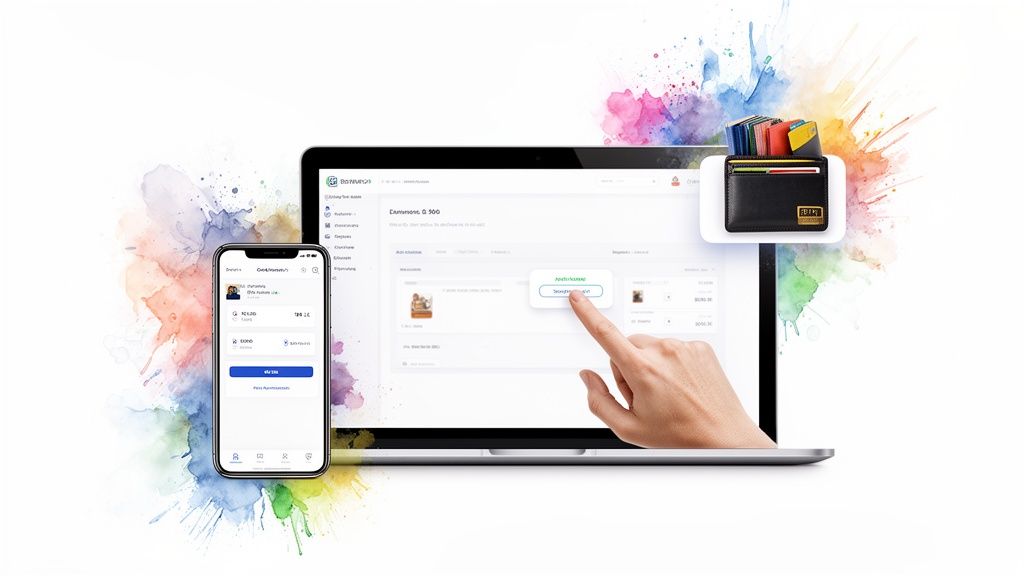
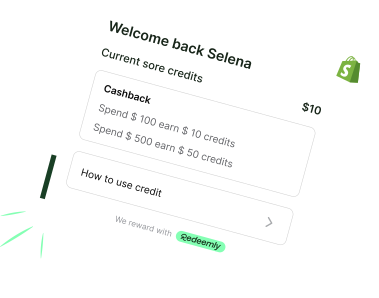
A floating wallet widget is non-negotiable. This is the small icon that sits on the corner of the screen, giving customers a constant, one-click view of their credit balance. It's a powerful psychological trigger, turning an abstract "reward" into tangible cash they can't wait to spend. This is how you weave loyalty into the very fabric of the shopping journey.
You can see just how clean and simple a native Shopify app like Redeemly is.
Everything you need is right there in your Shopify admin dashboard. It feels less like a bolted-on tool and more like a natural part of your store's operations.
Your Proven Pre-Launch Checklist
A great launch isn't about quietly flipping a switch. It's about building buzz and getting people excited to participate from the get-go. Before you go live, you need a communication plan that makes your customers feel like they're being let in on a fantastic new secret. For a smooth rollout, you'll also want a clear guide on how to give store credit on Shopify to handle the operational details.
Here’s a simple checklist I've seen work time and time again for a powerful launch:
Email Your List: Draft an announcement email that explains the new program. Frame it as an exclusive perk just for them. Emphasize how simple it is—no confusing points, just real dollars back.
Build Hype on Social: A few days before launch, start a countdown on your social channels. Share visuals of the wallet widget and use quick, punchy copy to explain the value.
Update Your Homepage Banner: This is your most valuable on-site real estate. Use it. Create a bold banner announcing the new rewards program and link it to a simple landing page that breaks down all the benefits.
Prep Your Support Team: Your customer service reps are on the front lines. Make sure they know the program inside and out so they can answer questions confidently and get customers excited.
Marketing Campaigns That Drive Repeat Purchases
Your store credit program isn't just a backend loyalty feature—it's a high-octane marketing engine waiting to be fired up. But like any engine, it needs fuel. To really start moving the needle on customer loyalty and lifetime value, you have to actively remind people about the value sitting in their accounts, giving them irresistible reasons to come back and spend it.
The goal is to transform your program from a passive perk into a proactive driver of repeat sales and higher LTV. This all comes down to a smart communication strategy using email and SMS to keep that store credit balance top-of-mind. Think of it as a gentle, persistent pull that brings customers back for their second, third, and fourth purchases.
Email Flows That Turn Credit Into Cash
Automated email flows are your secret weapon here. Forget one-off email blasts. Instead, you can set up smart triggers that send the perfect message at the perfect time, nudging customers back to your store exactly when they're most likely to buy again.
Here are a few must-have automations:
The Post-Purchase Nudge: Right after a customer earns credit, hit their inbox with a confirmation. But don't just state the balance. Frame it as a head start on their next order. Something like, "You've got $10 waiting for you!" makes the value feel real and immediate.
The Expiration Reminder: A little urgency goes a long way. A friendly heads-up that their credit is expiring in 30 days can be the perfect push they need to come back and browse. It's a classic for a reason—it works.
The "New Arrivals" Pairing: This one is a killer combo. Announce a new product drop and remind them of their credit balance in the same email. The message becomes incredibly compelling: "Check out our new summer line—and don't forget you have $15 in credit to put towards it."
A customer's store credit balance is an asset you've both invested in. Don't let it sit idle. Your marketing should treat it like cash in their pocket, constantly reminding them of the value they'd be foolish to ignore.
Using SMS For Instant Impact
Email is great for telling a story, but SMS is your tool for quick, punchy reminders that get immediate attention. A well-timed text can bring a customer back to your site within minutes, especially if they already know and love your brand.
For example, a simple message like, "Hey Sarah, just a reminder you have a $10 credit in your wallet at The Good Co. Perfect time to grab that new candle you were eyeing! 😉" feels personal and actionable. This direct line is priceless for driving impulse buys powered by their existing credit.
Store Credit Campaign Email Templates
To get you started, here are a few plug-and-play email templates for the automations we just covered. Tweak them to match your brand's voice and watch your credit redemption rates climb.
Campaign Trigger | Subject Line Idea | Core Message |
|---|---|---|
Credit Earned | You've got cash waiting! Your $10 credit is here. | Congrats! You've just earned $10 in store credit from your recent purchase. It's already in your account, ready for your next order. Think of it as a head start on something new! |
30-Day Expiration | Don't let your $15 credit disappear! | Just a friendly heads-up! Your $15 store credit is set to expire in 30 days. Come find something you'll love before it's gone. |
New Product Launch | Our new collection is here (+ you have credit!) | The moment you've been waiting for... our new arrivals just dropped! And the best part? You have $20 in credit waiting to be spent. See what's new and treat yourself. |
Win-Back Campaign | We miss you! Here's $5 to come back. | It's been a while! We've added $5 in store credit to your account as a little welcome-back gift. We hope to see you again soon. |
These templates are just a starting point. The key is consistent, helpful communication that makes customers feel valued and smart for shopping with you.
Turning your loyalty program into a true marketing channel is one of the most effective Ecommerce Growth Strategies focused on both revenue and retention. By doing this, you create a sustainable cycle that directly boosts lifetime value and keeps your brand right where you want it: front and center in your customer's mind.
Measuring Success and Optimizing for LTV
So, you’ve built a killer store credit program. That’s a huge first step. But the real magic happens when you can prove it’s actually boosting your lifetime value (LTV) and not just a cost center. You can't just set it and forget it.
The good news is that a native Shopify store credit system cuts through the noise. No more guessing if a discount code really brought someone back or trying to figure out the ROI on a confusing points system. We’re going to focus on clear, hard numbers that tell the story of your customer loyalty.
Defining Your Core Loyalty KPIs
Let’s be honest, vanity metrics don’t pay the bills. Your success hinges on a few core KPIs that tie your store credit program directly to your bottom line, specifically your LTV and AOV.
Repeat Purchase Rate: This is ground zero for loyalty. Are customers who get store credit coming back to buy again more often than those who don't? A solid lift here is the clearest signal that your program is hitting the mark.
Average Order Value (AOV): Watch the basket size like a hawk. You want to see AOV climb, both for new customers trying to hit that credit threshold and for returning shoppers spending their balance. A higher AOV is a direct input to higher LTV.
Time Between Purchases: A great program shortens the buying cycle. When a customer has a credit balance sitting in their account, they have a real, tangible reason to come back sooner. If this number starts to drop, you know you're creating a sense of urgency.
Think of these KPIs as your program's dashboard. They give you the real-time feedback you need to see what's working and what needs a little tweaking.
The Ultimate Metric: Customer Lifetime Value
While those KPIs give you a great snapshot, the long-term play is all about increasing customer lifetime value (LTV). This is the total amount of money you can expect to make from a single customer over their entire time with your brand. A store credit program is built from the ground up to push this number higher.
Every time you drive a repeat purchase or nudge AOV up, you're extending the value of that customer relationship. For a deeper dive, understanding how to approach measuring marketing campaign effectiveness is crucial.
LTV is the north star for any retention strategy. It proves you're not just creating one-time transactions but are building a sustainable, predictable revenue stream from a loyal customer base.
Ready to take it a step further? Start A/B testing your offers. Does "Spend $100, Get $10" outperform "Spend $120, Get $15"? Dig into your Shopify analytics to see which one delivers the best blend of AOV and conversion, then put your money behind the winner. Small, continuous optimizations like this are what turn a good loyalty program into an absolute powerhouse for increasing LTV.
To get started, check out our guide on how to calculate customer LTV and begin making smarter, data-driven decisions today.
Got Questions? We've Got Answers
Switching up your loyalty strategy is a big move, and it's natural to have questions. Here are the most common ones we hear from Shopify merchants who are thinking about moving to a native store credit program to build real, profitable customer loyalty.
Isn't a Points System Just as Good?
Honestly, for most Shopify stores, the answer is a hard no. The beauty of store credit is its simplicity. $10 in credit is worth exactly $10. There’s no mental gymnastics, no confusing conversion rates—just straightforward value your customers can instantly understand.
This kind of clarity is incredibly motivating. It pushes customers to actually use their rewards, which is what drives up your average order value (AOV) and repeat purchase rate. While massive, enterprise-level brands might have the resources to run complex points programs, the sheer simplicity of native store credit is a huge win for most direct-to-consumer businesses.
What About My Profit Margins? Is This Just Another Discount?
This is the best part. Store credit is so much healthier for your margins than slapping a 20% discount on everything. A discount is an immediate, painful cut to your profit on that single sale.
But with store credit, you only incur the cost when a customer comes back to make a second purchase. The entire model is built to encourage that next sale, directly boosting lifetime value (LTV).
You're not just giving away profit on a one-time transaction. Instead, the cost is strategically tied to the very action you want to encourage: repeat business with a higher average order value. It's a much smarter way to protect your upfront revenue.
Will Adding Another App Slow Down My Site?
Not if you’re smart about the tool you choose. The key is to use a native Shopify app. These are built directly on Shopify’s infrastructure, meaning they’re incredibly lightweight and optimized for performance.
Many third-party loyalty platforms rely on heavy, external scripts that can absolutely wreck your page load times and create a clunky user experience. A native solution gives you all the power of a sophisticated rewards program without ever compromising your site speed.
Ready to ditch the discounts and confusing point systems? Start building loyalty that actually pays off. See how Redeemly can reshape your retention strategy with a simple, native Shopify store credit program designed to boost AOV and LTV.


Join 7000+ brands using our apps