Unlocking Increased Customer Loyalty With Shopify Store Credit
Feb 14, 2026
|
Published
For years, brands have leaned on discount codes and complex point systems to goose sales. We've all done it. But let's be real—it's a short-term sugar high that erodes brand value and profit margins. The endless cycle of coupons brings in one-time deal hunters, not the kind of loyal customers who build a sustainable business with high lifetime value (LTV). If you want to build increased customer loyalty, you must create a strategy that rewards repeat business and boosts average order value (AOV), not just slash prices.
Why Your Discount Strategy Is Limiting Growth
The constant pressure to offer discounts feels like a race to the bottom, doesn't it? A quick 20% off coupon might bump your sales for a weekend, but it comes at a steep cost. You aren't just giving up profit; you're teaching your customers that your products aren't worth full price. You're training them to wait for the next sale, which is a direct hit to your customer lifetime value.
This behavior chips away at your brand equity and makes forecasting revenue a nightmare. It’s a cycle that primarily attracts bargain shoppers with zero allegiance to your brand. They buy once and vanish, doing almost nothing for your LTV. A smart loyalty strategy should do the exact opposite: rewarding repeat business and encouraging your best customers to spend more, thereby increasing their lifetime value.
The Hidden Costs of Coupons and Points
The problems with old-school loyalty models run deep, directly impacting your ability to grow lifetime value.
Discount codes are a direct hit to your revenue on every single transaction, making it incredibly difficult to maintain healthy margins. On the other hand, those complicated point systems create a whole different kind of headache. They're often confusing, forcing customers to do mental math to figure out what their points are actually worth. The result? Low engagement, even lower redemption rates, and no meaningful impact on LTV or AOV.
Both of these methods feel transactional, not relational. They don't build a genuine, lasting connection. Instead of fostering loyalty, they just create a dependency on the next incentive.
The real problem is that discounts reward the transaction, not the customer. An effective loyalty program using Shopify native store credit flips that script. It makes your best customers feel valued, which is what actually drives higher average order value and lifetime value.
The chart below breaks down exactly how different loyalty models stack up when it comes to the metrics that matter.
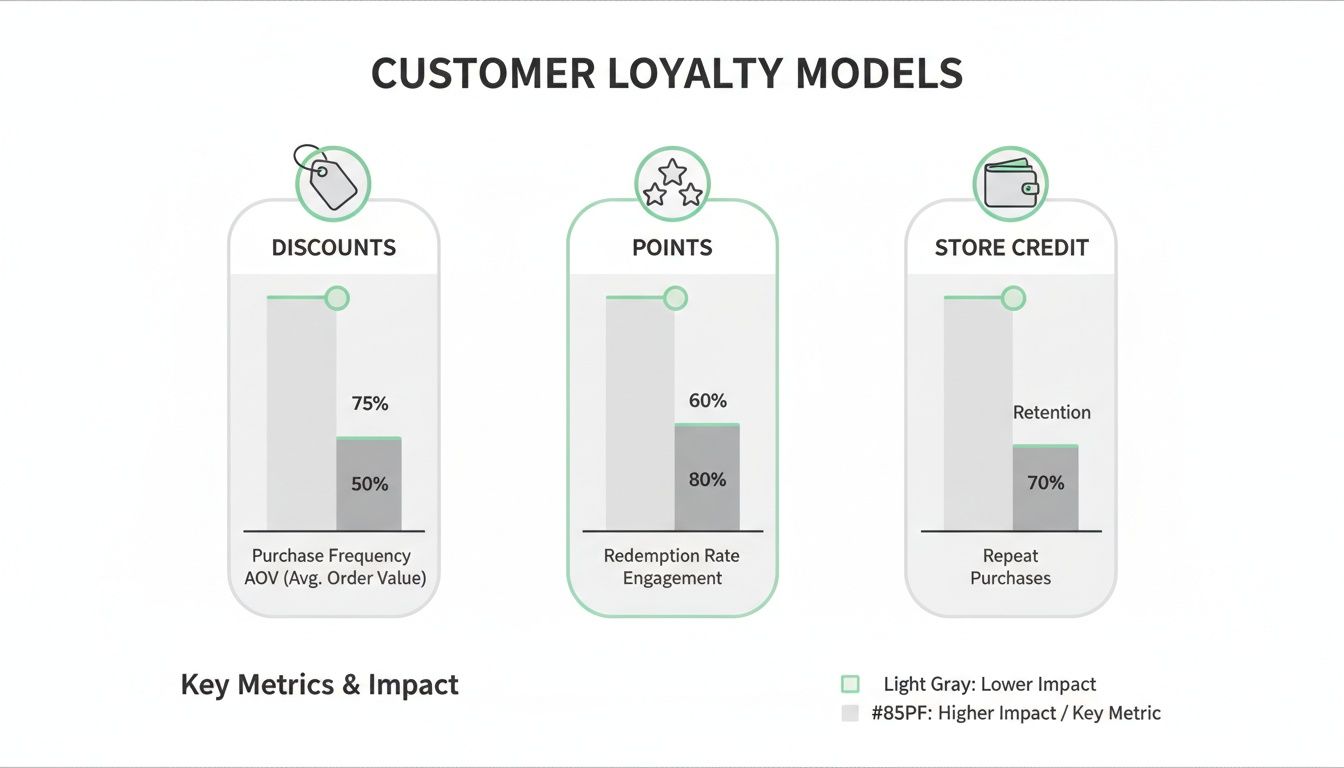
When you look at the data, it's clear: store credit consistently beats discounts and points by directly boosting metrics like LTV and AOV, all while protecting your precious margins.
Comparing Loyalty Models: Discounts vs. Points vs. Store Credit
To really see the difference, it helps to put these models side-by-side. Each one has a drastically different effect on your bottom line and your ability to increase customer lifetime value.
Metric | Discount Codes | Complex Points Systems | Shopify Store Credit |
|---|---|---|---|
Profit Margins | Directly reduces revenue per sale; trains customers to expect lower prices. | Can be margin-friendly, but complexity often leads to low redemption ("breakage"). | Protects margins; credit is applied to a future full-price purchase. |
Customer LTV | Attracts one-time bargain hunters, leading to low repeat purchase rates and LTV. | Can increase LTV if customers engage, but friction often limits its impact. | Significantly boosts LTV by creating a strong incentive for the next purchase. |
Average Order Value (AOV) | No direct impact; customers often buy the minimum to use the code. | Minimal impact; rewards are often too small to encourage larger cart sizes. | Increases AOV as customers "spend up" to use their full credit balance. |
Customer Experience | Simple and immediate, but feels impersonal and transactional. | Often confusing and frustrating; customers have to track and convert points. | Feels like cash in hand; simple, intuitive, and creates a positive feedback loop. |
The takeaway here is pretty clear. While discounts offer a quick fix and points try to gamify loyalty, Shopify native store credit provides a sustainable, margin-friendly model that genuinely encourages customers to come back and spend more, directly increasing their lifetime value.
A Smarter Path to Loyalty
There's a much better way forward. It's time to shift your focus from cutting prices to building real, measurable value with Shopify native store credit.
Unlike a one-off discount that's forgotten moments after the purchase, store credit is a powerful, lingering incentive for a customer's next purchase. It feels like real money sitting in their account, creating a psychological pull to come back and spend it. This simple change turns your retention strategy from a cost center into a powerful engine for LTV growth.
By focusing on rewards that don't kill your margins, you can build a truly loyal customer base. If you want to dig deeper, we've broken down more on how to improve profit margins while still delighting your customers.
Why Store Credit Just Feels Different (And Works Better)
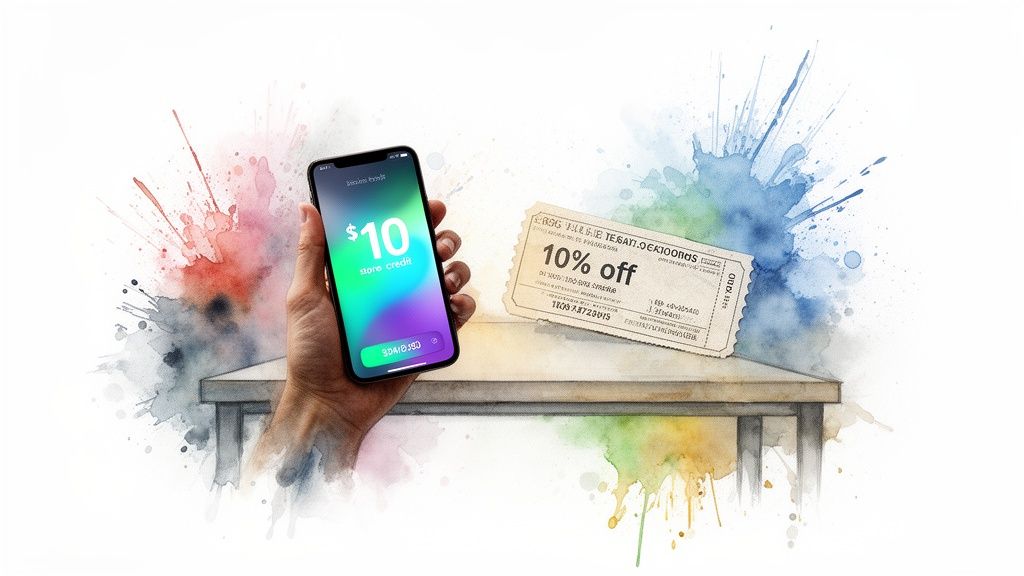
Ever noticed how a $10 store credit feels more exciting than a 10% off coupon? It’s not your imagination. There's some fascinating behavioral science behind this. At its core, Shopify native store credit taps into powerful psychological triggers that typical discounts and confusing points systems often miss entirely.
It really boils down to something called cash equivalency. When a customer sees a $15 credit sitting in their account, their brain doesn't file it away as a coupon or some abstract reward. It perceives it as their own money just waiting to be spent in your store. That simple shift in perception is a huge driver for getting them to come back and increase their lifetime value.
It’s Not a Coupon, It’s Their Money
This feeling gets even stronger thanks to a principle known as mental accounting. We all do this—we mentally separate our money into different buckets. A store credit balance gets put into a special "shopping at your brand" bucket. It's not just a random discount; it’s a specific fund earmarked for their next purchase with you. This creates a tangible, real incentive that a percentage-off deal just can't match.
Think about it. Unlike a complicated points system where someone has to figure out "what is 100 points even worth?", store credit is dead simple. There's no mental gymnastics, no friction. Just a clear dollar amount ready to go. That clarity is exactly what you need to drive repeat purchases and boost your customer lifetime value.
A discount feels like saving money, which is a fleeting moment. A store credit balance feels like having money, which creates a constant, nagging reminder to come back and spend it, driving up lifetime value.
Giving Customers What They Actually Want
If you want to understand customer motivation, just look at the data. A recent report found that 7 in 10 consumers join loyalty programs for one primary reason: to save money. They're looking for direct, financial benefits, not a confusing game of collecting points. Store credit delivers exactly that—a clear, cash-like reward.
The same study also revealed that while 56% of consumers feel valued by loyalty programs, a whopping 75% would jump ship for a better one. This tells us there's a huge opportunity to stand out with a simple, effective strategy. You can dive deeper into these findings by checking out the full report.
When you make that credit balance a highly visible part of the customer account, you're not just simplifying the reward—you're keeping your brand top of mind. It’s a constant, gentle nudge that they have value just waiting for them. This does more than just push another sale; it builds the kind of reciprocal relationship that turns one-time buyers into high LTV customers.
Shaping Your Program to Drive Up AOV and LTV
Turning the psychology of store credit into real revenue comes down to how you design your program. You need a system that actively shapes what customers do from the moment they land on your site. Forget just rewarding past purchases—a smart store credit program gets people to spend more right now, paving the way for a much higher customer lifetime value.
The real goal here is to stop thinking of rewards as an afterthought and start using them to influence the initial sale. This is where strategic campaigns become your secret weapon for bumping up your average order value (AOV) and getting customers to stick around for the long haul.
Set Up Strategic Spend Thresholds
One of the most powerful plays you can run is a classic "spend and get" campaign using Shopify native store credit. This isn't about just handing out credit. It's about setting a specific spending target that encourages shoppers to toss one more item in their cart.
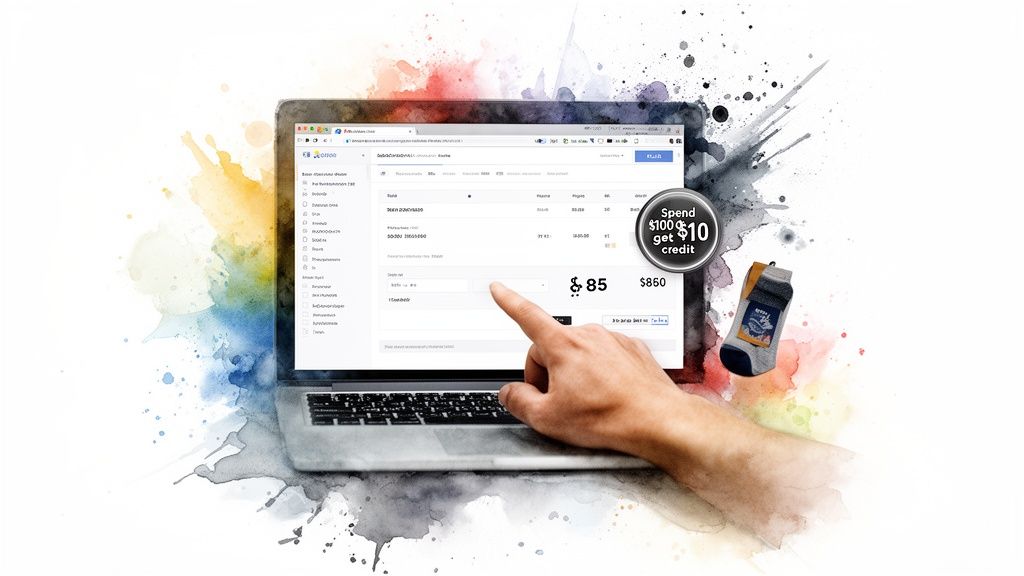
Picture this: a customer is sitting with an $85 cart. If you offer a generic 10% off coupon, you’re just slicing your own margin on that sale. But watch what happens when you reframe the deal.
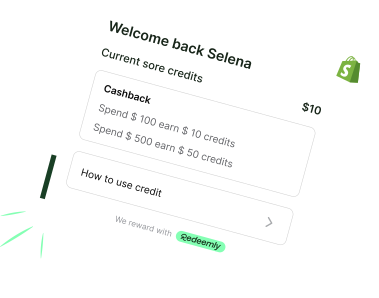
The Offer: "Spend $100 and get $10 in store credit."
All of a sudden, the customer isn’t thinking about the $8.50 they’d save. Their mind jumps to the $15 gap they need to bridge to unlock a $10 reward for later. This simple shift is often all it takes to get them browsing for one more thing, pushing their cart over the line and giving your average order value an instant lift. If you're wondering how to get this running, we've got a whole guide on how to give store credit on Shopify.
A well-placed spending threshold doesn't just reward a purchase; it actively increases its value. You're not just giving a customer a reason to come back later—you're giving them a reason to spend more today, boosting both AOV and future LTV.
Of course, to truly increase customer loyalty, this needs to fit into your wider strategy. A cohesive approach ensures every customer touchpoint works together to keep them coming back.
Make Their Rewards Impossible to Ignore
Earning the credit is just half the battle. If you want your program to actually drive repeat business and increase LTV, those rewards have to be front and center. A forgotten balance has zero power to bring a customer back.
This is where your on-site experience is absolutely critical. You have to weave reminders of their credit balance throughout their entire shopping journey. Think about it from their perspective.
Floating Wallet Widgets: Imagine a small, slick widget that follows them as they browse, always showing their available credit. It’s a constant, gentle nudge.
On-Page Reminders: Place banners or text right on product and collection pages. A simple "You have $10 to spend!" keeps the reward top-of-mind while they’re deciding what to buy.
Checkout Notifications: This is your last chance. A clear, unmissable display of their balance right at checkout makes applying it completely frictionless.
By baking the store credit balance into your site experience, you turn it from a passive perk into an active, compelling reason to buy. That visibility is what makes the credit they earned on their first purchase the driving force behind their second, locking in that profitable LTV loop.
Automating Campaigns to Drive Repeat Purchases
Handing out store credit is a great first step, but the real magic happens when you actively remind customers to come back and actually use it. Earning that balance is only half the battle; getting them to redeem it is how you truly lock in their loyalty and see your customer lifetime value climb.
This is where automated email and SMS campaigns become your secret weapon for retention.
Instead of just crossing your fingers and hoping customers remember they have a balance, you can build simple, automated flows that consistently pull them back to your store. This strategy transforms their earned credit from a forgotten perk into a compelling reason for their next purchase, creating a reliable cycle of repeat business that directly boosts LTV.
Crafting the Perfect "Credit Is Waiting" Campaign
The most effective reminder campaigns are timely, crystal clear, and make spending that credit feel completely effortless. A customer's motivation to use their credit is highest right after they've earned it, so your automation needs to capitalize on that window.
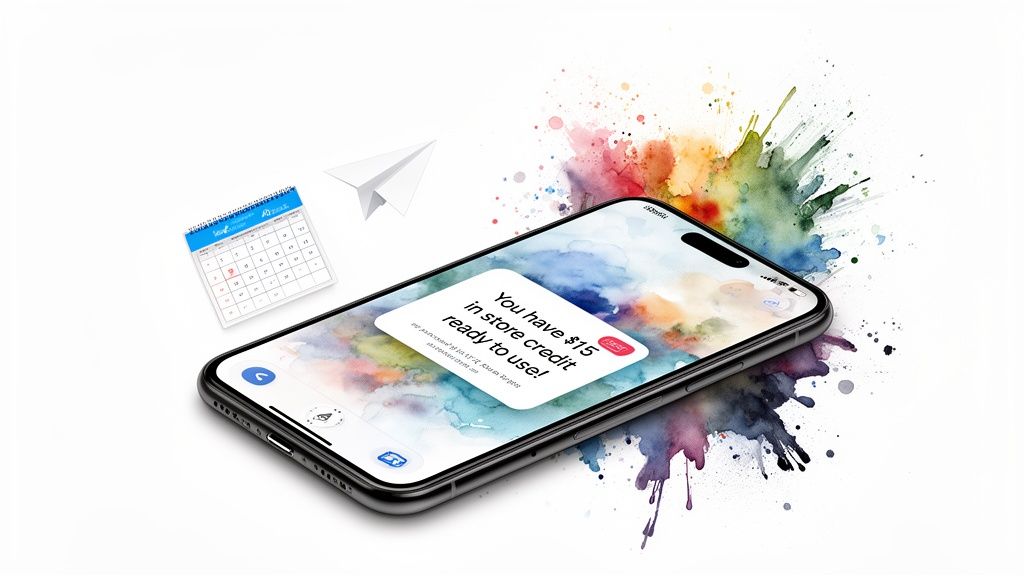
Imagine a simple, powerful message that lands in their inbox 30 days after their last purchase: "Hey [Customer Name], you still have $15 in store credit waiting for you!" That’s not just a notification; it's a personalized invitation to come back and shop. By integrating directly with a platform like Shopify, these reminders can be triggered automatically based on real customer behavior.
For example, a simple two-part flow is incredibly effective:
First Reminder (14 days post-purchase): A friendly email highlighting their available balance. It’s the perfect place to showcase a few new arrivals or best-sellers to get them browsing.
Second Reminder (30 days post-purchase): An SMS message with a more direct call-to-action. Something like, "Your $15 credit is ready. Tap here to shop now!" gets straight to the point.
This systematic approach ensures your store credit program is an active engine for increased customer loyalty and a higher lifetime value.
An automated reminder turns store credit into an ongoing conversation. It’s no longer a one-time reward; it’s a gentle, persistent reason for your customers to keep your brand top of mind and make that crucial second purchase that multiplies their LTV.
The entire loyalty landscape is booming, with the global customer loyalty programs market hitting an estimated $215-216 billion back in 2020. This massive investment proves that smart businesses see loyalty as an essential growth engine, not just a marketing extra. For DTC brands, having an effective, automated system is a key competitive advantage. You can find more customer loyalty statistics that show the power of a strong retention program to see just how big the opportunity is.
Driving Lifetime Value with Automation
This automated follow-up is precisely what fuels customer lifetime value (LTV). Every single time a customer redeems their store credit, it reinforces the habit of shopping with your brand.
It's a well-known fact in e-commerce: customers who are prompted to make a second purchase are far more likely to make a third and a fourth, dramatically increasing their LTV.
The real beauty of this system is how margin-friendly it is. Unlike a discount code that just slashes your profit, a store credit reminder encourages a full-price purchase where the credit acts as a partial payment. This model protects your unit economics while building a predictable stream of revenue from your highest LTV customers.
By turning earned credit into automated campaigns, you build a sustainable growth loop that consistently boosts your bottom line.
How to Measure the ROI of Your Loyalty Program
So, you've launched a Shopify native store credit program. The real question is, how do you prove it’s actually making you money? Moving away from the typical discount model requires a solid, data-backed approach to show you’re not just making customers happy—you’re driving profitable growth focused on lifetime value.
The goal here is simple: get an undeniable picture of your program's financial impact. The good news? The data is overwhelmingly on your side.
Recent findings show that 9 out of 10 program owners who actually track performance report a positive ROI. In fact, some see returns as high as 5.3 times their initial investment. With nearly 90% of businesses confirming that loyalty programs deliver unique value, it’s clear they've become profit drivers, not just another expense.
Isolating Your Program’s Impact with Customer Segmentation
To really prove your store credit program is working, you need a clean comparison. The most effective way to do this is by creating two distinct customer groups right inside your Shopify analytics.
It's a classic A/B test approach:
Group A (The Loyalty Cohort): These are all the customers who have earned and, more importantly, redeemed store credit. They're your engaged group.
Group B (The Control Group): This group includes customers who have purchased from you but have never interacted with the store credit program.
By tracking these two segments side-by-side, you can directly attribute any differences in their buying habits to your loyalty efforts. This isn't guesswork; it's hard data that tells a clear story about LTV and AOV.
Your loyalty program's ROI isn't just a number—it's the story of how you're building a more profitable customer base. By isolating the data, you can clearly narrate that story to your team and stakeholders.
Key Metrics That Tell the Real Story
Once you have your segments set up, it’s time to focus on the KPIs that directly connect to profit and lifetime value. Forget vanity metrics like 'engagement.' We're talking about the numbers that hit your bottom line and are crucial for achieving increased customer loyalty.
There are three metrics, in particular, that will give you a crystal-clear view of your program's impact on LTV and AOV.
Customer Lifetime Value (LTV): This is the holy grail of loyalty measurement. You need to track the average LTV of your loyalty cohort and compare it against the control group. A higher LTV in Group A is direct proof that store credit is creating more valuable, long-term relationships. For a deeper dive, check out our guide on https://www.redeemly.ai/blogposts/how-to-calculate-customer-ltv.
Average Order Value (AOV): Does giving someone $10 in credit encourage them to spend $60 instead of $40? Compare the AOV between your two groups. If customers using store credit consistently spend more per transaction, you know your "spend and get" campaigns are boosting your average order value as intended.
Repeat Purchase Rate: This one is all about retention. A significantly higher repeat purchase rate in your loyalty cohort shows that store credit is a powerful magnet for bringing customers back for that crucial second, third, and fourth purchase, which is the foundation of high LTV.
Understanding the true financial impact is crucial, which is why a comprehensive approach to Mastering Marketing Automation ROI is essential for sustained growth. By focusing on these core metrics, you shift the conversation from "Are customers happy?" to "How much more profitable are our loyal, high-LTV customers?" And that's a question you'll finally have the data to answer.
Common Questions About Shopify Store Credit
Let's be honest, shifting from your go-to discount strategy to a Shopify native store credit model can feel like a leap. It’s a totally different way of thinking about loyalty—less about one-off deals and more about building real, lasting relationships that increase customer lifetime value.
So, it's natural to have questions. Let's walk through some of the most common things I hear from Shopify merchants. My goal here is to give you straight answers so you can move forward with confidence and focus on what really matters: boosting your AOV and customer LTV.
Is Shopify Native Store Credit Really Better?
Without a doubt. Tapping into Shopify's native store credit system is a huge advantage because it's baked right into the checkout. It’s incredibly fast, reliable, and frictionless.
Think about it: no clunky, third-party scripts slowing down your site or causing weird glitches. Forget confusing point systems that require customers to do mental math.
This seamless experience is everything. Your customers see their balance and can apply it instantly, without ever leaving the checkout page. That’s a massive win for conversions and customer experience, which in turn boosts lifetime value. Plus, it keeps your tech stack lean and clean.
How Does Store Credit Impact Profit Margins?
This is where the magic happens for your lifetime value calculations. Store credit is so much healthier for your margins than a typical discount. A 20% off coupon is a direct, immediate hit to your profit on that sale. You're rewarding the transaction, not necessarily the customer's loyalty.
Store credit flips that model on its head. It only becomes a "cost" when a customer comes back to make their next purchase, increasing their lifetime value. You're only rewarding proven, repeat business. The profit you make from that second, third, or fourth sale almost always outweighs the initial credit you issued. This creates a sustainable growth loop that fosters increased customer loyalty without cannibalizing your profits.
Store credit flips the script from "How can I make this sale cheaper?" to "How can I guarantee a second sale?" This shift protects your margins while directly increasing customer lifetime value.
Will Customers Just Use Their Credit and Leave?
It’s a fair concern, but this is where customer psychology really works in your favor to increase LTV. When someone has a credit balance sitting in their account, it feels like they have money to spend—a gift card just waiting to be used at your store. This creates a powerful mental nudge to come back.
But here’s the best part: customers almost always spend more than their credit balance. They use the credit to get the product they really want, even if it costs a bit more. This naturally bumps up the average order value (AOV) of their repeat purchase. The credit isn't just a simple rebate; it's a powerful catalyst to bring them back and encourage them to spend more, building a far more profitable relationship and a much higher lifetime value.
Ready to replace margin-killing discounts with a loyalty program that actually grows your LTV and AOV? Redeemly makes it simple to launch powerful, native store credit campaigns on Shopify. See how it works at https://redeemly.ai.


Join 7000+ brands using our apps