Increase Customer Engagement with Store Credit Not Discounts
Jan 8, 2026
|
Published
If you're serious about increasing customer lifetime value (LTV), you have to think beyond the next sale. The old playbook of throwing discount codes around is a temporary fix that ultimately hurts your brand and profit margins. The real game-changer? Ditching confusing points systems and one-off coupons for something much simpler and more powerful: Shopify native store credit.
Think of it as giving your customers cash that’s only good in your store. It’s a move that not only defends your profit margins but also gives customers a real, tangible reason to come back. This is how you start building a sustainable business by focusing on LTV and average order value (AOV).
The Hidden Costs of a Discount-First Strategy
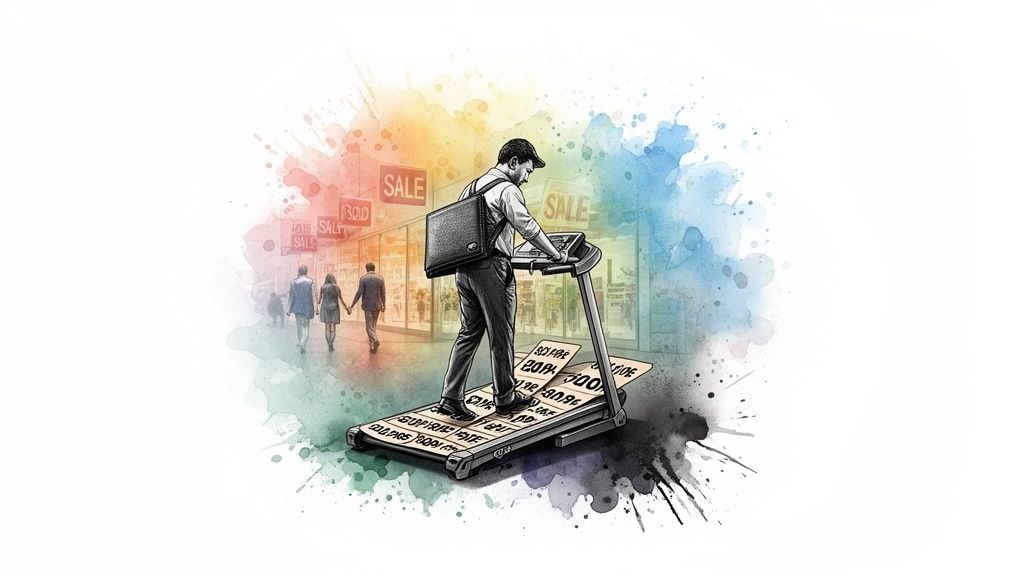
Caught in the endless cycle of flash sales and promo codes? You're not alone. So many brands lean on discounts to get people in the door, but this promotional treadmill is a silent killer for long-term growth. It eats away at your profits and, worse, teaches your customers to wait for the next sale.
This race to the bottom trains a customer base to only buy when the price is slashed, killing your average order value (AOV) and cheapening your brand. Instead of building a loyal following with high lifetime value, you're just curating a list of bargain hunters who will jump ship the second a competitor offers a better deal.
From Coupon Culture To Customer Lifetime Value
The way out is to stop thinking in transactions and start building relationships. Instead of just knocking a percentage off today’s purchase, you reward them with real, spendable store credit for their next one. It's a small change in mechanics but a massive shift in mindset, focusing squarely on increasing customer lifetime value.
A customer with a store credit balance feels like they have money sitting in their account, just waiting to be spent. That creates a powerful psychological pull to return, turning one-time buyers into repeat loyalists with a significantly higher LTV.
Let's break it down. A 20% off coupon is a one-and-done deal. But a $10 store credit reward almost guarantees a second visit, boosting your repeat purchase rate. You're not just giving away margin on a current sale; you're investing in a future, full-price purchase that increases that customer's overall value to your business.
This simple comparison shows just how different the two approaches are for your bottom line.
Store Credit vs Traditional Discounts A Quick Comparison
Here's a look at how a native Shopify store credit program stacks up against the typical discount-based strategy. The differences in business impact are stark, especially when it comes to LTV and AOV.
Metric | Store Credit Loyalty Program | Traditional Discounting |
|---|---|---|
Customer Behavior | Encourages repeat purchases and future spending. | Drives one-off transactions, often from bargain-hunters. |
Profit Margin | Preserves margin on the initial sale; reward is for a future purchase. | Directly erodes the margin of the current sale. |
Brand Perception | Builds value and exclusivity; seen as a member benefit. | Can devalue products and train customers to expect sales. |
Lifetime Value (LTV) | Significantly increases LTV by creating a reason to return. | Has little to no positive impact on LTV; may even attract low-LTV customers. |
Average Order Value (AOV) | Drives higher AOV as customers spend "found money". | Often limits AOV as customers focus on the discount. |
Ultimately, Shopify store credit transforms a simple transaction into the beginning of a long-term, high-value relationship, whereas discounts often mark the end of one.
Building a Profitable Engagement Loop
This model directly fuels your most critical growth metrics. When a customer comes back to spend their credit, their LTV skyrockets. The data backs this up. We know that omnichannel customers, for example, have a 30% higher lifetime value primarily because they engage more often and have more reasons to return.
You're also encouraging bigger carts right now. Customers will often toss another item in their cart just to hit a spending threshold for a reward, giving you an instant AOV boost. This creates a virtuous, profitable cycle where every purchase not only strengthens the customer relationship but also pads your bottom line.
Here’s the thing: what makes a $10 store credit feel so much heavier in a customer's pocket than a 20% off coupon? It’s not about the raw numbers. It’s all psychology. Store credit plugs directly into some powerful cognitive biases, making it a surprisingly effective way to get customers excited and coming back for more.
Unlike a vague percentage that requires a bit of mental math, store credit feels real. It's a specific dollar amount that a customer mentally files away in their own personal "wallet." That small shift in perspective changes everything.
It Feels Like Their Money, Not Your Discount
The secret sauce here is something called the endowment effect. We're all wired to value things more highly once we feel like we own them. A 20% off coupon is just a potential saving, but a $10 store credit feels like cash they’ve already earned. It's theirs.
This feeling of ownership is magnetic. The credit isn't just a promo code; it's a balance waiting to be used. Suddenly, not spending it feels like leaving their own money on the table, which kicks another powerful psychological trigger into gear.
Loss aversion—our deep-seated desire to avoid losing something—is roughly twice as powerful as our desire to gain something of equal value. A customer is far more motivated to use the $10 they already have than to chase a new $10 discount.
See what happened there? The entire dynamic flips. Instead of you pushing a sale on them, they’re pulling themselves back to your store to claim what's rightfully theirs. This is how you start seriously boosting customer lifetime value (LTV).
How "Found Money" Leads to Bigger Carts
This "money in the bank" feeling has a fantastic side effect: it almost always leads to a higher average order value (AOV). When a customer comes back to your Shopify store with a $10 credit, they rarely spend just $10.
They see that credit as a head start on a bigger purchase.
Discount Scenario: A customer eyes a $40 t-shirt. With a 20% off coupon, they pay $32. Transaction over. AOV is low.
Store Credit Scenario: That same customer has a $10 credit. The $40 t-shirt now feels like it only costs them $30 out of pocket. They're way more likely to add a $15 pair of socks because their mental budget feels larger and they want to "make the most" of their credit.
In the second scenario, the customer ends up spending $45 (a $55 cart minus their $10 credit). You just bumped the AOV on that sale by a significant margin. They walk away feeling smart and rewarded, and you secured a larger, more profitable order.
The credit didn't just bring them back; it got them to spend more. That's the simple, powerful advantage of store credit over confusing point systems and forgettable one-off discounts.
Designing Your High-Impact Store Credit Program
Let's be honest, building a loyalty program that actually makes you money is the real goal here. It’s not about just handing out free cash. It’s about being smart and structuring your store credit rewards to directly pump up your Average Order Value (AOV) and Lifetime Value (LTV)—all without torching your margins.
You want to turn your loyalty efforts from a line item expense into a predictable profit engine.
So, where do you start? The big question is always how to structure the rewards. A flat $5 credit for every $100 spent? Or maybe a tiered system that tempts shoppers to add just one more thing to their cart? The right answer is always tied to your unique margins and how your customers actually shop.
This isn’t just about offering another discount. It's about creating a cycle of repeat business that builds genuine loyalty and increases customer LTV.
Look at it this way: a coupon creates a one-time transaction. Native Shopify store credit, on the other hand, gives the customer an asset—a balance in their account—that all but guarantees they'll be back. That’s the foundation of real LTV growth.
Finding Your Margin-Safe Sweet Spot
First things first, you need to land on a reward percentage that won’t put you in the red. A great starting point for most brands is somewhere between 5% and 10% back in store credit.
Think about it: offering $5 in credit for every $100 spent is a simple 5% reward rate. This is almost always more sustainable than a blanket 20% off coupon, mainly because the cost to you only kicks in when they make their next full-price purchase.
Here are a couple of popular models I’ve seen work wonders:
The Flat Rate: This is your straightforward, no-fuss option. "Spend $100, Get $5" is crystal clear and does a great job of motivating that next visit. Simple, effective.
Tiered Rewards: Now this is where you can get clever and really start nudging that AOV upward. For example, you could offer 5% back on orders under $100, but jump it to 8% for any order over that threshold. Suddenly, that shopper with $85 in their cart has a powerful reason to find something else to buy.
The secret is to frame your store credit program as a genuine reward for loyalty, not just another discount for spending. It’s a "thank you" for being a great customer, one that naturally brings them back and preserves the premium feel of your products.
This simple shift in perspective is what truly helps increase customer engagement. You're building a relationship, not just ringing up a sale. It’s a smart investment in future revenue, and with the right tools, it can run on autopilot.
If you want to get into the nitty-gritty of the setup, our guide on how to give store credit on Shopify breaks down all the technical steps.
Seamless Implementation with Native Tools
Trying to manage all this manually would be an absolute nightmare. That's why a native Shopify tool like Redeemly is a game-changer. An app that’s built directly on Shopify’s store credit API lets you set up all these rules—like those powerful tiered rewards—in just a few minutes.
Crucially, it does this without loading your site down with clunky, external scripts that kill your page speed.
A clean, native integration feels like it's just part of your store. It works seamlessly within the Shopify ecosystem you already know, creating a fast and trustworthy experience for you and, more importantly, for your customers.
By automating the whole process of issuing and tracking credit, you're free to focus on the strategy. You can set up rules that automatically reward customers based on what they spend, letting the program run smoothly in the background. It'll be your silent salesperson, constantly working to boost your AOV and lock in that next valuable purchase.
Weave Store Credit Throughout the Customer Journey
Issuing store credit after a purchase is a solid move, but it's only half the equation. If a customer gets that credit and immediately forgets about it, it's not doing you—or them—any good. The real magic happens when you make that store credit balance an unmissable, ever-present part of their experience with your brand.
You have to weave their balance into every single touchpoint. This constant visibility is what transforms a forgotten reward into a powerful, active motivator for their next purchase. It creates a natural retention loop that keeps them coming back for more, directly increasing their lifetime value.
This is a non-negotiable step to increase customer engagement. Why? Because it makes the reward tangible and keeps it top-of-mind. Instead of a one-and-done "thank you," it becomes an ongoing conversation about the value they get just by shopping with you.
Make Their Balance Impossible to Miss On-Site
The second a returning customer lands on your homepage, they should know exactly how much credit they have waiting for them. Because let's be honest: out of sight is completely out of mind in ecommerce. Integrating highly visible, on-site reminders is the only way to turn a past reward into a present-day shopping incentive.
Here are a few tactics I’ve seen work wonders:
Floating Wallet Widgets: Picture a small, persistent widget that follows the customer around your site, quietly displaying their balance ("You have $15.00!"). It’s a subtle but incredibly effective nudge toward the checkout.
Product Page Banners: Imagine a shopper is eyeing a $50 sweater. A dynamic banner that pops up and says, "Use your $15 credit and get this for only $35!" instantly reframes the price. The purchase suddenly feels like a savvy deal.
Cart and Checkout Reminders: Just before they pull the trigger, reinforce the value one last time. A simple message in the cart summary—"Don't forget your $15.00 store credit!"—can be the final push needed to get them across the finish line and boost your conversion rate.
By making the credit balance a core part of the on-site UX, you shift the customer's mindset from "Should I buy this?" to "How should I spend the money I already have here?" This is a subtle but powerful psychological trick that dramatically shortens the path to their next purchase.
Keep the Conversation Going After They Leave
Your engagement strategy can't end the moment a customer clicks away from your site. That post-purchase period is a golden opportunity to remind them of the value they’ve earned and start pulling them back for another visit. This is where smart, personalized communication becomes your most powerful tool.
Personalized, value-driven engagement consistently moves the needle on purchase frequency and average order value. In fact, a staggering 80% of customers are more likely to buy from a brand that offers personalized experiences. If you're looking to build a modern loyalty strategy, understanding how to increase customer loyalty through tactics like this is essential.
Here are a few post-purchase plays that flat-out work:
"Your Credit is Waiting" Emails: A week or two after issuing the credit, send a dedicated email. A simple, direct subject line like, "You've earned $15 in store credit!" is almost guaranteed to get opened.
Balance Reminders in Newsletters: Don't just send another generic promo. Add a dynamic module to your regular marketing emails that shows each recipient their personal store credit balance. It adds genuine value to your campaigns.
Supercharged Abandoned Cart Flows: Give your abandoned cart sequence a serious upgrade. A message like, "Complete your order and use your $15 credit," is far more compelling than the usual, "Did you forget something?"
These touchpoints are designed to keep your brand—and their balance—front and center. It’s not about being pushy; it’s about creating a helpful system that drives repeat business and grows lifetime value.
Measuring the True Impact on LTV and AOV
So, you've decided to lean into a store credit strategy. It feels like the right move, but how do you actually prove it’s working? Let’s be clear: this isn't about vanity metrics like social media likes. If you want to justify this shift, you need to track the numbers that hit your bottom line.
The whole point of this playbook is to drive customer engagement that translates into long-term value. We’re talking about real loyalty and repeat business, not just a series of one-off sales. Every dollar you issue in store credit needs to have a measurable financial return.
Key Metrics for Store Credit Success
It's time to refocus your analytics dashboard. There are really only three core metrics that will tell you the true story of how your native Shopify store credit program is performing.
Customer Lifetime Value (LTV): This is your north star metric. Are the customers who use your store credit spending more over time compared to those who don't? If LTV is climbing, you’ve got a winning formula.
Repeat Purchase Rate: Look at how often customers are coming back. A great store credit program should shrink the time between purchases and make buying from you a more regular habit.
Average Order Value (AOV): Are people spending more when they cash in their credit? Keep a close eye on the AOV for orders where credit is redeemed. You want to see those carts consistently larger than your store-wide average.
Here’s a critical piece of advice: you absolutely must have a "before" picture. Benchmark your LTV, repeat purchase rate, and AOV before you launch the program. Without that baseline data, you’ll never be able to prove the uplift and calculate a real ROI.
Analyzing Customer Cohorts
To really dig in and see what's working, don't just stare at store-wide averages. The real insights come from segmenting your customers into cohorts.
For example, you could compare the LTV and buying habits of customers you acquired in March (post-launch) against the cohort from January (pre-launch). This is how you prove that your new strategy isn't just a gimmick—it's actively creating more valuable customers from day one. If you want to get into the weeds on this, our guide on how to calculate customer LTV is the perfect resource for this kind of deep-dive analysis.
At the end of the day, all your engagement efforts need to lead to commercial success. Better engagement almost always leads to better conversion, which is another crucial part of the puzzle. For a wider lens on this topic, check out a practical guide to improving ecommerce conversion rates.
Answering Your Top Store Credit Questions
Making the leap from a discount-heavy strategy to a store credit program is a big move, and it's smart to have questions. I get it. Merchants I talk to are always curious about how it affects profitability and if it's really better than the old-school loyalty programs they've been using for years.
Let's cut through the noise and tackle these questions directly. The whole point here is to simplify how you reward customers while seriously boosting their lifetime value. We're getting away from convoluted systems that just confuse people and don't actually build loyalty. Shopify native store credit is different—it's a direct, cash-like reward that people instantly understand and value.
Is Store Credit Actually Better Than a Points System?
For the vast majority of Shopify stores? Absolutely. The beauty of store credit lies in its simplicity. $10 in credit is $10 to spend. There's no math, no confusion. Customers see that value in their account and get it immediately, which is half the battle when it comes to getting them engaged.
Think about it from your customer's perspective. Points systems make them do mental gymnastics—figuring out what a point is worth, when they can cash them in, what the redemption tiers are. It's friction. And that friction often leads to them just giving up. Shopify native store credit, on the other hand, feels like their own money just waiting to be spent. It’s a much stronger pull to bring them back for that next purchase, boosting LTV.
How Do I Keep Store Credit From Killing My Margins?
This is where store credit really pulls ahead of discounts. It’s inherently designed to protect your margins. You're not just slashing the price on a current sale; you're investing in a future sale that increases lifetime value.
A discount hits your profit on that transaction, right then and there. Store credit only becomes a "cost" when a customer comes back to spend it, often on a full-price item.
Here's the key: you control the economics. By offering a strategic rate, like 5-10% back in credit, you make sure the cost is manageable. That small investment is almost always wiped out by the increase in customer lifetime value and the new full-margin sale the credit just brought in.
Will a Native Shopify App Slow Down My Store?
Not if you use the right one. This is a huge deal for your customer experience. An app like Redeemly that's built on Shopify's native store credit API doesn't have to load a bunch of clunky, external scripts that kill your site speed and tank your conversion rates.
Because it's native, the entire flow—from earning the credit to using it at checkout—happens inside Shopify's own ecosystem. This means it’s lightning-fast and completely seamless for your customers. You get all the benefits of a powerful rewards program without the performance headaches that plague so many other loyalty apps. Your site stays fast, and your shoppers stay happy.
Ready to swap out confusing points and profit-draining discounts for a loyalty program that actually builds your bottom line? Redeemly makes it dead simple to launch a native store credit program on Shopify that drives up AOV and LTV. Get started with Redeemly today.


Join 7000+ brands using our apps