A Shopify Merchant's Guide to Customer Retention Metrics
Feb 12, 2026
|
Published
So, what exactly are customer retention metrics? Think of them as the vital signs for your business's health. They’re the specific numbers that tell you how good you are at keeping customers coming back. More than just data, these metrics give you a clear window into customer loyalty, help you forecast future revenue, and pinpoint the exact moments in your customer experience that are either winning people over or driving them away.
Why Your Shopify Store Is Leaking Money
Picture your Shopify store as a big bucket. You're constantly pouring money into marketing and ads to fill it with new customers. But what you might not see are the tiny, silent holes at the bottom, draining customers—and your profits—away. This is the classic "leaky bucket" problem, and it's a silent killer for many ecommerce businesses.
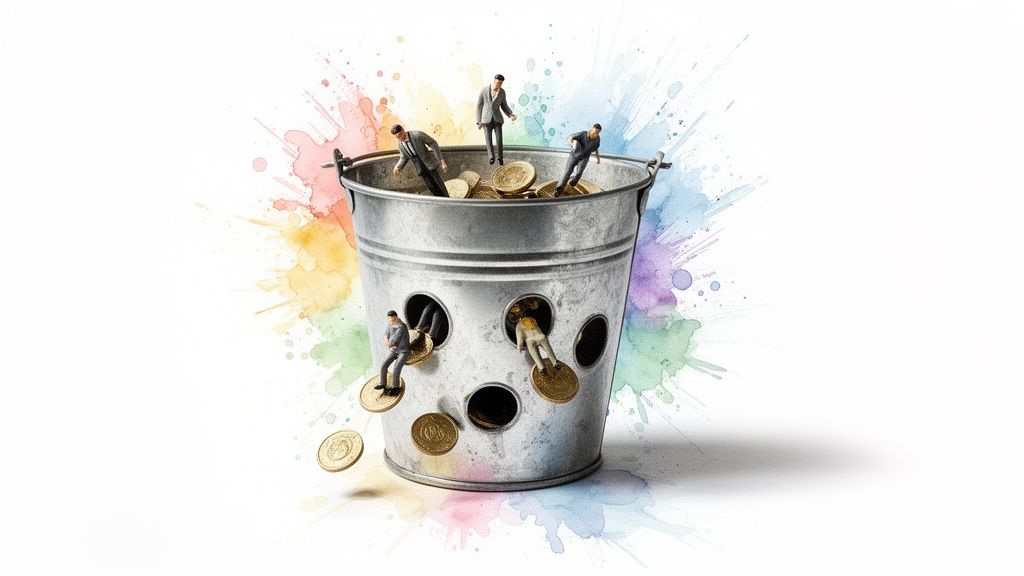
It’s incredibly easy to get caught up in the chase for new customers. The thrill of acquisition is real. But focusing only on filling the top of the bucket while ignoring the leaks is an exhausting—and expensive—cycle. The secret to sustainable growth isn't just pouring more in; it's about plugging those holes. That's where smart retention strategies come in, boosting crucial figures like customer lifetime value (LTV) and average order value (AOV).
Shifting Focus From Acquisition to Profitability
Getting a handle on your customer retention metrics isn't just a nerdy data exercise. It's about building a fundamentally stronger, more profitable business. It forces a mindset shift from chasing short-term sales to nurturing long-term relationships, turning one-time buyers into loyal fans who spend more, and more often.
The financial upside here is huge. Consider this: a tiny 2% increase in customer retention can impact your profits as much as cutting your operating costs by a whopping 10%. That’s a game-changer, especially for Shopify stores operating on thin margins. The data consistently shows that your existing customers spend 67% more on average and 31% more per transaction than brand-new shoppers. If you want to go deeper, exploring the latest customer retention statistics really paints the full picture.
The core idea is simple but powerful: it’s far more profitable to keep a customer than to acquire a new one. Focusing on retention metrics is the most direct path to a healthier bottom line.
Introducing a Smarter Retention Tool
So, how do you actually plug these leaks? For years, the go-to answers were margin-eroding discount coupons and clunky, confusing points systems. These tools often train customers to wait for a sale, attracting bargain hunters instead of loyal fans. A much smarter, more profitable solution has come into its own: native Shopify store credit.
Think about it. A discount attracts a one-time purchase. But store credit feels like real money in a customer's digital wallet—a powerful, tangible reason to come back for their next purchase. It keeps the relationship going and focuses on building long-term value.
Throughout this guide, we'll break down the essential retention metrics you need to be tracking, with a high focus on Lifetime Value and Average Order Value. More importantly, we'll show you how modern tools like native store credit can directly move the needle on each one, helping you build a business that doesn't just survive, but truly thrives.
The Core Metrics That Drive Ecommerce Growth
Let's cut through the noise. You don't need a thousand different data points to understand if your store is on the right track. Real, sustainable growth comes down to a handful of core customer retention metrics that tell you the true story of your business's health.
These aren't just numbers on a dashboard; they're the pulse of your profitability and the clearest signals of long-term success.
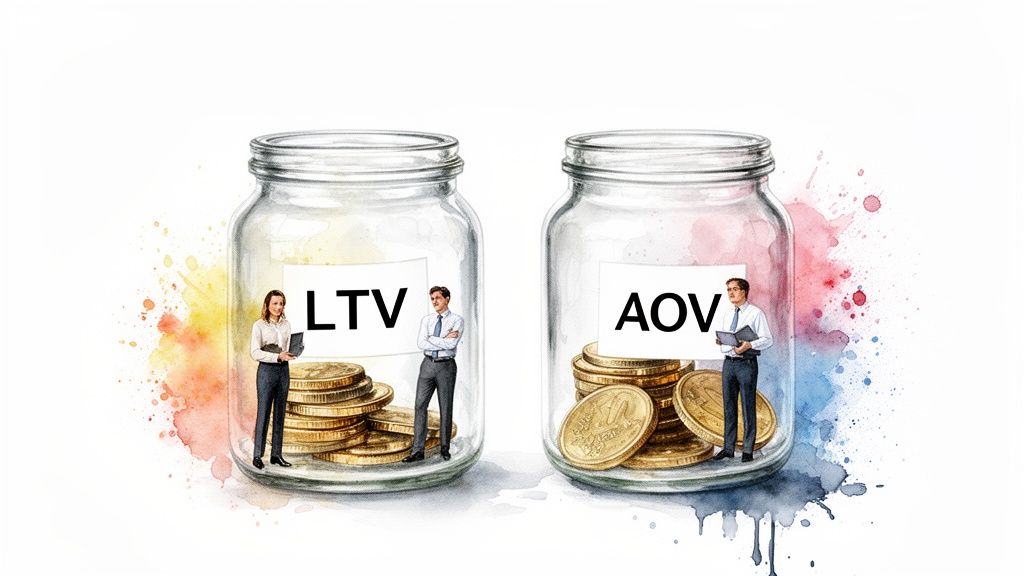
We're going to zero in on the two north stars that every Shopify merchant should live and breathe: Customer Lifetime Value (LTV) and Average Order Value (AOV). Get these right, and you're building a business that lasts.
Customer Lifetime Value (LTV)
Customer Lifetime Value (LTV, or CLV) is the big one. It's the total profit you can realistically expect to make from a single customer over their entire relationship with your brand.
Think of it this way: AOV is the value of a single coffee date, but LTV is the value of the entire friendship. It’s the difference between a one-time transaction and a long-term, loyal relationship. A high LTV is the ultimate proof that you've turned a first-time buyer into a genuine fan. Focusing on LTV means you're not just making a sale; you're building an asset.
LTV Formula:
(Average Order Value) x (Purchase Frequency) x (Customer Lifespan)
Focusing on LTV forces a crucial mental shift. You stop asking, "How much did they spend today?" and start asking, "How much value can we create for them over the long haul?" That's where the real money is made.
Average Order Value (AOV)
Average Order Value (AOV) is much simpler but just as powerful. It’s the average amount a customer spends each time they check out.
Want a fast track to more revenue without spending a dime on new ads? Boost your AOV. Getting customers to add just one more small item to their cart can dramatically impact your bottom line. It's all about increasing the value of the traffic you already have and is often the first step to growing a customer's lifetime value.
AOV Formula:
(Total Revenue) / (Total Number of Orders)
This is where smart incentives, like offering store credit rewards for hitting a certain cart value, can work wonders. A little nudge is often all it takes to push that AOV number higher, directly impacting your top-line revenue.
Other Key Players: RPR and CRR
While LTV and AOV are your headliners, a couple of supporting metrics give you the full picture.
Repeat Purchase Rate (RPR) tells you what percentage of your customers have come back to buy again. A strong RPR means your products are hitting the mark and your customer experience is solid—it’s the first step to building a high LTV.
Customer Retention Rate (CRR) measures how many customers you keep over a specific time frame. It's the opposite of churn and shows you how "sticky" your brand is. When you consider that acquiring a new customer costs 5-7 times more than keeping an existing one, you can see why this matters.
To give you a quick cheat sheet, here’s a breakdown of the essential metrics you should be watching.
Essential Ecommerce Retention Metrics At a Glance
Metric | Formula | What It Measures |
|---|---|---|
Customer Lifetime Value (LTV) |
| The total profit you'll earn from an average customer. |
Average Order Value (AOV) |
| The average amount spent per transaction on your site. |
Repeat Purchase Rate (RPR) |
| The percentage of customers who return for a second purchase. |
Customer Retention Rate (CRR) |
| The percentage of customers you keep over a specific period. |
These metrics work together to give you a 360-degree view of your store’s health. While it's also helpful to understand the broader landscape of digital marketing performance metrics, mastering these four will put you on the path to building a truly profitable and resilient ecommerce business.
How Store Credit Directly Boosts Your LTV and AOV
Knowing your customer retention metrics is one thing. Actually moving the needle on them is where the real growth happens. Many stores immediately jump to margin-crushing discounts or overly complicated points systems, but one of the most powerful tools is often hiding in plain sight: native Shopify store credit.
This isn’t just another promotional gimmick. It’s a simple, powerful strategy that directly targets your two most important profitability metrics—Customer Lifetime Value (LTV) and Average Order Value (AOV). It helps you shift from chasing one-off transactions to building a sustainable, profitable cycle of repeat business.
Transforming AOV Without Sacrificing Margins
The first and most immediate win from a smart store credit program is a real, measurable lift in your Average Order Value. Instead of just dangling a flat discount, you’re giving customers a reason to spend more to earn a valuable reward. This simple psychological switch from "saving money" to "earning credit" fundamentally changes how people shop.
Picture this: a customer has $85 worth of products in their cart. A pop-up offering "10% off" might get them to check out, but you just gave away profit. Now, what if the offer was: "Spend $100 and get $10 in store credit"?
This small tweak accomplishes a few critical things:
It sets a clear target: The customer now has a tangible goal to hit.
It encourages browsing: They’re now actively looking for one more item to reach that $100 threshold.
It protects your current sale: The reward is for next time, meaning you secure the full margin on this larger, initial purchase.
The customer feels like they’ve won by unlocking a future reward, and you’ve successfully nudged that transaction's value up. This isn't just theory; it's a proven way to get shoppers to add that one last item to their cart, boosting your AOV without the immediate gut punch of a discount code. And to make sure these offers land perfectly, using the right email marketing platforms is key for communicating with customers and driving up metrics like LTV and AOV.
Creating the Ultimate Retention Magnet for Higher LTV
While a bigger AOV gives you a nice short-term win, the real magic of store credit is how it can supercharge your Customer Lifetime Value. Points can feel abstract and discounts can cheapen your brand, but store credit feels like cold, hard cash. It's a tangible asset sitting in their account—a very compelling reason to shop with you again instead of a competitor.
This creates what we call a "retention magnet."
Once a customer has credit, they have skin in the game. That $10 credit they earned is essentially a down payment on their next order. It lowers the mental barrier to making a second or third purchase because, in their mind, part of it is already paid for.
Issuing store credit isn't a cost; it's an investment in a customer's next purchase. It only becomes an expense when a loyal customer comes back to spend more money with you, creating a self-funding loyalty loop.
This is the cycle that builds a truly high LTV. A customer buys something, earns credit, and gets a gentle nudge reminding them of their "balance." They come back to use it—often spending more than the credit amount—and maybe earn even more credit. Every transaction strengthens the relationship, turning a one-time buyer into a predictable, high-value repeat customer.
Why Simplicity Wins in Loyalty
Let's be honest: one of the biggest reasons traditional loyalty programs fail is because they're too complicated. Confusing point conversions ("Wait, 2,000 points equals $5?"), expiring rewards, and complicated tiers create mental friction for the customer. When a program is hard to understand, people just tune out.
Store credit cuts right through all that noise.
It's a beautifully simple and transparent system that people actually appreciate and use. A dollar in credit is a dollar they can spend. No math, no tiers, no confusion. That clarity makes the reward feel more valuable and a lot more immediate.
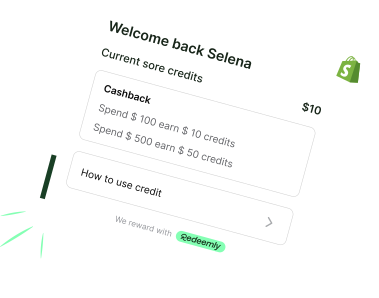
When you use a native system, like the one Redeemly provides through Shopify's own store credit API, the whole experience is seamless. Customers can see their balance in a floating wallet on your site, get automated reminders, and apply their credit at checkout with a single click. You can see how this works by exploring the details of a native Shopify store credit system. This frictionless process removes every possible barrier, making it ridiculously easy for customers to come back for more.
Building a Profitable Repeat Purchase Loop
At the end of the day, the goal is to build a reliable and profitable repeat purchase loop. Store credit is perfectly designed to fuel this engine. Let's walk through the journey it creates:
The Incentive: A new customer is encouraged to spend a bit more on their first order to earn store credit. Your AOV gets an instant boost.
The Hook: After they buy, they have a tangible credit balance tied to their account—a powerful reason to come back.
The Reminder: Automated emails or on-site notifications remind them of their available credit, keeping your brand top-of-mind when they're ready to shop again.
The Return: The customer comes back to your store specifically to use their credit, all but guaranteeing a second purchase.
The Upsell: On that second purchase, they almost always spend more than their credit amount and might even qualify to earn more, starting the whole cycle over again.
This isn't a one-off promotion; it's a sustainable business model. By swapping out costly, single-use discounts for a self-funding loyalty system, you are systematically building a customer base with a much higher repeat purchase rate and LTV. You're no longer just selling products; you're building a community of loyal fans who are rewarded for sticking with you.
Tracking Your Retention Health in Shopify
Knowing your customer retention metrics is one thing, but actually using that knowledge is what separates the stores that thrive from those that just get by. Let's move past the theory and get our hands dirty. We'll look at how you can track your store's retention health right inside Shopify, turning those abstract numbers into a real, working dashboard that drives smart decisions.
The good news? You don't need a bunch of fancy, expensive tools to get started. Shopify's own analytics are a goldmine of information, giving you direct access to the data you need to calculate and monitor your most important metrics—especially Customer Lifetime Value (LTV) and Average Order Value (AOV).
This simple loop shows how something as straightforward as offering store credit for returns or rewards can directly boost LTV, creating a profitable cycle of customers who keep coming back.
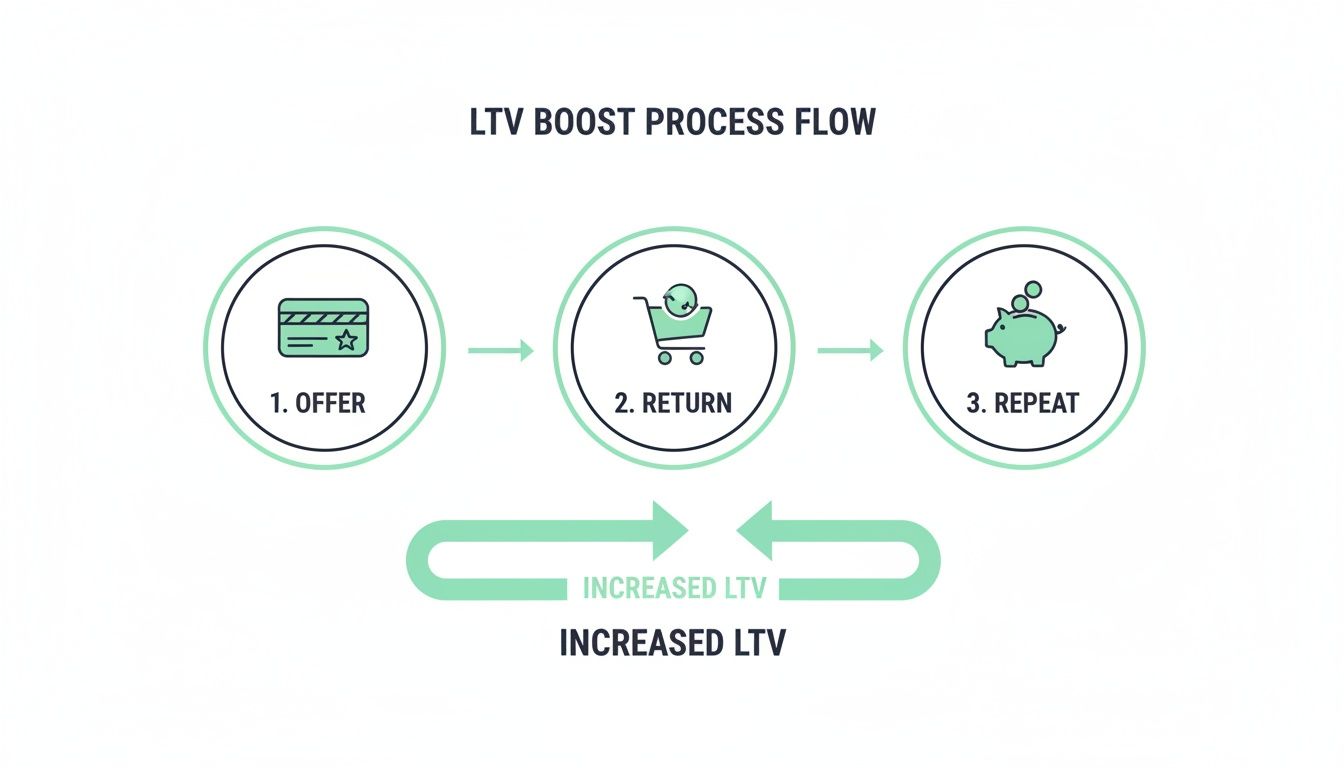
The big idea here is that every step in that store credit loop—from the initial offer to the repeat purchase—is engineered to systematically grow the long-term value of your entire customer base.
Finding Your Key Metrics in Shopify Analytics
To build out your retention dashboard, you first need to know where to find the raw ingredients. Think of Shopify's 'Analytics' and 'Reports' sections as your command center. Here’s a quick roadmap to locating the data for your core metrics.
For Average Order Value (AOV): Head over to
Analytics > Reports > Sales over time. This report shows your total sales and the total number of orders for any period you choose. Just divide the total sales by the number of orders, and that's your AOV. Simple as that.For Customer Lifetime Value (LTV): Shopify has a
Sales by customerreport that is incredibly useful. It breaks down the total amount spent by each customer, their total order count, and their AOV, giving you a clear view of who your most valuable shoppers really are.For Repeat Purchase Rate: The
Returning customer ratereport is your best friend here. It tells you, straight up, what percentage of your customers have made more than one purchase.
By checking these reports regularly, you can finally stop guessing and start making moves based on what your customers are actually doing. If you're ready for a deeper dive into the numbers, you can learn more about how to calculate AOV in our detailed guide.
Simplifying Cohort Analysis
I know, "cohort analysis" sounds like something you'd need a PhD in statistics for, but the concept is actually simple and incredibly powerful. Just think of it like tracking different "graduating classes" of your customers.
A cohort is just a group of customers who all made their first purchase around the same time (like all new customers from January). By analyzing cohorts, you can follow these groups over time to see how they behave.
Cohort analysis answers the real questions: Are customers from our Black Friday sale sticking around longer than the ones from our summer launch? Do customers we acquired in Q1 spend more over their lifetime than those from Q2?
Shopify's Retention over time report does this for you. It groups your customers into monthly cohorts and shows you what percentage of each group comes back to buy again in the following months. This is one of the single most effective ways to spot trends and truly understand the long-term impact of your marketing campaigns.
From Data to Actionable Insights
Let's be clear: tracking these numbers isn't about filling up a spreadsheet. It's about spotting trends and taking action.
Is your AOV looking a little flat? This is your cue to introduce a spend-to-earn store credit incentive, like offering $10 in credit for any order over $100. This nudges customers to add just one more item to their cart to unlock a reward, boosting your AOV without cheapening your brand with a discount.
Maybe your cohort retention drops off a cliff after the first month. That’s a huge red flag pointing to a problem with your post-purchase experience. You could set up automated emails that remind customers about the store credit they earned on their first purchase, giving them a compelling reason to come back and place that second order.
By building a simple retention dashboard using these native Shopify reports, you give yourself the power to catch these problems early. From there, you can use smart strategies like store credit to systematically improve each metric, creating a healthier, more profitable business built on the best foundation there is: loyal, happy customers.
Why Store Credit Outperforms Discounts and Points
When it comes to keeping customers coming back, not all loyalty tactics are created equal. For years, Shopify merchants have leaned on two main tools: discount codes and points systems. And while they might give you a quick sales bump, they often cause long-term headaches, from bleeding your margins dry to just plain confusing your customers.
There’s a much smarter, more profitable way forward that hinges on a surprisingly simple tool: native Shopify store credit.
Let's break down exactly why store credit is a superior retention tool. By looking at these three models from the two perspectives that matter most—your profitability as a merchant and your customer's experience—it becomes obvious why store credit is perfectly built to boost the customer retention metrics that actually grow your business, like Lifetime Value (LTV) and Average Order Value (AOV).
The Downside of Discounts
Discount codes are everywhere, but they come with a hefty hidden cost. They teach your customers to devalue your products and to simply wait for the next sale. This creates a vicious cycle of margin-crushing promotions that attracts bargain hunters, not genuine brand loyalists. You end up building a transactional relationship, not a relational one.
Think about it from a pure profitability angle: a 20% off coupon is an immediate 20% cut to your gross margin on that sale. Period. There's zero guarantee that customer will ever return, meaning you just sacrificed profit for a single, fleeting transaction.
Discounts are a short-term sales tool often disguised as a long-term loyalty strategy. They attract customers who are loyal to the deal, not to your brand, which ultimately harms your key customer retention metrics.
The Problem with Points
Points systems were supposed to fix the issues with discounts, but they usually just trade one problem for another: complexity. Suddenly, your customers have to become amateur mathematicians, trying to calculate how many points they need for a reward and what those points are even worth.
This mental gymnastics is a huge barrier. When a rewards program feels like work, customers check out. A confusing system where you "earn 5 points for every dollar" and "redeem 500 points for $5 off" feels abstract and unrewarding. The result? Low participation and a lot of wasted effort on your part.
Store Credit: The Clear Winner
This is where native Shopify store credit, especially when powered by an app like Redeemly, changes the game. It elegantly combines the simplicity of a discount with the retention power of a true loyalty program, all while protecting your margins and supercharging your most important metrics.
Here’s the magic behind why it works so well:
It Feels Like Real Money: Store credit is tangible. $10 in an account feels like $10 in a customer's wallet—no complicated math needed. This perceived value creates a powerful psychological pull to come back and spend it.
It Protects Your Margins: Unlike a discount that costs you money now, store credit is an investment in the next purchase. It only becomes a cost when a loyal customer returns to spend more with you, creating a self-funding loyalty loop that directly boosts LTV.
It Grows Your AOV: Store credit is the perfect lever for increasing Average Order Value. Offering $15 in credit on orders over $150 gives customers a concrete incentive to add just one more item to their cart to unlock that reward.
It’s Dead Simple: There are no confusing tiers, no abstract conversions, no hoops to jump through. Customers see their balance, they understand its value, and they can apply it at checkout with a click. This frictionless experience drives much higher engagement.
This direct, cash-like approach builds genuine brand affinity, not just flimsy transactional loyalty. You're giving customers a clear, compelling, and valuable reason to choose your store again and again.
Loyalty Models Compared: Store Credit vs. Discounts vs. Points
To really bring the differences into sharp focus, let’s put these three loyalty models head-to-head. The table below compares them across the factors that matter most for both you and your customers.
Feature | Store Credit (Redeemly) | Discount Codes | Points Systems |
|---|---|---|---|
Merchant Profitability | Excellent. Protects margins on the initial sale and funds future purchases. | Poor. Directly erodes margins on every transaction it's applied to. | Fair. Can be complex to model financially and often has low redemption rates. |
Customer Experience | Simple & High Value. Feels like cash, easy to understand and use. | Simple & Transactional. Easy to use but feels impersonal and temporary. | Complex & Low Value. Often confusing with abstract value and difficult to redeem. |
Impact on AOV | Positive. Directly incentivizes customers to spend more to earn rewards. | Neutral/Negative. Can encourage smaller, single-item purchases just for the deal. | Neutral. The connection between spending and rewards is often too abstract. |
Impact on LTV | Excellent. Creates a powerful "retention magnet" that pulls customers back. | Poor. Attracts one-time bargain hunters, not long-term loyalists. | Fair. Can build loyalty if simple, but complexity often leads to disengagement. |
Ultimately, the loyalty strategy you choose will have a direct and lasting impact on your store’s financial health. While discounts and points can sometimes feel like a quick fix, store credit stands out as the most effective and sustainable tool for systematically improving your core customer retention metrics and building a more profitable, resilient business.
Got Questions About Customer Retention Metrics? We've Got Answers.
Pivoting from the adrenaline rush of new customer acquisition to the long-term game of retention always brings up a few questions. It’s a smart move, but you want to get it right. Let's tackle some of the most common things Shopify merchants ask when they start focusing on the numbers that really drive profitable growth.
How Often Should I Actually Check These Metrics?
Look, you don't need to be glued to your dashboard every day. The key is finding a consistent rhythm that lets you see real trends, not just random daily blips. For most stores, a weekly or bi-weekly check-in is the sweet spot.
Here’s a simple schedule to start with:
Average Order Value (AOV): Keep an eye on this one weekly. AOV is sensitive and gives you fast feedback on whether that new product bundle or upsell prompt is actually working.
Customer Lifetime Value (CLV) & Repeat Purchase Rate: A monthly review is perfect for these. They’re slow-burn metrics that reflect the health of your customer relationships over time—this is where you’ll see the impact of things like your store credit program.
This cadence helps you make informed decisions without getting bogged down in meaningless data noise.
Seriously, What Is a "Good" Customer Lifetime Value?
This is the big one, isn't it? The honest-to-goodness answer is: it completely depends. A furniture store selling $3,000 sofas will have a wildly different "good" CLV than a brand selling $25 lipsticks.
Instead of getting hung up on someone else's numbers, focus on your own trajectory. Is your CLV going up month-over-month? Are the customers you bring back with store credit spending more over their lifetime than those you don't? That’s your north star.
A "good" CLV is one that's always growing. The real win isn't hitting some arbitrary industry benchmark; it's seeing your own numbers improve. That's the undeniable proof that your retention strategy is working.
How Do I Start a Store Credit Program Without Messing Everything Up?
The thought of adding a new system can be daunting, but launching a native Shopify store credit program is surprisingly straightforward. You don't need to overhaul your entire business. The trick is to start with your biggest pain point: returns.
Instead of issuing cash refunds and watching that money walk out the door forever, make a simple change. Offer customers a little something extra—say, 110% of their refund value—if they take it as store credit.
Just like that, you’ve plugged a massive revenue leak. You’re not just saving a sale; you're giving that customer a fantastic reason to come back and shop again, directly fueling your retention rate and CLV with almost zero friction.
Ready to stop leaking profits and start building loyalty that pays? Redeemly makes it easy to replace margin-killing discounts with a native Shopify store credit system that boosts CLV and AOV. See how Redeemly works and turn your returns into a revenue driver.


Join 7000+ brands using our apps