10 Customer Retention Examples That Boost LTV & AOV with Store Credit
Feb 19, 2026
|
Published
Winning e-commerce brands aren't built on steep discounts. They're built on profitable growth, turning one-time buyers into lifelong fans by maximizing customer lifetime value (LTV) and average order value (AOV). The old methods—confusing points systems and margin-eroding coupons—are failing. Today's customers demand real value, not complicated math.
The secret to sustainable growth lies in a powerful, yet surprisingly simple strategy: native Shopify store credit. Instead of giving away revenue with discount codes that attract bargain hunters, you can reward customers with cash-like credit they are eager to spend. This simple shift creates a powerful incentive for repeat purchases, pulling them back to your store again and again and directly boosting your LTV.
Store credit builds a loyal customer base that values your brand. It encourages higher spending by creating a built-in reason for shoppers to increase their cart size, directly impacting your AOV without sacrificing profit margins.
This article breaks down 10 powerful customer retention examples, showing exactly how leading Shopify brands use native store credit to build unbreakable loyalty and predictable revenue. Get ready to discover a more profitable way to keep your customers coming back.
1. Store Credit & Cash-Like Rewards Programs
One of the most powerful customer retention examples involves shifting from abstract points to tangible, cash-like store credit. This approach reframes loyalty by giving customers a clear monetary value they can spend, eliminating the confusion of traditional points systems. It makes rewards feel like real money in their digital wallet, creating a compelling reason to return and boosting customer lifetime value (LTV).
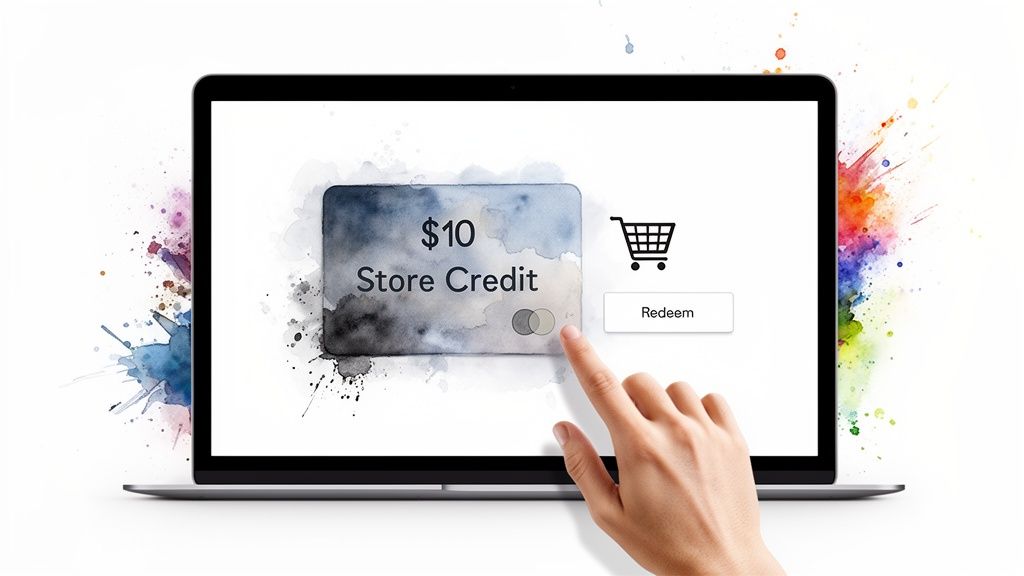
Unlike discounts that devalue your products, store credit acts as a prepaid balance that encourages a future purchase. Major retailers have proven this model's effectiveness at a large scale. The psychological impact is significant; customers are more motivated to use a "$10 credit" than they are to figure out what "500 points" can get them. This directness increases redemption rates and makes the value proposition of your loyalty program crystal clear.
Strategic Implementation
Prominent Display: Always show the customer's available store credit balance on the homepage, product pages, and in the cart. This constant reminder keeps the incentive top-of-mind.
Simple Redemption: Integrate a single-click "Apply Store Credit" button at checkout. The easier it is to use, the more likely customers will redeem it and complete their purchase.
Tiered Earning to Boost AOV: Encourage higher spending by offering better credit-back rates at certain thresholds. For example, offer 5% back on orders over $100 and 10% back on orders over $200 to directly increase average order value.
Targeted Communication: Send email and SMS alerts when a customer earns new credit or when their balance is sufficient for a meaningful purchase.
Key Takeaway: Native Shopify store credit transforms loyalty from a passive game into an active financial incentive. It gives customers a concrete reason to return, directly funding their next visit and protecting your profit margins while growing LTV.
For brands on Shopify, apps make it easy to set up a native store credit system that feels like a core part of the shopping experience. You can learn more about how store credit works by reading this detailed guide. This method is a direct, effective way to build lasting customer relationships.
2. Behavioral Triggers & Redemption Reminders
Earning a reward is only half the battle; getting customers to use it is where retention happens. This is why automated redemption reminders are crucial customer retention examples. These proactive messages combat customer inertia by keeping their available store credit top-of-mind, creating a direct path back to your store. This strategy turns a passive balance into an active purchase driver, increasing the velocity of repeat purchases and boosting LTV.
Instead of waiting for a customer to remember their balance, these triggers use their behavior to send relevant nudges. The goal is to make redeeming credit feel like an obvious, easy next step. These reminders don't just inform; they create a sense of urgency and opportunity, making customers feel like they are losing out by not using their earned value, which powerfully drives repeat business.
Strategic Implementation
Segment Reminders: Avoid notification fatigue by only sending reminders for meaningful balances. For example, trigger alerts only when a customer’s store credit exceeds a $5 or $10 threshold, ensuring the incentive is strong enough to prompt a visit.
Time Nudges Intelligently: Schedule reminders to land just before peak shopping periods. Sending an email or SMS on a Thursday or Friday can capture weekend purchase intent and position your brand as the go-to option.
Include Product Recommendations: Reduce friction by suggesting what a customer can buy with their credit. Pairing a reminder like "You have $10 to spend!" with a carousel of new arrivals or best-sellers makes the path to purchase nearly seamless.
A/B Test Cadence: Experiment with the frequency of your reminders. Test whether weekly, bi-weekly, or expiration-only notifications generate the highest redemption rates without annoying your customers.
Key Takeaway: Proactive redemption reminders activate the value of your store credit program. By automating timely communication, you turn dormant credit into a powerful tool for driving repeat purchases, boosting customer lifetime value, and creating a reliable retention loop.
For Shopify brands, apps automate this process with features like floating wallet prompts and triggered email notifications. These tools ensure customers are always aware of their spending power, making your store credit program a constant and compelling reason to return.
3. Tiered Spending Thresholds & Progressive Rewards
One of the most effective customer retention examples is creating a tiered loyalty program with progressive store credit rewards. This strategy incentivizes customers to spend more to unlock higher-value benefits, moving beyond a simple, flat earning rate. By setting clear spending thresholds, you create psychological anchors that motivate shoppers to increase their cart size just to reach the next level, directly boosting average order value (AOV).
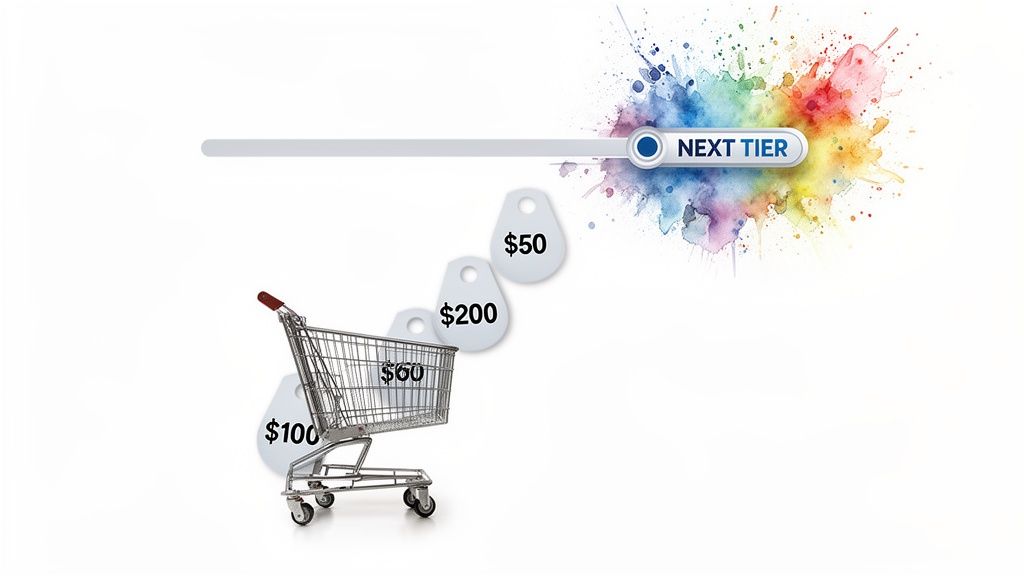
Unlike generic point systems, tiered store credit programs create a sense of status and achievement. This gamified approach makes customers feel valued for their loyalty and gives them a clear reason to consolidate their spending with your brand. The goal is to make the next tier feel both desirable and attainable, encouraging sustained investment and increasing overall customer lifetime value.
Strategic Implementation
Visualize Progress: Clearly display a customer's progress toward the next tier on their account page and in the cart. A visual progress bar can motivate them to add one more item to unlock better store credit rewards.
Make Tiers Achievable: Set spending thresholds that customers can realistically reach within 1-2 purchase cycles. If the goals are too distant, customers will lose motivation.
Celebrate Achievements: Send a personalized email or SMS congratulating customers when they unlock a new tier. Amplify the moment by including a bonus, like an extra $5 in store credit.
Create Urgency: Tie tier status to specific timeframes or events. For example, "Reach the Gold Tier by December to unlock exclusive holiday shipping."
Key Takeaway: Tiered rewards turn spending into a compelling game of achievement. By offering progressively better store credit, you not only increase AOV but also build a powerful emotional connection that drives long-term loyalty and higher lifetime value.
Implementing this model with a native Shopify store credit system is especially effective, as the rewards are tangible and easy to understand. This approach gives customers a clear path to greater value, encouraging them to keep coming back.
4. Targeted Win-Back Campaigns Using Rewards
Re-engaging dormant customers is a crucial retention strategy, but generic discounts can feel desperate. One of the most effective customer retention examples is the targeted win-back campaign using store credit. Instead of a "15% off" coupon, this tactic offers a specific dollar-value credit to lapsed customers, creating a powerful, funded reason for them to return without devaluing your brand.
This approach focuses marketing spend on customers who have already shown a willingness to buy. The offer feels less like a promotion and more like a personalized invitation, making it a "soft landing" that protects margins while directly incentivizing another purchase. This reignites the customer relationship and recovers potential lifetime value (LTV) that would otherwise be lost.
Strategic Implementation
Define 'Lapsed' Sensibly: Set your win-back trigger based on your typical purchase cycle. A beauty brand might define a lapsed customer at 90 days, while a furniture store might use 180 days.
Segment Your Offers: Not all lapsed customers are equal. Segment your win-back campaigns by past spending, offering higher credit values (e.g., $25) to high-LTV customers and smaller amounts (e.g., $10) to others.
Automate Your Outreach: Implement an automated email or SMS sequence that triggers when a customer enters your 'lapsed' segment. This ensures consistent re-engagement without manual effort.
Create Urgency: Set a reasonable expiration date for the credit, typically 14-21 days. This encourages prompt action without creating negative pressure.
Personalize the Message: Reference the customer's last purchase category in the subject line or email body to make the communication more relevant and personal.
Key Takeaway: Win-back campaigns using store credit are a surgical tool for re-engagement. They target proven buyers with a high-value incentive that respects your brand's pricing, making it far more effective at boosting LTV than broad, margin-eroding discounts.
For Shopify stores, automation can trigger store credit offers based on customer inactivity. This makes it simple to set up a continuous, segmented win-back system that turns at-risk customers into repeat buyers by directly funding their next purchase.
5. Post-Purchase Credit Rewards & Transactional Triggers
One of the most impactful customer retention examples is rewarding customers the moment they complete a purchase. Post-purchase credit programs issue an automatic, immediate reward that creates a powerful positive feedback loop. This strategy capitalizes on the "peak-end" effect by making the final step of the shopping experience a rewarding one, conditioning customers to associate buying from you with an instant gain.
Instead of a vague promise of future points, this transactional trigger provides a tangible store credit balance right away. The psychological effect is immediate: the customer’s focus shifts from the money they just spent to the money they now have for their next purchase. This directly funds their return visit, shortening the time between purchases and increasing lifetime value.
Strategic Implementation
Highlight in Confirmations: Immediately feature the earned credit in the order confirmation email and on the post-checkout thank you page. Frame it as a direct benefit of their recent purchase.
Trigger Bonus Credits: Use transactional moments to issue surprise bonuses. Reward a customer’s first purchase, fifth purchase, or brand anniversary to deepen their loyalty and make them feel valued.
Set Meaningful Rates: Ensure the credit-back rate is high enough to feel substantial, typically at least 2-3% of the order value. A small, insignificant reward can have the opposite effect.
Seamless Redemption: Automate the process by showing the available credit balance in the cart and at checkout, with a simple one-click option to apply it to their next order.
Key Takeaway: Transactional store credit rewards turn the end of one purchase into the beginning of the next. By instantly rewarding the customer, you create a compelling incentive to return, which significantly boosts repeat purchase rates and customer lifetime value.
For Shopify stores, an app can automate this entire workflow, issuing store credit based on transactional triggers you set. It ensures every purchase ends on a high note and encourages the next one. You can learn more about setting up these triggers by reading this store credit guide.
6. Exclusive Early Access & VIP Perks Using Store Credit
One of the most effective customer retention examples elevates a rewards program from a simple transaction tool to a gateway for exclusivity. Instead of just offering discounts, brands can use a customer's spending history and accumulated store credit to grant them VIP status with perks like early access to new products or members-only sales. This strategy creates powerful segmentation, making high-value customers feel recognized and part of an exclusive community.
This approach transforms your loyalty program from a mere saving mechanism into a symbol of status. When customers see their loyalty as a key to unlocking premium experiences, their motivation to consolidate their spending with you increases, directly driving higher average order value (AOV) and lifetime value (LTV). This turns loyal shoppers into brand advocates who value the status as much as the savings.
Strategic Implementation
Define Clear Tiers: Create aspirational tier names (e.g., Bronze, Silver, Gold) and clearly communicate the spending required to reach each level. Display a progress bar to show customers how close they are.
Offer Tangible Perks: Go beyond basic store credit. Provide valuable, non-monetary benefits like early access to limited-edition products, invitations to exclusive online events, or extended return windows.
Maintain Exclusivity: Rotate the exclusive products and early access opportunities regularly to keep the program fresh and exciting. Implement tier maintenance rules, such as a minimum spend per year, to ensure the perks remain valuable.
Personalize Communication: Use a customer's VIP status in marketing communications. Emails with subject lines like "Your VIP Early Access Is Here" or "A Special Offer for Our Gold Members" reinforce their special status.
Key Takeaway: Unlocking VIP tiers and exclusive perks creates a powerful sense of belonging. This strategy shifts the focus from one-time savings to a long-term relationship, encouraging sustained spending and turning your best customers into passionate brand ambassadors with high LTV.
For Shopify stores, you can manage these VIP programs by tracking customer spending and automatically assigning them to different tiers. This allows you to easily segment your audience and offer targeted rewards that foster true loyalty. You can learn more about building customer loyalty by reading this comprehensive loyalty guide.
7. Referral Programs with Store Credit Incentives
One of the most profitable customer retention examples is transforming your happy customers into brand advocates through a store credit referral program. This strategy links acquisition directly to retention by rewarding both the referrer and the new customer with tangible store credit. Unlike margin-cutting discounts, store credit feels like a genuine thank-you and a direct incentive to make their next purchase with your brand.
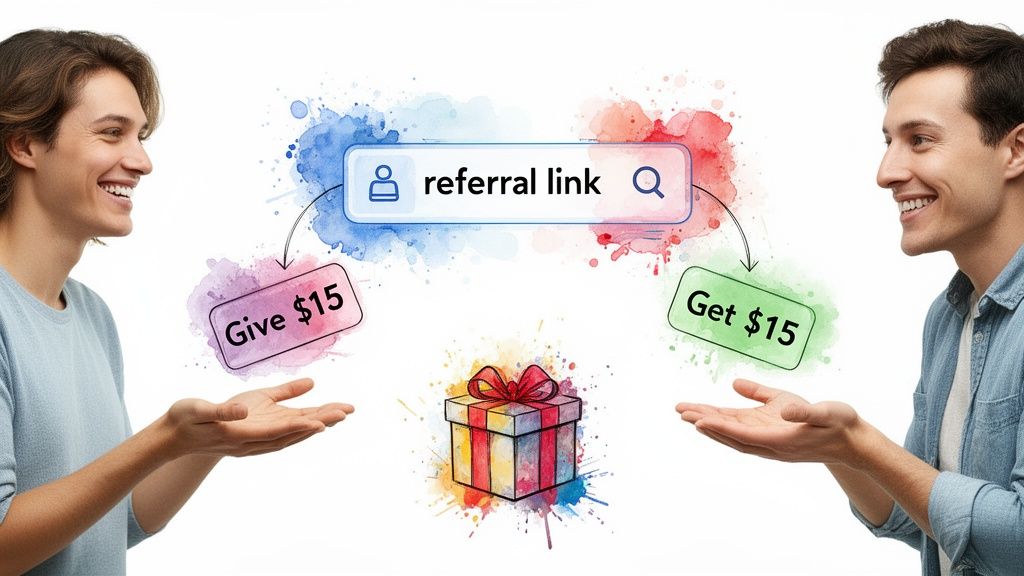
This creates a powerful viral loop where each new customer is a potential source of another. Successful "Give $15, Get $15" models prove that a balanced, cash-like incentive drives participation. The new customer gets a funded first purchase, and the loyal customer is rewarded for their advocacy, directly boosting their lifetime value (LTV) and your overall profitability.
Strategic Implementation
Equal Incentives: Offer the same store credit value to both the referrer and their friend. This fairness makes the recommendation feel more authentic and less transactional.
Frictionless Sharing: Provide pre-written email and SMS templates with one-click sharing links. The easier it is to share, the more referrals you will generate.
Smart Triggers: Issue the store credit only after the referred friend completes their first purchase, not just upon signup. This prevents fraud and ensures you're rewarding actual revenue-generating actions.
Targeted Promotion: Highlight the referral program at moments of highest customer satisfaction, such as on the post-purchase confirmation page or after a positive product review.
Key Takeaway: A store credit referral program is a self-funding growth engine. It lowers customer acquisition costs and simultaneously increases LTV by giving advocates a compelling financial reason to shop again, creating a win-win for your brand and your customers.
Brands on Shopify can easily set this up with tools that integrate referral rewards directly into the native customer account. To explore how to structure your own program, you can learn more about setting up a Shopify referral program with this detailed guide. This approach turns loyalty into a powerful, measurable growth channel.
8. Subscription & Predictable Purchase Models with Store Credit
One of the most effective customer retention examples is converting one-time purchases into predictable recurring revenue via subscriptions. This model dramatically increases customer lifetime value (LTV). When you combine it with store credit incentives instead of simple discounts, you create a powerful "stickiness" that makes it far less appealing for customers to switch to a competitor.
Instead of a standard 10% discount for subscribing, providing a bonus store credit for each renewal encourages future engagement with your full product line. A customer who has a growing store credit balance is not just a subscriber; they are an invested partner. This approach turns a transactional relationship into a loyalty loop where the reward for staying is a tangible cash value to spend on other products, increasing AOV over time.
Strategic Implementation
Offer a Compelling First-Time Bonus: Overcome initial hesitation by offering a substantial store credit bonus (e.g., $15-$20) on the first subscription order. This provides an immediate, high-value incentive.
Reward Renewals: Automatically add a smaller store credit (e.g., $5) to the customer's account with each successful renewal. This creates a compounding reason to stay subscribed.
Flexible Management: Allow customers to easily skip or pause their subscription without losing their accumulated credit. This flexibility reduces the fear of commitment and lowers cancellation rates. Understanding how to effectively prevent subscription churn is paramount for fostering long-term customer loyalty and ensuring predictable purchase models.
Promote Upsells with Credit: Use email and SMS to notify customers of their credit balance, suggesting they use it to add a one-time product to their next shipment.
Key Takeaway: Pairing subscriptions with store credit transforms a simple auto-ship program into a rewarding loyalty ecosystem. It secures recurring revenue while giving customers a growing financial incentive to explore your product catalog, boosting both LTV and AOV.
For Shopify stores, apps like Bold Subscriptions or Subbly can be integrated with store credit systems to automate this entire process. You can create rules that automatically issue credit upon renewal, making it a seamless experience that deepens customer relationships.
9. Gamification & Achievement Badges with Store Credit
Turning loyalty into a game is one of the most effective customer retention examples because it taps into our innate desire for progress and achievement. This strategy uses elements like unlockable badges and exclusive tiers to create an engaging experience. Instead of just earning points, customers feel a sense of accomplishment, which fosters a powerful emotional connection to your brand and drives repeat purchases.
When customers unlock an achievement like "Top Reviewer" or "5-Time Buyer," the reward feels earned. Pairing these milestones with a tangible store credit reward makes the victory even sweeter. Unlike a discount that simply lowers the price, a store credit reward feels like a prize won through effort, which increases a customer's investment in your brand and boosts their lifetime value.
Strategic Implementation
Define Clear Milestones: Create both short-term goals (like a weekly purchase challenge) and long-term achievements (like reaching a new annual tier). This provides consistent opportunities for engagement.
Design Desirable Badges: Create aesthetically pleasing and meaningful badges that customers will feel proud to earn. The visual appeal is a key part of the motivation.
Combine with Store Credit: Award store credit upon unlocking specific badges or completing challenges. For example, unlock the "Adventurer" badge and get a $10 credit after trying products from three different categories.
Visualize Progress: Use progress bars to show customers how close they are to the next tier or reward. This visual feedback is a powerful motivator to increase their spending or frequency to close the gap.
Key Takeaway: Gamification makes your loyalty program an active experience rather than a passive system. By rewarding desired behaviors with achievement badges and store credit, you create an addictive loop that increases customer lifetime value and makes shopping with you more engaging.
Modern loyalty apps allow you to build these gamified systems directly into the Shopify experience. By combining visual achievements with the real monetary value of store credit, you can build a system that drives both emotional loyalty and repeat revenue.
10. Personalized Offers & Dynamic Store Credit Based on Purchase History
Generic rewards rarely inspire true loyalty. One of the most advanced customer retention examples is using customer data to create dynamic, personalized store credit offers. Instead of giving every customer the same $10, this strategy segments users based on their purchase history and browsing behavior to deliver incentives that genuinely resonate, boosting conversion rates and average order value.
This approach turns store credit into a precision tool. A frequent buyer might receive an accelerated credit-earning rate, while a customer who only buys skincare could get a special credit valid only on that category. Pairing this level of personalization with a store credit incentive creates a powerful motivation to complete a purchase, driving both repeat sales and a higher average order value (AOV).
Strategic Implementation
Segment Your Customers: Start by grouping customers into basic segments like first-time buyers, high-LTV VIPs, and at-risk or lapsed customers. Tailor credit offers for each group's specific needs.
Identify Category Affinity: Use purchase history to find a customer’s top product categories. Send them store credit offers specifically for those categories to encourage deeper engagement.
Combine Behavioral Triggers: Integrate purchase data with browsing data. If a customer repeatedly views a specific product but doesn't buy it, trigger an email offering a small store credit to nudge them toward conversion.
Automate with Your Tech Stack: For sophisticated personalized offers and dynamic store credit programs based on purchase history, effective CRM and automation development are essential. Tools like Klaviyo or Omnisend can automate these behavioral triggers.
Key Takeaway: Personalized store credit makes customers feel seen and valued. By aligning financial incentives with individual shopping habits, you create a more compelling reason to return and spend, transforming your retention program from a generic perk into a highly relevant, revenue-driving engine for both LTV and AOV.
For Shopify stores, apps can use customer tags and order data to issue dynamic, targeted store credit. This allows you to build sophisticated retention flows, such as offering a bonus credit to a customer who has purchased from your "Best Sellers" collection three times, directly encouraging loyalty where it matters most.
Comparison of 10 Store-Credit Customer Retention Strategies
Approach | 🔄 Implementation Complexity | ⚡ Resource Requirements | 📊 Expected Outcomes & ⭐ Effectiveness | Ideal Use Cases | 💡 Key Advantages |
|---|---|---|---|---|---|
Store Credit & Cash-Like Rewards Programs | Medium — Shopify integration, wallet UI, accounting setup | Moderate — dev + design; integration with checkout & accounting | Higher redemption and faster redemptions; AOV uplift; ⭐⭐⭐ | Retailers wanting tangible, margin-protecting rewards | Clear monetary value; deferred expense; simple UX |
Behavioral Triggers & Redemption Reminders | Low–Medium — automation + segmentation logic | Low — email/SMS/in-app tooling and templates | Increases redemption ~20–40%; re-engages lapsed users; ⭐⭐⭐ | Brands with unused-credit pools or churn risk | Low-cost boost to redemption; scalable automation |
Tiered Spending Thresholds & Progressive Rewards | Medium–High — dynamic tiers, cart calculations, UI progress | Medium — analytics, UX, pricing calibration | Raises AOV by ~15–25%; stronger repeat purchase behavior; ⭐⭐⭐ | Merchants seeking to increase basket size and frequency | Encourages stretch purchases; gamified progress toward rewards |
Targeted Win-Back Campaigns Using Rewards | Low–Medium — dormancy detection, offer automation | Low–Medium — CRM, messaging, segmentation effort | Cost-effective reactivation; lower CAC vs. new acquisition; ⭐⭐ | Lapsed customers or seasonal churn recovery | Targets high-LTV dormant customers; personalized offers |
Post-Purchase Credit Rewards & Transactional Triggers | Low–Medium — issue credit at purchase, transactional messaging | Low — order-triggered automation & messaging templates | Immediate gratification; habit formation and higher repeat rate; ⭐⭐⭐ | Onboarding, first-time buyers, repeat-purchase nudges | High open rates; clear reinforcement loop; easy to communicate |
Exclusive Early Access & VIP Perks Using Store Credit | Medium–High — gating, inventory and privileges management | Medium — tier management, merchandising, content ops | Increases loyalty and full-price sales among VIPs; ⭐⭐⭐ | Premium brands or high-LTV customer programs | Status signaling; switching costs; drives premium purchases |
Referral Programs with Store Credit Incentives | Medium — referral link tracking, fraud prevention | Medium — tracking dashboard, social sharing tools, fraud controls | Low CAC for referred users; higher retention for referrals; ⭐⭐⭐ | Growth-focused brands with engaged customer base | Two-sided incentives; viral acquisition; measurable LTV uplift |
Subscription & Predictable Purchase Models with Store Credit | High — subscription logistics, billing, fulfillment integration | High — subscription platform, inventory forecasting, CS overhead | Converts revenue to predictable recurring revenue; LTV ×2–3; ⭐⭐⭐ | Consumables, replenishment categories (skincare, supplements) | Predictable cashflow; higher retention; accelerated earning for subscribers |
Gamification & Achievement Badges with Store Credit | Medium–High — UX, badge systems, seasonal content updates | Medium — design, product/marketing cadence, optional leaderboards | Increases engagement and repeat behavior; social sharing; ⭐⭐ | Younger demographics, community-driven brands, engagement-first strategies | Emotional investment; drives secondary actions (reviews/referrals) |
Personalized Offers & Dynamic Store Credit Based on Purchase History | High — analytics/ML, recommendation engine, privacy controls | High — data infrastructure, testing, personalization tooling | Higher conversion and repeat rates (≈30–40% uplift when targeted); ⭐⭐⭐ | Data-rich merchants seeking efficient, margin-protecting incentives | Maximizes ROI on credits; highly relevant offers; protects margins through targeted spend |
From Examples to Execution: Your Next Steps to Higher LTV
We’ve explored a wide range of powerful customer retention examples, all centered on a single truth: resilient brands trade short-term, margin-eroding discounts for long-term, value-building relationships. They have stopped renting customer loyalty with one-off coupons and started earning it with tangible, cash-like incentives.
The common thread is a strategic pivot to native Shopify store credit. Unlike confusing points systems that create friction or deep discounts that devalue your products, store credit acts as a direct investment in the next purchase. It creates a powerful psychological loop where customers feel both rewarded and committed. This is how you systematically build a higher lifetime value (LTV) and encourage a healthier average order value (AOV) with every single interaction.
Your Actionable Roadmap to Retention Mastery
Seeing these customer retention examples is one thing; implementing them is another. The path forward doesn't need to be complex. Your goal is to choose one or two of these strategies and integrate them into your post-purchase flow immediately. Don’t try to do everything at once.
Start with the highest-impact, lowest-effort tactics first.
Implement a Post-Purchase Reward: This is the foundational first step. Instead of a simple "thank you," surprise your customers with a small amount of store credit toward their next purchase. This immediately reframes the end of one transaction as the beginning of the next.
Launch a Simple Win-Back Flow: Identify customers who haven't purchased in 60 or 90 days. Instead of a generic "we miss you" email with a 10% off code, send them a targeted offer with a pre-loaded store credit balance. Make the value clear and the path back to your store frictionless.
Establish Tiered Spending Thresholds: Motivate customers to increase their cart size with clear, achievable rewards. A simple banner that says, "Spend $100, Get $10 in Store Credit" is a powerful AOV booster that protects your margins far better than a site-wide sale.
The Real Impact: Profitability and Predictability
Mastering customer retention is about building a more profitable and predictable business. When you shift your focus from the constant, expensive grind of acquiring new customers to nurturing the ones you already have, you create a stable foundation for growth.
Each of the customer retention examples we've examined is designed to build this foundation. By using native store credit, you are not just rewarding a past action; you are funding a future one. This creates a self-sustaining ecosystem where your best customers are continuously incentivized to return, spend more, and become advocates for your brand. The result is a stronger bottom line, less reliance on volatile ad spend, and a community of loyal customers who feel genuinely valued. The first step is simply to begin.
Ready to turn these customer retention examples into your reality? Redeemly offers a native Shopify solution to seamlessly launch and automate store credit rewards, helping you boost LTV and AOV without complex systems or deep discounts. Start building a more profitable customer base today by exploring what a native store credit program can do for your brand. Learn more at Redeemly.


Join 7000+ brands using our apps