Unlocking Growth with a CRM and Loyalty Program
Feb 22, 2026
|
Published
Let's be honest, a lot of Shopify merchants feel completely stuck. They're running the traditional loyalty playbook—dishing out endless discount coupons and complicated point systems—only to find it’s a losing game. It’s a magnet for one-time deal hunters, sure, but it’s also a slow poison for your profit margins.
You end up in a race to the bottom, constantly slashing prices just to keep the engine running. This cycle damages your brand and does very little to build genuine, profitable customer relationships that actually grow a business by increasing Lifetime Value (LTV) and Average Order Value (AOV).
The Hidden Costs of Traditional Loyalty Programs
For years, the go-to advice has been simple: use discounts to make sales. The glaring problem with this is that you’re training your customers to never pay full price. They learn to wait for the next sale, which devalues your brand and chips away at your margins with every single order.
This whole approach is fixated on the short-term win, the immediate sale. It completely ignores the two metrics that truly matter for a healthy, sustainable business: Lifetime Value (LTV) and Average Order Value (AOV).
And those confusing point systems? They’re not much better. Customers have no idea what "1,000 points" is actually worth, so they just don't engage. The program you're spending money on becomes a liability—a complex thing to manage that doesn't inspire anyone to come back and spend more, failing to impact your LTV.
Sustainable growth isn't about getting the next sale at any cost. It's about getting the right kind of sale—one that increases the total value of a customer over time and encourages them to spend more with each purchase.
A More Profitable Path Forward
A modern CRM and loyalty program completely flips this outdated script. It’s built around profitability from the ground up. Instead of constantly cutting your prices, you reward your best customers with something that feels just like cash: native Shopify store credit. This one simple shift has a massive impact on buying behavior.
Protects Your Profit Margins: Store credit isn’t an instant loss like a discount. It's an asset on your books that only turns into a cost when a happy customer comes back to make another purchase. Your loyalty reward literally guarantees a future sale.
Boosts Your Average Order Value: When a customer sees they can earn real, tangible credit just by spending a little bit more, you’d be surprised how often they’ll add another item to their cart to hit that next threshold.
Increases Customer Lifetime Value: Store credit is like a powerful magnet pulling customers back to your store. It creates a predictable cycle of repeat purchases, which is how you build a rock-solid revenue base. You can dig deeper into how to increase customer loyalty with strategies that actually help your margins.
By stepping away from the margin-killing promotion treadmill and embracing a Shopify native store credit model, you start building a more predictable and resilient business. You’re no longer chasing one-off transactions; you're investing in profitable, long-term relationships that drive up LTV.
Why Your CRM and Loyalty Program Belong Together
Imagine your Customer Relationship Management (CRM) system is the command center for your Shopify store. It's the central hub holding every piece of intel on your customers—who they are, what they buy, and how often they come back. But on its own, that data is just a collection of facts. It’s potential waiting to be unlocked.
Now, think of your loyalty program as the action arm of your strategy. It’s what gives customers a real, tangible reason to engage, to come back, and to spend more. It’s the engine that puts all that rich CRM data to work. The command center is useless without its field team, and the team is directionless without its command center.
When your CRM and loyalty program are disconnected, you're essentially fighting with one hand tied behind your back. The magic happens when they're in sync, creating a powerful feedback loop. Your CRM insights sharpen your loyalty offers, and in turn, your loyalty program activity feeds richer data back into your CRM.
Fueling a Smarter Loyalty Strategy
Your CRM holds the keys to crafting rewards that actually feel personal. Instead of blasting the same generic 10% off coupon to every single customer, you can dive into their purchase history and shopping habits to create offers they genuinely want.
Spot Your VIPs Instantly: Find your top spenders and automatically surprise them with bonus store credit. It’s a simple way to make your best customers feel truly appreciated, increasing their lifetime value.
Stop Churn in its Tracks: Use your CRM to flag customers who haven't shopped in a while. From there, you can trigger a "we miss you" campaign with a little store credit to entice them back.
Nudge Product Discovery: Got a customer who only ever buys one type of product? Your CRM can see that. Use that insight to offer them a small amount of store credit specifically to try something new from another category.
This isn’t just about giving things away; it’s a strategic shift away from margin-killing discounts toward a model that actually builds value and boosts LTV.
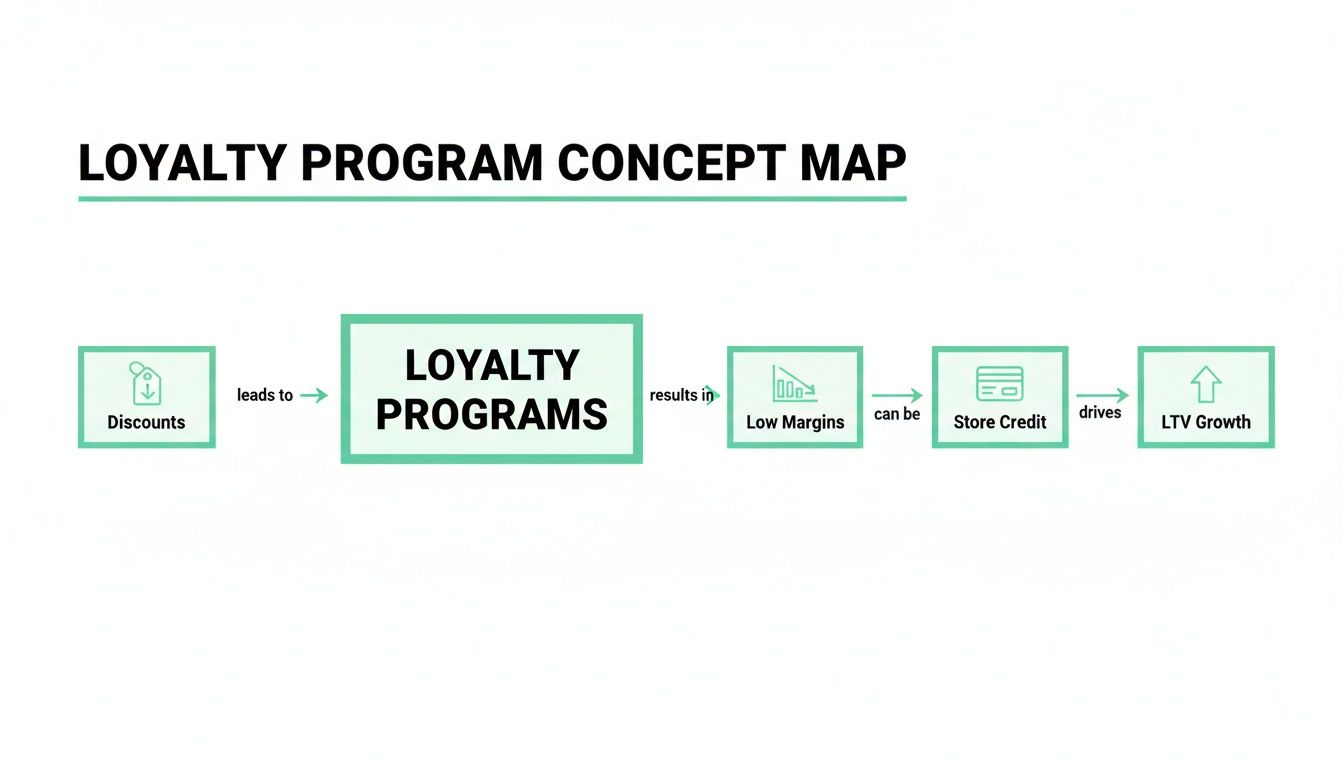
As you can see, the old path of constant discounting often just leads to thinner profits. A well-integrated, store-credit-based loyalty system, however, paves a direct road to higher customer lifetime value. You can dive deeper into how to leverage this data for smarter segmentation.
Enriching Customer Profiles with Every Action
This isn't just a one-way street. Every time a customer earns or redeems their store credit, that activity sends a signal back to your CRM. This constant flow of data makes your customer profiles richer and more detailed over time, so your next marketing move can be even smarter.
You start to learn who your most loyal customers really are and what truly motivates them to spend.
This synergy is more important than ever. A staggering 90% of companies now have some form of loyalty program, yet acquiring a new customer still costs 5X more than keeping an existing one. A deep understanding of what a powerful CRM feature can do is the foundation for making this integration work. When these two systems talk, customer retention doesn't just become easier—it becomes a profitable engine for growth.
The Smarter Economics of Store Credit Rewards
When you flash a 20% discount, you're not just giving a customer a friendly deal—you're taking an immediate, irreversible hit to your profit margin. The second that transaction goes through, that money is gone for good. This is the simple, often-overlooked flaw in discount-driven loyalty: you’re trading profitability for a quick, and often temporary, sales bump.
Shopify native store credit, especially when it’s tied into your CRM and loyalty program, plays by a completely different and far more advantageous set of rules. Instead of an instant loss, issuing store credit creates a liability on your balance sheet. Now, that might sound like dry accounting talk, but the impact on your business is huge.
That "liability" only turns into a real cost when the customer comes back to your store to make another purchase. This simple shift does two incredibly powerful things: it protects your immediate cash flow and flips a marketing expense into a guaranteed future sale. You're not just giving away value; you're investing it directly into future revenue and a higher lifetime value.
Protecting Margins and Guaranteeing a Second Sale
The psychological effect on the customer is just as important as the financial one for you. A discount code feels temporary, almost transactional. But store credit? That feels like finding cash in a coat pocket or having money in a personal account with your brand.
This sense of ownership completely changes how customers shop. They're far more likely to treat that store credit like real money, which often nudges them to spend more than the credit amount just to "make it worthwhile." This is a direct lever for increasing your Average Order Value (AOV) on their next purchase.
Store credit changes the customer's mindset from "How can I pay less?" to "What else can I get?" That simple switch is the secret to protecting your margins and boosting AOV.
A Clear-Cut Financial Comparison
Let's get down to brass tacks. While discount coupons and points certainly have their place, they often can't compete with the financial and psychological power of a well-run Shopify native store credit system. The table below lays out exactly why a native solution, like Redeemly, is a much smarter play for long-term growth focused on LTV.
Store Credit vs Discounts vs Points Programs
Metric | Store Credit (e.g., Redeemly) | Discount Codes | Points Programs |
|---|---|---|---|
Profit Margin Impact | Deferred cost. You only feel the impact on the next sale, protecting the margin on the first one. | Immediate and irreversible. Your profit is cut the moment the code is used. | Delayed and confusing. The cost is unpredictable, and points often have a low perceived value. |
Cash Flow | Positive. The initial sale is at full price, which means more cash in your bank right away. | Negative. You collect less cash from the sale at the time of purchase. | Neutral to slightly negative. You have program costs without an immediate return on investment. |
Customer Psychology | Feels like 'cash in hand.' It creates a strong pull to return and often encourages a bigger cart size (higher AOV). | Trains customers to hunt for deals and wait for sales, devaluing your products. | Often feels complicated and low-value, leading to poor engagement and low redemption rates. |
LTV Driver | Directly incentivizes a second purchase, creating a simple, powerful loop for repeat business and higher lifetime value. | Great for attracting one-time buyers, but does little to build a lasting, loyal relationship. | Can build loyalty over time, but the complexity can be a major barrier to consistent engagement. |
Ultimately, the choice comes down to your goals. If you're chasing sustainable growth and want to build a real relationship with your customers, Shopify native store credit offers a clear financial and psychological advantage that discount coupons and convoluted points systems just can't match.
How Store Credit Directly Boosts AOV and LTV
Let's move from the abstract to the practical. A Shopify native store credit system isn't just a feel-good reward; it's a powerful tool for engineering profitable customer behavior. You're strategically guiding shoppers toward actions that pump up your two most vital metrics: Average Order Value (AOV) and Customer Lifetime Value (LTV).
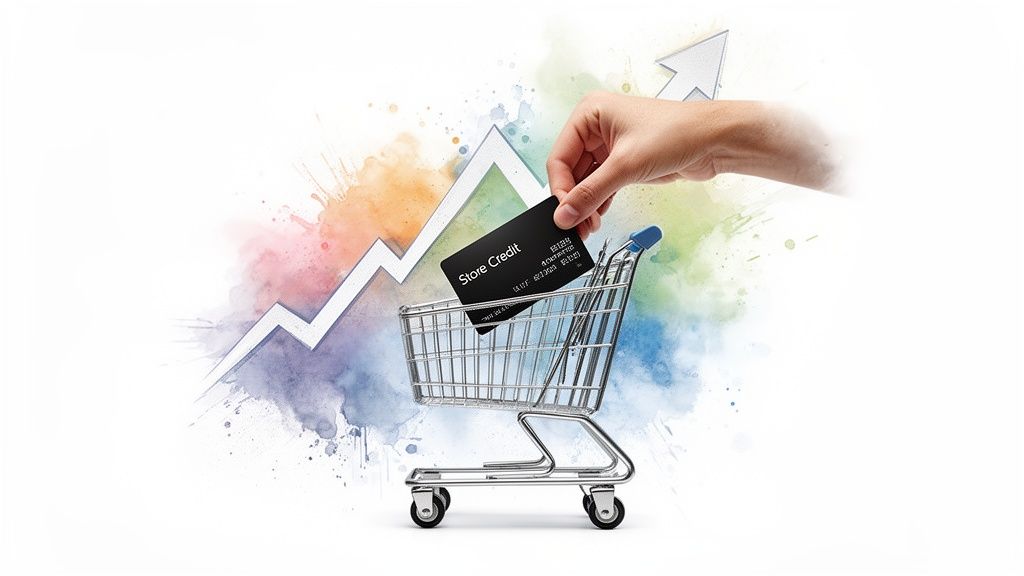
It all starts the moment a customer lands on your site. Unlike a confusing points system, store credit is dead simple. Everyone gets it. When a shopper sees a clear, compelling message like, "You're just $15 away from earning $10 in store credit," their entire purchasing mindset shifts. They're no longer just buying a product; they're investing in a future reward.
That little nudge is surprisingly effective at getting people to add one more thing to their cart, giving you an immediate lift in AOV without having to slash your margins on the current sale.
Creating the Retention Loop
Boosting AOV is great, but it's only half the story. The real magic of a store credit-based crm and loyalty program is how it creates an automated retention loop that keeps customers coming back, driving up your LTV. Once a customer earns that credit, you have a golden ticket to bring them back.
Think about it. An automated email or SMS that says, "Good news! You have $10 in store credit waiting for you," is worlds more persuasive than a generic marketing blast. It feels personal and valuable—like finding money in a coat pocket. This simple, timely message pulls customers back for their second, third, and fourth purchases, fundamentally increasing your repeat purchase rate and LTV.
This isn't some complicated, multi-tiered system that nobody understands. It’s a clean, straightforward cycle:
Incentivize: Customers spend a little more to earn real, tangible credit (boosts AOV).
Reward: The credit lands in their account automatically. No fuss.
Remind: Automated messages notify them of their balance.
Retain: They return to spend their credit, often adding more to their cart (boosts LTV).
This process builds subscription-like buying habits without the commitment or complexity. You're automating the very behaviors that lead to predictable, long-term growth in lifetime value.
The goal isn't just to make a sale; it's to start a profitable relationship. Store credit turns a one-time transaction into the first step of a long-term journey, where each purchase is a stepping stone to the next.
This is exactly why the global loyalty management market, currently valued at $8.6 billion USD, is projected to rocket to $18.2 billion USD by 2026. This explosive growth is driven by smarter, integrated solutions like Shopify-native store credit that offer a clear path to repeat revenue. You can read more about these loyalty market trends on loyaltylion.com. For direct-to-consumer brands, this represents a massive opportunity to build sustainable growth without sacrificing your profit margins.
Implementing a Shopify Native Store Credit System
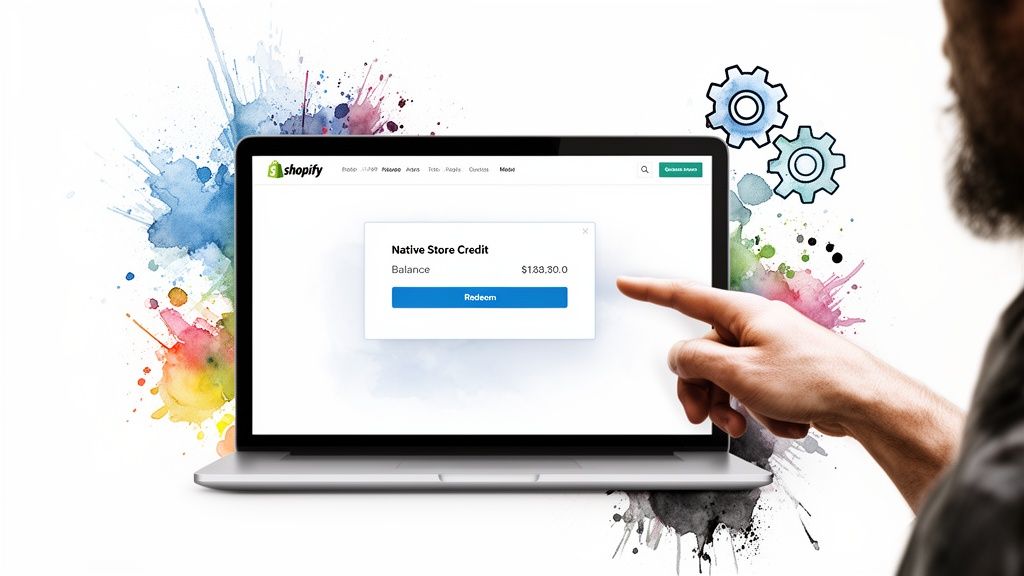
You might think that launching a sophisticated CRM and loyalty program means hiring a team of developers or installing a clunky app that slows your site to a crawl. But it doesn't have to be that way. The real magic of a Shopify native store credit system lies in its elegant simplicity and how seamlessly it fits into your store. It’s a powerful engine for boosting lifetime value that just works—no technical headaches required.
We've all seen the old way: external apps that create a disjointed experience for shoppers and a maintenance nightmare for merchants. Native solutions are a different breed entirely. They're built to work hand-in-glove with Shopify’s core features, which means your site stays lightning-fast and your customer data remains secure and all in one place. It’s about weaving loyalty into the very fabric of your brand experience.
Defining Your Earning Rules
Getting this off the ground is surprisingly simple. Your first move is to decide how customers will earn credit. The best approach is often the most direct one: tie spending directly to rewards. This gives customers a clear incentive to increase their average order value.
Here are a few high-impact earning structures that work wonders:
Simple Percentage Back: This is a classic for a reason. Offer a flat rate, like 5% back in store credit on every purchase. It's clean, easy to understand, and customers instantly see the value.
Spend Thresholds: Turn shopping into a game. Set clear goals like, "Spend $100, get $10." This little nudge often convinces shoppers to add one more item to their cart to hit the reward, directly lifting AOV.
Tiered Rewards: Go a step further by encouraging even bigger carts with escalating rewards. For instance, "Get $5 for spending $75, but get $15 for spending $150."
Whatever you choose, the key is clarity and value. If customers can immediately figure out how to earn, they'll be much more likely to participate. For a more detailed walkthrough, you can learn how to issue store credit on Shopify and tailor the setup to your brand.
Migrating from Points to Store Credit
If you’re currently using an old-school points system, the switch to Shopify native store credit needs to be handled with care. The secret? Communication. You have to frame this as an upgrade—a move that makes rewards simpler and more valuable for them. Ditch the confusing points and give them real "store cash."
Announce the switch with enthusiasm. A simple message like, "Great news! We're making our rewards program even better. Your points are now store credit you can spend like cash," completely reframes the change and highlights the benefit.
To make the transition seamless, calculate a fair conversion rate for your customers' existing points (e.g., 1,000 points = $10 credit) and issue the new balance directly to their accounts. This one action does two things: it honors their past loyalty and immediately shows them the tangible value of the new system. It’s a fantastic, stress-free way to level up your loyalty strategy and get them excited to come back and spend.
The Future of Customer Loyalty Is Profitable
Let's be honest, the old ecommerce playbook is getting tired. The endless cycle of pouring money into customer acquisition is losing its punch. Smart Shopify merchants are realizing that the real, sustainable growth comes from retention—and for a simple reason: it delivers a much higher return.
The future for a powerful CRM and loyalty program isn't about handing out margin-killing discount coupons or forcing customers to track confusing points. It’s about something much simpler and more powerful: Shopify native store credit.
This modern approach does two critical things at once: it protects your profits while systematically boosting both your Average Order Value and customer Lifetime Value. When you reward customers with real, cash-like credit, you’re not just giving them a coupon; you're giving them a reason to come back and spend more. It’s a cleaner, more valuable experience that turns one-time buyers into genuine fans. To really nail this, you have to keep an eye on the broader key marketing trends that shape how people shop.
The most resilient businesses aren't built on attracting the most customers, but on maximizing the value of the ones they already have. A store credit strategy is a direct investment in that profitability.
This isn't just a hunch; it's a massive industry shift. By 2026, marketers are expected to dedicate a staggering 51.5% of their total budgets to loyalty and CRM efforts. That’s a loud and clear signal of where the money—and the growth—is heading. You can see the full breakdown of this shift in marketing spend.
Now is the perfect time to take a hard look at your own retention strategy. Think of this approach not just as another tool, but as a core part of building a more resilient and profitable business for the long haul.
Got Questions? Let's Talk Strategy
Switching to a modern loyalty program built on CRM and store credit is a big move. It's a total departure from the old "discounts and points" playbook, so it’s smart to ask how this actually affects your bottom line, especially metrics like lifetime value.
Here are some of the most common questions we hear from Shopify merchants.
"Is a Store Credit Program Really Better Than VIP Tiers?"
VIP tiers can feel exclusive, but let's be honest—they often create a confusing maze of rules and benefits that most customers never bother to figure out. A Shopify native store credit system, on the other hand, is refreshingly simple. It's basically store cash.
The message is clear: spend more, get more back. This direct value clicks with everyone, not just a small segment of your most die-hard fans. For most brands, a clean, simple store credit system delivers all the punch of a loyalty program without the headache, making it a much stronger foundation for your retention strategy and lifetime value growth.
"How Do I Move My Customers Off Our Old Points-Based App?"
Think of this migration as a marketing event. It’s your chance to get back in front of your customers with some good news.
Start by framing the change as an upgrade to a system that’s easier and more valuable for them. Most Shopify-native apps have tools that let you export your customer data and import it right into the new system.
The key is a fair conversion. You can turn their old points into a clear dollar value (say, 1000 points becomes $10 in store credit) and drop it directly into their accounts. It's a seamless switch where nobody feels like they lost out. You look good for valuing their loyalty, and they get a better experience moving forward. Win-win.
"Won't Giving Away Store Credit Kill My Profit Margins?"
Not at all. In fact, it's built from the ground up to protect them.
Unlike a discount coupon that instantly eats into your revenue on a sale, store credit is only "spent" when a customer comes back to make a second purchase. This is a huge deal for cash flow. You're turning a marketing cost into a guaranteed future sale.
Because the credit is a powerful nudge for a repeat visit—and often encourages a bigger cart size—the lifetime value you gain easily offsets the cost of the reward. It's a fundamentally more profitable strategy than running constant sales.
This one change helps you build a healthier, more sustainable business. You start focusing on profitable repeat customers, which naturally lifts both your average order value and LTV.
Ready to build a loyalty strategy that actually drives profit? Redeemly helps Shopify merchants replace margin-killing discounts with a native store credit program that boosts LTV and AOV. Get started today.
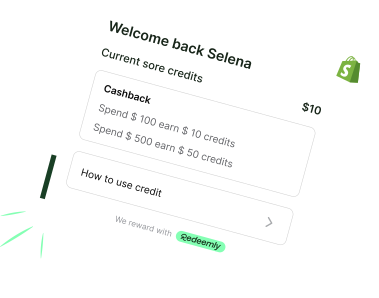


Join 7000+ brands using our apps