Mastering Client Retention Metrics to Boost LTV and AOV
Jan 23, 2026
|
Published
When we talk about client retention metrics, we're really talking about a brand's ability to keep its customers coming back. For anyone running a Shopify store, this is the secret sauce. It's about moving past the thrill of one-time sales and building a loyal following that generates predictable, profitable growth by boosting your Lifetime Value (LTV) and Average Order Value (AOV).
Stop Burning Profits with the Discount-Driven Growth Model
Too many Shopify merchants feel trapped in a relentless cycle of discounts just to keep the sales needle moving. Sound familiar? The problem is, this approach is like trying to fill a leaky bucket—it slowly drains your profit margins and teaches customers to wait for the next sale. It's a race to the bottom that devalues your brand.
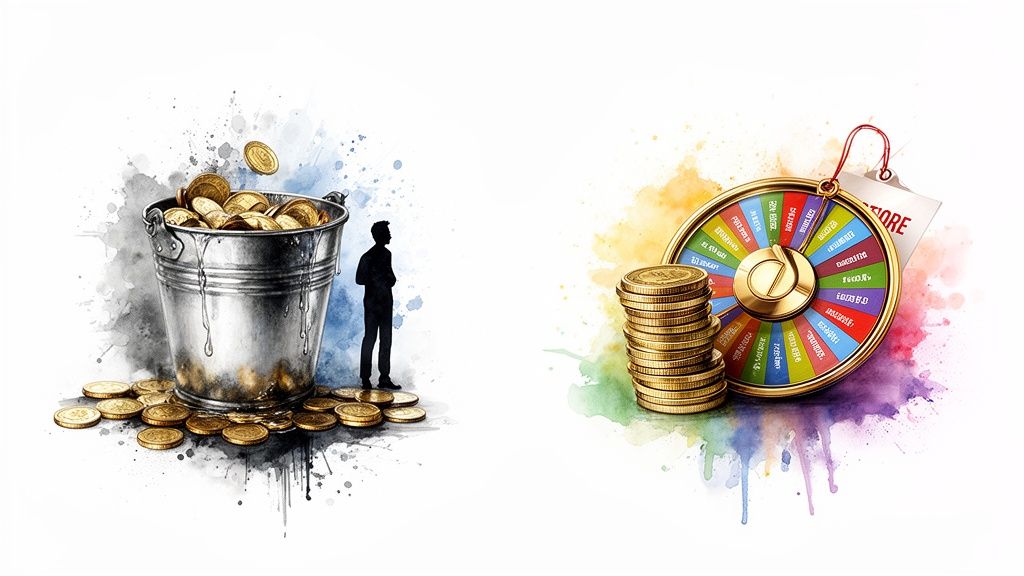
This guide isn't about staring at abstract data points. It's about using client retention metrics as a roadmap to a more sustainable, profitable business. We're talking about a fundamental shift in strategy: stop chasing every new customer with a coupon and start cultivating the immense value within the customers you already have by focusing on native Shopify store credit.
The Treadmill vs. The Flywheel
The old discount model is a "discount treadmill." You have to keep running faster, offering deeper promotions, just to stay in the same place. It's exhausting, unsustainable, and chips away at your brand’s perceived value. Every sale you make costs you a chunk of your margin, making it incredibly difficult to build a truly healthy business.
Now, imagine a "loyalty flywheel." This is what a retention-focused model looks like. Every great experience and repeat purchase adds momentum. Instead of bleeding profits, you’re building a long-term asset. This is where a native Shopify store credit system, like what we've built with Redeemly, can completely change the game by replacing confusing points and margin-killing discounts.
Store credit feels like cash in a customer's pocket—a tangible, compelling reason to return and spend again. It builds a reciprocal relationship based on value, not just on the lowest price.
This simple shift has a massive impact on the two metrics that matter most for profitable growth:
Average Order Value (AOV): When customers can earn credit, they’re often happy to add another item to their cart to hit that reward threshold, naturally bumping up the value of each sale.
Customer Lifetime Value (LTV): That earned credit acts as a powerful hook, bringing shoppers back for their second, third, and fourth purchases. Their value to your business compounds over time.
By embracing a store credit strategy, you can finally step off the discount treadmill and start spinning a flywheel of profitable, predictable revenue. Let's dive into exactly which metrics to track and how you can start moving them in the right direction.
The Three Essential Client Retention Metrics for Shopify Stores
To stop burning cash and start building a real, sustainable business, you need to get smart about retention. For Shopify merchants, that means looking past daily sales numbers and tuning into the three client retention metrics that actually reveal the health of your brand.
Think of them as the vital signs for your customer relationships. They tell you if you're building a brand people love or just a revolving door for one-time buyers. Mastering them is the first step toward creating a store that customers don't just buy from, but feel like they belong to.
Essential Client Retention Metrics At a Glance
Before we dive deep, here’s a quick-reference table that breaks down the three metrics every Shopify store owner should have on their dashboard.
Metric | What It Measures | Simple Formula | Why It Matters for Shopify |
|---|---|---|---|
Customer Lifetime Value (LTV) | The total profit you can expect from a single customer. | (Avg. Order Value) x (Avg. Purchase Frequency) x (Avg. Customer Lifespan) | Your "north star." It tells you exactly how much you can afford to spend to acquire a new customer and still be profitable. The ultimate measure of a healthy business. |
Repeat Purchase Rate (RPR) | The percentage of customers who've come back for a second purchase. | (Customers with 2+ Purchases) / (Total Customers) | The most powerful early signal of customer satisfaction. A high RPR is a direct driver of higher LTV. |
Average Order Value (AOV) | The average dollar amount spent each time a customer places an order. | (Total Revenue) / (Number of Orders) | A key lever for profitability. Increasing AOV directly boosts your Customer Lifetime Value without needing more customers. |
This table gives you the basics, but the real power comes from understanding how these metrics work together to tell a story about your business.
Customer Lifetime Value: The North Star of Profitability
If you only track one thing, make it Customer Lifetime Value (LTV). This is the ultimate north star for any Shopify brand trying to scale profitably. LTV predicts the total net profit you can expect from a single customer over their entire relationship with you.
It fundamentally answers the question: "How much is one customer really worth to my business?"
When you focus on LTV, your entire mindset shifts from chasing one-off transactions to building long-term relationships. The data doesn't lie: a tiny 5% increase in retention can boost profits by a staggering 75%. Why? Because loyal customers keep spending long after you've paid to acquire them. This is especially true for brands that use native Shopify store credit—loyalty members already generate 12-18% more annual revenue than everyone else. You can see more powerful customer retention statistics that prove the point.
A customer with a high LTV is more than just a repeat buyer; they are a brand advocate, a source of predictable revenue, and your most valuable business asset.
A brand that truly gets LTV knows it's far smarter (and cheaper) to delight an existing customer than to constantly hunt for a new one. This is where a native Shopify store credit system like Redeemly shines, as it’s built specifically to encourage the repeat business that makes LTV grow.
For a deeper look at this crucial metric, check out our guide on how to calculate customer lifetime value.
Repeat Purchase Rate: Your Early Warning System
While LTV gives you the long-term vision, Repeat Purchase Rate (RPR) is your immediate health check. It simply measures the percentage of your customers who have made more than one purchase. It's one of the most powerful early indicators of whether you're on the right track.
A high RPR is fantastic news. It means customers loved their first experience enough to come back for more, validating your product, your shipping, and your overall brand experience. But a low or falling RPR? That’s a major red flag. It’s an early warning that something is broken in your post-purchase experience.
Think of it this way:
The first purchase: A customer takes a chance on you.
The second purchase: They confirm their trust in you.
That second purchase is everything. It’s the bridge that turns a curious browser into a loyal, high-LTV customer. This is why store credit programs are so effective at boosting RPR—they give customers a tangible, cash-like reason to come back for that crucial second visit, unlike a generic discount code that gets lost in an inbox.
Customer Retention Rate: The High-Level Report Card
Finally, Customer Retention Rate (CRR) gives you the big-picture view of how well you're holding onto customers over time. While RPR zooms in on the act of repurchasing, CRR measures the percentage of customers you kept from one period to the next (like from Q1 to Q2).
It's your ultimate report card on loyalty.
A high CRR means you've built a "sticky" brand that people feel connected to. This number is influenced by everything you do—from your product quality and customer service to your community-building and marketing. When CRR is strong, your LTV and AOV have a solid foundation to grow from.
By tracking these three metrics together, you get a complete, panoramic view of your business. LTV is the destination, RPR is your real-time GPS, and CRR tells you how well your engine is running.
How Store Credit Drives Repeat Purchases Better Than Discounts
We've all been trained to think that a "15% OFF!" banner is the fastest way to drive a sale. And sure, it works. But the customers you attract are often just one-time bargain hunters, not the loyal fans who will sustain your business. If you want to build real, lasting growth, you need to focus on your Repeat Purchase Rate (RPR). The secret isn't a bigger discount—it's a smarter approach using native Shopify store credit.
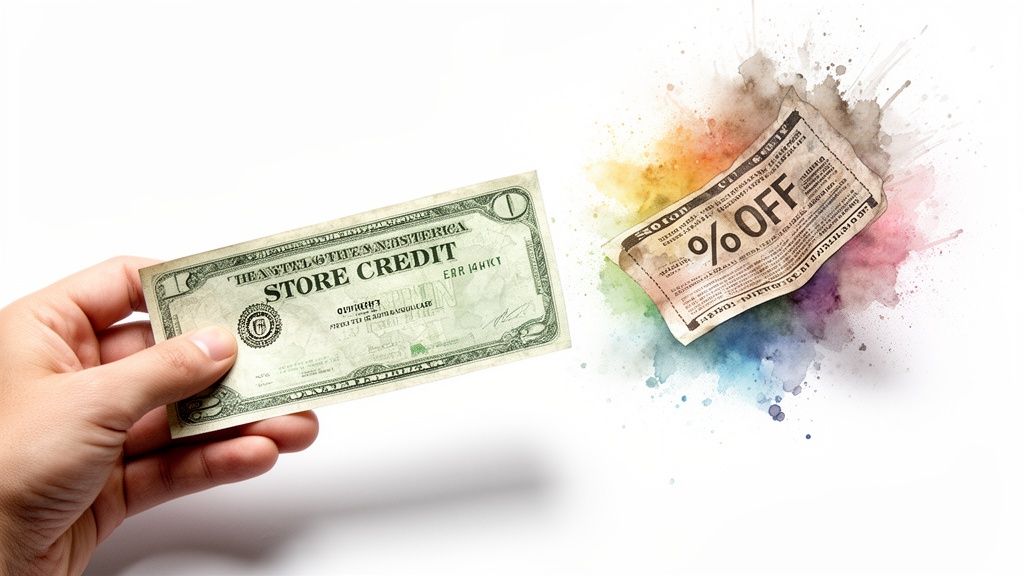
While a discount might clinch a single sale, it does very little to build a relationship. Worse, it can actually train your customers to devalue your products and just wait around for the next markdown. This is where a native Shopify store credit system completely changes the conversation. It gives customers a powerful, tangible reason to come back.
The Psychology of Ownership vs. The Thrill of the Hunt
Discounts play on the "thrill of the hunt." A customer feels like they've scored a deal, but that feeling is gone in a flash. Once the order is complete, so is their emotional connection to your brand. They got what they wanted—a cheap price—and now they're off to hunt for the next deal somewhere else.
Store credit, however, taps into the powerful psychology of ownership. When a customer has $10 in store credit, it doesn't feel like a flimsy coupon; it feels like their money. This creates a subtle but profound mental shift. It’s no longer just a potential saving; it's a real asset they already own, waiting to be spent at your store and your store alone.
Store credit feels like 'cash in hand,' transforming a customer's mindset from 'Maybe I'll buy again' to 'Where can I spend my money?' This sense of ownership creates an open loop that their brain wants to close by making another purchase.
This distinction is absolutely critical for boosting your retention metrics. A discount is a one-off transaction. Earned store credit is an ongoing relationship—a compelling reason to return and a reward for their loyalty.
Eliminating Friction and Building Momentum
Let's be honest: traditional loyalty programs can be a pain. Confusing point systems create mental friction. How much is a point really worth? How many more do I need for that reward? This confusion is a killer. It leads to inaction, and those hard-earned points just sit there, unused.
A native Shopify store credit system, like what we offer with Redeemly, cuts right through that friction. The value is crystal clear: $10 in credit is $10 to spend. No math, no conversions, no headaches. That simplicity is the key to encouraging the behavior you want: a quick, easy repeat purchase.
Discount Coupons: They get lost in inboxes, expire, or just feel impersonal. They incentivize a single purchase by shrinking your margin.
Point Systems: They often feel abstract and create a barrier to actually using them. If customers don't get the value, they won't engage.
Store Credit: It’s simple, tangible, and feels like a personal balance in their account. It directly encourages a future purchase, often at full price, protecting your margins.
By making the reward process seamless and intuitive, you're essentially automating the path to a second sale. This directly pumps up your RPR, which is pure gold for ecommerce brands. In fact, repeat customers are known to spend 67% more than new ones. Their trust in your brand makes them decide faster and feel more comfortable placing bigger orders.
Ultimately, store credit helps you build a much healthier, more resilient business. It nurtures a cycle of loyalty where every purchase deepens the customer's connection to your brand, boosting not just their next purchase, but their entire lifetime value. For a deeper dive, learn more about the benefits of Shopify store credit in our article.
More Than Just Repeat Business: Boosting AOV and LTV with Smart Store Credit
Sure, getting customers to come back is great. But the real magic of a well-crafted retention strategy is how it simultaneously cranks up your two most vital growth levers: Average Order Value (AOV) and Customer Lifetime Value (LTV).
A smart store credit program, built right into your Shopify store, does more than just encourage another purchase. It creates a powerful feedback loop. Customers spend more with each visit, and they come back more often, which compounds their value to your business over time.
This is a complete shift away from the short-term sugar rush of discount codes. Instead of just slicing your margins to close one sale, you’re building a system that fosters bigger, more profitable customer relationships for the long haul.
The AOV Snowball Effect
One of the first things you'll notice with a spend-based store credit program is its immediate lift on your AOV. It’s psychology 101. When a customer sees they’re just a few dollars away from unlocking a reward, the urge to add one more item to their cart is almost irresistible.
Picture this: a shopper has $85 worth of products in their cart. They get a little notification that hitting $100 will earn them $10 in store credit. That $15 item they were on the fence about suddenly seems like a no-brainer. They aren’t just spending more; they feel like they’re making a smart financial decision, locking in a future discount.
This tiny nudge, when multiplied across thousands of transactions, starts a snowball effect:
Bigger Carts, Naturally: Customers actively hunt for ways to hit those reward thresholds, turning smaller checkouts into larger ones.
Higher Perceived Value: Spending more at your store becomes linked with earning real rewards, which reinforces that positive buying behavior.
Protected Margins: Unlike a blanket "15% OFF" coupon that eats into the revenue from the entire order, the cost of store credit is pushed to a future purchase. You get a full-price, higher-value sale today.
Turning Bigger Carts into Lifelong Value
That bigger AOV is just the first domino to fall. The store credit they just earned is the hook that brings that customer back for a second, third, and fourth time. This is where the direct line to Customer Lifetime Value (LTV) becomes impossible to ignore.
At its core, LTV is the ultimate report card for your customer relationships. It's simply a function of how much a customer spends (AOV) multiplied by how often they return (purchase frequency). A smart credit system pours fuel on both sides of that equation.
A store credit program transforms a single transaction into a long-term conversation. The credit acts as a promise of future value, giving customers a concrete, cash-like reason to continue their journey with your brand.
By first bumping up the AOV and then using that earned credit to guarantee the next visit, you are systematically engineering a higher LTV for every single customer. This isn't just a hopeful theory; it’s a repeatable engine for profitable growth. And to truly tap into this, you have to increase customer lifetime value with strategies that actually last.
Protecting Your Profits While Building Loyalty
Maybe the best part of this entire model is how financially sound it is. Traditional discounts are a direct hit to your bottom line, right now. You offer 20% off, and that revenue is gone the second the order is placed—whether that customer ever thinks about you again or not.
Store credit works on a completely different, and frankly, better principle. The "cost" of that reward only hits your books when the customer returns to make another purchase, which is usually at full price. This structure gives you a massive advantage:
You reward real loyalty, not just bargain hunting. Credit is earned by spending and redeemed by coming back.
You keep your unit economics healthy. By sidestepping upfront discounts, you protect the profitability of every single sale.
You build a predictable revenue stream. A growing base of customers holding store credit is like a savings account of future sales you can count on.
This strategic approach ensures you’re not just chasing client retention metrics for a nice-looking dashboard. You’re building a more resilient, profitable business where every customer you reward is making your brand's financial future stronger.
How to Track and Improve Your Customer Retention Rate
Alright, let's move from theory to action. It's one thing to talk about client retention metrics, but it's another to actually use them to grow your business. For Shopify merchants, your Customer Retention Rate (CRR) is the ultimate report card on your brand’s health and customer happiness. A high CRR doesn't happen by accident; it's the direct result of a smart, well-executed retention strategy.
The real magic happens when you start interpreting your CRR. If you see a sudden drop, it's a huge red flag—a warning that something is broken in your post-purchase experience, your communication, or even your core value proposition. Are your shipping times suddenly lagging? Is your customer support team dropping the ball? Or are customers just not finding a good enough reason to stick around? A falling CRR forces you to confront these tough questions head-on.
Calculating Your Store's CRR
In the cutthroat world of ecommerce, your CRR can literally make or break your profitability. Let's make this real.
Imagine your Shopify store starts a quarter with 2,500 customers. Over the next three months, you bring in 600 new ones and end the period with 2,800 total customers. Using the simple CRR formula—((end customers - new customers) / starting customers) x 100—you land at an 88% retention rate. That’s solid, but in this game, anything below 90% hints at untapped potential to create a stickier, more delightful customer experience. You can discover more insights about retention benchmarks on clearlyrated.com.
This single number gives you a clean, high-level snapshot of how magnetic your brand is. Think of it as the foundation. Once you have a handle on it, you can build more sophisticated strategies that go beyond just keeping customers and start actively growing their lifetime value.
The infographic below really nails how the key metrics work together, especially when you bring store credit into the mix.
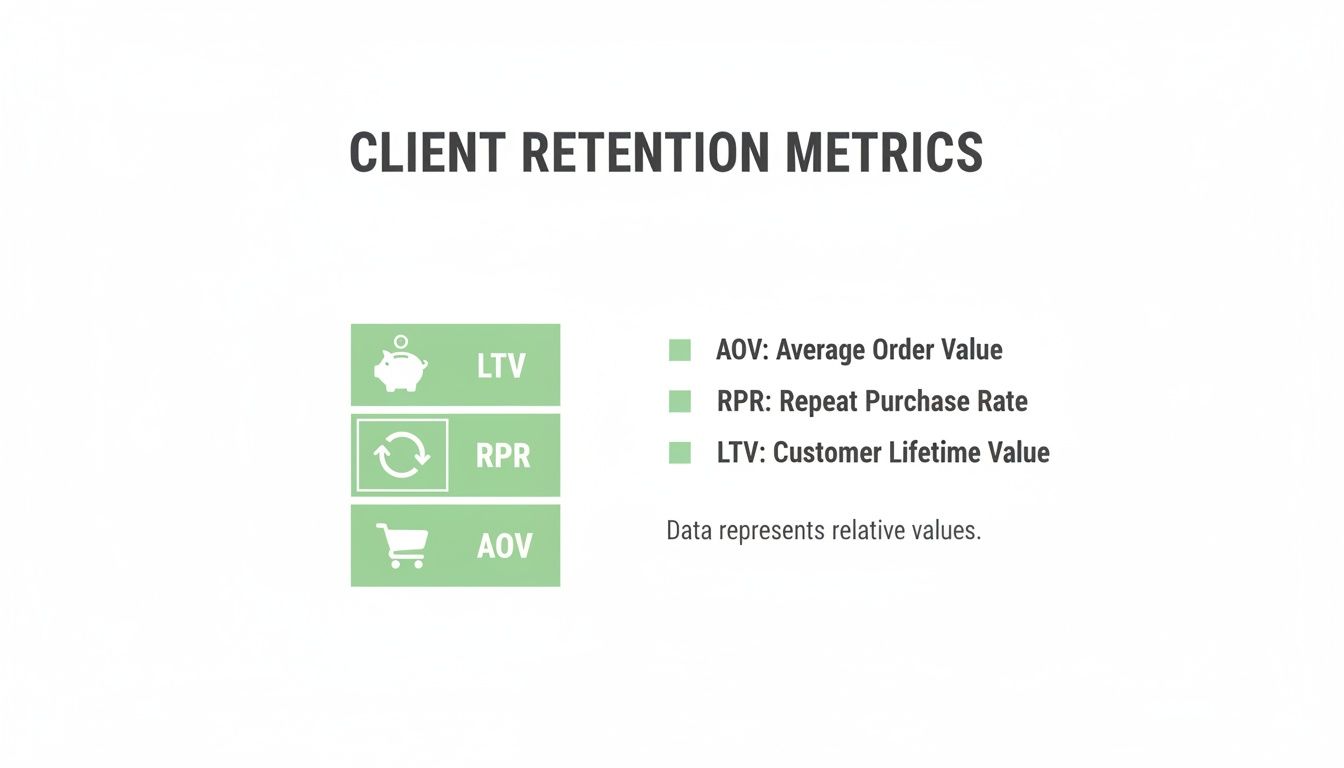
As you can see, store credit programs are designed to directly juice up your AOV, RPR, and LTV, creating a powerful feedback loop of profitable growth.
Store Credit: The Ultimate CRR Booster
When you need to give your CRR a lift, a seamless store credit program is one of the most powerful tools in your arsenal. It’s not just another discount coupon that gets lost in an inbox. Store credit creates a real, cash-like reason for customers to come back. It directly tackles the root causes of churn by making shoppers feel genuinely valued.
Think about the psychology here. A coupon feels temporary and transactional. Store credit, on the other hand, feels like money in the bank—an asset they own and need to spend. This simple shift reinforces an ongoing, positive relationship with your brand and gives them a compelling reason to choose you over a competitor next time.
By rewarding loyalty with something of tangible value, you shift the customer relationship from a series of one-off purchases to a continuous journey. This is the essence of turning buyers into long-term brand advocates.
This approach doesn't just improve your CRR in isolation. It creates a domino effect across your other key metrics:
It boosts Repeat Purchase Rate (RPR): That credit sitting in their account is an open invitation, a little nudge encouraging them to make that crucial second or third purchase.
It increases Lifetime Value (LTV): As customers return more often, their total spend naturally grows, forging more profitable, long-term relationships.
A well-designed store credit system, especially a native Shopify solution like Redeemly, makes this whole process feel effortless for both you and your customers. It’s a simple, elegant way to ensure your best customers keep coming back for more, turning your retention efforts into a predictable engine for growth. If you're hunting for more practical strategies, check out our guide on how to improve customer retention.
FAQs: Putting Store Credit and Retention Metrics Into Practice
As you start thinking more strategically about customer retention, a few common questions always pop up. Let's tackle the ones we hear most often from Shopify merchants who are considering a switch from discounts to store credit.
Is Store Credit Really That Much Better Than a Points Program?
Hands down, yes. Think about it: store credit is just digital cash. Your customers see a real dollar value they can spend, not some abstract number of points they have to mentally convert. That directness removes all the friction.
There's no "How much is 500 points worth again?" confusion. This simple, tangible value creates a much stronger pull to come back and shop, which is why we see it drive higher redemption rates and better engagement every time.
Points programs feel like a game you might play. Store credit feels like money you've already got waiting for you. That simple shift in perception is why it's a powerhouse for boosting your repeat purchase rate and LTV.
Where Do I Actually Track These Metrics in Shopify?
Shopify's built-in analytics are a great starting point. You can easily find high-level reports for things like your Average Order Value and repeat customer rate, giving you a solid baseline for customer behavior.
But to really see the cause-and-effect of your retention efforts, you need more. A dedicated app will give you a clear dashboard showing exactly how your store credit program is lifting LTV, shortening the time between purchases, and improving other key metrics. You get to see the direct ROI without wrestling with a bunch of spreadsheets.
Won't Giving Out Store Credit Kill My Profit Margins?
It’s a fair question, but the answer is no—in fact, it does the opposite. Unlike a 20% off coupon that slashes your revenue on the spot, the "cost" of store credit only kicks in when a customer actually comes back to make another purchase. And that next purchase is often at full price.
You’re rewarding proven loyalty, not just handing out discounts to attract a one-time sale. This model helps you build a far more profitable and sustainable business because you're investing in the repeat behavior that truly grows your brand by increasing LTV and AOV.
Ready to stop burning profits on one-off discounts and start building real, lasting customer loyalty? Redeemly is a native Shopify solution built to boost AOV, LTV, and your bottom line with a smarter store credit program. See how Redeemly can reshape your retention strategy.


Join 7000+ brands using our apps