How a Store Credit Rewards Program Drives Sustainable Growth
Feb 16, 2026
|
Published
At its core, a rewards program should do two things incredibly well: increase how much customers spend per order and keep them coming back for more. It’s about giving shoppers a genuine, financial reason to return, transforming one-off buyers into a community of loyal fans who drive predictable revenue.
Moving Beyond Discounts to Boost Lifetime Value
For a long time, the standard playbook for Shopify stores was the quick fix of a discount code. It works, sure—for a temporary sales bump. But that approach usually attracts bargain hunters, not brand advocates who will stick around.
This endless cycle of promotions eats away at your profit margins. Worse, it teaches your customers to wait for the next sale, cheapening your brand's value and making it difficult to build a stable financial foundation.
Smart DTC brands are shifting their focus from short-term sales to long-term profitability. The conversation is no longer about chasing the next transaction at any cost. It's about building a predictable revenue stream driven by metrics that actually matter for sustainable growth: Customer Lifetime Value (LTV) and Average Order Value (AOV). This is where a rewards program built on Shopify native store credit changes the game.
The Power of Simplicity with Store Credit
Instead of confusing point systems where rewards feel a million miles away, the most effective strategy uses something simple and powerful: Shopify store credit.
Think of it as putting real cash into your customer's digital wallet—a balance that’s always there, encouraging them to come back for their next purchase. This sidesteps the complexity of points and gives people a clear, immediate incentive to shop with you again, directly boosting LTV.
This isn't just a hunch; it's a reflection of a massive shift in how people shop. The global loyalty market is on track to hit $93.79 billion in 2025, and customers in these programs spend 12%-18% more on average. An incredible 84% of consumers say they’re more likely to stick with a brand that has a loyalty program. It’s no longer a nice-to-have; it's a must-have. You can dive deeper into these retention marketing strategies to see just how critical they've become.
The goal isn't just to reward a purchase; it's to create a compelling reason for the next one. Store credit acts as a magnetic force, pulling customers back to your store by putting money directly into their account, which is the cornerstone of increasing lifetime value.
By building your program around store credit, you create a base of loyal customers who feel genuinely valued and are financially invested in your brand. To see a great example of this in action, check out how the Rewards Advantage Club is structured. Programs like this aren't just about loyalty; they're about building sustainable, profitable growth for the long haul.
Why Store Credit Is Smarter Than Discounts and Points
When you’re mapping out a rewards program, the type of reward you offer is a make-or-break decision. It’s tempting to lean on discount coupons—they seem like a quick and easy way to get a sale. But in reality, they often kickstart a race to the bottom, attracting one-off bargain hunters who don't contribute to lifetime value. You end up just chipping away at your profit margins for a fleeting bump in sales.
On the flip side, you have complex point systems. We've all been there, squinting at a checkout page trying to figure out what our points are actually worth. "Is 1,000 points a dollar or ten dollars?" This kind of confusion just creates friction and can lead to 'breakage'—a pile of unredeemed points that feels more like a broken promise than a genuine reward.
The Psychology of "Cash in Hand"
This is where native Shopify store credit completely changes the game. Instead of a vague discount or a confusing point balance, store credit feels like real money sitting in a customer’s account. Think of it as a dedicated digital wallet, loaded with funds they can only spend with you.
That simple mental shift is incredibly powerful. A customer with a $10 store credit doesn't feel like they're getting a temporary discount; they feel like they have cash to burn. This gives them a real, tangible reason to come back and make another purchase—a core driver of higher lifetime value.
Store credit flips the script on customer rewards. It transforms a one-time transaction into a future investment. The cost is only realized when a loyal customer returns, turning a retention tool into a profit-safe strategy for boosting LTV.
This approach creates a clear, direct path to boosting the metrics that actually matter. The whole system is designed to fuel sustainable growth by focusing on Lifetime Value (LTV) and Average Order Value (AOV), which are the true pillars of a healthy business.
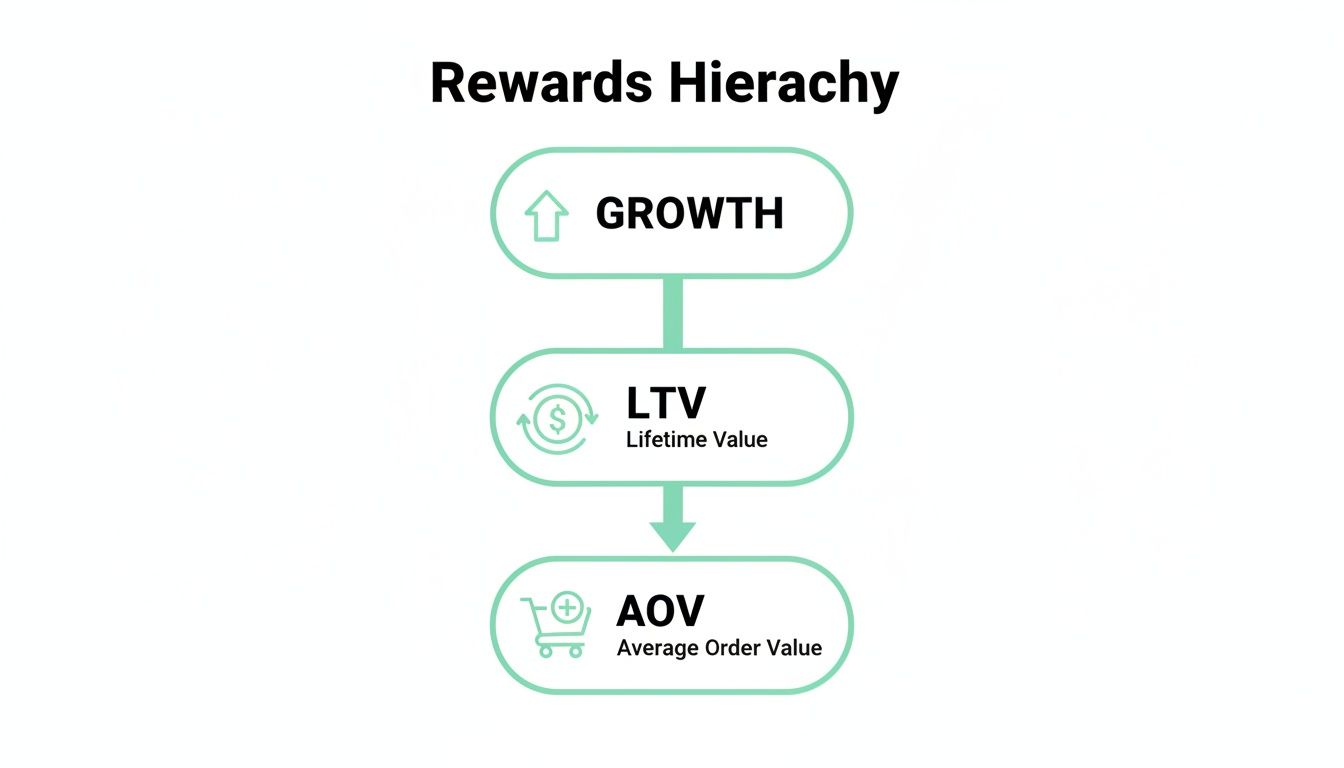
As you can see, it's a simple hierarchy. Smart rewards drive up AOV, which in turn builds LTV, and that's what ultimately leads to long-term, profitable growth.
A Head-to-Head Comparison of Rewards Models
Not all rewards are created equal. The model you choose has a direct impact on your margins, customer lifetime value, and your ability to drive repeat business. Here’s a breakdown of how the three main approaches stack up.
Metric | Discount Coupons | Points Systems | Shopify Store Credit |
|---|---|---|---|
Margin Impact | High. Erodes profit on the spot. | Moderate. Delayed cost but can be complex to model. | Low. Cost is deferred and tied directly to a repeat purchase. |
Customer Perception | Transactional. "I got a deal." | Gamified. "I'm earning something abstract." | Ownership. "I have money to spend." |
LTV Impact | Weak. Attracts one-time deal seekers. | Moderate. Can be effective if the system is simple. | Strong. Creates a powerful psychological pull to return. |
Simplicity | Simple for the customer. | Often complex. Requires calculation and understanding. | Crystal clear. A dollar value is a dollar value. |
Ultimately, while discounts and points have their place, store credit offers a far more strategic advantage by creating a "closed-loop" economy within your store, encouraging repeat visits and higher spending without sacrificing your bottom line.
Driving Real Engagement and Higher Spending
Here’s the thing about rewards programs: their real power is unlocked when customers actually use their rewards. While roughly 50% of rewards get used on average across all programs, the customers who bother to redeem them are absolute gold. They spend 3.1 times more annually than customers who don't. This is especially true for younger shoppers—a whopping 94% of millennials actively look for ways to maximize their bonuses. You can dig deeper into these trends and learn how consumers engage with loyalty programs.
Store credit taps directly into this behavior by making redemption effortless. There are no hoops to jump through, no complicated math. It's just a clear dollar amount waiting to be applied at checkout. This not only encourages customers to come back sooner but also pushes them to spend more than their credit balance, directly lifting your average order value and, over time, their lifetime value.
How Store Credit Instantly Boosts Average Order Value
One of the first things you'll notice when you switch to a store credit rewards program is the immediate lift in your Average Order Value (AOV). This isn’t just about long-term loyalty; it’s about making each sale bigger and more profitable right at the checkout.
Unlike a discount that just eats into your revenue on an already-decided cart, store credit gets customers to actively spend more to earn a future reward.
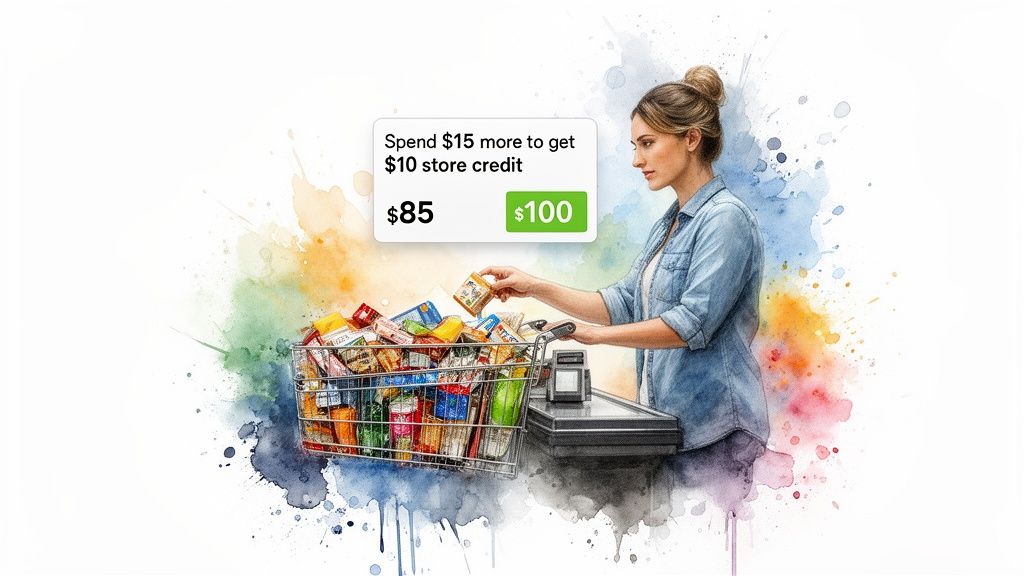
Think about it from your customer's perspective. Let's say someone is about to check out with $85 worth of products in their cart. A traditional 10% discount just means you make less money on that sale. End of story.
But what if we change the offer using store credit? This is where the magic happens.
The Power of the Next Reward
Instead of offering a discount on their current cart, you show them a simple message: "Spend just $15 more to get $10 in store credit."
That little nudge completely reframes their mindset. All of a sudden, they’re not just finishing a purchase; they’re on a mini-quest to unlock a future reward. This simple gamification is incredibly powerful, and it motivates them to pop back to your store and find one more thing to tip their cart over that $100 threshold.
Just like that, an $85 cart becomes a $100+ order.
You’ve not only increased the value of that specific transaction, but you've also protected your margin on the initial $85. That $10 in credit is an investment in their next purchase, and it only gets "spent" when they come back to your store—where they’ll almost certainly spend more than the credit itself, further boosting LTV.
Store credit reframes the transaction from "how can I save money now?" to "how can I earn value for later?" This simple shift is the key to motivating customers to increase their cart size in the moment, directly boosting AOV.
This is a fundamentally more profitable move than a blanket discount. The customer feels like they've won by earning a valuable reward, and you win by banking a higher-value sale right now. For more ideas on this topic, check out our guide on how to increase average order value.
The real beauty here is how it taps into basic human psychology. We’re all wired to respond to clear goals. Giving someone an achievable spending target with a cash-like reward at the end is far more compelling than confusing points or a simple percentage off. It turns your rewards program into an active sales tool that elevates both AOV and LTV.
Building Your Customer Lifetime Value Engine with Store Credit
Getting that first sale is a great start, but the real money is made on the second, third, and fourth purchase. That's where you turn a one-time buyer into a high-value repeat customer, and a store credit program is the best engine to power that journey. It gives customers a powerful, tangible reason to come back.
Think about the psychology at play. A discount code feels temporary; it's used once and forgotten. But earned store credit? That feels completely different. It feels like money your customer has already invested in your brand—their money, just sitting in their account, waiting to be used.
This subtle shift creates a sense of ownership. That store credit becomes a constant, gentle nudge, a magnetic pull that brings shoppers back to your store far more effectively than any generic "we miss you" email ever could, directly contributing to a higher customer lifetime value.
Reactivating Shoppers and Driving Repeat Purchases
One of the biggest wins with a store credit system is its incredible power to wake up "sleeping" customers. To really make this sing, you'll want to lean into automation; after all, email automation is key to building customer loyalty.
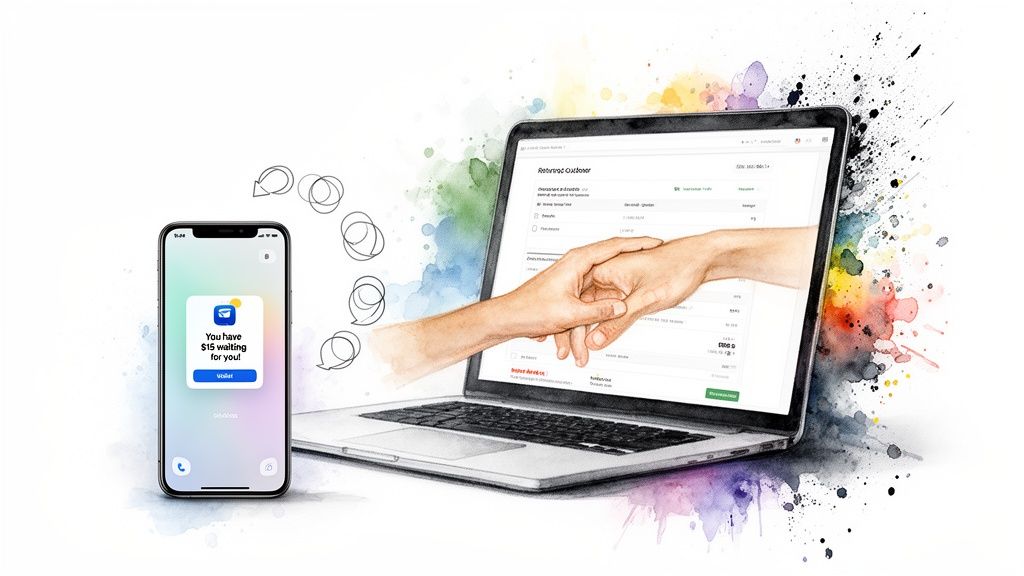
Automated reminders are a game-changer when they have real value attached. An email with the subject line, "You have $15 waiting for you!" is going to get a lot more clicks than a vague "Come back and see what's new." It's a direct, compelling trigger that gets people back on your site with an immediate reason to browse.
And the data doesn't lie. Customers who redeem rewards spend 3.1 times more each year than those who don't. When the rewards are personalized, that number skyrockets to 4.3 times higher. This is precisely why a store credit system is such a powerful tool for boosting customer lifetime value (LTV).
Store credit doesn't just reward past behavior; it actively shapes future actions. It creates a virtuous cycle where customers spend more to earn, then return to redeem—often spending far more than their credit balance—building a powerful and profitable retention engine that maximizes LTV.
This flywheel effect is the secret to sustainable growth. You’re not just giving something away; you’re investing in your next sale. You’re turning one-time buyers into loyal repeat customers, and loyal customers into your most profitable brand evangelists—all without killing your margins with upfront discounts.
How to Launch Your Shopify Store Credit Program
So, you're ready to get a store credit program up and running? The great news is that it’s far simpler than you might imagine. Forget about clunky, third-party apps that bog down your site speed. The best way forward is a native Shopify solution that keeps things fast and seamless for you and your customers.
The ideal setup is a no-code experience that works straight out of the box. That means you can launch in minutes—not days—without needing a developer. This approach lets you start seeing a real impact on your AOV and LTV almost immediately.
Step 1: Configure Your Earning Rules
First, decide how your customers will earn credit. Keep it simple. Overly complicated tiers and confusing calculations just create friction and turn people off.
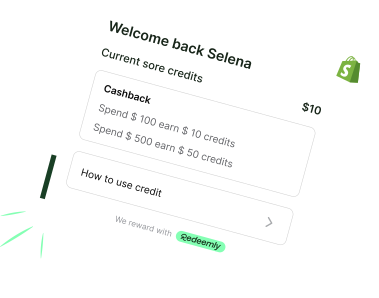
A straightforward, spend-based rule works wonders. A classic example is “Spend $100, get $10 in store credit.” This clear, attainable goal naturally encourages shoppers to bump up their cart size to hit that reward, directly increasing average order value. You set the rules once, and the system automatically issues credit as soon as a customer qualifies.
Step 2: Make Rewards Visible On-Site
A rewards program that nobody knows about isn't much of a program at all. To actually change customer behavior, they need to see their balance and understand exactly how to earn more. This is where on-site messaging is critical.
A floating wallet widget is a brilliant tool for this. It can sit quietly on your site, serving as a constant reminder to logged-in customers that they have "cash" waiting to be spent. This small touch makes their store credit balance feel less like an abstract number and more like a tangible incentive, pushing them to browse for their next purchase.
A visible store credit balance acts as a constant, low-pressure sales assistant. It reminds customers of their investment in your brand and gives them a compelling reason to start shopping, turning a passive visit into an active buying session.
Step 3: Automate Post-Purchase Engagement
The customer journey doesn’t stop once the order is confirmed. The window right after a purchase is your golden opportunity to tee up the next sale and build lifetime value. This is where automated post-purchase emails do the heavy lifting.
You can set up simple, automated emails that ping a customer the moment they earn credit. A friendly message like, “Congratulations! You’ve just earned $10 in store credit for your next order,” reinforces the value they just received and plants the seed for their return. This simple follow-up keeps your brand top-of-mind and helps turn a one-off transaction into a long-term relationship. If you want a closer look at the mechanics, check out our guide on how to give store credit on Shopify.
Step 4: Track Your Success
Finally, you can’t know if a program is truly working unless you track its financial impact. Don't get distracted by vanity metrics. You need to focus on the numbers that tie directly back to profitability and growth.
Your Key Performance Indicators (KPIs) should be laser-focused on business outcomes:
Repeat Purchase Rate: Are customers coming back to buy more frequently since you launched the program?
Average Order Value (AOV): Are shoppers spending more per order to reach those reward thresholds?
Customer Lifetime Value (LTV): Is the total revenue you generate from each customer growing over time?
By keeping a close eye on these core metrics, you’ll have hard data to prove the ROI of your store credit program and see firsthand how it’s fueling your business.
Your Questions About Store Credit, Answered
Jumping into a new rewards program is a big step, so it’s smart to have questions. I get it. After helping hundreds of Shopify merchants make the switch from discounts and points, I’ve heard them all.
Let's walk through the most common concerns I hear from store owners just like you.
Will This Just Eat Into My Margins?
This is easily the number one question, and the answer is always a relief: No. In fact, a store credit program is one of the best ways to defend your margins.
Think about it this way: a 20% off discount is an immediate, guaranteed hit to your revenue on that very sale. Store credit, on the other hand, is a deferred liability. You only "pay" for that reward when a happy customer comes back to make another purchase—which is exactly what you want them to do!
It completely flips the script. The cost of the reward is directly tied to a repeat sale, ensuring your investment in loyalty actually generates future revenue and protects your profitability.
How Does Store Credit Actually Increase Lifetime Value?
Customer Lifetime Value (LTV) is the long game. It’s the total amount a customer spends with you over their entire relationship, and store credit is your secret weapon for growing it.
A $10 credit sitting in a customer’s account is more than just a number; it’s a powerful psychological nudge. It feels like an open tab, an unfinished shopping trip. It’s a compelling reason to come back for that second, third, and fourth purchase.
This creates a beautiful, profitable loop. Customers spend to earn credit, then come back to spend that credit (almost always adding more of their own money to the cart), and the cycle continues. Each visit strengthens their connection to your brand and steadily increases their LTV.
My Customers Seem to Like Points. Isn't That Better?
Points can feel fun, but they often create a barrier to purchase. You're forcing customers to do mental gymnastics: "Okay, so 500 points equals... what? A free sticker? Half a t-shirt?" This friction kills momentum.
Store credit is brutally effective because it’s simple.
$10 is $10.
There’s no math, no confusion. It’s a clear, tangible value that feels like cash in their pocket. This clarity makes the reward far more motivating and effective at driving repeat business. You’re not asking them to play a game; you're giving them a straightforward financial reason to choose you again. In e-commerce, simplicity always wins.
How Can I Tell if It's Actually Working?
The best part about a Shopify native store credit program is that its success is measured directly in the numbers that matter most to your bottom line.
To see if it’s working, you only need to track a few core KPIs:
Repeat Purchase Rate: Are more customers coming back? This is your clearest indicator of improved retention.
Average Order Value (AOV): Are people spending more per order, maybe to hit that next reward milestone?
Customer Lifetime Value (LTV): Is the total revenue you generate from each customer going up over time?
If these numbers are climbing, your program is driving real, profitable growth. It's as simple as that.
Ready to stop eroding your margins with discounts and start building real, profitable customer loyalty? Redeemly makes it easy to launch a native Shopify store credit program that boosts AOV and LTV without the complexity. Get started with Redeemly today.


Join 7000+ brands using our apps