AOV Meaning Marketing Unlocked for Ecommerce Growth
Jan 21, 2026
|
Published
In marketing, Average Order Value (AOV) boils down to a simple but powerful metric: it’s the average amount of money a customer spends every single time they hit "buy" on your site. Think of it as your store's average ticket size. It's a vital sign that tells you a lot about your customers' spending habits and the overall financial health of your business.
What AOV Really Means for Your Store's Health
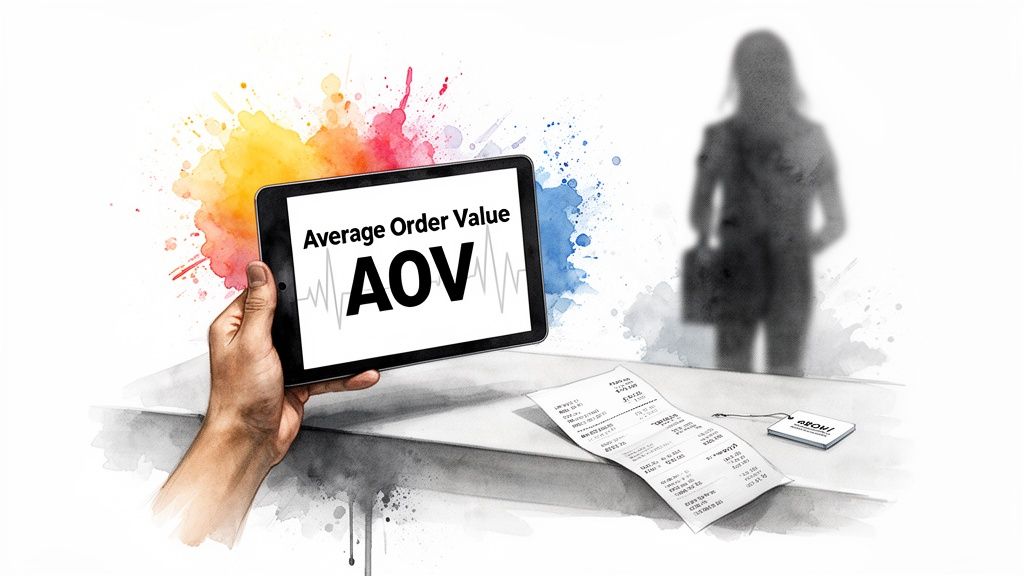
Let's cut through the noise. AOV isn't just another vanity metric to glance at on your dashboard. It’s the very pulse of your e-commerce store. It reveals how much value you're squeezing out of each transaction, long before you even think about finding new customers.
Imagine you run a restaurant. You have two ways to make more money each night: get more people to walk in the door, or convince the diners you already have to add a side dish or dessert. Focusing on AOV is like getting everyone to order that dessert—you're making more money from the traffic you've already worked so hard to get.
Why AOV Is a Direct Lever for Profitability
Shifting your focus to AOV changes the game. You move from a constant, expensive scramble for new customers to a smarter strategy of maximizing the value of the ones you have. This small shift creates powerful ripples across your entire business.
A higher AOV directly pumps up your profitability. Here’s how:
Eases the pressure on ad spend: When each customer spends more, you can afford to pay more to acquire them. This gives your marketing campaigns a much bigger cushion to work with, making them more resilient and effective.
Boosts Customer Lifetime Value (LTV): It’s a simple truth—customers who spend more on their first purchase are often more bought-in. This can lead to greater loyalty, more repeat business, and a much higher LTV down the road.
Fortifies your financial footing: By getting more out of every single transaction, you create a more predictable and sustainable revenue stream. You become less dependent on constant sales and one-off promotions to hit your numbers.
In short, AOV is about making every transaction count. It’s about elevating the quality of your sales, not just the quantity. That’s the secret to building a truly healthy and profitable store in a crowded market.
If you want to dig deeper into your store's current performance and uncover hidden opportunities to drive up your AOV, a professional performance audit for your e-commerce store can give you a clear roadmap.
How to Calculate Your Average Order Value
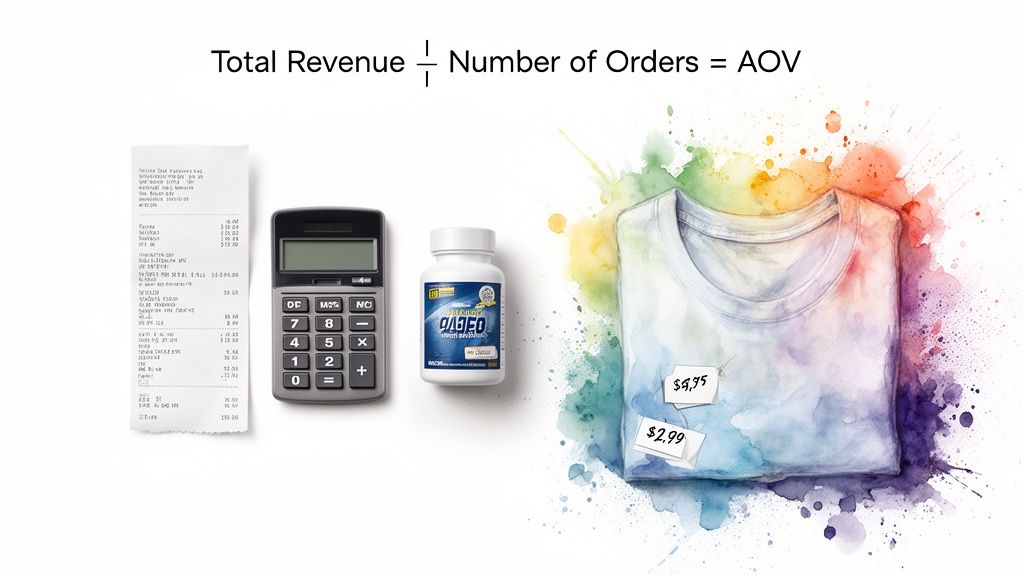
The good news is that figuring out your AOV is refreshingly simple. You don't need any complex software or spreadsheet gymnastics—just one straightforward formula that gets right to the heart of your customer's spending habits.
It’s the first real step toward understanding what your customers are actually worth to you on a per-transaction basis, and it sets the baseline for all your growth efforts.
The formula for AOV is: Total Revenue ÷ Number of Orders = Average Order Value
Once you start tracking this number, you can see the real impact of your marketing campaigns, product launches, and website changes over time. It’s a powerful health metric for any e-commerce store.
Putting the AOV Formula into Practice
So, how does this look in the wild? Let's run the numbers for a couple of common e-commerce scenarios.
Example 1: DTC Apparel Brand Imagine your online clothing store pulled in $50,000 in revenue last month from a total of 1,000 separate orders.
$50,000 (Total Revenue) ÷ 1,000 (Number of Orders) = $50 AOV
This tells you that, on average, a customer checks out with about $50 worth of products in their cart.
Example 2: Subscription Supplement Company Now, let's picture a supplement brand that generated $75,000 from 500 orders, which includes both one-time purchases and recurring subscriptions.
$75,000 (Total Revenue) ÷ 500 (Number of Orders) = $150 AOV
The higher AOV here makes sense, as subscription models often encourage larger, bundled purchases.
By keeping an eye on this metric—whether you check it weekly, monthly, or quarterly—you turn a simple number into a dynamic gauge of your store's performance. For a more detailed walkthrough, you can explore our full guide on how to calculate AOV and apply it to your brand.
How AOV Feeds into a Higher Customer Lifetime Value
While AOV gives you a fantastic snapshot of a single sale, its real magic comes out when you connect it to Customer Lifetime Value (LTV). LTV is the long game—it's the total amount of money a customer is likely to spend with you over their entire relationship with your brand. A higher AOV isn't just a quick win; it's one of the strongest signs of a loyal customer and a profitable future.
Think about it from a customer's perspective. Their first purchase is more than just a transaction; it sets the stage for everything that follows. When someone spends more on that initial order, they're making a bigger psychological commitment to your brand. They've invested more, so they're more likely to feel a connection, actually use your products, and—most importantly—come back for more.
From a Single Sale to a Loyal Fan
This is where so many brands stumble. They get so caught up chasing that first sale with steep discounts that they accidentally train customers to only buy when there's a deal. This race to the bottom absolutely tanks your profit margins and rarely builds the kind of loyalty that sustainable businesses are built on.
A much smarter approach is to find ways to increase that first order's value while also giving customers a great reason to make a second purchase. Forget confusing point systems or coupons that kill your margins. The goal is to give them a reward that actually brings them back.
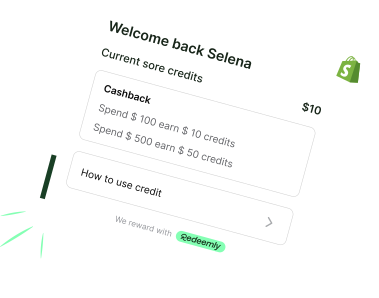
By rewarding a bigger first purchase with store credit that works right in your Shopify store, you're doing more than just bumping up your AOV. You’re building a bridge directly to the next sale. That earned credit feels like cash in their pocket, creating a powerful incentive to return.
The Store Credit Retention Loop
This strategy kicks off a positive growth cycle that practically runs itself. A customer might add one more item to their cart to hit a threshold and earn a $10 store credit reward. Boom—your AOV for that sale just went up.
But here’s the best part: that $10 credit is now waiting in their account, a constant reminder of value they can unlock. When they come back to use it, they almost always spend more than the credit amount, which in turn boosts their LTV. This simple, margin-friendly tactic turns a one-and-done purchase into the start of a long and profitable customer relationship.
To really see how powerful this is, it helps to understand what goes into the formula when you calculate customer LTV and see just how much repeat purchases move the needle.
Benchmarking Your AOV: How Do You Stack Up?
So, you've calculated your Average Order Value. That's a great first step, but the number itself doesn't tell the whole story. Is a $50 AOV good? Is $150 AOV something to celebrate? The honest answer is: it depends.
Without context, a metric is just a number. This is where benchmarking comes in. By comparing your AOV to your industry's average, you can instantly see where you stand. It helps you understand if you're leading the pack, keeping pace, or leaving serious money on the table.
Think of it as a roadmap. A higher initial spend from a customer often kickstarts a powerful cycle, leading to greater lifetime value and, ultimately, a loyalty loop that keeps them coming back.
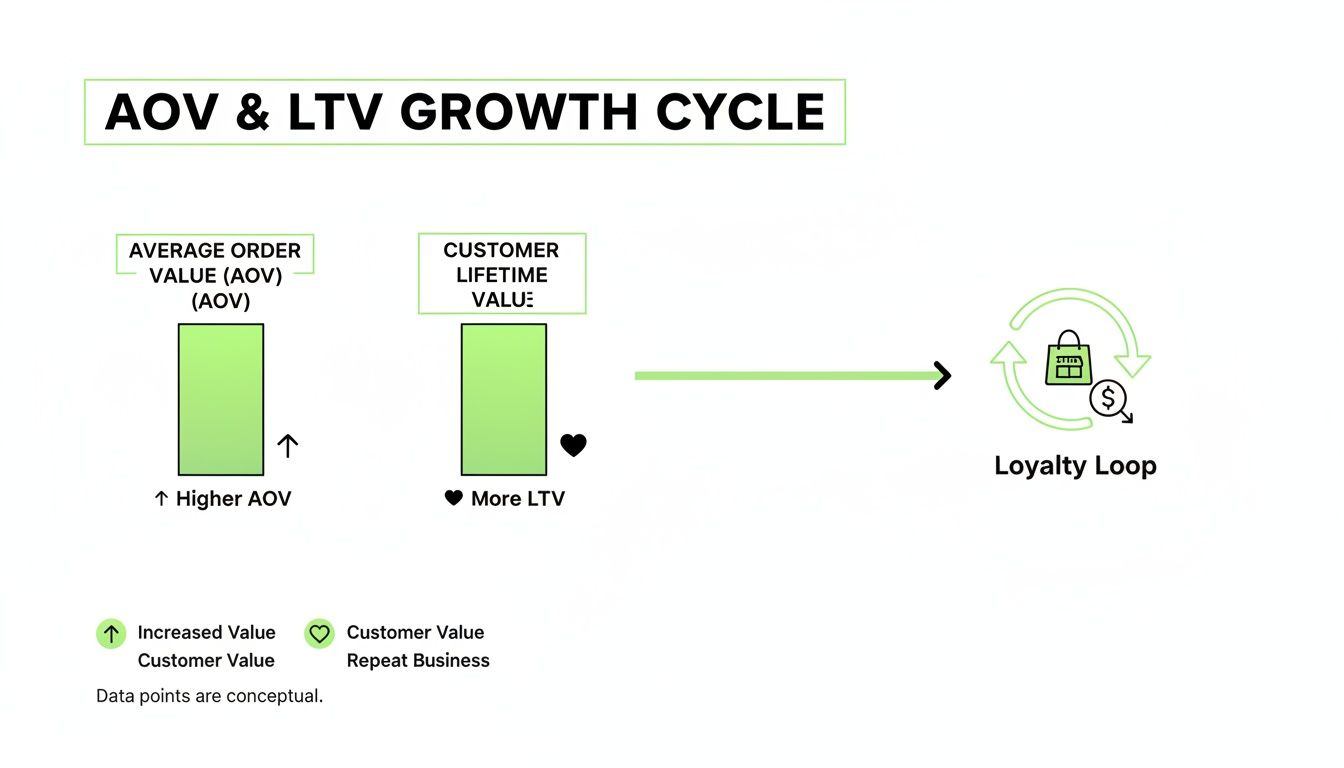
This cycle shows how a bigger first purchase can be the first step in creating a long-term, high-value customer.
Average Order Value (AOV) by Ecommerce Industry
To give you a clearer picture, let's look at some real-world numbers. The table below breaks down the average AOV for different ecommerce sectors, giving you a baseline to measure your store's performance against.
Industry Vertical | Average Order Value (AOV) | Average Revenue Per Customer |
|---|---|---|
Home Goods | $266 | $311 |
Fashion & Apparel | $191 | $225 |
Health & Beauty | $151 | $177 |
Supplements | $70 | $82 |
Source: LittleData, Q4 2023
Seeing these benchmarks immediately puts your own numbers into perspective. If you're in the supplements space and your AOV is $50, you now know that a $70 average is not just possible—it's the norm. Suddenly, you have a clear, achievable target.
Shopping Habits: Device Matters More Than You Think
Another fascinating layer to this is how people shop. The device a customer uses can have a surprisingly big impact on how much they're willing to spend in a single transaction.
Desktop: $204
Tablet: $144
Mobile: $137
People shopping on a desktop still spend the most, likely because the larger screen makes it easier to browse and compare products. This doesn't mean you should ignore mobile—far from it—but it highlights the importance of optimizing the experience on every device to close any spending gaps. For a deeper dive, you can explore more e-commerce benchmarks and see how your store truly compares.
By grounding your goals in real-world data, you move from guesswork to strategy. You can set realistic targets and build a clear plan to encourage every customer to add just one more thing to their cart.
Five Margin-Friendly Strategies to Boost Your AOV
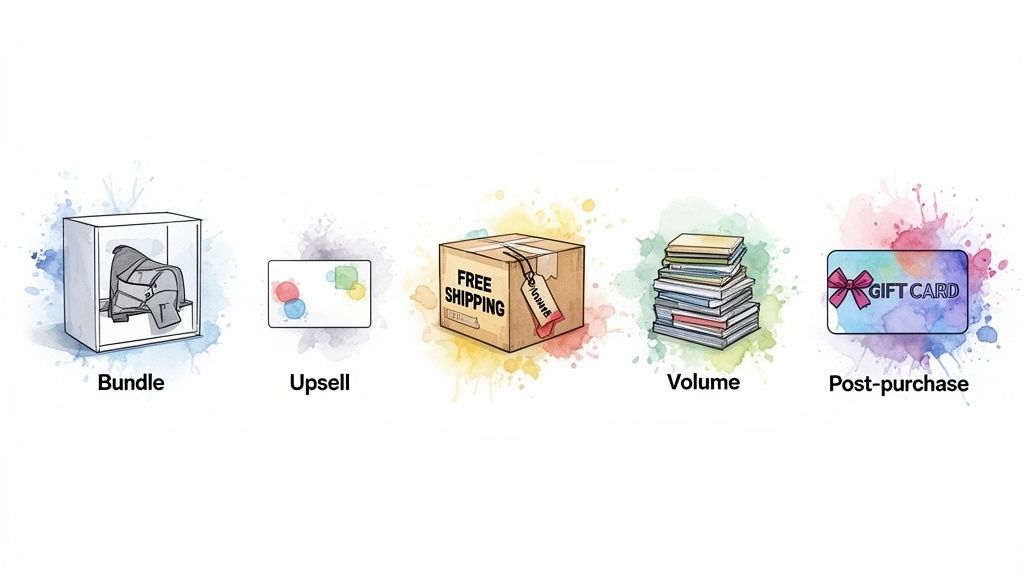
Knowing what AOV means is one thing, but actually growing it without torching your profit margins is where the magic happens. Forget sitewide discounts that eat into your bottom line. These five strategies are all about adding real value to the shopping experience, which naturally encourages customers to spend a little more.
The best part? If you're running a Shopify store, you can put these tactics into play almost immediately.
Create Irresistible Product Bundles
Product bundling is a classic for a reason—it just plain works. Instead of selling a single cleanser, why not offer a "Skincare Starter Kit" that includes a moisturizer and toner? You're not just selling products; you're selling a complete solution.
This approach makes the customer's decision easier while increasing the perceived value of their purchase. It’s an easy "yes" for them and a clear win for your AOV.
Implement Smart Upsells and Cross-sells
The art of the upsell isn't about being pushy; it's about being genuinely helpful. The moment a customer adds something to their cart is the perfect time to show them a relevant upgrade or a complementary item.
Cross-sell: Think of it as suggesting the perfect case to go with the new phone they just picked out.
Upsell: This is about offering a larger bottle of their favorite supplement for a much better price-per-ounce.
When the suggestion is relevant and logical, it feels less like a sales pitch and more like a helpful recommendation. This builds trust and naturally nudges the cart total higher. Ultimately, a higher AOV is a key part of a bigger picture. You can explore other proven strategies to increase online sales to see how everything connects.
Set Strategic Free Shipping Thresholds
Let's be honest, nobody likes paying for shipping. It's one of the top reasons people abandon their carts. You can flip this common pain point into a powerful sales driver by offering free shipping for orders over a certain amount.
The key is setting that threshold just slightly above your current AOV.
For example, if your average order is $80, try setting the free shipping mark at $100. You'd be surprised how many people will happily add another item to their cart just to save on shipping, giving your AOV a direct boost.
Use Post-Purchase Offers
What if you could increase an order's value after the customer has already paid? That's the beauty of a post-purchase offer. Right after they click "complete purchase," but before they even see the confirmation page, you present them with a special, one-time-only deal.
It’s a completely risk-free way to increase AOV because it can't possibly interrupt the original sale. This is a golden opportunity to capture an impulse buy on a small, relevant add-on, increasing the total value of that single customer interaction.
Why Store Credit Is Your Strongest AOV and LTV Lever
The strategies we've covered so far are great for a quick win, but they mostly focus on a single transaction. If you want to build a truly sustainable growth engine, you need to think bigger. It's time to move beyond fleeting discounts and clunky points systems and embrace a simpler, more powerful alternative: Shopify-native store credit.
Think about it. A 20% off coupon is a one-and-done deal—used and forgotten. But earned store credit? That feels like real money just waiting to be spent in a customer’s account. It creates a magnetic pull, encouraging shoppers to toss one more item into their cart to hit that next reward tier. This gives you an immediate AOV boost while paving the way for their next purchase.
The Virtuous Cycle of Store Credit
What you're really creating is a self-fueling growth loop that discount codes just can't replicate. A higher AOV on today's purchase funds the credit for tomorrow's, pulling customers back into your orbit again and again. And because store credit only becomes a cost when it's actually redeemed, you're protecting your margins while building an incredible retention machine. It’s just a cleaner, smarter way to do loyalty.
The data backs this up, especially when you look at different industries. A Home Goods store might already enjoy a hefty $266 AOV, but what about brands in Supplements ($70)? For them, a retention-focused strategy that increases both AOV and LTV is everything. A store credit system is the perfect tool to lift AOV and is a game-changer for merchants who need margin-friendly ways to drive repeat business. You can dive deeper into how these industry benchmarks highlight growth opportunities.
Store credit transforms a single AOV boost into a long-term LTV asset. It simplifies the customer experience, protects your profits, and gives shoppers a tangible reason to choose your brand again and again.
This whole approach is designed to build a fiercely loyal customer base. It’s a simple shift with a massive impact on your bottom line. To get started, you can learn more about implementing Shopify store credit as the heart of your retention strategy.
Got Questions About AOV? We've Got Answers.
Here are a few common questions we hear from merchants trying to get a handle on their Average Order Value.
So, What’s a “Good” AOV Anyway?
Honestly, there’s no magic number. A “good” AOV is all about context. A fine jewelry brand might see an AOV of $300 and feel great, while a company selling supplements could be thrilled with $70.
The real benchmark isn't some universal figure; it's how you stack up against your direct competitors. Figure that out, and you’ll have a much clearer, more realistic target to aim for.
How Can I Nudge AOV Higher Without Slashing My Prices?
This is the million-dollar question. Forget discounts—they just train your customers to wait for sales. The smarter play is to add more value to their cart.
Think about things like product bundles that solve a complete problem, a free shipping threshold that’s just one small item away, or thoughtful cross-sells that genuinely complement what they’re already buying. But the real powerhouse? Store credit rewards. You’re not just giving a discount; you're giving them a reason to spend more now to get money back for later. It boosts AOV and builds loyalty without crushing your margins.
What’s the Link Between AOV and Customer Lifetime Value?
They're two sides of the same coin. A customer who spends more on their very first purchase is sending a strong signal—they're invested. A higher AOV is often the first chapter in a long story of repeat purchases.
This is where strategies like store credit really shine. You get that initial AOV bump, but you also give that customer a compelling reason to come back. That first big purchase becomes the foundation for a long-term, profitable relationship, turning a one-time win into a sustained boost in lifetime value (LTV).
Ready to stop giving away your profits with discounts? Redeemly swaps them out for smart, Shopify-native store credit that bumps up your AOV and turns new buyers into loyal fans. Start growing profitably today.


Join 7000+ brands using our apps