What Is a Good Conversion Rate on Shopify in 2026
Mar 5, 2026
|
Published
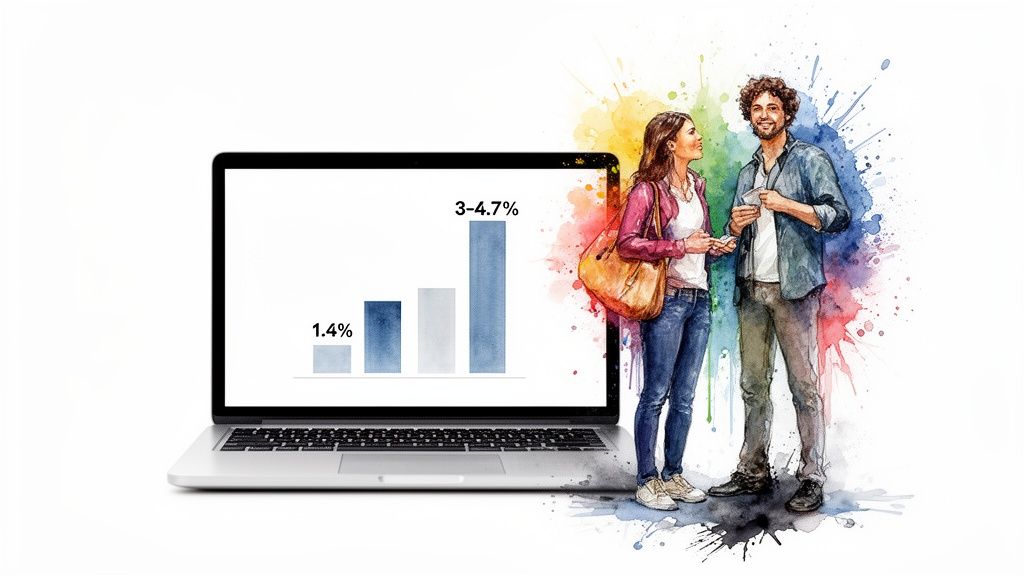
Alright, let's get straight to the point. Everyone wants to know the magic number for a "good" Shopify conversion rate. If you’re hitting between 3% and 4.7%, you’re doing great—that puts you in the top 20% of all stores on the platform.
But here’s the thing most people miss: The average store barely scrapes by at 1.4%. Chasing that average is a losing game. The real secret to building a lasting ecommerce brand isn't just about getting one-time sales; it's about boosting customer lifetime value (LTV) and average order value (AOV) without having to slash your prices.
Your Quick Guide to Shopify Conversion Rates
Understanding your conversion rate is the first step, but it’s so much more than a number on a dashboard. Think of it as your store’s report card. It tells you how effectively your marketing, product pages, and checkout process are all working together to convince a visitor to become a customer.
Too many store owners get obsessed with this single metric. They throw endless discounts and confusing loyalty point systems at the wall, hoping something will stick and nudge that percentage up. This is a classic short-term fix that can absolutely kill your profitability. You’re essentially training your customers to wait for a sale, which cheapens your brand and eats away at your margins.
Forget the Average, Focus on Growth
A much smarter approach is to zero in on the metrics that actually build wealth over time: customer lifetime value (LTV) and average order value (AOV). Instead of asking, "How do I get this one sale today?" start asking, "How can I increase the value of each customer and keep them coming back?"
That simple shift in perspective is what separates the stores that struggle month-to-month from the brands that see real, sustainable growth. You stop chasing expensive one-off transactions and start building a loyal community that generates predictable revenue. This is exactly where margin-safe incentives, like native Shopify store credit, can be a total game-changer.
Shopify Conversion Rate Performance Tiers (2026)
So, where does your store really stand? The table below breaks down performance tiers based on data from millions of Shopify stores. Use these benchmarks not just to see how you stack up, but to set realistic goals for where you want to be.
Performance Tier | Conversion Rate | What It Means for Your Store |
|---|---|---|
Elite | 4.7% + | You're in the top 10%. Your store experience is exceptional, and customers find it incredibly easy and compelling to buy from you. |
Top Tier | 3.2% – 4.6% | You're in the top 20%. You're doing most things right, with clear opportunities to optimize for even better performance. |
Average | 1.4% – 1.8% | This is where most stores land. It's a sign that your store is functional, but there's significant room for improvement. |
Needs Work | < 1.4% | Your store is likely facing major friction in the buying journey. It's time to diagnose and fix the core issues. |
As you can see, the gap between an "average" store and an "elite" one is huge. According to recent data analyzing over 6.9 million stores, the difference between the bottom 80% and the top 10% is massive. You can explore more Shopify conversion benchmarks on redstagfulfillment.com to see the full picture.
Ultimately, bridging that gap isn't about getting just any visitor to convert. It's about converting the right visitors into high-LTV customers who will form the foundation of your business for years to come.
Why Chasing Averages Can Hurt Your Profitability
So, you see that the average Shopify conversion rate is 1.4% and think, "Okay, that's my target." It seems logical, but be careful—chasing that number with the wrong tactics can be a trap that slowly drains your profits.
Think about how many stores hit that average. A lot of them do it by running constant, aggressive sales. They train their customers to wait for a discount, creating a dangerous race to the bottom where your margins get thinner and thinner.
When your only goal is hitting a certain conversion percentage, it’s all too easy to justify a big, flashy sale. A 20% off coupon will almost certainly get you more sales and bump up your conversion rate for a little while. But it also carves a huge chunk out of your profit on every single order. Even worse, you're attracting bargain hunters, not building a loyal customer base with high LTV.
The Problem with One-Time Sales
Here’s the real kicker: those discount-driven sales rarely turn into repeat business. You spend a fortune on ads and give up your margin to acquire a customer, only to have them vanish until your next big sale. It's the fastest way to burn through your marketing budget just to stay in the same place.
Think of deep discounts as a 'sugar rush' for your store. You get a quick, exciting spike in sales, but it’s followed by a crash that leaves your margins depleted and your brand’s long-term health and customer LTV in question.
A much stronger, more resilient business is built by focusing on two other metrics: Average Order Value (AOV) and Customer Lifetime Value (LTV). Shifting your attention here changes the entire game.
From Conversion Rate to Customer Lifetime Value
Instead of asking, "How do I get a sale today?" you start asking, "How can I get this customer to spend a little more and build a relationship that keeps them coming back?" This is how you build a genuinely profitable brand, not just a store that makes one-off sales. It also completely changes what a "good" conversion rate on Shopify actually means for your business.
This high-LTV strategy is the 'nutritious meal' your business really needs. It’s all about creating a core group of loyal, repeat customers who spend more with you over time. Here's how to start reframing your goals:
Boost AOV: Encourage shoppers to add more to their cart with incentives that don't kill your margins. A simple offer like, "Spend $100, get $10 in store credit," can instantly lift your order values without you giving away profit upfront.
Increase LTV: Use rewards like native Shopify store credit to give customers a powerful reason to return. That earned credit feels like cash in their pocket, turning a first-time buyer into a loyal fan.
This approach builds a much healthier and more predictable business. You can dive deeper into the economics behind this in our guide on the cost of customer acquisition vs retention. By prioritizing LTV, you’ll stop chasing empty numbers and start building real, lasting value.
So, what’s a “good” conversion rate on Shopify? The honest answer is: it depends.
Asking that question without context is like asking "how long should a piece of string be?" A rate that’s phenomenal for a store selling high-end furniture would be a massive red flag for one selling coffee beans. To set goals that actually make sense for your business, you have to look past the generic averages and dig into benchmarks for your specific industry and traffic sources.
Think about it—the customer journey for a $50 pair of leggings is completely different from the one for a $5,000 engagement ring. One might be an impulse buy, while the other involves weeks of research. This difference in buying behavior is exactly why conversion rates vary so wildly.
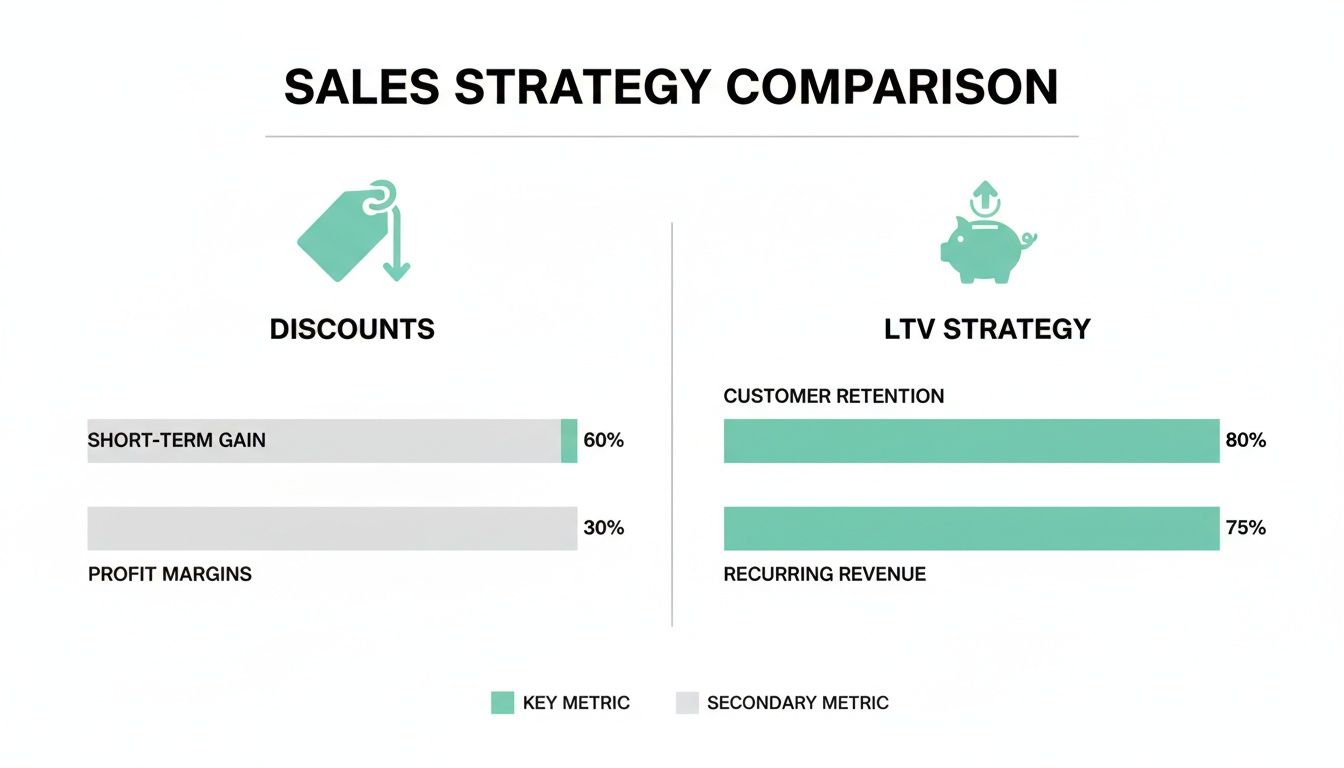
As you can see, chasing short-term sales with constant discounts can eat away at your margins. A smarter approach focuses on building long-term value, often using incentives like store credit to encourage repeat business, higher AOV, and healthier growth.
Industry Numbers Tell a Story
Let's get into the nitty-gritty. Your product category is the single biggest factor influencing what a "good" conversion rate looks like. Industries with frequent, repeat purchases naturally have higher rates than those built around considered, big-ticket items.
Recent analysis from Shopify backs this up. For example, the Food & Beverage industry leads the pack with an average conversion rate of 6.22%, with Beauty & Cosmetics close behind at 4.94%. These are consumables people buy again and again.
On the other end of the spectrum, you have categories with much longer sales cycles. Home & Furniture averages just 1.41%, and Luxury & Jewelry comes in at a slim 0.94%. You can explore more of Shopify's official benchmarks to see how your own niche stacks up.
A 2% conversion rate is absolutely crushing it for a fine jewelry brand, but it would signal deep-seated problems for a pet food store. Your real goal isn't to hit some universal number—it's to outperform the competition in your specific vertical.
How Traffic Source Changes the Game
Where your shoppers come from is just as important as what you sell. Someone who clicked a link in your newsletter already knows who you are and probably likes what you do. They're primed to buy. Contrast that with a first-time visitor who just stumbled across your brand from a TikTok ad—they're in a completely different mindset.
This is why you can't treat all traffic the same. To give you a clearer picture, here’s a quick breakdown of what you can generally expect from different channels:
Email & SMS Marketing: This is your warmest audience. These channels consistently deliver the highest conversion rates, often hitting 5-8% or even more.
Direct Traffic: These are people who type your store's URL directly into their browser. They’re usually loyal customers or highly motivated shoppers, and their conversion rates are typically very strong.
Paid Search (Google Ads): When someone searches for a product you sell, their intent to buy is high. This channel is a workhorse, often converting in the 2-4% range.
Organic Search (SEO): Like paid search, these visitors are actively looking for a solution. They've found you on their own terms, which usually translates to healthy conversion rates.
Social Media (Paid & Organic): Traffic from platforms like Instagram or Facebook tends to have lower conversion rates. Users are often in "discovery mode," not "buying mode," so it takes more work to turn a scroll into a sale.
Shopify Conversion Rate Benchmarks by Industry & Traffic Source (2026)
Compare your store's performance against industry and channel-specific averages to identify your biggest opportunities for growth.
Category/Source | Average Conversion Rate | Top 20% Performance Target |
|---|---|---|
Food & Beverage | 6.22% | 8.5% or higher |
Beauty & Cosmetics | 4.94% | 7.0% or higher |
Home & Furniture | 1.41% | 3.0% or higher |
Luxury & Jewelry | 0.94% | 2.5% or higher |
Email & SMS | 5-8% | 10.0% or higher |
Paid Search | 2-4% | 5.0% or higher |
Organic Search | 2-3% | 4.5% or higher |
Social Media | 1-2% | 3.0% or higher |
By segmenting your analytics this way, you can finally stop comparing apples to oranges. Instead of fixating on one blended, often misleading, conversion rate for your entire store, you can start asking much smarter questions. You'll see which channels are punching above their weight and which ones need a little more love.
This is how you build a strategy that doesn't just lift your conversion rate, but more importantly, grows your customer lifetime value for sustainable, long-term success.
The True Cost of Chasing Conversions with Discounts
Let’s be honest, we’ve all been tempted. Your conversion rate is lagging, and the oldest trick in the ecommerce playbook is calling your name: the discount. Slap a 20% OFF banner on the homepage, and voilà, the numbers tick up. It feels like an easy win.
But here’s the catch. That quick fix is like a shot of adrenaline—a temporary boost that leaves you weaker in the long run. By constantly chasing sales with coupon codes, you're slowly poisoning your brand and gutting your profitability.
You're teaching your customers one simple, dangerous lesson: never pay full price. You’re turning potential brand loyalists into bargain hunters who vanish the moment a sale ends, only to reappear when the next one begins. It's a cycle that not only creates an administrative headache but actively works against building a sustainable business with a high LTV.
How Discounts Quietly Destroy Your Profitability
Every discount code you issue is a direct cut from your profit margin. Sure, it might nudge your conversion rate from 1.4% to 1.7%, but what's the real cost of that bump? You end up selling more product just to make less money. It's a frantic race to the bottom, and nobody wins those.
Worse, this strategy chips away at the two metrics that truly drive growth: Average Order Value (AOV) and Customer Lifetime Value (LTV).
Eroding AOV: Why would a customer explore your catalog and add more to their cart when the discount encourages them to buy the bare minimum and get out?
Destroying LTV: Once a customer gets a deal, they're conditioned to wait for the next one. The incentive to come back and buy at full price is completely gone.
Chasing a higher conversion rate with discounts is a classic vanity metric trap. It makes the numbers on your dashboard look good while your bank account quietly suffers. The real goal isn’t more one-off transactions; it's building more profitable, high-LTV customer relationships.
The Problem with Complicated Points Programs
So, what about points systems? Many brands turn to them, thinking they're a clever alternative. While the intention is good, they often just trade one problem for another. These programs can be a real headache for customers. They're left wondering, "How many points do I need for that?" or "What is this even worth?"
Instead of feeling like a reward, the complexity adds friction and confusion right when you want the buying process to be smoothest. This is the exact frustration so many Shopify merchants feel—stuck between sacrificing their margins with discounts or confusing their customers with points. It feels like a lose-lose situation.
Thankfully, there's a much smarter way to drive sales. It’s time to break the discount addiction and embrace a strategy that protects your margins while actually boosting AOV and LTV. The answer is simple, powerful, and built right into your store: native Shopify store credit.
Boost LTV and AOV with a Store Credit Strategy
If you're stuck in the endless cycle of flash sales and margin-slashing discounts, it's time for a change. Forget confusing points programs that feel like a chore. The answer is simpler and far more powerful: a native Shopify store credit strategy. This isn't just another tactic; it's a fundamental shift that turns one-time bargain hunters into loyal, high-LTV customers.
Instead of handing out a discount that evaporates instantly, you give customers store credit. Psychologically, this is a game-changer. It doesn’t feel like a coupon; it feels like cash in their pocket—money that’s just waiting to be spent at your store.
This simple pivot has an immediate, powerful effect on two of the most important metrics for any ecommerce business: Average Order Value (AOV) and Customer Lifetime Value (LTV). It's how you build a resilient brand that thrives on loyalty, not just transactions.
How Store Credit Instantly Lifts Average Order Value
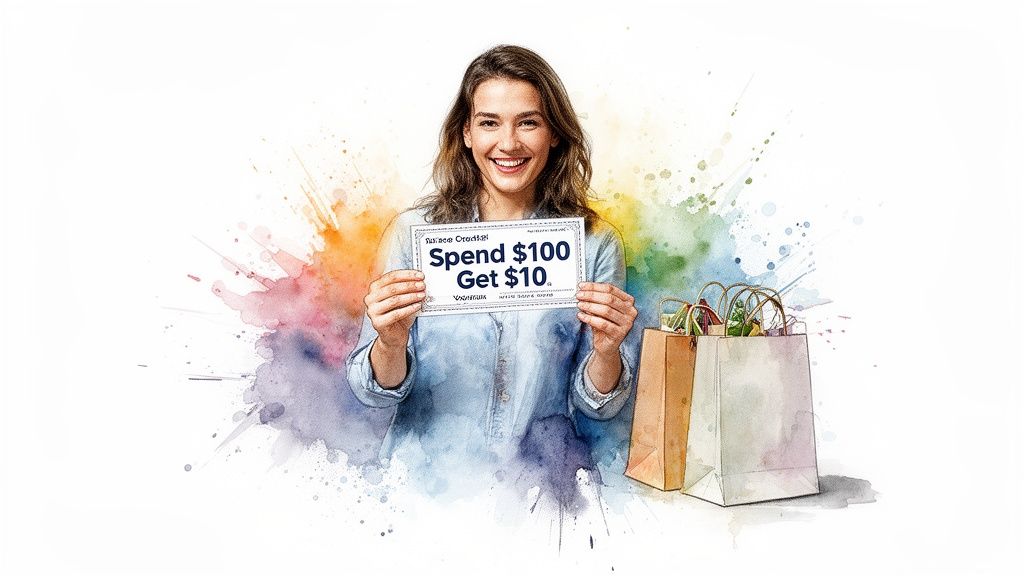
Let’s put this into practice with a classic campaign: "Spend $100, Get $10 in Store Credit." Notice you’re not giving away profit on the current sale. What you are doing is giving shoppers a compelling reason to add just one more item to their cart to hit that magic number.
Think about a customer who has $85 worth of products in their cart. They see that offer, and a quick calculation clicks in their head: "I'm only $15 away from getting $10 back." Suddenly, adding that $20 accessory becomes a no-brainer.
The results are immediate and tangible:
Your AOV climbs.
You move more inventory.
Your profit margins are protected on the initial sale.
The customer feels like they got a great deal, and you just increased the order's value without the steep cost of a site-wide discount. If you want to dig deeper into how these small wins add up, you can explore how to calculate AOV and see its massive impact on your bottom line.
Kickstarting the Loyalty Loop with Earned Credit
That earned $10 in store credit is now a powerful magnet. It's an unused balance that creates a nagging, positive reminder to come back. This is the moment you ignite a profitable loyalty loop, supercharging your customer LTV.
A discount attracts a customer for a single transaction. Store credit builds a bridge to the next one. It’s a direct investment in your store’s future revenue and a clear signal to customers that their loyalty is valued.
This approach is so much cleaner than those clunky point systems that shoppers often ignore. There's no confusing math like "100 points = $1." With a native Shopify store credit system, the value is crystal clear: $10 in credit is simply $10 off at checkout. It’s intuitive, immediate, and incredibly effective.
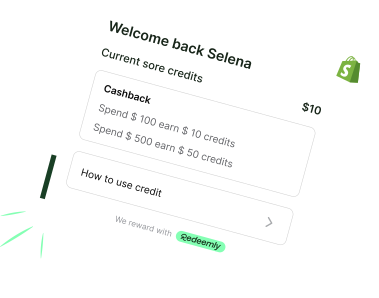
A simple floating wallet widget can constantly remind returning shoppers of their balance, nudging them to browse and buy. For example, a small on-site display can show a customer exactly what they have to spend.
This little reminder keeps the reward top-of-mind, turning an abstract "loyalty point" into a tangible reason to place another order. By focusing on store credit, you stop obsessing over "what is a good conversion rate on Shopify?" and start building a business with an exceptional repeat purchase rate and a sky-high LTV.
Your Profit-Focused Conversion Action Plan
Alright, enough with the theory. Let's talk about putting this into practice and actually growing your profits. Building a truly profitable store isn't an accident; it happens when you deliberately shift your focus from chasing empty metrics to building a loyalty engine with native Shopify store credit.
First things first: you can't know where you're going if you don't know where you are. Before you change anything, get a crystal-clear picture of your current performance. Calculate and write down your baseline conversion rate (CVR), average order value (AOV), and customer lifetime value (LTV). These are your benchmarks, the numbers you'll measure all future success against.
With that baseline in hand, it's time to break some old, unprofitable habits. The biggest culprit? Those blanket, site-wide discounts and confusing point systems. Start weaning your store off them. This is a crucial first step in re-training your customers to appreciate the real value of your products, not just the temporary thrill of a sale.
Launching Your First Store Credit Campaign
Now for the fun part. It’s time to introduce your first targeted store credit campaign. A spend-based reward is the perfect entry point because it’s so simple and effective. An offer like “Spend $100, Get $10 in Store Credit” is incredibly easy for customers to grasp and immediately nudges them to increase their AOV.
Of course, an offer no one sees is an offer that doesn't work. You need to make sure this new incentive is front and center.
On-Site Messaging: Use banners and pop-ups to make the spend-and-get offer impossible to miss.
Email Marketing: Send a dedicated email to your subscribers announcing this new, better way to get value from your store.
Product Pages: A small note near the "Add to Cart" button can be a powerful motivator, showing shoppers just how close they are to earning a reward.
For more practical ideas on this front, it's worth reading this guide on how to improve your e-commerce conversion rates.
The goal isn't just to launch a campaign; it's to build a system. By replacing discounts with store credit, you're not just improving your conversion rate—you're investing in your store's AOV and LTV.
Finally, make sure you're tracking what actually matters. Stop obsessing over daily conversion rate swings. Instead, focus on the long-term trends that build a healthy business: your repeat purchase rate, your profit margins, and the growth of your LTV. You can find more tips on this in our complete guide to conversion rate optimization for Shopify. That’s how you know your strategy is driving real, sustainable growth.
Got Questions? Let's Talk Store Credit
Thinking about swapping out those constant discounts for a store credit program? It’s a smart way to boost your LTV and AOV, but I get it—you probably have a few questions. Let's walk through the concerns I hear most often from store owners.
Isn't Store Credit Just as Expensive as a Discount?
That's a common worry, but let's break down the math. When you offer a 20% discount, that's 20% of your profit gone, right off the top. Instantly.
Store credit, on the other hand, only becomes a "cost" when a customer comes back to spend it. And what does that mean? It means you just secured a second sale. You've turned a one-time cost into an investment in customer lifetime value (LTV), all while protecting the profit on your initial sale.
But Will My Customers 'Get' Store Credit?
Absolutely. In fact, they'll probably find it a whole lot clearer than a complicated points system. Think about it: trying to figure out that "100 points equals $1" takes mental gymnastics.
But "$10 in store credit is $10 to spend"? That's just cash in their pocket.
The beauty of store credit is its simplicity. It feels tangible, like real money, which makes it a much stronger hook for boosting AOV and ensuring repeat purchases that drive up LTV.
How Much Work Is It to Set This Up?
I know what you’re thinking: custom code, clunky integrations, and a slowed-down site. The good news is, it’s not like that at all anymore.
With a native Shopify app, you can have a full store credit system up and running in a matter of minutes. No coding, no developers needed. It all plugs right into your existing checkout, so it’s completely seamless for you and your customers. You can start boosting your AOV and LTV almost immediately.
Ready to stop giving away your margins and start building real loyalty? Redeemly helps you replace confusing points and profit-killing discounts with simple store credit rewards that customers love.


Join 7000+ brands using our apps