A Modern Loyalty Marketing Program That Boosts Lifetime Value
Feb 15, 2026
|
Published
Let's be honest. For too long, we’ve treated loyalty marketing programs as a necessary evil—a cost of doing business. But what if that program is actively hurting your bottom line? For so many brands, the endless cycle of discounts and confusing points systems is a race to the bottom. You’re just training customers to wait for the next sale instead of actually valuing what you sell. It’s a strategy that slowly bleeds your margins dry and fails to build real customer relationships.
Is Your Loyalty Program Secretly Draining Your Profits?
A lot of direct-to-consumer brands stumble into the same trap: building a loyalty program that’s just a glorified discount machine. While these tactics might give you a quick sales bump, they often cause more harm than good over time. You're creating a transactional relationship, not a loyal one, and missing the opportunity to significantly increase customer lifetime value (LTV) and average order value (AOV).
Think of it as a business running on a sugar high. That sudden coupon drop or "double points weekend" gives you a quick burst of energy, but the crash is inevitable. Customers buy, but they also learn to expect these handouts. It devalues your brand and conditions them to never, ever pay full price. It's a vicious cycle that makes building sustainable, profitable growth feel next to impossible.
The Downside of Price-Driven Loyalty
When your loyalty program is built on discounts or complicated points, you're essentially paying customers to come back. It's a strategy that quietly chips away at your profit margins with every single sale. A simple 10% discount isn't just a 10% hit to revenue; it can demolish your net profit, forcing you to sell way more just to break even.
The real problems with this old-school model run deep:
Margin Erosion: Every coupon redeemed is a direct shot to your profits. It messes with the fundamental economics of each sale.
Customer Devaluation: You're unintentionally teaching your best customers that your products aren't worth what you charge for them.
Delayed Purchases: Smart shoppers learn the game. They hoard points or just wait for the next promo email, which throws a wrench in your natural buying cycle and hurts LTV.
A recent report found something startling: only 13% of consumers truly value loyalty programs, while a massive 85% prioritize price. This just goes to show that when your program is just a disguised discount, it completely fails to build any real brand affinity.
The Shift to Profitable Retention
So what's the alternative? It’s about shifting from a cost-first mindset to a profit-first loyalty marketing program. Instead of pushing discounts that cheapen your brand, a smarter approach uses something you already have: Shopify native store credit. This simple tool becomes a powerful reward that encourages future spending without torching your immediate revenue.
Store credit changes the entire dynamic. It turns a transactional relationship into a relational one. For your customer, it feels like real cash in their pocket—a powerful reason to come back and shop again.
This approach directly fuels the two metrics that matter most for long-term growth: customer lifetime value (LTV) and average order value (AOV). By giving customers a reason to spend more to earn credit, you naturally lift your AOV. And that earned credit? It’s a magnet, pulling them back for their next purchase, which boosts LTV and creates a predictable, profitable flywheel for your Shopify store.
For decades, points and discounts have been the go-to tools for loyalty marketing. They seem like the safe, standard way to reward customers, but their hidden costs can quietly eat away at your brand’s health and profitability. It’s time to pull back the curtain on these traditional models and see them for what they often are: roadblocks to increasing LTV and AOV.
The hard truth is that constant couponing does real, measurable financial damage. That simple 10% discount isn't just a 10% loss of revenue. If your net profit margin is 20%, that 10% discount forces you to sell 50% more product just to make the same amount of profit. You end up on a treadmill, running faster just to stand still, all while teaching your customers that your products aren't worth full price.
The Problem with Points Systems
Points systems look engaging on the surface, but they introduce a layer of psychological friction that actually works against you. You’re forcing customers to become mental mathematicians, trying to calculate what their points are really worth.
This confusion almost always leads to a few predictable headaches:
Customer Service Nightmares: Your support team gets bogged down explaining conversion rates ("How much is 100 points worth?") instead of handling actual product questions.
Delayed Purchases: Many customers become "point hoarders," saving up for a big reward that may never come. This behavior stalls their next purchase and completely disrupts natural buying cycles.
Perceived Low Value: When a customer spends $100 to earn 100 points, only to find out it converts to a meager $1 discount, the reward feels underwhelming—almost insulting.
A loyalty program should feel like a genuine 'thank you,' not a complex math problem. When the reward feels disconnected from the purchase, it fails to build an emotional connection and drive the immediate repeat business that boosts lifetime value.
Why Discounts Are a Race to the Bottom
While points create confusion, discounts create a transactional relationship stripped of any real loyalty. You're not building a brand; you're just becoming the cheapest option available, and only when a sale is on. This approach actively harms your ability to grow key metrics like average order value (AOV) and lifetime value (LTV) organically.
The global loyalty market, valued at $15.19 billion in 2025, is projected to soar to an incredible $41.21 billion by 2032. This explosion is happening because brands now rank boosting LTV as their top priority, yet so many are still using outdated discount models that do the exact opposite.
A store credit system, on the other hand, completely flips the script. Instead of discounting the current purchase, you're investing in the next one. It gives customers a tangible, cash-like balance that feels like real money in their pocket, pulling them back to your store without the nasty side effects of coupons. You can learn more about how cash-back rewards create this powerful psychological pull.
Comparing Loyalty Models Store Credit vs Points vs Discounts
To make the contrast crystal clear, let's stack these models up against each other based on the metrics that truly matter for a modern Shopify merchant: LTV and AOV.
Metric | Store Credit Model | Points Model | Discount Coupon Model |
|---|---|---|---|
Margin Impact | Profit-safe. Cost is deferred until a future, profitable sale. | Moderate. Cost is realized upon redemption, but can be managed. | High. Immediately erodes profit margin on the current sale. |
Customer Understanding | Simple. '$10 in credit' is universally understood as cash. | Complex. Requires customers to calculate conversion rates. | Simple. '10% off' is easy to understand. |
AOV & LTV Impact | Increases both. Encourages spending more to earn credit and pulls customers back. | Neutral to low. Hoarding can delay purchases and reduce LTV. | Decreases both. Trains customers to wait for sales and spend less over time. |
Implementation | Seamless. Native Shopify functionality is fast and lightweight. | Complex. Often requires third-party apps and heavy scripts. | Simple. Easy to create codes but hard to manage profitably. |
When you see it laid out like this, the choice becomes obvious. While points and discounts might give you a quick, short-term sales spike, a store credit-based loyalty marketing program builds a sustainable foundation for long-term, profitable growth focused on maximizing lifetime value.
Using Store Credit to Increase LTV and AOV
If you're tired of the complicated, often razor-thin margins that come with points and discount-based loyalty programs, it's time to look at a simpler, more powerful tool right inside Shopify: store credit. This isn't just another way to give something away. It's a strategic lever you can pull to directly boost the two metrics that define sustainable growth: Customer Lifetime Value (LTV) and Average Order Value (AOV).
Something fascinating happens in a customer's mind when they earn store credit. It doesn't feel like a flimsy coupon or a temporary discount. It feels like their money. This "found cash" gives them a real, tangible reason to come back, transforming a one-time buyer into a loyal, repeat customer almost effortlessly.
Boosting Average Order Value on Every Purchase
One of the first things you'll notice with a store credit program is how it naturally nudges customers to spend more. When someone sees they're just a few dollars away from earning their next reward, the motivation to add one more item to their cart is incredibly strong.
Imagine a customer with $85 worth of products in their cart. A simple message like, "Spend $100, get $10 in credit," makes adding a $15 item a no-brainer. They aren't just buying another product; they're actively investing in their next purchase with you. It’s a simple mechanic that works time and again, encouraging shoppers to hit that next threshold.
This is a brilliant way to protect your margins. The customer pays full price on their current, larger order. The store credit you issue only becomes a cost against their next profitable sale. You get a higher AOV today while practically guaranteeing a repeat visit tomorrow.
Supercharging Customer Lifetime Value for Long-Term Growth
While the AOV bump is a great immediate win, the real magic of store credit is its long-term impact on LTV. Earned credit is like a magnet, constantly pulling customers back to your store. A shopper with a $10 balance is far more likely to choose you over a competitor for their next purchase. It's a built-in advantage that keeps them happily locked into your ecosystem.
This "pull" effect is how you build a truly loyal customer base. It creates a powerful, repeating cycle that directly increases LTV:
First Purchase: A new customer buys and earns their first chunk of store credit.
Reason to Return: That credit balance sits in their account, acting as a constant reminder of the value they have waiting.
Second Purchase: They come back to spend their credit, often adding more to their cart to earn the next reward.
Loyalty Loop: This process repeats, slowly turning transactional, one-off purchases into a genuine, long-term relationship.
Protecting Your Unit Economics with a Profit-First Model
Maybe the most important reason to embrace Shopify's native store credit is how it protects your bottom line. When you offer an upfront discount, you're immediately slashing the revenue and profit from that sale. Store credit works completely differently.
When a customer earns credit, it’s simply recorded as a liability on your books—not an instant expense. It only becomes a real cost when the customer comes back and redeems it on a future purchase. You’re only "paying" for their loyalty when it delivers exactly what you wanted in the first place: another profitable sale.
This deferred-cost model makes your loyalty program a true engine for growth, not a drain on your margins. You stop renting loyalty with temporary discounts and start earning it with real value that drives higher spending and more frequent visits. The ultimate goal here is to improve overall business health, a strategy that ties directly into discussions around how to improve e-commerce conversion rates. By making this shift, you're building a healthier, more predictable revenue stream for your Shopify store.
How to Launch a Store Credit Program on Shopify
Let's be honest. Switching from a familiar points system to a store credit program can feel like a big leap. But it’s one of the smartest, most profitable moves a Shopify merchant can make. You’re not just changing how you reward customers; you're fundamentally shifting your loyalty strategy toward boosting lifetime value and average order value, all without handing out margin-killing discounts.
This isn't some complex technical nightmare. It's a clear, straightforward plan to build a more profitable relationship with your customers using Shopify's native functionality.
First things first: set clear goals focused on LTV and AOV. Forget vague targets like "boosting engagement." Get specific. Do you want to increase your repeat purchase rate by 15% in the next six months? Or maybe lift your AOV by $10? Having real numbers to aim for will shape every decision you make, turning your program into a performance-driven machine from day one.
Structuring Your Rewards for Maximum Impact
When it comes to rewards, simplicity always wins. Customers don’t have time to do mental math to figure out what their points are worth. A simple tiered, spend-based structure using Shopify store credit is hands-down the most effective way to encourage bigger carts while being dead simple to understand.
Picture it from a customer's perspective:
Spend $75, Get $5 in Credit: An easy win that feels accessible to almost everyone.
Spend $150, Get $15 in Credit: This is your sweet spot. It rewards your better customers and gives smaller shoppers a reason to add just one more item to their cart.
Spend $250, Get $30 in Credit: Make your top tier feel special but still achievable. It’s the perfect motivation for your best customers to keep coming back.
There’s zero friction here. A shopper immediately gets the value proposition and knows exactly what they need to do to earn their next reward. The best part? You can set up these tiers in minutes using a native Shopify app like Redeemly. No custom code, no headaches. For a deeper dive, check out our guide on how to give store credit on Shopify.
Migrating From an Old Points or Discount System
If you already have a loyalty program, moving your members over is the most delicate part of the process. But don't think of it as a technical chore—it's a massive marketing opportunity. You’re not taking anything away; you're giving them an upgrade from confusing "points" to tangible, cash-like credit.
Your communication plan is everything. Draft an email campaign with a simple, powerful subject line: "Your Points Are Now Cash!" In the email, explain that you’re making the program better and easier for them.
When you make the switch, be generous. Convert their old points balance to an equivalent or slightly higher store credit value. A customer who sees their 1,000 points are now worth $12 instead of $10 will feel valued and excited, not short-changed. It makes the transition feel like a gift.
This whole process is about creating a profitable loop. A customer buys, gets rewarded with Shopify store credit, and is immediately encouraged to come back and spend again.
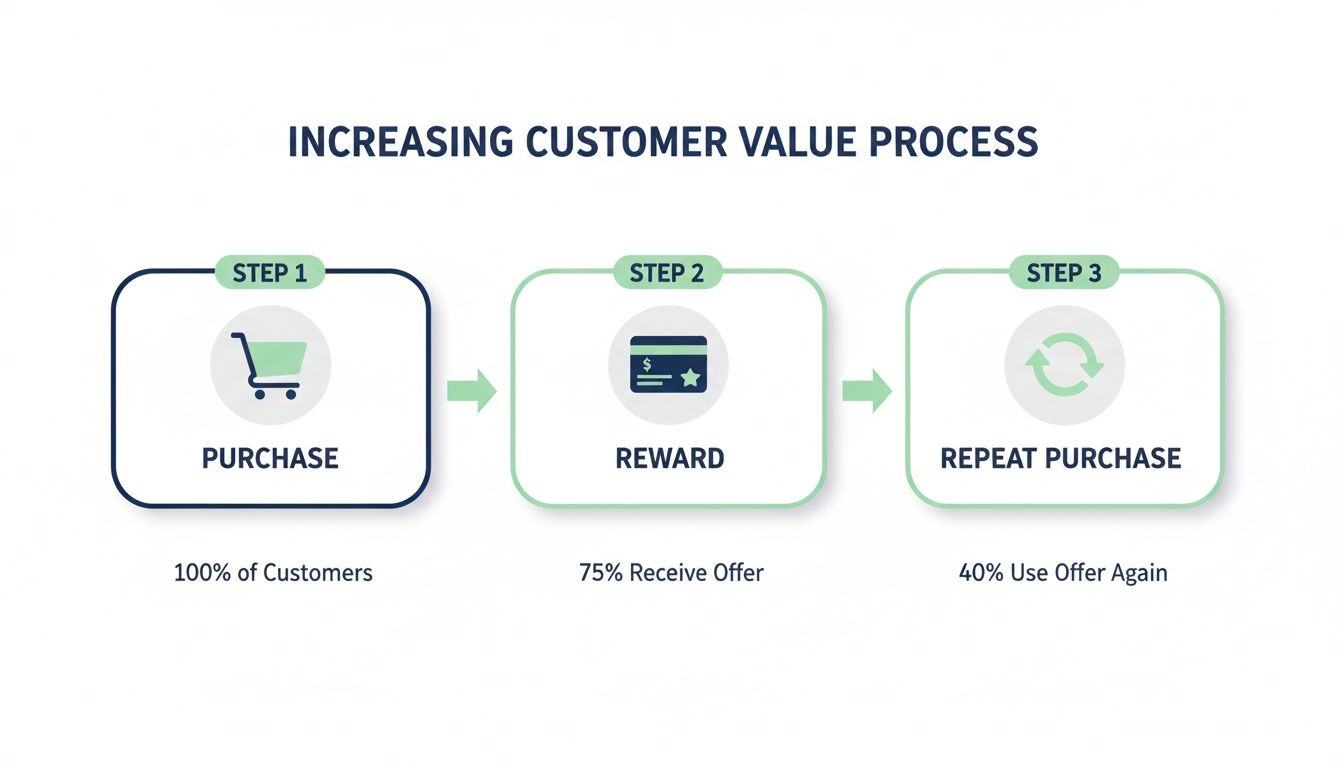
As you can see, the reward isn't just a "thank you"—it’s the engine for the next purchase.
Communicating the Value of Your New Program
Once your new loyalty marketing program is live, you can't be shy about it. It needs to be front and center. Use on-site widgets, email notifications, and post-purchase messages to constantly remind customers about their balance. A simple message like, "You have $10 waiting for you!" is far more compelling than "You have 500 points."
This isn't a new concept; the world's biggest brands have perfected it. Look at Sephora’s Beauty Insider program, which drove a 30% jump in customer engagement by using personalized offers. Their most loyal members spend a staggering 3x more annually. H&M is another great example—their program now drives 35% of total revenue, with top-tier members also spending 3x more than non-members.
It’s no wonder why 60% of businesses are now laser-focused on improving LTV through loyalty. For Shopify merchants, a store credit system is the most direct path to these kinds of results, nudging AOV up and pulling customers back for that next purchase without giving away the farm.
How to Measure Your Program's Success
Getting your new store credit loyalty marketing program live is a huge milestone, but it's really just the starting line. A great program has to deliver real, measurable results that prove its worth to your bottom line. It's time to get into the data—and I mean the right data—to track the Key Performance Indicators (KPIs) that actually signal profitable growth.
The best part about a Shopify store credit system is that its impact isn't a mystery. You're not just guessing if points are "engaging" people; you're seeing tangible lifts in how much they spend and how often they come back. This is all about proving the ROI on your investment in loyalty.
Key Metrics That Actually Matter
Forget vanity metrics like how many people signed up or how many points they cashed in. When you’re focused on profit, your attention needs to be on four critical KPIs that tell the real story of your customer relationships. These are the numbers that prove your program is driving LTV and AOV.
Customer Lifetime Value (LTV): This is the holy grail of loyalty metrics. LTV tells you the total revenue a customer brings in over their entire time with your brand. A successful program will create a clear, undeniable gap between the LTV of members and non-members.
Average Order Value (AOV): This is the average checkout total for each order. With store credit tied to spending thresholds, you should see your AOV climb. It’s simple psychology—customers will happily add another item to their cart to unlock that next reward.
Repeat Purchase Rate: This one’s straightforward: what percentage of your customers come back for a second purchase? That little bit of earned store credit acts like a magnet, pulling them back in. A rising repeat purchase rate is a direct signal that you're building real habits, not just one-off sales.
Program ROI: This is where the rubber meets the road. You need to connect the cost of your program to the value it’s creating. The goal is to see a direct lift in revenue from members that far outweighs the cost of the credit you've issued.
Calculating Your Program's ROI
To know for sure that your store credit program is a winner, you have to prove it's generating more value than it costs. You don't need a data science degree to do this; a straightforward approach can paint a very clear picture.
Here's a simple formula to get you started:
Program ROI = (Gross Profit from Members - Cost of Redeemed Credit) / Cost of Redeemed Credit
This calculation tells you exactly how many dollars in profit you’re generating for every single dollar of store credit you give away. When this number is positive and growing, you have irrefutable proof that your loyalty strategy is a profit center, not a cost center. For a deeper dive, you can learn how to calculate customer LTV and see how it all ties together.
A Real-World Example of Success
Let's look at a real story. A direct-to-consumer apparel brand was stuck in a discount death spiral. Their loyalty program was just a glorified coupon machine, and their repeat purchase rate was flatlining at 22%. AOV was stuck at a stubborn $85 because customers were trained to just wait for the next 20% off email.
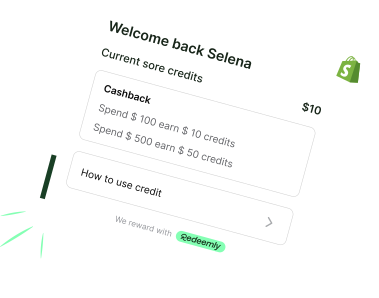
They took the leap and switched to a dead-simple Shopify store credit system: "Spend $100, Get $10 in Credit."
The results within six months were incredible:
Their Average Order Value (AOV) shot up from $85 to $105—a 23.5% increase. Customers were consistently topping off their carts to hit that $100 mark.
The Repeat Purchase Rate jumped from 22% to 34%. That earned store credit was a powerful hook that brought first-time buyers back for a second round.
Because of these two massive improvements, their average Customer Lifetime Value (LTV) saw a major lift, proving their new loyalty program wasn't just a short-term gimmick but a sustainable growth engine.
This brand didn't just tweak their rewards. They fundamentally changed the customer dynamic from a transactional, discount-driven relationship to one built on real, cumulative value. And their bottom line showed it.
Got Questions About Store Credit Loyalty? Let's Clear Them Up.
Even after seeing how Shopify store credit can boost customer lifetime value and protect your margins, it’s natural to have a few questions. Making a change to your loyalty program is a big deal, and you want to be certain it's the right move for your customers and your bottom line.
Think of this section as our final huddle before you launch a program that drives real, profitable growth. We’ll tackle the most common concerns we hear from Shopify merchants to help you move forward with total confidence.
"Will This Just Confuse My Customers?"
This is probably the number one question we get, and the answer is almost always a resounding no. In fact, the opposite is true. Store credit is far more intuitive for customers than trying to figure out what an abstract pile of "points" is actually worth.
Everyone instantly understands that $10 in credit means they have $10 to spend. There's no mental math, no confusing conversion rates, and no friction. It feels like cash in their pocket.
The key to a silky-smooth transition is all in how you communicate it. You aren’t taking anything away; you’re giving them a genuine upgrade.
Frame it as a win: Announce the change with exciting, positive language. Something like, "Great news! We're making our rewards program simpler and more valuable."
Be generous when you switch: As you migrate existing members, convert their old points to an equivalent or even slightly higher store credit balance. It’s a small gesture that builds a ton of goodwill right out of the gate.
Highlight the simplicity: Make it clear that their rewards are now cash-like and will be waiting for them at checkout—no codes, no hassle.
When you use a native Shopify app, this whole experience becomes completely seamless. The credit just shows up automatically, making customers feel rewarded, not confused.
"How Does This Affect My Books?"
This is where store credit truly shines and gives you a massive advantage over standard discounts. A typical coupon immediately slashes the revenue on a sale. Store credit, on the other hand, is booked as a liability on your balance sheet when it's earned.
It only hits your cost of goods sold when a customer actually redeems it on a future, profitable purchase.
This accounting shift is a game-changer for your financials. It protects your cash flow today and preserves the profit margin on the initial sale. Because the cost is tied to a subsequent transaction, you ensure every dollar you spend on loyalty is directly fueling repeat business and boosting your lifetime value. And since it’s all native to Shopify, tracking your issued and redeemed credit is dead simple—no accounting headaches required.
By deferring the cost, you transform your loyalty program from a marketing expense into a direct investment in future revenue. It's a fundamentally healthier, more sustainable way to grow.
"Will a Store Credit Program Even Work for My Niche?"
Absolutely. The beauty of Shopify store credit is its universal appeal. It works across nearly any direct-to-consumer industry because it taps into core psychological drivers that aren't specific to any one niche, like the feeling of reciprocity and the "found money" effect.
The model is incredibly flexible. Let's look at a few examples:
Consumables (Coffee, Supplements, etc.): For products people buy often, store credit is a powerful magnet for that very next order. It helps lock in the repeat purchase and builds a strong buying habit.
Apparel and Cosmetics: In these visual, aspirational markets, store credit is brilliant for encouraging customers to explore new products or add that one extra accessory to their cart, naturally increasing average order value.
High-Ticket Items (Furniture, Electronics, etc.): A significant store credit reward becomes a compelling reason to come back. Someone who just bought a sofa can use their credit for pillows, a side table, or an extended warranty.
You have complete control over the reward structure—"Spend $X, Get $Y"—so you can easily tailor the program to fit your product margins, customer buying cycles, and specific business goals. This adaptability is precisely what makes it one of the most effective loyalty strategies you can implement.
Ready to build a loyalty program that protects your profits while boosting LTV and AOV? Redeemly helps you launch a powerful, native store credit system on Shopify in minutes. Stop giving away your margins with discounts and start building real, sustainable loyalty.


Join 7000+ brands using our apps