How to Increase Customer Lifetime Value Using Shopify Store Credit
Dec 5, 2025
|
Published

If you want to genuinely increase customer lifetime value, it's time to ditch the discounts. For too long, Shopify merchants have been stuck in a cycle of chasing short-term sales with margin-killing coupons and confusing points systems. This approach hurts your profitability and attracts the wrong kind of customer.
The real path to sustainable growth is building profitable relationships. The secret lies in a simpler, more powerful strategy: native Shopify store credit rewards. This approach doesn't just encourage repeat business; it directly boosts your average order value (AOV) and builds the kind of loyalty that elevates your entire brand.
Why Lifetime Value and AOV Are Your Most Important Metrics

In the noise of eCommerce, it’s far too easy to get caught up in vanity metrics. Website traffic and social media likes can make you feel busy, but they don't pay the bills. The two metrics that truly signal the financial health and long-term potential of your business are customer lifetime value (LTV) and average order value (AOV).
LTV is the total revenue you can expect from a single customer over their entire journey with your brand. AOV is the average amount they spend per transaction. Focusing on both prompts a crucial shift in thinking—from scrambling for costly one-off sales to cultivating a loyal community of repeat buyers who spend more each time they shop.
The Problem with Short-Term Thinking
The old eCommerce playbook was all about acquisition. Brands would pour money into ads, often dangling steep discounts to hook new shoppers. This gives you a quick sales bump, but it's a dangerous and unsustainable game. You end up training customers to wait for a sale, which decimates your profit margins and attracts bargain-hunters with zero brand allegiance.
With advertising costs constantly on the rise, this acquisition-at-all-costs model is officially broken. A business built on one-time, discounted transactions is fragile. A business built on repeat, full-price purchases with a high AOV is built to last.
Focusing on LTV and AOV fundamentally changes your business priorities. Instead of asking, "How can we make a sale today?" you start asking, "How can we create a high-value customer for life?" This perspective is the foundation for long-term profitability and brand strength.
This shift isn't just a good idea; it's essential, especially as shopping habits evolve. For instance, recent UK commerce data shows that while overall online sales growth is modest, the average order value (AOV) has climbed by 7%. This tells us that consumers are making fewer, but more considered, purchases. They're spending more each time they check out.
If you'd like to dig deeper, you can explore the full report on the state of UK commerce. This trend is clear proof that getting customers to spend more per order is a massive lever for increasing lifetime value.
The table below illustrates this strategic shift in focus. It's about moving from metrics that measure momentary interest to those that track genuine, long-term value.
Shifting Focus From Acquisition Metrics to Lifetime Value
Metric Focus | Traditional Metric (Acquisition) | Modern Metric (Retention) | Business Impact |
|---|---|---|---|
Customer Value | First-Order AOV | Customer Lifetime Value (LTV) | Shifts focus from a single transaction to the entire customer relationship, maximising long-term revenue. |
Purchase Frequency | Conversion Rate (CR) | Repeat Purchase Rate | Prioritises building loyalty and habit over just getting the first sale, creating predictable income. |
Marketing Efficiency | Customer Acquisition Cost (CAC) | LTV:CAC Ratio | Measures the true ROI of marketing spend, ensuring you're acquiring profitable customers, not just costly ones. |
Order Value | Discount-Driven Sales | Average Order Value (AOV) | Moves beyond volume to focus on the profitability and value of each transaction. |
By reorienting your strategy around metrics like LTV and AOV, you build a much healthier, more resilient business.
The Power of Repeat Customers
The real value of a repeat customer goes far beyond that second purchase. We all know it’s significantly cheaper to retain a customer than to acquire a new one. But the benefits run much deeper.
Loyal customers tend to spend more over time, directly boosting AOV. They trust you. And, most importantly, they become your most powerful marketing channel through authentic word-of-mouth recommendations.
Here’s why a relentless focus on LTV is a non-negotiable for serious Shopify merchants:
Sky-High Profitability: Repeat customers are far more likely to buy at full price, which goes straight to your bottom line.
Predictable Revenue: A solid base of loyal customers smooths out the peaks and valleys, creating stable and forecastable cash flow.
Bigger Baskets (Higher AOV): Customers who trust you are more open to your suggestions, making them perfect candidates for bundles, upsells, and higher-ticket items.
Smarter Marketing Spend: Nurturing existing relationships is infinitely more cost-effective than shouting into the void to find new buyers.
The most direct way to make this happen is to completely rethink your rewards strategy. Stop confusing customers with points and stop destroying your margins with discounts. A simple, tangible reward like native Shopify store credit gives customers a compelling reason to come back and spend more, laying the perfect foundation to successfully increase customer lifetime value.
Ditch Discounts and Points. Embrace Native Store Credit.
Let's be honest. Discount codes are the eCommerce equivalent of a sugar rush. They give you a quick sales spike but are a terrible long-term habit. You're teaching your customers to wait for a price drop, eroding brand value with every coupon. Similarly, points systems are often overly complex, creating a barrier between the customer and the reward.
If you’re serious about increasing customer lifetime value and AOV, it’s time to break that cycle. The most powerful way to do it is by using something already built into Shopify: store credit.
This one simple shift creates a profound psychological change. A 10% off coupon feels temporary. A balance of 500 points feels confusing. But £10 of store credit? That feels like actual cash sitting in their digital wallet. It's a tangible asset, a concrete reason to come back. That feeling of ownership is the key—it turns the next purchase from a vague possibility into a definite plan.
The Psychology: Ownership vs. Urgency
The real magic behind store credit lies in simple human psychology. A discount code works by creating scarcity and urgency. It’s a classic tactic designed to push a sale through right now. It's all about the transaction.
Store credit, on the other hand, cultivates a sense of ownership. When a customer has a credit balance, they have skin in the game. They're financially tied to your brand, which builds a subtle but incredibly powerful form of loyalty. You're not just nudging them into a purchase; you're giving them a prepaid reason to return.
Think of it like this: issuing store credit is like handing a customer a gift card to your own shop. It doesn’t just incentivise a purchase; it makes their next one feel like a smart, savvy decision. They'll come back sooner and feel better about spending.
This simple change moves the entire focus from a one-off sale to an ongoing relationship. And that, right there, is the cornerstone of any high-LTV business.
Watch Your Average Order Value Climb Naturally
One of the best side effects of using store credit is how it naturally lifts your average order value (AOV). Picture this: a customer comes back to your site with £15 of credit. They find something they want for £12.
What happens next is where it gets interesting:
The "Found Money" Feeling: Because that credit feels like free money, customers are suddenly less price-sensitive and more open to adding a little something extra to their cart.
Maximising the Deal: Nobody likes leaving money on the table. To "use up" their full £15 credit, that shopper is highly motivated to find another item, pushing their total order value well past the credit amount.
This isn't an aggressive, pop-up-driven upsell. It's a gentle, customer-led behaviour that directly helps your bottom line. They feel like they're getting a fantastic deal by using their full balance, and you see a bigger basket size without slashing your prices. It’s a win-win.
Keep It Simple, Keep Them Coming Back
Let’s face it, complicated points systems are a headache for everyone. How many points is a pound worth? When do they expire? What are the redemption rules? This friction often leads to customers just giving up or, even worse, hoarding points they never use—creating a liability on your books without actually driving loyalty.
Native Shopify store credit cuts right through that noise.
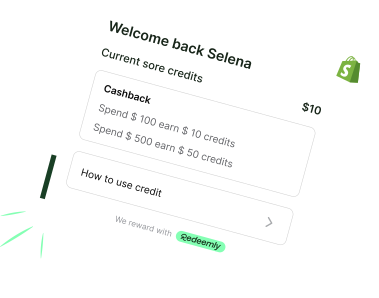
Clarity is everything: £10 is £10. There's no maths, no tiers to figure out. The value is instant and obvious.
Effortless redemption: Native Shopify store credit can be applied automatically at checkout. It's a smooth, frictionless experience that makes customers feel smart, not frustrated.
Protect your brand equity: You’re rewarding loyalty without ever putting a red strikethrough on your prices. Your products retain their perceived value, and you build a base of customers who are happy to shop at full price, knowing they'll be rewarded in a way that feels tangible.
By swapping the chaos of coupons and points for the clean, cash-like value of store credit, you create a far more rewarding journey for your customers. That clarity and real value are exactly what you need to build lasting relationships that fuel sustainable growth.
A Tactical Playbook for Issuing Store Credit
Alright, let's move from theory to action. This is where the real growth happens. Issuing store credit isn't just a backend transaction; it’s a strategic touchpoint that can turn a one-time buyer into a genuine advocate for your brand. A well-timed reward makes customers feel seen and appreciated, creating a powerful reason to come back and spend more.
The real trick is to weave native store credit seamlessly into the customer journey. You want to turn key moments into opportunities to build loyalty and directly increase customer lifetime value. This playbook gets into the nitty-gritty, covering specific, high-impact scenarios for issuing credit, complete with what to offer and how to say it to get the best results.
This diagram shows the strategic shift from short-lived discounts to a lasting loyalty model built on the solid value of store credit.
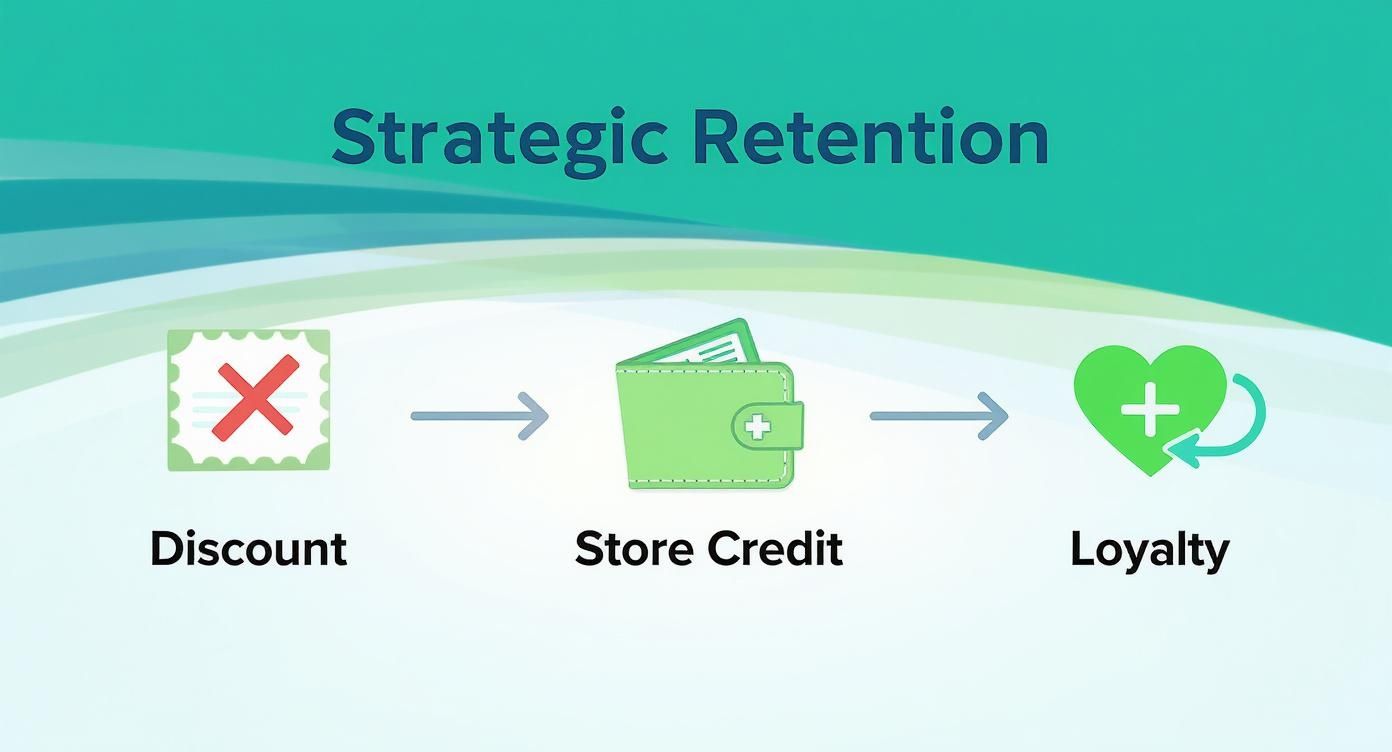
As you can see, store credit acts as a vital bridge, guiding customers from a simple purchase towards real, long-term connection with your brand.
Reward High-Value Post-Purchase Actions
A customer's journey doesn't just stop at the checkout. What they do after buying is incredibly valuable—it gives you the social proof and user-generated content that fuels your marketing. Rewarding these actions with store credit isn't a cost; it's a smart investment.
Take product reviews, for instance. A thoughtful, honest review from a real customer is far more persuasive than any ad copy you could ever write. It builds trust with potential buyers and gives you priceless feedback.
Tactic: Issue store credit for verified product reviews.
Recommended Credit: £5 - £10. This is enough to feel substantial and motivate a return visit without eating into your margins.
Objective: Generate authentic social proof and nudge them towards a second purchase, directly boosting your repeat purchase rate.
Communication Tip: Set up an automated post-purchase email: "Loving your new [Product Name]? Share your thoughts and get £5 towards your next order as our thank you!"
Celebrate Customer Milestones
Personalisation is about more than just slotting a first name into an email template. When you acknowledge important moments in a customer's life, it shows you see them as a person, not just an order number. That's how you create a powerful emotional connection.
A customer's birthday is the perfect chance to do this. A generic "Happy Birthday" email is forgettable. But an email with a tangible store credit gift? That's a delightful surprise that often prompts immediate action. You can explore more ideas on effective Shopify store credit strategies in our detailed guide.
A birthday credit should feel like a genuine gift, not a marketing promotion. Frame it that way. This small gesture can yield a massive return in goodwill and future sales, reinforcing their decision to shop with you.
Surprise and Delight Your Best Customers
Your most loyal customers are the bedrock of your business. These are the people who buy from you repeatedly, spend the most, and tell their friends about you. Identifying and rewarding this group isn't just nice—it's essential for long-term success.
So, instead of making them jump through hoops in a complicated points program, proactively surprise them with a 'thank you' credit. This unexpected gesture reinforces their loyalty in a way a predictable, earned reward never could.
Tactic: Manually issue a significant store credit to your top 5% of customers by LTV each quarter.
Recommended Credit: £20 - £50. The amount should feel special and reflect their high value to your business.
Objective: To lock in the retention of your most profitable customer segment and encourage even higher future spending.
Communication Tip: Send a personal email, maybe even from the founder: "We've noticed you've been one of our most loyal customers, and we just wanted to say thank you. As a small token of our appreciation, we've added £25 to your account."
This kind of proactive approach aligns perfectly with what customers today expect. In the UK, 63% of consumers now want more from loyalty program than just transactional benefits. They're looking for experiential rewards and a sense of being truly valued—a need that flexible store credit fills perfectly.
Ultimately, this playbook is all about being intentional. Every credit you issue should have a clear purpose, whether it's driving a specific action, celebrating a milestone, or simply saying thanks. By weaving these tactics into your retention marketing, you create a rewarding, profitable, and smooth journey that keeps your best customers coming back for more.
Tactics to Boost Your LTV and AOV

While a smart store credit program is a fantastic engine for retention, it truly shines when it's part of a bigger picture—a whole ecosystem designed to increase customer lifetime value. Your aim is to build several complementary paths that nudge customers to spend more with each order and come back sooner. When you combine these tactics, you don't just add to their effects; you multiply them, creating a solid foundation for real, sustainable growth.
Let's dig into a few of the most effective strategies that pair perfectly with a store credit system to push up both your LTV and Average Order Value (AOV).
Create Compelling Product Bundles
One of the most straightforward ways to lift your AOV is to start bundling products. This isn't just about throwing a few items together and hoping for the best. It’s about solving a complete problem for your customer. A good bundle doesn’t feel like an upsell; it feels like a thoughtfully curated solution.
Take a skincare brand, for example. Instead of just selling a moisturiser, they could offer a "Morning Glow Kit" with a cleanser, serum, and that same moisturiser. This move not only bumps up the initial order value but also gets customers to try more of your product line, planting seeds for future individual purchases. The trick is to offer a bit of a saving, making the bundle the obvious choice over buying each item on its own.
Launch a Subscription Service
For any product that people use up and buy again, subscriptions are an absolute game-changer. They turn unpredictable, one-off purchases into a reliable, recurring revenue stream. It's pretty much the ultimate way to lock in loyalty and maximise LTV.
And don't forget, subscriptions are a huge win for the customer, too. They get convenience, they never run out of their favourite stuff, and they usually get a small discount or some exclusive perks for their commitment. A beauty brand could offer a monthly restock of essentials, or a coffee roaster could send a rotating selection of beans. That predictable income also makes your life easier, helping you forecast and manage inventory like a pro.
By turning a single purchase into a long-term commitment, subscriptions create the most predictable form of LTV. They are a powerful complement to a store credit system, rewarding your most dedicated customers for their ongoing loyalty.
For a deeper dive, exploring other retention marketing strategies can give you plenty of fresh ideas to keep your customers coming back.
Personalise the Customer Journey
In today’s crowded market, personalisation is what makes your brand feel relevant and shows you're paying attention. Using customer data to tailor product recommendations and emails isn't just a nice-to-have; it's essential. When a customer feels like you "get" them, their trust—and their spending—will follow.
If someone just bought hiking boots from you, your next email shouldn't be pushing beach sandals. It’s common sense. Instead, show them waterproof jackets, durable socks, or new trail guides. Shopify apps and most email platforms can automate these recommendations based on purchase history, making every touchpoint feel personal.
This goes beyond just product suggestions. You can set up email flows that trigger based on specific actions, like someone viewing a product several times without buying or abandoning their cart. A gentle reminder, maybe sweetened with a small store credit offer, can be incredibly powerful in turning that hesitation into a sale. For more on building these lasting relationships, check out this an actionable guide on increasing customer retention.
Now, let's tie these ideas together with a simple table to see how they fit into your LTV strategy.
High-Impact LTV & AOV Tactics
Here’s a quick summary of these complementary tactics, their main impact, and how easy they are to get started with on a platform like Shopify.
Tactic | Primary Impact | Implementation Difficulty | Example |
|---|---|---|---|
Store Credit | Retention & LTV | Low | Offer £5 in credit for every £100 spent. |
Bundles | AOV | Low-Medium | "Beginner's Skincare Kit" saves 15% vs. individual items. |
Subscriptions | LTV & Predictable Revenue | Medium | "Subscribe & Save 10%" on monthly coffee deliveries. |
Personalisation | Conversion & AOV | Medium | Automated emails showing products related to past purchases. |
Customer Service | Retention & LTV | Low-Medium | Proactive support and easy returns process. |
When you start combining these—smart bundling, the predictable revenue from subscriptions, and truly personal marketing—you create a powerful system. Each strategy makes the others stronger, turning your store credit rewards into an even more effective tool for driving serious, long-term growth.
How to Measure Your LTV Strategy's Success
Rolling out a native store credit program is a fantastic first step, but a strategy without measurement is just a shot in the dark. To know if it’s genuinely working, you have to track the right metrics. This isn’t about drowning in spreadsheets; it’s about zeroing in on a few key indicators that tell you the real story about your customer relationships and profitability.
The goal is to see tangible shifts in buying behaviour. Are people coming back more often? Are they spending more when they do? Your data holds the answers, turning your Shopify analytics into a clear roadmap for growth. But before you get too deep in the weeds, getting a solid handle on how to calculate customer lifetime value is the bedrock for setting your benchmarks.
Key Metrics to Keep an Eye On in Shopify
Your Shopify dashboard is a goldmine of information, but the trick is knowing what to look for. When you swap out discounts and points for store credit, you should expect to see some very specific, positive changes.
Here’s what I always tell merchants to track:
Customer Lifetime Value (LTV): This is your north star. It's the total revenue you can reasonably expect from a single customer account. A rising LTV is the clearest sign your retention efforts are paying off.
Average Order Value (AOV): Watch this one closely. Store credit creates a powerful psychological nudge. Customers often add a little extra to their cart to "use up" their balance, giving you a natural AOV boost without having to be pushy.
Repeat Purchase Rate: This is simply the percentage of your customers who come back for a second, third, or fourth purchase. A healthy climb here means your credit is doing its job of bringing people back.
Purchase Frequency: How often does a customer buy from you? Store credit acts as a constant, gentle reminder that they have value waiting for them, which should naturally shorten the time between their visits.
Think of these four metrics as the dashboard for your LTV strategy. If LTV, AOV, and your repeat purchase rate are all trending up, you know you've got a winner. If one is lagging, you know exactly where to focus your energy.
Using Cohort Analysis to See the Real Impact
One of the most powerful—and surprisingly simple—tools you have is cohort analysis. It sounds technical, but it’s not. All you’re doing is grouping customers based on when they made their first purchase (for example, all new customers from January).
From there, you can track the behaviour of that specific group over time.
This is where it gets interesting. Compare the LTV of your January cohort (before you launched store credit) with your March cohort (after it was running). Did the March group have a better repeat purchase rate after three months? Did their average spend grow faster? This kind of direct comparison cuts through the noise and shows you the actual impact of your strategy on new customer behaviour. For a deeper look at the nuts and bolts, check out our full guide on how to calculate customer LTV.
The Future is Predictive
Looking ahead, the way we measure LTV is getting a serious upgrade, with Artificial Intelligence (AI) taking centre stage. AI isn’t just a buzzword; it’s becoming a crucial tool for boosting customer value. Projections show that by 2025, a massive 85% of companies will be using AI-driven predictive models to figure out LTV.
And for good reason. Companies already using AI in their marketing report that 71% see significant lifts in LTV. Having real-time data allows for smarter, adaptive strategies that can improve customer retention by as much as 30%. Discover more insights about the future of AI in marketing on SuperAGI.com.
So, while you might start with the basics in Shopify today, it’s clear that data-driven, predictive analysis is where we’re all headed to truly prove and perfect our LTV initiatives.
Got Questions About Using Store Credit? Let's Dig In.
Switching from the familiar world of discount codes to a native store credit strategy can feel like a big leap. I get it. It’s natural to have questions. But this isn't just a minor tweak; it's a fundamental shift in how you build relationships with your customers—moving from one-off transactions to genuine, long-term loyalty. The entire goal here is to drive up that all-important customer lifetime value.
So, let's tackle the most common questions I hear from Shopify merchants when they're ready to embrace this more profitable, customer-centric model. My aim is to give you clear, straight-up answers so you can move forward with confidence.
Is Store Credit Really Better Than a Points System?
For most Shopify stores, the answer is a resounding yes. Native Shopify store credit is simpler and more powerful than a classic points program. Points systems, while they seem like the standard, often create friction and confusion that actively works against your goals.
The problem with points is they're abstract. Your customer has to stop and do the mental gymnastics: "Okay, I have 500 points... what does that even mean in pounds? What can I actually get with this?" This tiny moment of hesitation often leads to customers hoarding their points and never redeeming them. Your loyalty program isn't actually driving loyalty.
Native store credit cuts right through all that static.
It feels like real money. A £10 credit balance is instantly understood. It has a clear, tangible value that feels like cash sitting in their account, waiting to be spent.
It directly drives the next purchase. That "found money" feeling is a powerful psychological nudge to come back and shop again, often boosting purchase frequency.
It naturally lifts your Average Order Value (AOV). Someone with £10 of credit is far more likely to push their cart total to £30 or £40 to make the most of it, rather than just buying something for £8.
Essentially, store credit ditches the confusing, gamified feel of points for a straightforward, cash-like incentive that people immediately understand and appreciate.
Points can feel like a gimmick; store credit feels like a genuine reward. That distinction is crucial for building the kind of authentic loyalty that fuels real, sustainable growth.
How Do I Stop People from Abusing Store Credit?
This is a smart question and a concern every merchant should have. The good news is that with Shopify's native functionality, often enhanced with a dedicated app, you have significant control over how credit is issued and used. You can absolutely minimise the risk of abuse.
The trick is to set up clear, common-sense rules that reward genuine customer behaviour, not just random actions that can be easily exploited.
A few best practices I always recommend:
Set expiry dates. Giving credit an expiry date—say, 90 days—creates a bit of urgency without feeling punitive. It encourages people to use their reward and stops a huge, unused credit liability from piling up on your balance sheet.
Reward verified actions only. Only issue credit for things that have real value. For instance, give credit for a product review after you've approved and published it, not just when it’s submitted. You could also save the big rewards for a customer's second or third purchase to reward proven loyalty.
Put caps in place. You can easily limit how much credit someone can earn in a month or apply to a single order.
These simple guardrails ensure your program rewards your best customers and doesn't become a loophole for opportunists.
How Should I Announce Our New Store Credit Program?
How you roll this out is just as important as the strategy itself. You need to frame this as a major upgrade to their shopping experience, not just a policy change. The idea is to get your customers genuinely excited about this better, simpler way to get value back.
My advice? Launch it like a new product. Plan a coordinated, multi-channel campaign that screams "benefits!"
Your launch plan could look something like this:
A dedicated email campaign. Send a series of emails to your whole list explaining the new program. Keep the message simple and value-focused: "Say goodbye to confusing points and coupon codes. Say hello to real value back in your account with every purchase."
On-site promotion. Use homepage banners and pop-ups to make sure no one misses it. A clear, punchy message like, "Earn Rewards, Not Points. Get Store Credit On Every Order," works wonders.
Weave it into your flows. Don't just announce it and forget it. Mention the new credit system in your post-purchase emails, on your order confirmation pages, and even in your abandoned cart reminders. Reinforcing the value at every single touchpoint is key.
By positioning your store credit program as a customer-first upgrade, you build excitement and ensure a smooth transition that really sets the stage for a more profitable, long-term relationship.
Ready to stop killing your margins with discounts and start building real, profitable loyalty? Redeemly makes it simple to replace confusing points systems with cash-like store credit rewards that increase customer lifetime value and boost your AOV, all natively within Shopify. Learn how Redeemly can transform your retention strategy today.


Join 7000+ brands using our apps