Master the customer retention metric for Shopify success
Feb 20, 2026
|
Published
Let's be honest: are you tired of the endless discount cycle? For so many Shopify merchants, slapping a coupon on everything feels like the only way to get a sale. But this race to the bottom is a trap. It eats into your profits and attracts bargain hunters, not the loyal fans who will stick with your brand for the long haul.
It's a short-term sugar rush that does very little for long-term health. Sustainable growth isn't about one-and-done transactions; it’s about building real relationships that increase lifetime value.
This is exactly why getting a grip on your customer retention metrics is so important. When you shift your focus from frantically acquiring new customers to delighting the ones you already have, everything changes. It's far cheaper and more profitable to encourage a second or third purchase than it is to constantly pour money into finding new leads for a leaky bucket.
For small businesses ready to break free from the discount trap, exploring effective 8 Customer Retention Strategies for Small Business is the first step toward building a more resilient brand.
The Real Indicators of a Healthy Business: LTV and AOV
When you zoom in on retention, two metrics tell most of the story: Customer Lifetime Value (LTV) and Average Order Value (AOV). Think of LTV as the total amount of money a customer is likely to spend with you over their entire relationship with your brand. AOV is simpler—it's just the average size of a single transaction.
The goal isn't just to improve one or the other; the real magic happens when you find a strategy that boosts both. That's the formula for truly profitable, sustainable growth.
In this guide, we'll pull back the curtain on the key metrics that reveal the truth about your customer loyalty. More importantly, we'll introduce a powerful, profit-friendly alternative to the endless cycle of coupons and confusing points programs. It’s time to look at how a simple, Shopify-native store credit system can become your secret weapon to boost LTV and AOV.
By rewarding customers with tangible store credit instead of fleeting discounts, you give them a compelling reason to come back and spend more. This naturally increases both Average Order Value and Customer Lifetime Value without you having to sacrifice your margins.
This simple shift turns your retention efforts from a cost center into a powerful profit driver. You can dive deeper into this framework in our guide to building a winning retention marketing strategy. It’s time to stop the discount madness and start building a business fueled by genuinely loyal customers.
The Four Essential Customer Retention Metrics
If you're tired of the endless discount cycle, the first step is to get a handle on what healthy, sustainable growth actually looks like. Instead of just chasing one-off sales, the most successful Shopify stores track a handful of key numbers that act like a health check for the business.
Think of a customer retention metric not as some boring number on a spreadsheet, but as the very pulse of your brand’s relationship with its shoppers.
Getting a grip on these metrics helps you see the real impact of your strategies. Are your marketing efforts creating fleeting transactions, or are they building a solid foundation of loyal, repeat buyers? Let's break down the only four metrics you really need to understand, translating the jargon into clear, actionable insights for your Shopify store.
The big takeaway here? Real growth comes from nurturing the customer relationships you already have, not just acquiring new ones at any cost.
To help you get started, here's a quick look at the core metrics we're about to cover.
Core Customer Retention Metrics at a Glance
This table breaks down the four key metrics, what they measure, and the simple formula to calculate them. It's a handy reference as you begin to track your store's performance.
Metric Name | What It Measures | Simple Formula |
|---|---|---|
Customer Retention Rate (CRR) | The percentage of existing customers you keep over a specific period. |
|
Customer Churn Rate | The percentage of customers you lose over a specific period. |
|
Repeat Purchase Rate (RPR) | The percentage of your customer base that has made more than one purchase. |
|
Customer Lifetime Value (LTV) | The total profit you can expect from a single customer over their entire relationship with you. |
|
Think of these four metrics as the vital signs for your business. When they're healthy, you know you're on the right track. Let's dig into each one.
1. Customer Retention Rate (CRR): Your Loyalty Score
Your Customer Retention Rate (CRR) is the single most important measure of how loyal your customers are. It answers a simple question: what percentage of your customers stuck around over a given time? A high CRR is fantastic news. It means you're delivering an experience that keeps people coming back for more, which is the absolute bedrock of a profitable business.
Imagine all your customers are in a room at the start of the month. CRR tells you how many of those original people are still in the room at the end of the month, not counting any newcomers who walked in. It’s a direct reflection of customer satisfaction and the strength of your brand.
CRR Formula:
[(Customers at End of Period - New Customers Acquired) / Customers at Start of Period] x 100
Let's say you started a quarter with 1,000 customers. You gained 200 new ones, and ended the quarter with 1,100 total. Your CRR would be 90%, because you managed to keep 900 of your original 1,000 customers. For a deeper look at the calculation, this Customer Retention Rate Formula guide is a great resource.
2. Customer Churn Rate: The Leaky Bucket
Customer Churn Rate is the flip side of retention. It’s the metric that measures the percentage of customers you’ve lost. Think of your business as a bucket you're trying to fill with water (customers). Churn is the hole in the bottom. If your churn rate is high, you're losing customers faster than you can bring new ones in, making real growth feel impossible.
This customer retention metric is a critical warning light on your dashboard. A rising churn rate signals that something might be off with your product, your pricing, or your overall customer experience. It’s a problem that needs immediate attention before it drains your resources.
Churn Rate Formula:
(Customers Lost During Period / Customers at Start of Period) x 100
So, if you began the month with 1,000 customers and 50 of them didn't come back, your monthly churn rate is 5%. Job one is keeping this number as low as you possibly can.
3. Repeat Purchase Rate (RPR): The Happiness Meter
While CRR measures loyalty over a longer stretch, your Repeat Purchase Rate (RPR) gives you an instant snapshot of customer satisfaction. It calculates the percentage of your customers who have come back to make a second purchase (or more). A high RPR is a strong signal that your products are hitting the mark and your first-time buyer experience was good enough to earn a second sale.
This is where a simple Shopify-native store credit reward for a first purchase can work wonders. Instead of a confusing points program, you're directly encouraging that all-important second order. This immediately boosts your RPR and starts building the habit of returning to your store.
RPR Formula:
(Number of Customers with 2+ Purchases / Total Number of Customers) x 100
If 300 out of your 1,000 total customers have bought from you more than once, your RPR is 30%. We cover this and more in our complete guide on key user retention metrics.
4. Customer Lifetime Value (LTV): The Ultimate Profit Indicator
Finally, we have Customer Lifetime Value (LTV)—the ultimate metric. It projects the total net profit you can expect to earn from a single customer over their entire relationship with your brand. LTV is the number that ties everything together: your retention, your average order value, and your overall profitability.
Focusing on LTV shifts your entire perspective from chasing short-term sales to building long-term, profitable relationships. This is crucial. In the hyper-competitive world of ecommerce, the average customer retention rate is a shockingly low 38%, one of the worst across all industries. This directly tanks LTV, especially when you consider that the average revenue per retained customer is 2.3x higher than a one-off buyer.
Simple LTV Formula:
Average Order Value (AOV) x Average Purchase Frequency x Average Customer Lifespan
A strategy built around Shopify-native store credit is designed specifically to raise LTV. It gives customers a reason to come back more often (boosting purchase frequency) and spend more when they do (increasing AOV), directly fueling long-term profitability without killing your margins.
Why LTV Is Your Most Important Growth Lever
Forget the vanity metrics. Social media likes and website traffic might feel good, but they don't pay the bills. If you want to know the real health of your DTC brand, you need to look at Customer Lifetime Value (LTV).
It’s the one metric that reveals the long-term, sustainable strength of your business in a way single-purchase AOV never could.
Think of it this way: AOV is just a snapshot of one transaction. LTV is the whole photo album. It shows you the total revenue you can expect from a customer over their entire relationship with you, painting a clear picture of future cash flow and brand loyalty. When you start focusing on LTV, you stop chasing the next sale and start building a business people want to come back to.
That long-term view is where the real profit is hiding. Consider this powerhouse stat: repeat customers spend a whopping 67% more than new ones. That means an $80 first-time order, if you can get that customer to come back, turns into an average spend of $134 on their next visit. Their LTV just keeps compounding. You can find more data like this in a great deep dive on customer retention statistics.
From Simple Calculation to Scalable Growth
Calculating a basic LTV doesn't require a data scientist. At its core, the formula is refreshingly simple. It just multiplies how much customers spend by how often they buy and how long they stick around.
Simple LTV Formula: Average Order Value (AOV) x Average Purchase Frequency x Average Customer Lifespan
Let's run a quick example. Imagine your average customer spends $100 per order (AOV), makes 3 purchases a year (Purchase Frequency), and stays with you for 2 years (Lifespan).
Your simple LTV is $600. Now the fun begins. Your job is to find smart ways to nudge any of those three numbers up without just giving away your margins.
But knowing LTV is only half the story. Its real power is unleashed when you compare it to what you spent to get that customer in the first place.
The LTV to CAC Ratio: Your Ultimate Health Check
This brings us to the LTV to CAC (Customer Acquisition Cost) ratio. This is it—the key metric that tells you if your business is actually scalable. It answers the most critical question you can ask: for every dollar I spend to get a customer, how many dollars do I get back over their lifetime?
A healthy, growing ecommerce brand should be aiming for an LTV to CAC ratio of at least 3:1. For every $1 you spend on marketing to land a new customer, you should expect to get $3 back in lifetime revenue.
A 1:1 ratio? You're losing money on every new customer once you factor in your cost of goods.
Below 3:1? You're probably spending too much to acquire customers who aren't valuable enough over time.
Above 3:1? That's the sweet spot. You've got a profitable, sustainable growth engine on your hands.
This ratio is where your retention strategy meets your bottom line. Every single thing you do to increase LTV directly improves this critical number, making your entire business healthier. For a more detailed walkthrough on this, check out our guide on how to calculate customer LTV.
How Store Credit Becomes Your LTV Engine
This is exactly where a smart, Shopify-native store credit program leaves traditional discounts and confusing point systems in the dust. Instead of just slashing your margins with coupons, store credit becomes a powerful engine for increasing LTV by systematically improving its core components.
When a customer earns credit on a purchase, they have a tangible, cash-like reason to return. This naturally drives up their purchase frequency. Even better, you can set smart reward rules—like offering more credit for spending above your current AOV—that nudge shoppers to add just one more item to their cart, directly boosting your Average Order Value.
You're creating a powerful, positive feedback loop. Higher AOV and more frequent purchases lead to a much stronger LTV, which in turn fortifies your LTV to CAC ratio. You’re no longer just making a sale; you’re investing in a more profitable and predictable future for your brand.
How Store Credit Rewards Actually Move the Needle on Your Retention Metrics
Knowing the formulas for retention metrics is one thing. Actually using that knowledge to make your business more money? That’s a whole different ball game. This is precisely where a smart, Shopify-native store credit system stops being a "nice-to-have" and becomes a serious growth engine.
Forget confusing point systems or discounts that just eat away at your margins. Store credit gets right to the heart of the matter, directly boosting the core metrics that signal a healthy, growing brand: Lifetime Value (LTV) and Average Order Value (AOV).
It’s not just another reward program; it's a strategic lever for cranking up your most important numbers by giving customers a simple, powerful reason to come back and spend more.
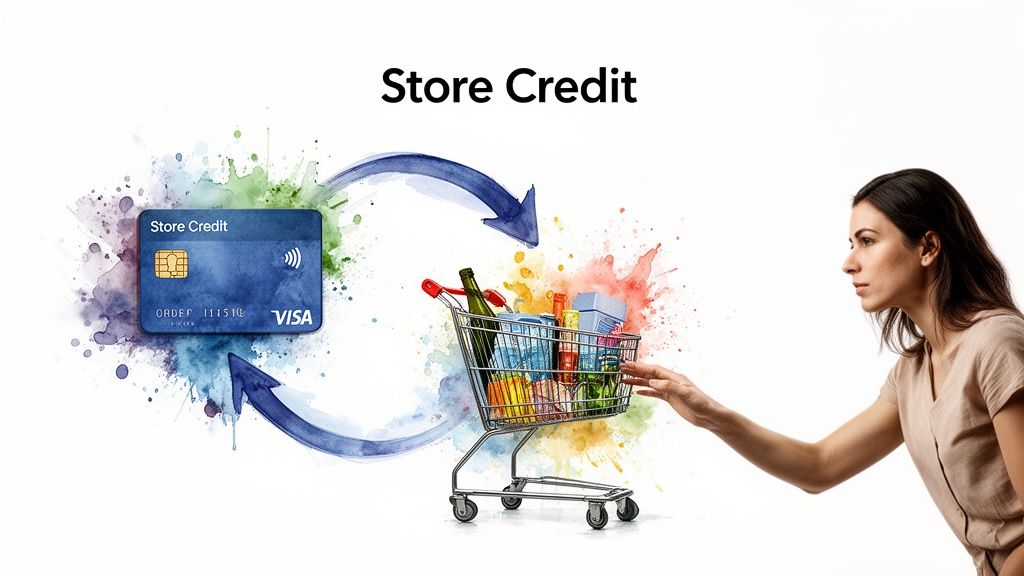
The real magic is in tying rewards to specific actions. For instance, you can set up smart rules in a tool like Redeemly to issue credit when a customer spends over a certain amount, directly lifting your Average Order Value.
Driving Up Your Repeat Purchase Rate
Let's be honest: the toughest hurdle for most Shopify stores is getting that first-time buyer to come back for a second purchase. Store credit is your secret weapon here.
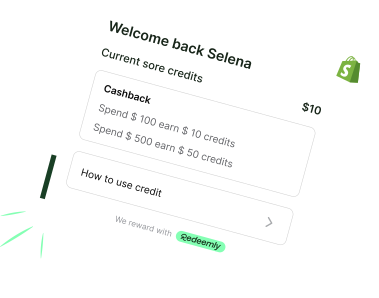
Imagine a customer spends $100 and instantly gets $10 in store credit. They now have a real, tangible asset locked to your brand. This isn't some flimsy coupon they’ll lose in their inbox or a confusing pile of "points"; psychologically, it feels like found money in their account. That feeling is incredibly powerful and gives them a compelling reason to make their next purchase with you, directly boosting your Repeat Purchase Rate (RPR).
Think of it as a positive "switching cost." A customer with a store credit balance is far less likely to even bother looking at a competitor. Why would they? They have money to spend at your store, so that’s where their shopping journey begins.
This simple mechanic turns the end of one sale into the beginning of the next, creating a natural, effective retention loop.
Naturally Increasing Average Order Value
Getting customers to spend more each time they check out is another constant battle. A Shopify-native store credit program offers a brilliant, margin-friendly way to lift your Average Order Value (AOV) without resorting to steep, across-the-board discounts.
Instead of a flat 15% off coupon that bleeds profit, you can set up intelligent reward tiers. For example, you can create rules that offer more credit as the cart value climbs just past your current AOV.
Spend $75, get $5 in credit.
Spend $100, get $10 in credit.
Spend $150, get $20 in credit.
This simple nudge encourages shoppers to add just one more item to their cart to unlock that next reward. They feel like they're getting a great deal, and you successfully increase your average transaction size. It’s a win-win that fattens your top line.
Slashing Churn and Maximizing Lifetime Value
A high churn rate is like trying to fill a leaky bucket. You can pour new customers in, but you’re losing them just as fast.
Every customer who has unused store credit is a vote against churn. They are financially tied to your brand, which makes them think twice before walking away. This directly lowers your Customer Churn Rate and, just as importantly, drives a higher Customer Lifetime Value (LTV).
By boosting both how often people buy (RPR) and how much they spend (AOV), a store credit system methodically increases the total revenue you earn from each customer over time. You stop the exhausting chase for one-off sales and start cultivating a loyal base of repeat buyers—the true foundation of any sustainable brand.
Putting Store Credit to Work for You
Knowing your numbers is one thing, but turning those metrics into a real-world growth strategy is where the magic happens. The aim is to create a system that consistently drives up your Lifetime Value (LTV) and Average Order Value (AOV)—without the headaches of complex point systems or the margin-killing habit of constant discounting. This is exactly where a well-integrated, Shopify-native store credit program really proves its worth. It gives you a straightforward, powerful way to turn first-time buyers into lifelong fans.
What makes this approach so effective? It all comes down to psychology. A coupon feels like a one-off marketing trick. Store credit, on the other hand, feels like actual cash sitting in a customer’s account. It’s their money, waiting to be spent. That creates a powerful pull to come back and a sense of genuine value that a simple discount code just can't match.
And this isn't some niche idea; it's a massive shift in how brands build loyalty. In fact, 59% of sales leaders now say loyalty programs are their single most effective retention strategy. The global loyalty market is on a tear, projected to leap from $5.57 billion in 2023 to an eye-watering $28.65 billion by 2030. This trend tells a clear story: smart brands are moving away from one-time deals and investing in value-based incentives like store credit. You can dig deeper into the statistics behind customer retention to see why this pivot is happening so quickly.
Make Sure Your Customers Actually See It
Let’s be honest: the world's greatest retention program is useless if your customers don't know it exists. Visibility is everything. Your store credit system has to feel like a natural part of your Shopify store, not some clunky app you tacked on as an afterthought.
It all starts with how you communicate on your site. One of the simplest yet most effective tools is a floating wallet icon or a small widget that follows the customer around, always showing their available balance. It’s a constant, gentle nudge—a little reminder of the value they have waiting for them that can subtly influence what they browse and, ultimately, what they buy.
Beyond your website, you need to use automated emails to keep the conversation going and bring people back.
The Post-Purchase "Thank You": Right after someone buys, hit their inbox with an email confirming the store credit they just earned. This immediately reinforces the value of their purchase and plants the seed for their next one.
The "Hey, You've Got Cash" Reminder: If a customer has been quiet for a while, a friendly email reminding them of their balance can be the perfect prompt to get them browsing again.
Frictionless Checkout: Make sure their available credit is displayed clearly at checkout and is dead simple to apply. The easier it is to use, the more satisfying the experience.
Get Smart With Your Reward Rules
The real genius of a Shopify-native store credit system is in how you set up the rules. Instead of just handing out credit willy-nilly, you can create smart incentives that push customers toward specific, profitable actions. This lets you directly target your most important customer retention metrics, especially AOV and LTV.
The most potent strategy? Tie your rewards to spending thresholds that are just a bit higher than your current Average Order Value.
Let's say your AOV is currently $85. You could create a rule that gives customers $10 in store credit whenever they spend $100 or more. That simple incentive is often all it takes to convince a shopper to add one more item to their cart. You've just boosted your AOV, and for the customer, it feels like a rewarding game, not a hard sell.
This method puts you firmly in control. You're not just giving away your margins; you're strategically reinvesting them to build more valuable customer relationships. It's a simple, tangible way to turn your retention data directly into a healthier, more predictable revenue stream.
Your Questions About Retention Metrics Answered
Diving into customer retention can feel like you're trying to solve a puzzle with a dozen missing pieces. If you're like most Shopify merchants, you're probably asking the same questions: Are my efforts actually driving profitable growth, or am I just throwing money at leaky-bucket marketing?
Let’s tackle some of the most common hurdles head-on. My goal here is to help you move past temporary fixes like one-off discount codes and build a real system—one that consistently boosts your Average Order Value (AOV) and, more importantly, your Customer Lifetime Value (LTV).
We'll clear up the confusion and show you why a simple, Shopify-native store credit system is the smarter way to build a business that lasts.
How Is Store Credit Different From a Points System?
This is a big one, and it gets to the heart of customer psychology. While both are loyalty tools, the way a customer perceives them is night and day.
A points system is abstract. Your customer sees they have 500 points, but what does that really mean? They're forced to do mental gymnastics to figure out the actual cash value. That little bit of friction is often enough to make the reward feel like a gimmick, leading to abysmal engagement and redemption rates. The whole program just fizzles out.
Store credit, on the other hand, is refreshingly direct. A customer sees $10 in store credit, and they get it instantly. It feels like real money sitting in their account—a tangible asset they can spend. That simplicity is its superpower, making it a much more compelling reason to come back and make another purchase. It directly fuels every customer retention metric you care about.
Why Not Just Offer Discount Coupons?
Ah, the classic discount code. It's the go-to for so many stores, but it's a crutch that can seriously hurt your business in the long run.
Think about it: a coupon is a one-time bribe. You’re basically training your customers to wait for sales, eroding your brand's value and killing your margins on the spot. Worse, it tends to attract bargain-hunters who have zero intention of ever becoming loyal, full-price customers. It’s a short-term sugar rush with a long-term hangover.
Store credit flips the script entirely. It's not a cost; it's an investment in a future purchase. You only recognize the cost when a loyal customer returns to spend it—which is exactly what you want them to do! This one change protects your unit economics and creates a powerful, self-sustaining cycle of repeat business.
Suddenly, you've turned a margin-killing expense into your best tool for boosting LTV.
Discount Codes vs. Store Credit Rewards: A Comparison
To really spell it out, let’s put them side-by-side. You'll quickly see why store credit is the more strategic play for long-term profitability and brand health.
Feature | Discount Codes | Redeemly Store Credit |
|---|---|---|
Customer Psychology | Creates a "deal-seeking" mindset. Customers just wait for the next sale. | Fosters a feeling of "earned value." Customers feel rewarded and appreciated. |
Margin Impact | Slashes your profit on the current sale, right off the top. | Protects margins on the initial sale. The cost only hits when they return. |
Impact on AOV | Usually has no minimum spend, doing nothing to encourage a larger cart. | Easily tied to spending thresholds, directly motivating customers to add more. |
Impact on LTV | Attracts one-time buyers who are unlikely to stick around, hurting LTV. | Builds a loyal base of repeat purchasers, which is the key to a high LTV. |
The choice becomes pretty clear. One is a short-term tactic that cheapens your brand, while the other is a long-term strategy that builds it.
Will This Complicate My Shopify Store?
Not at all, and that’s the beauty of it. We've all seen those clunky, third-party loyalty platforms that slow down your site with heavy code and confuse customers with pop-ups and weird widgets. A native store credit system is the complete opposite.
Because it’s built for Shopify, it integrates perfectly. Setup takes minutes, not days. The customer experience is seamless—they see and redeem their credit right at checkout, just like they would with a gift card. There are no technical headaches or hoops to jump through.
The whole thing feels like a natural part of your store, not some bolted-on gimmick. This lets you focus on what actually matters: rewarding your best customers and growing your business.
Ready to stop sacrificing your margins and start building a more profitable, loyal customer base? Redeemly makes it simple to replace discounts with a powerful, Shopify-native store credit program that boosts both AOV and LTV. Start growing more profitably today at redeemly.ai.


Join 7000+ brands using our apps