A Client Engagement Strategy to Boost LTV and AOV
Dec 7, 2025
|
Published

A solid client engagement strategy is all about rewarding customers in a way that builds your brand up, not tears it down. It’s a conscious move away from the short-sighted world of discount codes and confusing point systems, and toward a model that actually grows your two most important metrics: Customer Lifetime Value (LTV) and Average Order Value (AOV).
Why Your Discount Strategy Is Hurting Your Brand
Let's be honest. If your "engagement" plan is just an endless stream of discount codes and complicated points systems, you're probably stuck in a vicious cycle. This all-too-common approach tends to attract bargain hunters who buy once and disappear, training your best customers to just wait for the next sale.
The result? A direct hit to your profit margins.
Worse, this constant discounting cheapens your brand over time. You stop being a brand people love and start being a commodity people buy when it's on sale. That’s a race to the bottom you can't win. It's time for a smarter approach—one that’s laser-focused on boosting lifetime value and average order value.
The Shift to Value-Building Rewards
The modern, more profitable alternative is surprisingly simple: native Shopify store credit. Stop thinking of it as a discount and start seeing it for what it is—a cash reward your customers can only spend at your store. This one change has a massive psychological impact.
Here’s why it works so well:
It Fosters Real Loyalty: Store credit feels like actual money sitting in a customer's account, giving them a powerful, tangible reason to come back. This directly increases LTV.
It Drives Repeat Purchases: When a customer has a balance just waiting to be used, the decision to make that second or third purchase becomes a no-brainer.
It Protects Your Brand's Value: You’re not slashing prices; you're rewarding loyalty. This crucial distinction helps you maintain a premium perception of your products.
By rewarding customers with flexible Shopify store credit, you create a healthier, more sustainable business. It’s one of the most effective retention marketing strategies out there because it essentially locks their future spending into your brand’s ecosystem.
To build a truly holistic plan, you should also look at things like a social media engagement strategy that actually works, which can also give your LTV and AOV a serious lift. This playbook will walk you through building an entire client engagement strategy from the ground up, all centered on this value-first philosophy.
Auditing Your Current Customer Retention Health
Before you jump into building a new engagement strategy, you need to take a brutally honest look at where you stand today. You can't fix what you don't measure. This initial diagnostic is all about getting your hands dirty in your Shopify analytics to see how customers really behave after they hit "buy."
The goal is to get a clear, data-driven baseline. Are you burning cash to acquire customers who vanish after one purchase? Is your average order value stuck in neutral? The answers are sitting in your data, and finding them is the first real step toward building something better.
Finding the Truth in Your Numbers
I always tell clients to think of these numbers as the vital signs of their business. They tell the true story of your customer relationships and expose the leaks in your retention bucket. Don't be afraid of what you might find; this is where you'll uncover your biggest opportunities for growth.
Here’s a quick rundown of the essential metrics you need to pull.
Metric | How to Measure It | What It Tells You |
|---|---|---|
Customer Lifetime Value (LTV) | (Average Order Value) x (Number of Repeat Sales) x (Average Retention Time) | The total revenue you can expect from a single customer. A low LTV is a huge red flag. |
Average Order Value (AOV) | Total Revenue / Number of Orders | The average amount spent each time a customer places an order. Stagnant AOV means your incentives aren't working. |
Repeat Purchase Rate | (Number of Customers with >1 Purchase) / (Total Number of Customers) | A direct measure of loyalty. It shows if your initial experience is good enough to earn a second visit. |
Customer Acquisition Cost (CAC) | Total Sales & Marketing Costs / Number of New Customers Acquired | How much it costs to get a new customer. A healthy LTV:CAC ratio should be at least 3:1. |
These KPIs are your diagnostic toolkit. They're available right in your Shopify dashboard and will give you a clear, unbiased picture of your current reality.
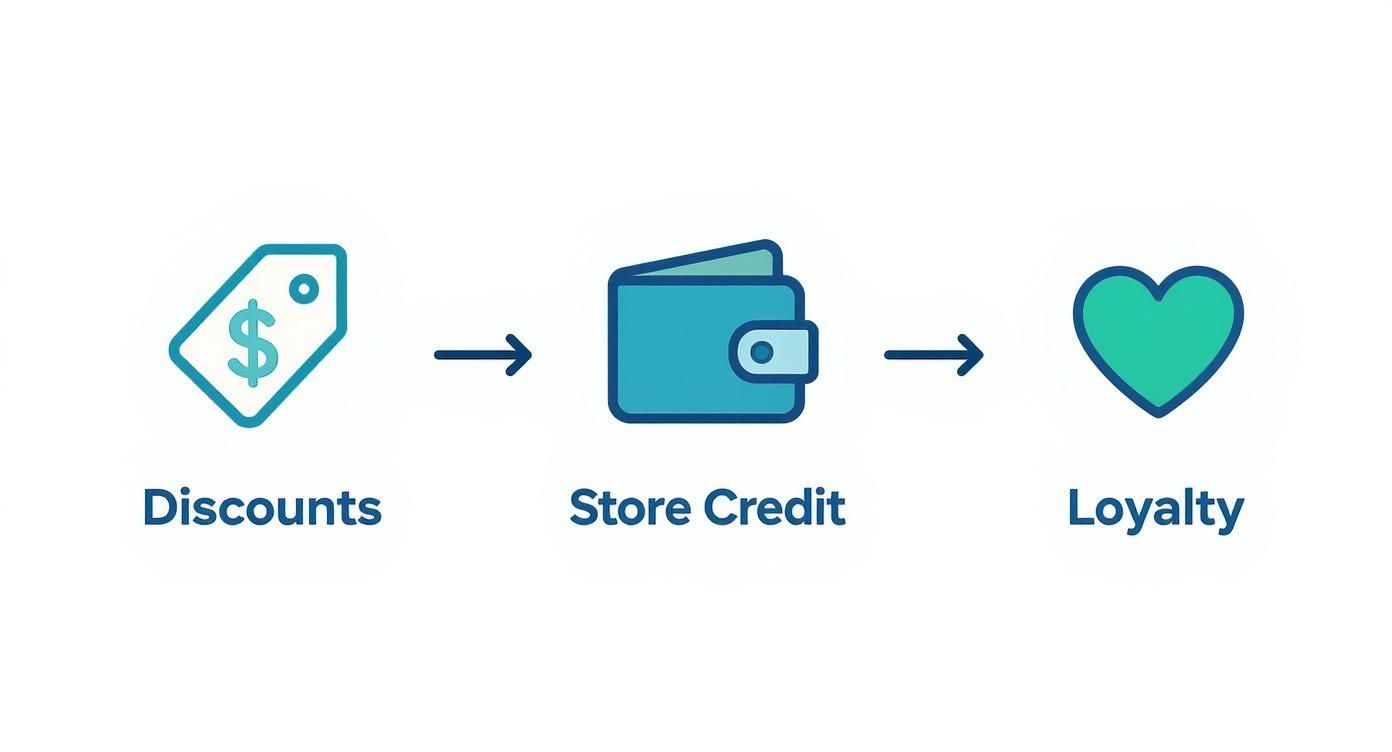
As you can see, the whole idea is to shift from the short-term sugar rush of discounts to a long-term loyalty loop built on store credit. It's about turning a one-time transaction into a lasting relationship.
Interpreting the Gaps in Your Strategy
Once you have these numbers laid out, the story often tells itself.
Is your CAC sky-high while your LTV is flatlining? That’s a classic sign you're overpaying for one-and-done buyers—a recipe for disaster. If your AOV and repeat purchase rate are low, it’s clear your current engagement efforts just aren't sticky enough.
The core purpose of any client engagement strategy is to reduce churn rate and cultivate customer loyalty. This audit shines a spotlight on exactly where and why your customers are leaving.
With this diagnosis, you're no longer operating on guesswork. You know precisely which levers you need to pull. Now, you’re ready to design a store credit program that directly addresses these weak spots and starts building a more profitable, resilient customer base.
Designing a Store Credit Program That Actually Drives Action
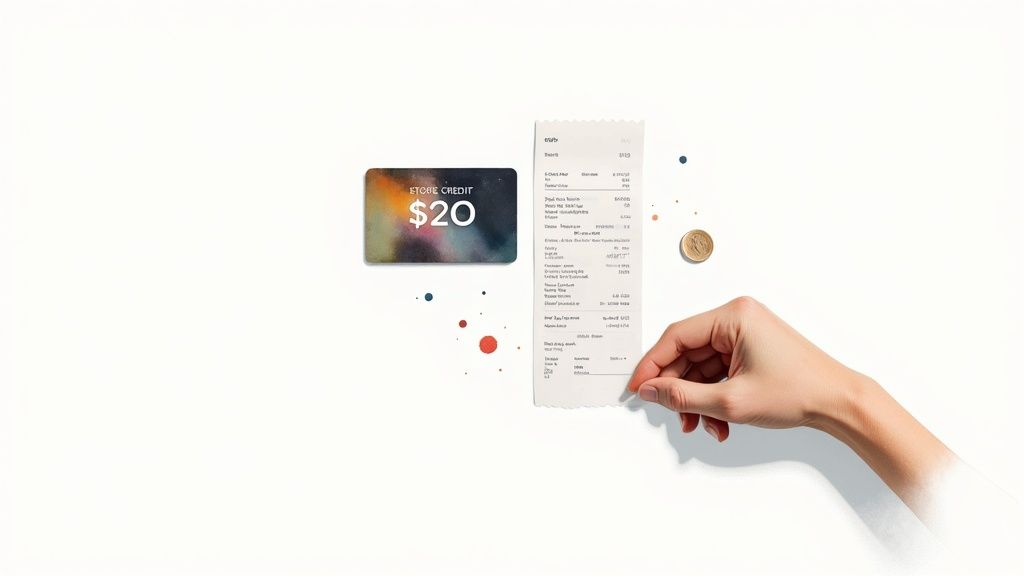
Alright, let's get down to brass tacks. A killer client engagement strategy built on native Shopify store credit isn't about just tossing out rewards and hoping for the best. It’s about building a calculated system that encourages the specific behaviors you want to see.
Forget those confusing point systems that customers hoard but never actually redeem. We're going to focus on rewarding high-value actions that directly pump up your bottom line.
The core idea is simple: connect every single dollar of credit you issue to a specific, profitable outcome. Think of it less like a cost and more like a direct investment in a customer’s future with your brand. This mindset shift is what turns a simple reward into a powerful tool for boosting both Lifetime Value (LTV) and Average Order Value (AOV).
Rewarding High-Value Milestones
Your mission is to turn those one-time buyers into loyal regulars and nudge everyone to add just one more thing to their cart. Issuing Shopify store credit at just the right moment is the most effective way I’ve seen to make that happen.
Ditch the generic "welcome" discount and try these action-oriented triggers instead:
The Second Purchase Bonus: Getting a customer to come back for that second purchase is the biggest hurdle in building loyalty. As soon as their first order is fulfilled, automatically drop $10 in store credit into their account. It gives them a real, tangible reason to start browsing again right away, directly boosting your LTV.
The High-Value Order Reward: Want to push that AOV higher? Reward people for spending more. You could offer $15 in credit on all orders over $100. This is a brilliant little nudge that gets shoppers to add that extra item to their cart just to unlock the reward.
Surprise and Delight Moments: Every month, pick a handful of your best customers and drop $5 of unexpected credit into their accounts with a personal note. This isn't about driving a sale; it's about creating a powerful emotional connection that discounts could never replicate.
This targeted approach makes sure your rewards are earned, not just given away. Each dollar of credit becomes a "thank you" for behavior that makes your business stronger.
A well-designed store credit program acts as a guide, showing customers exactly how to get more value from your brand. It moves the relationship beyond the transactional and into a mutually beneficial partnership.
Using Store Credit as a Customer Service Superpower
Let’s face it, sometimes things go wrong. Your engagement strategy needs a plan for that, and store credit is an incredible tool for turning a negative experience into a loyalty-building moment.
Picture this: a customer gets a damaged item. Instead of just processing a refund, you offer a full refund plus $20 in store credit for their trouble. This simple gesture accomplishes two critical things at once. It fixes their problem and gives them a powerful incentive to place another order, basically locking in a future sale.
This is worlds better than offering a discount code, which still feels like you’re asking them to spend more money after they just had a bad time. Store credit feels like a genuine apology—a cash gift that proves you actually value their business.
The smartest brands are moving beyond generic rewards entirely. They're digging into behavioral data to offer hyper-personalized rewards like digital gift cards or special experiences. Getting this right pays off, as deep personalization can boost average revenue per user by a staggering 166%.
But be warned: relevance is everything. A recent study showed 78% of consumers tune out when brands fail to make their offers relevant. To get a better handle on where things are headed, you can explore the full findings on Toastycard.com.
Weaving Store Credit Into Every Customer Touchpoint

So you've designed the perfect store credit program. That's a huge win, but it's only half the battle. If your customers don't see it, it doesn't exist. Visibility is everything.
A truly effective engagement strategy weaves these rewards into the very fabric of your customer's journey. It’s about making sure your store credit is a constant, gentle nudge back to your brand, not just a one-off confirmation email that gets lost in an inbox. Your goal is to make their credit balance feel like an exciting part of their account—ready and waiting to be used.
Making It Impossible to Miss On-Site
Your Shopify store is ground zero. This is where customers fall in love with your products, and it's precisely where they should be reminded of the value waiting for them. Simple integrations can make a world of difference in your credit redemption rate, which has a direct line to your LTV.
Here are a few high-impact tactics I’ve seen work wonders:
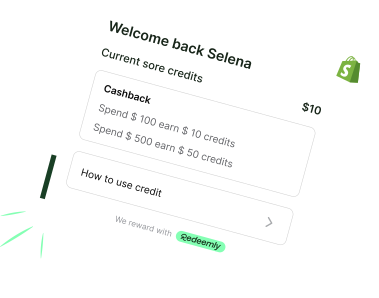
Plaster Balances Everywhere: Don't be shy about showing them their credit. Put the balance in their account section, on the cart page, and even in a subtle header banner. The constant visibility keeps it top-of-mind.
Build a Dedicated Rewards Page: This is your program’s home base. Create a simple, clean landing page that spells out exactly how it all works. Show them how to earn credit and, more importantly, what they can spend it on.
Use Banners and Pop-Ups Wisely: You don’t need to be annoying. A simple, well-placed banner like, "Spend $100, Get $15 Back in Store Credit" can be a powerful motivator to bump up that cart size and boost your AOV.
A visible, easy-to-understand store credit balance is the cornerstone of a successful program. When customers see what they have, they're far more motivated to come back and use it.
Keeping the Conversation Going with Email and SMS
The moment a customer leaves your site, the conversation shifts to email and SMS. These channels are your lifeline for re-engagement, and this is where you can build powerful automated flows that keep your brand—and their store credit—on their radar. A well-timed message is often the only thing standing between a forgotten balance and a repeat purchase.
Let's face it, omnichannel engagement isn't a "nice-to-have" anymore; it's a must. Companies with strong omnichannel strategies retain up to 89% of their customers, a massive jump from the 33% for those with weak ones. And with 58% of consumers wanting to choose how you communicate with them, you need to be everywhere they are. If you're curious, you can discover more insights about customer engagement on Useinsider.com.
Here are a few essential automation flows you need to set up:
The "Credit Earned" Celebration: The second a customer earns credit, hit them with a celebratory email or SMS. Don't just inform them; thank them. Clearly state their new balance and invite them back to browse.
The Friendly Nudge: If a customer hasn't touched their credit in 30 days, trigger a gentle reminder. This is a great chance to suggest products based on their past purchases or showcase new arrivals.
The "Top-Up" Prompt: When a customer's balance is running low, send a message encouraging them to make another purchase to unlock that next reward. It's a simple, effective way to drive the next sale.
These touchpoints create a cohesive experience that feels personal and valuable. For a deeper look into the nuts and bolts, you might want to check out our guide on how to best implement Shopify store credit. By tying your program into these channels, you ensure your engagement strategy is always working for you, constantly bringing customers back for more.
How to Know if It's Working (and How to Make It Work Better)

You’ve done the hard work of designing and launching your store credit program. Now for the most important part: proving this new engagement strategy is actually making you money.
Getting a program live isn't the finish line; it’s the starting block. Real, sustainable growth comes from obsessively tracking its impact and making smart, data-backed tweaks along the way.
This is where you close the loop, circling back to those initial KPIs you benchmarked to see a clear upward trend. A solid store credit strategy shouldn't just feel right—it should deliver tangible improvements to your LTV and AOV, turning happy customers into profitable growth.
The Big Three: Core Growth Metrics to Watch
Your primary mission was to move the needle on a few key business metrics, so that’s where you need to look first. Your Shopify dashboard is your command center for tracking progress against the baseline you set in the beginning.
You’re looking for a steady, undeniable climb in these areas:
Customer Lifetime Value (LTV): Is the total revenue you get from the average customer going up month after month? This is the ultimate proof that your retention efforts are paying dividends.
Average Order Value (AOV): Are shoppers adding more to their carts to hit those store credit thresholds you set? A rising AOV is a fantastic signal that your incentives are working exactly as planned.
Repeat Purchase Rate: Are first-time buyers coming back faster and more often? This metric tells you, in no uncertain terms, how effectively store credit is pulling people back into your orbit.
Tracking these core KPIs is non-negotiable. They are the definitive proof that your shift from one-off discounts to a store credit system is building a more resilient and profitable customer base.
Program-Specific KPIs You Can't Afford to Ignore
Beyond the big-picture numbers, you have to get granular with metrics specific to your new program. These KPIs give you a closer look at how customers are actually interacting with their rewards, shining a light on what’s resonating and where you can optimize.
I recommend building a simple dashboard to keep an eye on these:
Store Credit Redemption Rate: This one is critical. What percentage of the credit you’re issuing is actually being spent? A high redemption rate tells you your on-site messaging and email reminders are hitting the mark.
Time Between Purchases: Is the average time between a customer's first and second purchase shrinking? This is a powerful indicator that store credit is successfully speeding up the buying cycle.
Keeping tabs on these numbers helps you understand the direct, real-world impact of your engagement tactics. And if you need a quick refresher, check out our guide on how to calculate customer LTV to make sure your numbers are rock-solid.
The Next Frontier: AI-Powered Optimization
To truly elevate your client engagement strategy, you have to get proactive. This is where AI-powered tools come into their own, helping you shift from simply reacting to data to predicting what your customers will do next.
Imagine being able to analyze your customer segments to pinpoint which groups are most likely to jump on a surprise credit drop. Or who would be most receptive to a special offer. This allows for hyper-targeted campaigns that feel personal and drive immediate action.
The data doesn't lie. By 2025, it's predicted that nearly 95% of all customer interactions will be AI-powered. Businesses already using AI are seeing huge wins, including a 20% bump in customer satisfaction. If you're curious, you can read more key trend insights from Braze. This data-driven approach ensures your strategy doesn't just work—it evolves, constantly improving to drive more profitable growth.
Answering Your Top Store Credit Questions
Switching from the familiar world of discounts to a store credit model can feel like a leap of faith. I get it. You've probably got a bunch of questions buzzing around your head. Let's tackle the big ones head-on so you can move forward with total confidence.
Is Store Credit Really Better Than Discounts?
Absolutely, and it's not even close when you're playing the long game. Discount codes are a magnet for bargain hunters who buy once and vanish. Worse, they train your best customers to hold out for a sale, which slowly eats away at your margins.
Store credit, on the other hand, is completely different. Think of it as cash that can only be spent in your store.
This simple shift encourages a repeat purchase and directly boosts Lifetime Value (LTV). It feels like a genuine reward, not just a price slash, which keeps your brand feeling premium and builds real loyalty. Plus, it’s tied right to their account—no more forgotten or lost coupon codes.
Here’s the key mindset shift: A discount is a cut you take on a past sale. Store credit is an investment you make in a future sale. That one change can fundamentally alter how you build a profitable brand.
How Do I Set Up a Real Store Credit System?
While Shopify’s built-in gift card feature exists, it’s not designed for a dynamic, automated rewards program. To do this right, you need a dedicated app. Hop on the Shopify App Store and look for tools specializing in native store credit rewards. "Native" is the key word here—it means the experience is seamless for you and, more importantly, for your customers.
A good store credit app will let you:
Automate Rewards: Automatically dish out credit when customers do something valuable, like making their second purchase or crossing a spending threshold. No manual work needed.
Manage Balances: Keep track of every customer's credit balance without lifting a finger.
Integrate Communications: Weave store credit notifications right into your email and SMS flows to remind customers they have money to spend.
What Metrics Actually Matter Here?
Beyond the obvious wins in LTV and Average Order Value (AOV), you need to keep a close eye on the health of the program itself.
Zoom in on these three KPIs:
Store Credit Redemption Rate: Of all the credit you've issued, what percentage are people actually using? This tells you if the reward is compelling enough.
Purchase Frequency: Are customers with a store credit balance coming back to buy more often than those without one? This is a huge indicator of success.
AOV of Redemption Orders: This one’s my favorite. When a customer uses their credit, are they spending more than the credit amount? If so, you're not just getting a repeat purchase—you're generating brand-new revenue.
Ready to build a client engagement strategy that actually boosts LTV and protects your margins? Redeemly makes it simple to replace discounts with a powerful, native Shopify store credit program. Start growing profitably today.


Join 7000+ brands using our apps